Choosing a diamond for your engagement ring can feel confusing, especially when the words “cut” and “shape” are used interchangeably at every jewelry counter. For engaged couples across the United States hoping to make a smart investment, understanding the difference is key. The diamond cut goes far beyond appearance—it shapes how your ring sparkles and stands out. This guide spotlights what diamond cut really means, dispels common myths, and helps you use cut knowledge to get true value for your budget.
Table of Contents
- Defining Diamond Cut And Common Myths
- Understanding The Cut Grading System
- Debunking Common Myths
- Popular Diamond Cut Types And Shapes
- How Shape Affects Your Diamond’s Performance
- Finding Your Perfect Shape
- How Cut Quality Affects Sparkle And Beauty
- Diamond Cut Grading Systems Explained
- Understanding The GIA Scale In Detail
- What About Fancy Cuts?
- Impact Of Cut On Price And Value
- How Cut Grade Affects Per-Carat Price
- Balancing Cut Quality With Other 4Cs
- Market Demand And Resale Considerations
- Choosing The Best Cut For Your Needs
- Decision Framework: Three Key Questions
- The Research And Comparison Process
Key Takeaways
| Point | Details |
|---|---|
| Understanding Diamond Cut | Diamond cut refers to how a diamond’s proportions and facets affect its interaction with light, influencing sparkle, brightness, and overall beauty. |
| Prioritize Cut Quality | Investing in diamonds with Excellent or Very Good cut grades will yield the most visual impact, often overshadowing other factors like carat weight and color. |
| Myths About Diamond Cuts | It is crucial to recognize that diamond shape is separate from cut quality; different shapes can have varying sparkle levels based on their cut. |
| Market Impact on Resale | Cut quality significantly influences resale value, with well-cut diamonds maintaining better market demand and pricing stability. |
Defining Diamond Cut and Common Myths
When shopping for an engagement ring, you’ll hear “diamond cut” thrown around constantly. But here’s what most people get wrong: cut isn’t about the shape of the diamond. A round diamond, a cushion, an emerald—these are shapes. Diamond cut refers to how a diamond interacts with light based on its proportions, facet arrangement, and polish quality. The distinction matters more than you might think, because cut quality directly affects how much your ring sparkles.
How a diamond interacts with light depends on three main performance factors: brightness (the overall light reflection), fire (the colored light sparkles you see), and scintillation (the play of light and shadow as the diamond moves). A poorly cut diamond can have excellent color and clarity but still look dull and lifeless in your engagement ring. A well-cut diamond with lower color or clarity grades will often appear more brilliant and valuable because light performance is what catches the eye first.
The GIA grades diamond cut quality on a consistent scale from Excellent to Poor, evaluating not just the angles and proportions but also polish and symmetry. These technical factors work together to determine how light enters the diamond, bounces around inside, and exits back to your eye. This is why two diamonds of identical carat weight and color can look dramatically different depending on their cut quality.
Understanding the Cut Grading System
The GIA’s grading system breaks down into five cut grades:
- Excellent: Reflects almost all light that enters the diamond; maximum sparkle and brilliance
- Very Good: Reflects most light with minimal light loss; excellent sparkle for a lower price point
- Good: Reflects a good portion of light but some leakage; noticeably less sparkle than higher grades
- Fair: Significant light loss; visible dulling in appearance
- Poor: Substantial light leakage; minimal sparkle
For engagement rings, Excellent and Very Good grades offer the best value. Very Good cuts often cost 15-25% less than Excellent while delivering nearly identical sparkle to the naked eye. This is where smart shoppers find tremendous value.
Debunking Common Myths
Misunderstandings about diamond cut can cost you thousands in wasted money or lead to a ring you’re disappointed in.
Myth 1: Shape equals cut. This is the biggest misconception. Your diamond’s shape (round brilliant, cushion, oval, etc.) is separate from its cut grade. You can have a round brilliant diamond with a Poor cut or an Excellent cut. The shape describes the outline; the cut grade describes the quality of the faceting and how light performs.
Myth 2: All cuts within a grade look the same. Cut grades are ranges, not exact specifications. Two Excellent-rated round brilliants can have slightly different proportions and thus slightly different light performance. Within a grade, variation exists.
Myth 3: Bigger carat weight equals more sparkle. A 1.5-carat diamond with a Poor cut will look less sparkly than a 1.0-carat diamond with an Excellent cut. Cut quality is the primary driver of visual brilliance. Carat weight affects size, not sparkle.
Myth 4: You can’t judge cut quality online. You absolutely can, using certified diamond reports and high-resolution imagery. Reputable retailers like SuperJeweler provide detailed specifications and photos so you can evaluate light performance before purchasing.
Cut quality is the most important factor you control when maximizing sparkle—even more important than carat weight or color.
When evaluating diamonds for your engagement ring, prioritize Excellent or Very Good cut grades. This single choice influences sparkle more than any other factor. Your future spouse will notice a brilliantly cut diamond long before they notice whether it’s D color or E color, or whether it’s 1.0 or 1.1 carats.
Pro tip: Compare diamonds side-by-side using photos and video specifications rather than relying on carat weight alone; a smaller carat weight with Excellent cut will outshine a larger diamond with average or poor cut quality.
Popular Diamond Cut Types and Shapes
Now that you understand what diamond cut actually means, it’s time to explore the specific shapes available for your engagement ring. This is where personal style enters the equation. The shape you choose affects not just how the diamond looks, but also how it performs optically and how well it works with different ring settings. The good news? You have plenty of options, each with distinct characteristics.
The round brilliant cut dominates the engagement ring market for one reason: it maximizes sparkle. With 57 precisely arranged facets, the round brilliant is engineered to reflect the most light back to your eye. It’s the safest choice if brilliance is your priority. Different diamond cuts offer different aesthetic appeals, though. If you prefer a more modern, angular look, the princess cut delivers a square shape with sharp corners and exceptional sparkle that rivals round brilliants. Princess cuts are popular with younger couples who want contemporary elegance without sacrificing light performance.
For those drawn to softer, more romantic aesthetics, cushion cuts offer a square or slightly rectangular shape with rounded corners that resembles a vintage pillow. They’re increasingly popular and work beautifully in both traditional and modern settings. Oval cuts provide an elongated silhouette that can make your finger appear slimmer while offering excellent light performance. Emerald cuts take a different approach altogether—they prioritize clarity and cut quality over maximum sparkle, featuring a stepped facet pattern that creates an understated, sophisticated look. If clarity is high, emerald cuts display stunning transparency.
Then you have the “fancy cuts,” which include shapes like pear, marquise, heart, and radiant. Pear cuts combine the best of oval and marquise shapes, working wonderfully as solitaires or in three-stone settings. Marquise cuts are elongated and pointed at both ends, creating a dramatic, vintage aesthetic. These less common shapes tend to cost less per carat because fewer people choose them, making them excellent for budget-conscious shoppers who want something distinctive.
How Shape Affects Your Diamond’s Performance
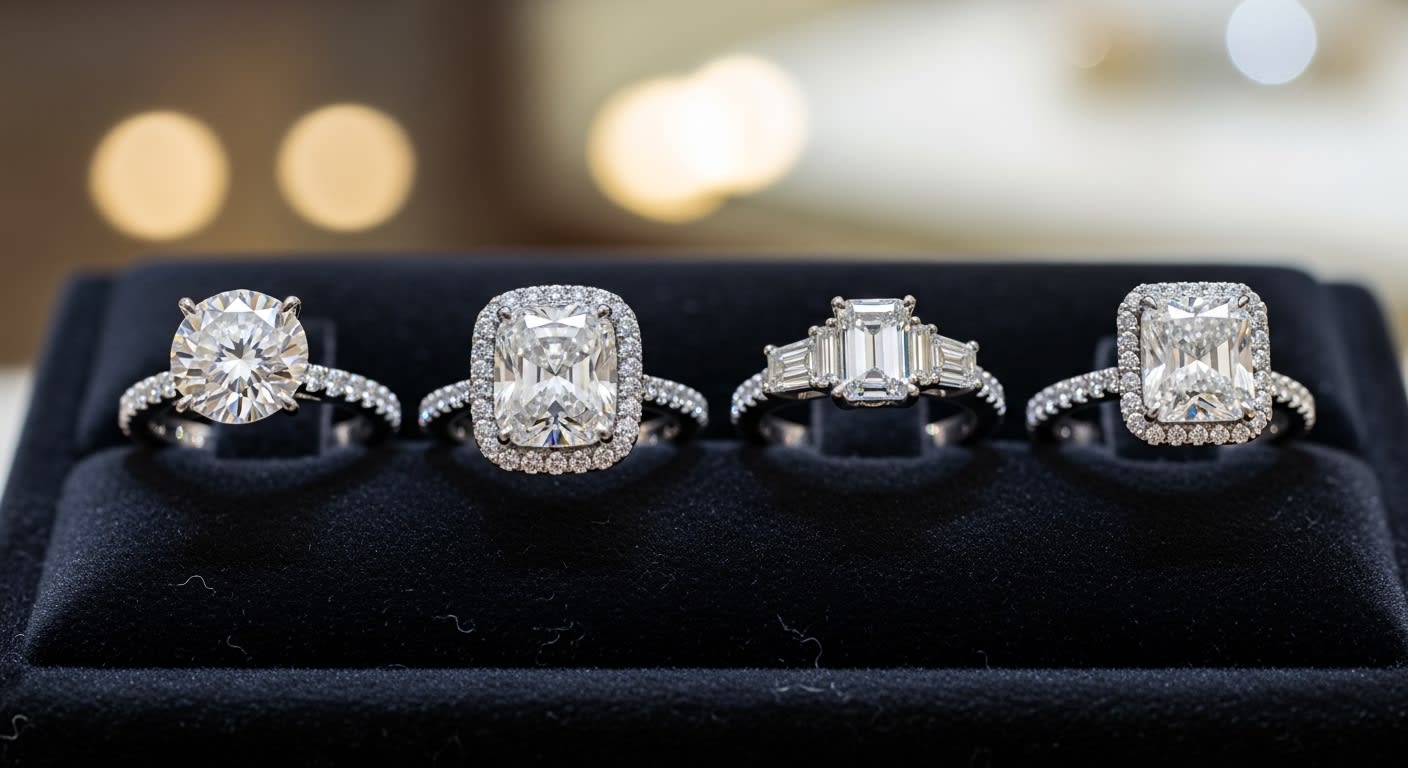
Each shape hides or reveals inclusions differently. This matters more than you might realize when looking at diamond reports.
- Round brilliants: Hide inclusions well due to numerous facets scattering light; can appear eye-clean even with minor inclusions
- Cushion and radiant cuts: Also hide inclusions effectively; great options if you’re accepting lower clarity grades
- Emerald and asscher cuts: Show inclusions more readily due to fewer, larger facets; require higher clarity grades for a clean appearance
- Pear, marquise, and oval: Show inclusions in the pointed or tapered areas; avoid inclusions in these zones
Your shape choice directly impacts which clarity grade you need. A VS1 clarity round brilliant might look flawless to the eye, while an emerald cut at VS1 could reveal visible inclusions. This is why understanding your chosen shape helps you make smart tradeoffs between carat weight, color, clarity, and cut—the four Cs.
Here’s a quick comparison of diamond shapes and what they’re best for:
| Shape | Visual Advantage | Clarity Needs |
|---|---|---|
| Round Brilliant | Maximum sparkle, classic appeal | Hides inclusions easily |
| Cushion | Soft, vintage look | Good at hiding flaws |
| Emerald | Elegant, step-cut transparency | Needs high clarity |
| Oval | Finger-elongating effect | Medium clarity required |
| Princess | Modern, sharp brilliance | Moderate clarity needed |
| Pear | Unique, elongating look | Watch tip for inclusions |
| Marquise | Dramatic, vintage style | Avoid flaws at points |
| Radiant | Bright with cropped corners | Good at masking flaws |
Finding Your Perfect Shape
The right shape depends on three factors: hand shape, personal style, and budget priorities. Round and cushion cuts work beautifully on all hand types. Longer cuts like oval, pear, and emerald tend to flatter longer fingers. Square cuts like princess work well on balanced hand proportions. Budget-wise, round brilliant commands a premium because demand is highest. You’ll find better value in cushion, radiant, or oval cuts that deliver similar sparkle at lower per-carat prices.
The shape you choose is purely personal preference—but it significantly affects how much clarity and color grade you need to achieve the look you want.
When browsing engagement rings at SuperJeweler, filter by shape first. This narrows your options dramatically and lets you focus on cut quality, color, and clarity within your chosen aesthetic. Try multiple shapes in person if possible; seeing how light reflects off each shape on your hand changes everything.
Pro tip: Visit a jewelry store to try on different shapes in person before shopping online; the same shape can look completely different depending on your hand proportions and skin tone, and this personal try-on eliminates buyer’s remorse.
How Cut Quality Affects Sparkle and Beauty
Here’s the truth that changes everything: a diamond’s beauty hinges almost entirely on cut quality. You can have a flawless, colorless diamond that looks dull and lifeless. Or you can have a diamond with slight color and minor inclusions that absolutely glows. The difference comes down to one thing: how well that diamond was cut.
When light enters a diamond, it doesn’t just pass straight through. How light behaves inside the stone depends on the precise angles and proportions of the facets. A well-cut diamond captures light, bounces it around inside the stone multiple times, and returns it to your eye as brilliance, fire, and scintillation. A poorly cut diamond lets light escape from the bottom or sides, creating dark zones and a lackluster appearance. The cutting angles control this light behavior entirely.
Think of it like a prism. Cut a piece of glass at the wrong angles, and light passes through without creating any sparkle. Cut it correctly, and you get rainbow flashes and brilliant reflections. Diamonds work the same way. The round brilliant cut, with its 57 carefully calculated facets, is engineered to maximize this internal light reflection. Every angle is designed to trap light and bounce it back to your eye at the perfect moment. That’s why round brilliants sparkle more than almost any other shape.
The Three Components of Sparkle
When gemologists evaluate cut quality, they look at three distinct optical effects that together create the sparkle you see:
- Brightness: The overall amount of light the diamond reflects. A well-cut diamond reflects nearly all the light that enters it, while a poorly cut stone loses light through the sides and bottom.
- Fire: The colored light flashes you see when the diamond moves. This comes from light being dispersed into spectral colors as it travels through the diamond. Better cutting enhances fire without washing it out.
- Scintillation: The pattern of bright and dark areas you see as the diamond moves. This creates the “sparkle” effect as light and shadow dance across the surface. Crisp, balanced scintillation signals excellent cut quality.
A well-cut diamond displays all three in harmony. You’ll see consistent brightness, colorful flashes when the diamond moves, and a crisp light-and-dark pattern that’s visually appealing. A mediocre cut sacrifices one or more of these effects, resulting in a stone that looks flat, dull, or unbalanced.
Cut Quality vs. Other Diamond Characteristics
This is where many shoppers get confused. They prioritize carat weight or color grade when they should be prioritizing cut. Why? Because cut quality directly impacts what you see every single day when you look at your ring.
A 1.2-carat diamond with an Excellent cut will look more brilliant and beautiful than a 1.5-carat diamond with a Good cut. A diamond with D color (completely colorless) but a Fair cut will look less impressive than a VS2 clarity diamond with an Excellent cut. Cut quality is the primary driver of visual beauty. Why diamond quality matters goes beyond grades on a certificate—it’s about what your eye perceives.
Cut quality is the factor that makes a diamond truly sparkle and shine, overshadowing all other characteristics in terms of visual impact.
This also has practical implications for your budget. If you prioritize Excellent cut quality, you can save money by accepting lower color or clarity grades and still get a stunning ring. You might choose a 1.0-carat Excellent cut diamond over a 1.3-carat Good cut diamond at the same price point, and yours will actually look better.
Polish and Symmetry Matter Too
Cut quality isn’t just about the angles and proportions. It also includes polish and symmetry. Polish refers to how smoothly the diamond was finished during cutting. Poor polish leaves scratches and blemishes that scatter light and reduce sparkle. Symmetry means the facets are aligned properly and mirror each other. A diamond with poor symmetry has facets that don’t line up, creating an imbalanced light pattern.
When you’re reviewing a diamond certificate, look for both Excellent polish and Excellent symmetry paired with an Excellent cut grade. This combination guarantees maximum sparkle and visual beauty.
Pro tip: Request high-resolution videos or images of any diamond you’re considering, and watch how the light moves across it as the camera angle shifts; a truly well-cut diamond will display consistent, crisp sparkle patterns without dark zones or dull areas.
Diamond Cut Grading Systems Explained
When you’re shopping for engagement rings, you’ll encounter diamond certificates with cut grades. But not all grading systems are created equal. Two major organizations—the Gemological Institute of America (GIA) and the American Gem Society (AGS)—have developed different approaches to measuring cut quality. Understanding these systems helps you compare diamonds accurately and make confident purchasing decisions.
The GIA system, introduced in 2005, became the global standard for grading round brilliant diamonds. It evaluates cut quality using a five-tier scale: Excellent, Very Good, Good, Fair, and Poor. The GIA considers multiple factors when assigning a grade: crown height, pavilion depth, table size, polish, and symmetry. The brilliance comes from how these proportions work together to reflect light. What makes the GIA system practical is that it allows flexibility within each grade range. Two diamonds can both receive an “Excellent” grade but have slightly different proportions, which means slightly different light performance. This is why comparing specific measurements matters, not just relying on the letter grade alone.
The AGS system takes a different approach entirely. Performance-based cut grading systems use advanced ray-tracing technology to analyze actual light performance rather than just measuring proportions. The AGS grades from 0 (ideal) to 10 (poor), with 0 being the best possible cut. What sets AGS apart is that it evaluates brightness, fire, light leakage, and contrast patterns—essentially measuring what your eye actually sees. This means an AGS-graded diamond tells you definitively how much light will return to your eye, not just whether the proportions are close to ideal.
Comparing the Two Systems
Both systems are reliable and trustworthy, but they measure different things:
- GIA: Measures proportions and finish quality; provides flexibility within grade ranges; widely used and recognized; best for understanding whether a diamond’s measurements fall within acceptable ranges
- AGS: Measures actual light performance through technology; provides more precise optical analysis; excellent for understanding exactly how bright and sparkly a diamond will be; slightly less common but increasingly respected
If you’re comparing a GIA-graded diamond to an AGS-graded diamond, don’t assume one system’s Excellent equals the other’s. Request specific measurements and ideally high-resolution videos showing the diamond’s actual sparkle. Both grading organizations are excellent, but their methodologies differ.
Understanding the GIA Scale in Detail
Since most diamonds you’ll encounter carry GIA certification, let’s break down what each grade means in practical terms:
Excellent: Reflects nearly all light that enters; maximum sparkle and brilliance; represents the top tier of cut quality
Very Good: Reflects most light with minimal loss; delivers nearly identical sparkle to Excellent in real-world viewing; often costs 15-25% less
Good: Reflects good amounts of light but with noticeable loss; visible reduction in sparkle compared to higher grades; noticeably lower price point
Fair: Significant light loss; appears visibly duller; substantially lower cost but compromised beauty
Poor: Substantial light leakage; minimal sparkle; rarely recommended for engagement rings
For engagement rings, Excellent and Very Good grades represent the sweet spot. You get excellent sparkle at Excellent, but Very Good offers tremendous value for money. The difference is so subtle that most people can’t distinguish them without side-by-side comparison.
Both GIA and AGS grading systems provide reliable assessments, but GIA focuses on proportions while AGS measures actual light performance—choose based on what information matters most for your decision.
What About Fancy Cuts?
Here’s something important: the GIA system for Excellent, Very Good, Good, Fair, and Poor grades only applies to round brilliant diamonds. For fancy cuts like cushion, oval, pear, and emerald, grading is less standardized. What makes a certified diamond matter becomes even more important for fancy cuts because grading ranges are wider and more subjective. When shopping for fancy cuts, pay special attention to the specific measurements and request detailed photographs or video. The certificate matters, but so does seeing the actual diamond’s performance.
Pro tip: Request GIA or AGS certification for any diamond over 0.5 carats, and use the specific measurements provided on the certificate to verify the cut quality independently rather than relying solely on the letter grade.
Impact of Cut on Price and Value
Here’s a reality that surprises many engagement ring shoppers: cut quality dramatically affects price, sometimes more than carat weight. A well-cut 0.9-carat diamond can cost significantly more than a poorly cut 1.2-carat diamond. Understanding how cut influences pricing helps you make smarter decisions and maximize value for your budget.
Round brilliant diamonds command premium pricing because they require the most precision cutting and lose the most rough diamond material in the process. A rough diamond might weigh 2 carats, but after cutting into a round brilliant, it might only be 1 carat. That 50% loss of material gets passed along as higher per-carat prices. Fancy cuts like cushion, oval, and pear lose less rough material during cutting, which is why they typically cost 10-20% less per carat than comparable round brilliants. If you want maximum carat weight for your budget, fancy cuts offer tremendous value.
How diamond cut affects pricing depends on multiple factors beyond just the shape. Superior cut grades—Excellent and Very Good—command higher prices because they deliver more sparkle and appeal to buyers. The relationship is direct: upgrade from a Good cut to a Very Good cut, and expect to pay 20-30% more. Upgrade to Excellent, and the premium increases further. This is where many shoppers find the best value opportunity. Very Good cuts cost significantly less than Excellent but deliver nearly identical sparkle. The visual difference is so minimal that most people cannot distinguish them without professional comparison.
How Cut Grade Affects Per-Carat Price
Let’s look at concrete numbers to illustrate this.
Suppose you’re comparing round brilliant diamonds at 1.0 carat with similar color (H) and clarity (VS1):
- Excellent cut: $4,500-5,200 per carat
- Very Good cut: $3,200-4,000 per carat
- Good cut: $2,200-2,800 per carat
The difference between Excellent and Very Good is roughly $1,000-1,500 per carat. For a 1.5-carat diamond, that’s $1,500-2,250 total. Very Good looks nearly identical to Excellent in real-world viewing, making it the smarter financial choice for most couples.
This table summarizes how cut grade impacts diamond pricing and appearance:
| Cut Grade | Price Impact (per carat) | Visible Sparkle Difference |
|---|---|---|
| Excellent | Highest | Maximum brilliance |
| Very Good | 15-25% less than Excellent | Nearly identical to Excellent |
| Good | Lower than Very Good | Noticeably less |
| Fair | Substantially lower | Dull appearance |
| Poor | Lowest | Minimal sparkle |
Fancy cuts show different pricing patterns. A cushion cut at Excellent grade costs maybe 8-12% less than a round brilliant at the same grade. An oval cut might be 12-15% less. This is why couples willing to choose a shape outside the traditional round brilliant can dramatically reduce costs while getting stunning sparkle.
Balancing Cut Quality with Other 4Cs
Here’s the strategic insight: cut quality is the best place to invest your money because it directly affects what you see every day. Don’t sacrifice cut quality to buy larger carat weight or higher color grades.
Smart budget strategy:
- Prioritize Excellent or Very Good cut quality
- Accept slightly lower color (H or I instead of D or E)
- Accept slightly lower clarity (VS1 or SI1 instead of VVS2 or VS1)
- Choose a fancy cut instead of round brilliant
- These tradeoffs often save 30-40% while delivering a more beautiful ring
A 0.95-carat diamond with Excellent cut, H color, and VS1 clarity often looks better and costs less than a 1.2-carat diamond with Good cut, D color, and VS2 clarity. Your eye notices the cut quality first. Color and clarity differences are far less noticeable to anyone looking at your hand.
Cut quality is the single best investment in your diamond because it directly determines how much the stone sparkles and catches light—something everyone notices immediately.
Market Demand and Resale Considerations
If you ever decide to sell or trade your engagement ring, cut quality affects resale value too. Round brilliants with Excellent cuts hold value better because demand remains high. Fancy cuts with Very Good or Good cuts can be harder to resell because fewer buyers want them, even if they’re beautiful. This doesn’t mean you shouldn’t choose a fancy cut—just understand that resale values differ.
Lab-grown diamonds offer another pricing advantage. A lab-grown diamond with Excellent cut costs 30-40% less than a mined diamond of identical specifications. The optical properties are identical. The value proposition is compelling if you’re budget-conscious and don’t prioritize the origin story.
Pro tip: Compare diamonds using per-carat pricing, not total price, and prioritize cut grade upgrades over carat weight upgrades; spending an extra $500 on cut quality yields far more visual sparkle than spending an extra $500 on additional carat weight.
Choosing the Best Cut for Your Needs
Selecting the right diamond cut is deeply personal. What sparkles beautifully on one person’s hand might not feel right for another. The best cut for you depends on three things: your visual preferences, your budget constraints, and how the diamond will work with your lifestyle and ring setting. By understanding your priorities, you can narrow down endless options and find the diamond that makes your heart skip a beat.
Start with honest conversations about what matters most to you as a couple. Do you want maximum sparkle that catches light from every angle? Go with a round brilliant or cushion cut in Excellent or Very Good grade. Do you prefer a more understated, sophisticated look that emphasizes clarity and color over flash? An emerald or asscher cut might resonate with you. How the right diamond cut works with your overall ring design helps ensure the stone complements both the setting and the wearer’s personal style.
Your lifestyle matters too. If you have an active lifestyle with hands-on work, consider that pointed cuts like marquise or pear are more vulnerable to chipping at the tips. Round brilliant, cushion, and radiant cuts are more durable for active lifestyles. If you work in an office and your hands are generally protected, fancy cuts with pointed ends work beautifully. Think about how you’ll interact with your ring every single day.
Decision Framework: Three Key Questions
Walk through these questions to identify your ideal cut:
1. What’s your priority: maximum sparkle or timeless elegance?
- Maximum sparkle: Choose round brilliant, cushion, or radiant cuts. Prioritize Excellent or Very Good cut grades. Expect to pay premium prices but get unmatched brilliance.
- Timeless elegance: Choose emerald, asscher, or oval cuts. These offer sophistication over flash. Cut quality still matters, but the look is more understated.
- Balanced approach: Princess or pear cuts offer good sparkle with distinctive style. They’re popular middle-ground options.
2. What’s your budget?
- Premium budget ($8,000+): You can afford round brilliant with Excellent cut. Prioritize cut quality and let other factors follow.
- Mid-range budget ($4,000-8,000): Choose Very Good cut in round brilliant, or Excellent cut in a fancy shape. This range offers maximum value.
- Budget-conscious ($2,000-4,000): Select a fancy cut (cushion, oval, pear) with Very Good cut quality. You’ll get stunning results at lower cost.
3. What does your hand shape suggest?
- Long, slender fingers: Oval, pear, marquise, or emerald cuts elongate the hand further, creating elegant proportion.
- Short or wider fingers: Round or cushion cuts create balance. Avoid extremely elongated cuts that might overemphasize hand width.
- Average proportions: Any cut works beautifully. Choose based purely on aesthetic preference.
The Research and Comparison Process
Once you’ve narrowed your preferences, the real work begins: comparing specific diamonds. Don’t rely on certificates alone. Request high-resolution videos or images showing the diamond’s actual sparkle. Watch how light moves across the stone as the angle shifts. A truly well-cut diamond will display crisp, consistent sparkle patterns without dead zones.
Visit jewelry retailers in person if possible. See multiple cuts side-by-side on your hand under different lighting conditions. Fluorescent office lighting, natural daylight, and evening lighting all reveal different aspects of a diamond’s beauty. What sparkles brilliantly under office lights might look different in candlelight at dinner.
Create a shortlist of three to five diamonds that meet your criteria. Compare them directly using per-carat pricing, not just total price. Note the specific measurements (crown angle, pavilion depth, table percentage) and how they correlate with visual performance. Over time, you’ll develop an intuition for which proportions produce the sparkle you love.
The best cut for you is the one that makes you smile when you look at your hand—prioritize personal preference over what anyone else thinks is “ideal.”
Don’t get paralyzed by perfectionism. No diamond is flawless, and no choice is wrong if you love it. Some couples agonize for months over tiny variations in cut grades when the visual difference is imperceptible. Once you’ve identified a diamond that meets your essential criteria and makes you happy, pull the trigger. You’ll wear this ring every day, and the joy you feel when you look at it matters far more than whether it’s Excellent or Very Good grade.
Pro tip: Bring printed images or videos of your shortlisted diamonds to try on with different ring settings in person; seeing how a specific diamond’s sparkle interacts with your preferred setting metal and band style often makes the final decision obvious.
Unlock Maximum Sparkle with Expertly Cut Diamonds at SuperJeweler
Choosing the perfect diamond cut is the key to making your engagement ring sparkle like no other. If you are seeking Excellent or Very Good cut quality that maximizes brilliance, fire, and scintillation as explained in our guide, you deserve a jeweler who offers a wide selection tailored to your needs. Many shoppers struggle to balance cut quality with budget and shape preferences but at SuperJeweler, you can explore diverse options including traditional and lab-grown diamonds—all with accurate certifications and detailed visuals that let you assess cut performance confidently.
Discover the diamond shape and cut grade that fits your style and budget by visiting SuperJeweler’s collection. Start your search with confidence knowing you have access to competitive pricing, free worldwide shipping, and customizable designs to create the ring that shines exactly as you imagined. Don’t compromise on sparkle or quality. Experience the difference a premium cut makes and take the first step toward a dazzling engagement ring today at SuperJeweler.com.
Frequently Asked Questions
What does diamond cut refer to in engagement rings?
Diamond cut refers to how a diamond interacts with light based on its proportions, facet arrangement, and polish quality. It is not about the shape of the diamond.
How does diamond cut affect the appearance of a ring?
The cut quality directly impacts a diamond’s sparkle, brightness, fire, and scintillation, meaning a well-cut diamond will appear more brilliant and valuable than a poorly cut one, even if they have similar color and clarity.
What are the different cut grades for diamonds according to GIA?
The GIA grades diamond cut quality on a scale from Excellent to Poor, which includes Excellent, Very Good, Good, Fair, and Poor. Excellent and Very Good cuts offer the best value for sparkle.
Can the cut quality of a diamond impact its cost?
Yes, cut quality significantly influences the price of a diamond. Well-cut diamonds, especially in the Excellent or Very Good categories, command higher prices due to their superior visual appeal compared to poorly cut stones.
Recommended
- Diamond Cut: The Secret to Sparkling Love
- Engagement Rings | SuperJeweler
- Halo Engagement Rings | Free Shipping | Lifetime Guarantee
- 7 Types of Engagement Rings for Every Budget and Style
- White Crystal Quartzite Elegance in Modern Design
