Choosing the right diamond for an engagement ring can feel overwhelming when you’re unsure how to judge quality. With so many grades, certifications, and technical terms, buyers often struggle to confidently identify stones that offer genuine value and beauty. This guide walks you through proven methods to assess diamond quality using expert-backed criteria, helping you make informed decisions whether shopping for natural or lab-grown diamonds. You’ll learn practical evaluation techniques, understand certification importance, and discover how to spot exceptional sparkle that matches your budget and expectations.
Table of Contents
- Key takeaways
- Understanding diamond quality: the 4Cs explained
- Certification and verification: ensure your diamond’s authenticity
- Evaluating natural versus lab-grown diamonds: grading nuances
- Practical tips for judging cut quality and sparkle in person
- Explore quality diamonds and engagement rings at SuperJeweler
- FAQ
Key Takeaways
| Point | Details |
|---|---|
| Four Cs priority | Prioritize cut first, then balance color and clarity based on your setting and budget. |
| Certified by reputable labs | Diamond certification from a reputable lab such as GIA protects buyers by providing an independent, standardized assessment of the four Cs. |
| GIA versus IGI standards | GIA is the strictest grading authority for natural diamonds, so its certificates often command higher resale values than IGI when similar grades are compared. |
| Near colorless value range | Near colorless diamonds in the G to H range offer strong value because they appear colorless in typical lighting while costing less than higher color grades. |
| Lab grown grading differences | Lab grown diamonds follow different grading protocols but can still deliver comparable sparkle with careful evaluation of the four Cs. |
Understanding diamond quality: the 4Cs explained
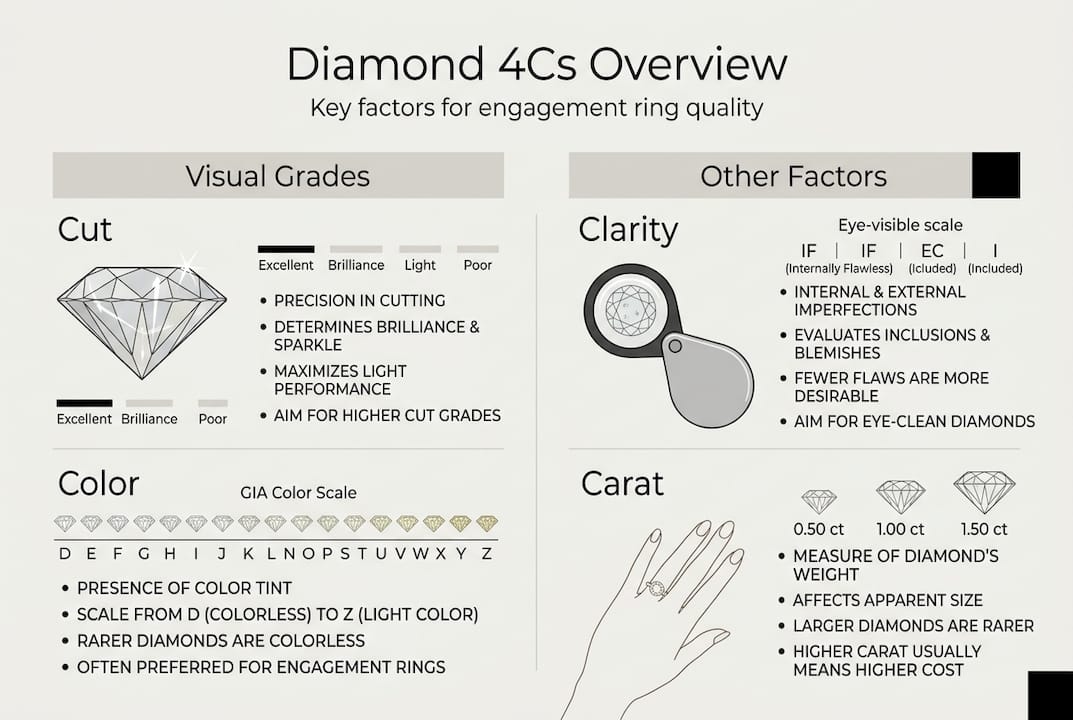
The diamond industry relies on four fundamental characteristics to evaluate quality: cut, color, clarity, and carat weight. Each dimension affects both appearance and price, but their relative importance varies depending on your priorities. Cut determines how light interacts with the stone, creating the brilliance and fire that make diamonds captivating. A superior cut can make a smaller diamond appear more impressive than a larger stone with poor proportions.
Color grading measures how colorless a diamond appears on a scale from D (completely colorless) to Z (noticeably tinted). Most diamonds fall somewhere in between, with color graded D (colorless) to Z (tinted); G-H often ideal value for near-colorless appearance. The G-H range offers exceptional value because these stones appear colorless to most observers yet cost significantly less than D-F grades. Only trained gemologists can typically detect the subtle warmth in G-H diamonds under controlled lighting.
Clarity refers to internal inclusions and external blemishes that occur naturally during diamond formation. The clarity scale ranges from Flawless (no inclusions visible under 10x magnification) to Included (inclusions visible to the naked eye). For most buyers, VS2 or SI1 clarity grades provide the sweet spot where inclusions remain invisible without magnification while keeping costs reasonable. Understanding why diamond quality matters helps you prioritize which characteristics deserve your budget focus.
Carat weight measures size but doesn’t directly indicate quality. Two diamonds with identical carat weights can have vastly different values based on their cut, color, and clarity grades. Larger stones command premium prices per carat, but smaller diamonds with superior grades often deliver more visual impact than bigger stones with compromised quality.
Pro Tip: Prioritize cut grade first, then balance color and clarity based on your setting choice. Yellow gold settings can mask slight color tints, allowing you to choose I-J color grades and allocate more budget toward superior cut quality.
| Color Grade | Description | Value Consideration |
|---|---|---|
| D-F | Colorless | Premium pricing, best for platinum settings |
| G-H | Near-colorless | Excellent value, appears colorless in most settings |
| I-J | Near-colorless with faint warmth | Good value, works well in yellow gold |
| K-M | Faint yellow tint | Budget-friendly, tint becomes noticeable |
Certification and verification: ensure your diamond’s authenticity
Diamond certification provides an independent assessment of a stone’s characteristics, protecting buyers from misrepresentation and ensuring you receive the quality you’re paying for. Reputable gemological laboratories examine diamonds using standardized methods and issue detailed reports documenting the 4Cs along with additional characteristics. Without certification, you’re relying solely on a seller’s claims with no objective verification.

The Gemological Institute of America (GIA) maintains the strictest grading standards in the industry, making their certificates the gold standard for natural diamonds. The International Gemological Institute (IGI) also provides certifications, though GIA or reputable lab certification; verify report online; GIA stricter than IGI especially for natural diamonds means GIA reports typically command higher resale values. When comparing certified diamonds, identical grades from different labs may not represent truly equivalent quality due to varying strictness in evaluation.
Verifying a certificate’s authenticity protects against fraudulent documentation. Every legitimate certificate includes a unique report number that you can check on the issuing lab’s website. This verification confirms the certificate matches their records and hasn’t been altered or fabricated. Many modern certificates also include security features like holograms or QR codes for additional authentication.
Follow these steps to verify your diamond’s certification:
- Obtain the complete certificate number and issuing laboratory name from your jeweler
- Visit the official laboratory website (avoid third-party verification sites)
- Enter the report number in their verification tool to pull up the official record
- Compare all details on the physical certificate against the online report
- Check that the diamond’s measurements match those listed in the certificate
- Request to see the diamond under magnification to confirm plotting diagram accuracy
Uncertified diamonds or those with certificates from unknown labs present significant risks. Without independent verification, you have no reliable way to confirm the stone’s actual quality or whether it’s even a natural diamond. The cost of certification from reputable labs represents a small fraction of a diamond’s value but provides essential protection for your investment. Understanding how to understand diamond certification empowers you to make purchases with confidence.
Pro Tip: Always verify certificates online before finalizing any diamond purchase. Some sellers present certificates from obscure labs with lenient grading standards, making stones appear higher quality than they actually are when compared to GIA standards.
Evaluating natural versus lab-grown diamonds: grading nuances
Lab-grown diamonds share identical chemical composition, crystal structure, and optical properties with natural diamonds, making them visually indistinguishable without specialized equipment. Both types consist of pure carbon atoms arranged in the same cubic crystal structure, which means they exhibit the same hardness, brilliance, and fire. The primary differences lie in their origin, market pricing, and certification approaches rather than their physical characteristics.
Certification protocols for lab-grown diamonds have evolved significantly, with major changes implemented in 2025. The GIA now uses a two-tier system for lab-grown stones, designating them as either Premium or Standard quality based on manufacturing precision and characteristics. This GIA uses Premium/Standard post-2025; chemically identical to natural but different grading system helps buyers differentiate between lab-grown diamonds of varying production quality, though both tiers maintain the same 4Cs grading scale used for natural stones.
When comparing natural and lab-grown options, consider these key distinctions:
- Natural diamonds receive traditional GIA grading reports with full 4Cs assessment
- Lab-grown diamonds are identified as such on all certificates and may include growth method details
- IGI certificates are more common for lab-grown stones and may use slightly different terminology
- Lab-grown diamonds typically cost 60-80% less than comparable natural diamonds
- Resale markets for lab-grown diamonds remain less established than for natural stones
| Aspect | Natural Diamonds | Lab-Grown Diamonds |
|---|---|---|
| Grading Standard | Traditional 4Cs with GIA/IGI | 4Cs plus Premium/Standard designation (GIA) |
| Certificate Marking | No special designation needed | Clearly marked as laboratory-grown |
| Price Point | Higher due to rarity and mining costs | 60-80% less expensive |
| Resale Value | Established secondary market | Limited resale market currently |
| Visual Appearance | Identical to lab-grown | Identical to natural |
The choice between natural and lab-grown diamonds often comes down to personal values and budget priorities rather than quality differences. Both options can achieve exceptional grades across all 4Cs when properly manufactured or formed. If you’re interested in exploring certified lab-grown options, browse lab grown diamond jewelry or compare selections of lab grown diamonds to see how they match your quality expectations and budget.
Certification lab choice affects perceived value and future resale potential. Natural diamonds with GIA certificates typically command premium prices in secondary markets, while lab-grown stones with any certification face more uncertainty in resale scenarios. However, for buyers focused on the engagement ring’s immediate beauty and symbolism rather than investment potential, lab-grown diamonds offer exceptional value.
Practical tips for judging cut quality and sparkle in person
Cut quality determines whether a diamond dazzles or disappoints, making it the most critical factor in visual appeal regardless of other grades. A diamond’s cut encompasses its proportions, symmetry, and polish, all of which control how effectively light enters the stone, reflects internally, and returns to your eye as brilliant white light and colorful flashes. Even a diamond with perfect color and clarity will look dull if poorly cut, while an expertly cut stone with lower grades can appear stunning.
Expert gemologists know that Excellent cut can mask lower color/clarity; check light performance over grades alone, which is why experienced buyers prioritize cut above all other characteristics. When light performance is optimized, the eye perceives more brilliance and fire, effectively disguising slight color tints or small inclusions that might otherwise be noticeable. This principle allows savvy buyers to maximize visual impact while managing budget constraints.
Follow these steps to evaluate cut quality and sparkle during your diamond search:
- View the diamond under multiple lighting conditions including natural daylight, LED spotlights, and diffused indoor lighting to see how it performs in real-world scenarios.
- Observe the diamond’s brilliance by noting how much white light reflects back when viewing from directly above the stone.
- Check for fire by tilting the diamond slightly and watching for colorful flashes of spectral light dispersing from the facets.
- Assess scintillation by moving the diamond gently and observing the pattern of light and dark flashes across its surface.
- Compare multiple diamonds side by side under identical lighting to identify which stones exhibit superior light return.
- Use magnification to examine facet alignment and symmetry, looking for precise meets between facets that indicate quality cutting.
- Request video documentation if shopping online, specifically asking for footage under various lighting to simulate in-person viewing.
When evaluating diamonds in person, trust your eyes alongside certification grades. Sometimes a diamond graded Very Good for cut will outperform one graded Excellent due to subtle proportion variations that suit your preferences. The interplay between a diamond’s depth percentage, table size, and crown angles creates unique personalities in each stone. Learning about role of cut in diamond quality maximize sparkle helps you understand these nuances.
Pay attention to how the diamond looks in the setting you’ve chosen. Certain cuts and proportions complement specific mounting styles, while others may appear less impressive once set. Halo settings can enhance sparkle in diamonds with good but not excellent cuts, while solitaire settings demand superior cut quality since nothing distracts from the center stone’s performance.
Pro Tip: Ask jewelers to show you the diamond’s light performance using specialized viewers like ASET or Ideal-Scope images if available. These tools reveal light leakage and help you identify truly exceptional cut quality beyond what certificates alone can tell you. Many online retailers now provide these images as standard documentation.
Explore quality diamonds and engagement rings at SuperJeweler
Now that you understand how to identify quality diamonds using the 4Cs, certification verification, and practical evaluation techniques, you’re ready to apply this knowledge to find your perfect engagement ring. SuperJeweler offers an extensive selection of certified natural and lab-grown diamonds across all quality grades, allowing you to choose stones that match both your standards and budget. Whether you’re seeking cheap engagement rings that maximize value without compromising beauty or premium options with exceptional grades, you’ll find certified quality backed by trusted gemological laboratories.

Explore the full range of lab grown diamonds to see how these certified stones deliver stunning visual appeal at accessible price points, or browse the complete collection of engagement rings to find settings that showcase your chosen diamond’s brilliance. Every diamond comes with the certification and quality assurance you need to purchase confidently, knowing you’ve identified a stone that will sparkle for generations.
FAQ
Which diamond characteristics most affect value?
Cut quality has the greatest impact on visual appeal and can compensate for lower color or clarity grades, making it the most important characteristic for maximizing perceived value. Color and clarity follow as secondary factors, with near-colorless G-H grades and VS2-SI1 clarity offering the best balance between beauty and cost. Carat weight affects price exponentially, but a smaller well-cut diamond often appears more impressive than a larger poorly cut stone.
How can I verify a diamond certificate online?
Locate the certificate number and laboratory name printed on your diamond’s grading report, then visit the official lab website such as GIA.edu or IGI.org. Enter the report number into their verification database to pull up the complete official record and compare all details against your physical certificate. This process confirms authenticity and ensures the certificate hasn’t been altered, protecting you from fraudulent documentation. Learn more about understand diamond certification to make informed purchasing decisions.
Are lab-grown diamonds considered less valuable than natural?
Lab-grown diamonds have identical physical and optical properties to natural diamonds but typically cost 60-80% less due to controlled production rather than mining. Their resale value remains lower than natural diamonds because secondary markets are still developing and supply is less constrained. However, for buyers prioritizing the engagement ring’s beauty and symbolism over investment potential, lab grown diamonds offer exceptional value with certified quality.
What cut grade should I prioritize for sparkle?
Excellent or Very Good cut grades deliver the best combination of brilliance, fire, and scintillation while maintaining reasonable pricing compared to lower grades. These grades ensure optimal light performance that maximizes visual impact regardless of other characteristics. Always confirm cut quality through visual inspection under multiple lighting conditions, as the interplay between proportions can make some Very Good cuts outperform certain Excellent grades depending on your preferences. Discover how role of cut in diamond quality maximize sparkle affects your diamond’s overall appearance and value.
Recommended
- Why Diamond Quality Matters for Engagement Rings
- Lab Grown Diamond Engagement Rings | SuperJeweler
- Engagement Rings | SuperJeweler
- Lab Grown Diamond Rings | SuperJeweler
