Buying a diamond can feel overwhelming when you’re faced with complex grading systems and technical jargon. Many shoppers assume a higher grade always means a better diamond, but that’s not the full story. Understanding how diamonds are graded helps you make informed decisions, avoid overpaying, and find a ring that truly sparkles. This guide breaks down the grading process, explains the 4Cs in practical terms, and shows you how to apply this knowledge when shopping for engagement rings, wedding bands, or fine jewelry.
Table of Contents
- Key takeaways
- Understanding the diamond grading process
- Explaining the 4Cs: carat, color, clarity, and cut
- The role of certifications and lab grading consistency
- Applying diamond grading knowledge to make smart purchases
- Explore quality diamond rings at SuperJeweler
- Frequently asked questions about diamond grading
Key Takeaways
| Point | Details |
|---|---|
| Four Cs framework | Understanding carat color clarity and cut helps you prioritize size versus sparkle and value. |
| Cut drives brilliance | A diamond with superior cut can enhance brightness and perceived size more than a larger stone. |
| Lab grading variation | Different labs may grade the same diamond differently, so always verify the actual stone alongside the certificate. |
| See the stone in person | Request to see the diamond in person to judge light performance beyond the certificate. |
Understanding the diamond grading process
Diamond certification begins with precise measurement and systematic evaluation. Professional labs follow structured procedures to assess each stone objectively. Grading involves sequential assessment from precise carat weighing to measurement with 3D scanners, color grading on a D to Z scale, clarity under 10x magnification, and cut evaluation including polish and symmetry. This standardized approach ensures consistency across the industry.
Here’s how the grading process unfolds:
- Carat weight measurement: Labs weigh diamonds to four decimal places using calibrated scales, establishing the exact size.
- Dimensional scanning: 3D scanners capture precise measurements of diameter, depth, and table percentage to evaluate proportions.
- Color assessment: Graders compare stones against master sets under controlled lighting, assigning grades from D (colorless) to Z (light tint).
- Clarity examination: Using 10x magnification, experts identify and map inclusions and blemishes, grading from Flawless (FL) to Included (I3).
- Cut analysis: Evaluators assess proportions, polish quality, symmetry, and light performance to determine how well the diamond reflects light.
Each step builds on the previous one, creating a comprehensive quality profile. Labs use anonymous tracking systems to prevent bias, ensuring graders evaluate stones based solely on physical characteristics. Multiple graders often review the same diamond to reach consensus on final grades.
Pro Tip: Different labs may grade the same diamond slightly differently due to human judgment variations. Always request to see the actual stone, not just rely on the certificate grades.
The grading process reveals objective quality indicators, but understanding what those indicators mean for real world appearance requires deeper knowledge of each component.
Explaining the 4Cs: carat, color, clarity, and cut
The 4Cs form the universal language of diamond quality. Each factor contributes differently to appearance and value, and understanding their interplay helps you prioritize what matters most.
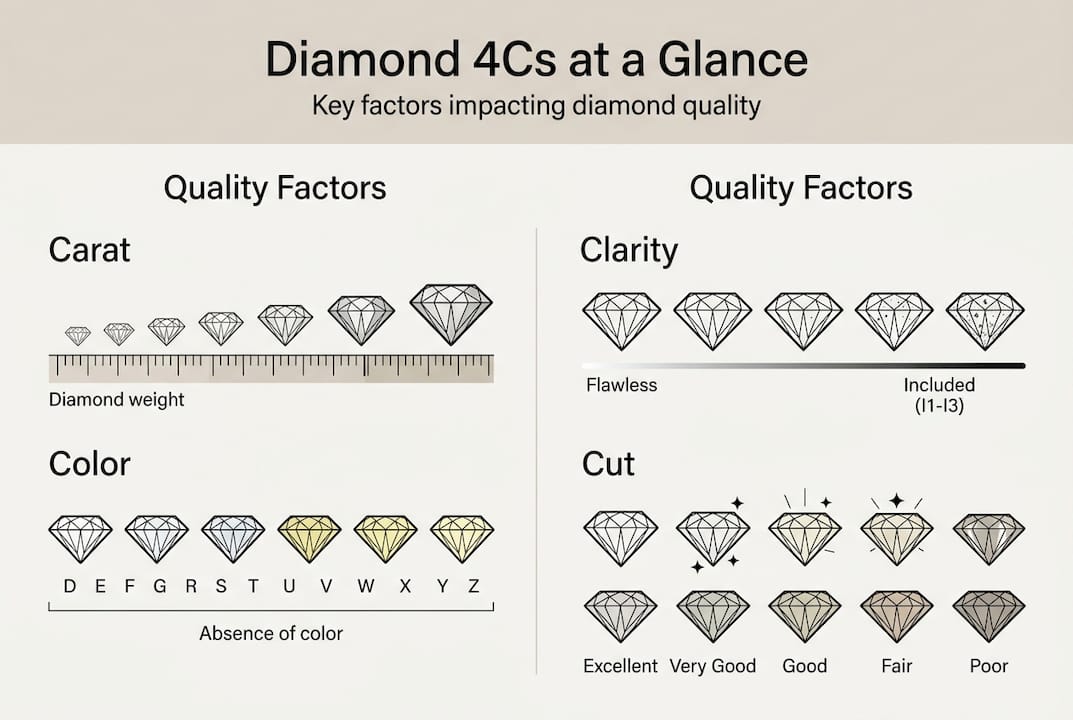
Carat measures weight, not size, though the two correlate closely. One carat equals 200 milligrams. Larger diamonds are rarer and command premium prices, but carat alone doesn’t determine beauty. A poorly cut 2 carat diamond can look dull compared to a brilliantly cut 1 carat stone.

Color refers to the absence of color in white diamonds. The color scale spans from D (colorless) to Z (tinted). D, E, and F grades appear colorless to the naked eye and carry premium prices. G through J grades show near colorless qualities that most people can’t distinguish in mounted jewelry. K through Z grades display noticeable yellow or brown tints. Diamond color grades impact how light interacts with the stone, affecting its overall brilliance.
Clarity assesses internal inclusions and external blemishes visible under 10x magnification. Clarity ranges from Flawless to Included grades. Flawless (FL) and Internally Flawless (IF) diamonds show no inclusions under magnification and are extremely rare. VVS1 and VVS2 (Very Very Slightly Included) contain minute inclusions difficult for experts to see. VS1 and VS2 (Very Slightly Included) have minor inclusions. SI1 and SI2 (Slightly Included) show inclusions visible under magnification but often invisible to the naked eye. I1, I2, and I3 (Included) display obvious inclusions affecting transparency and brilliance. Diamond clarity directly impacts how light travels through the stone.
Cut determines how well a diamond returns light to your eye, creating sparkle, fire, and brilliance. Cut is the most impactful but hardest to perfect, while pricing models reveal complex, nonlinear interactions among the 4Cs plus polish, symmetry, and fluorescence. Cut grades range from Excellent to Poor, evaluating proportions, angles, polish, and symmetry. Diamond cut quality transforms raw material into a light performance masterpiece.
| Factor | Impact on Appearance | Impact on Price |
|---|---|---|
| Carat | Determines size | Exponential increase with weight |
| Color | Affects warmth and brilliance | Premium for colorless grades |
| Clarity | Influences transparency | Higher grades command premiums |
| Cut | Controls sparkle and fire | Greatest impact on beauty and value |
These factors don’t operate independently. A well cut diamond can make a lower color grade appear brighter, while poor cut quality diminishes even the finest color and clarity grades.
Pro Tip: Prioritize cut quality over other factors. An Excellent cut with slightly lower color or clarity grades will outshine a Poor cut diamond with premium grades in other areas.
The 4Cs provide a framework, but certificates alone don’t tell the complete story. Lab consistency and grading reliability matter just as much.
The role of certifications and lab grading consistency
Certification adds credibility and transparency to diamond purchases, but not all certificates carry equal weight. Leading laboratories like GIA (Gemological Institute of America) and IGI (International Gemological Institute) maintain strict standards. GIA uses anonymous bar coded tracking, multiple graders for consensus, and laser inscription of report numbers to ensure objectivity.
Key certification features include:
- Anonymous grading: Stones receive bar codes so graders evaluate them without knowing ownership or previous assessments
- Multiple reviewers: Several graders independently assess each diamond, with supervisors resolving discrepancies
- Laser inscription: Certificate numbers are microscopically engraved on the diamond’s girdle for permanent identification
- Detailed documentation: Certificates include diagrams mapping inclusions, measurements, and comprehensive grade breakdowns
Despite rigorous procedures, lab inconsistencies require buyers to rely not only on grades but also on visual inspection to evaluate actual diamond beauty. Human judgment introduces variability. A diamond graded VS2 by one lab might receive SI1 from another. Color assessments can vary by one or two grades between laboratories.
“Certificates provide valuable information, but your eyes are the ultimate judge. Two diamonds with identical grades can look remarkably different based on how inclusions are positioned, how facets interact with light, and subtle variations in proportions.”
Pro Tip: Request to view diamonds under different lighting conditions. Natural daylight, LED, and incandescent light each reveal different aspects of a diamond’s performance.
Beyond the 4Cs, diamond certification documents additional factors affecting appearance:
- Polish: Surface finish quality, graded from Excellent to Poor
- Symmetry: Precision of facet alignment and shape, graded from Excellent to Poor
- Fluorescence: How the diamond reacts to ultraviolet light, ranging from None to Very Strong
Fluorescence deserves special attention. Some diamonds emit a blue glow under UV light. In lower color grades, fluorescence can make stones appear whiter. In colorless diamonds, strong fluorescence occasionally creates a hazy appearance, though this is uncommon.
Understanding certification nuances helps you interpret grades accurately and recognize when visual inspection should override certificate details.
Applying diamond grading knowledge to make smart purchases
Knowing grading criteria is one thing. Using that knowledge to find the perfect diamond requires strategic thinking. Cut has the greatest impact on diamond appearance and price, so prioritize it when shopping over other 4Cs.
Start with these practical guidelines:
- Set your priorities: Decide whether size, colorlessness, clarity, or sparkle matters most for your situation and budget
- Establish a realistic budget: Determine your spending limit before viewing options to avoid emotional overspending
- Focus on cut first: Choose Excellent or Very Good cut grades to maximize brilliance regardless of other factors
- Balance the remaining Cs: Select color and clarity grades that appear eye clean and colorless when mounted
- Consider the setting: Metal color affects how diamond color appears; yellow gold can make near colorless grades look whiter
Follow this step by step buying approach:
- Research and educate: Learn grading basics and identify which factors matter most for your preferences
- Compare certified diamonds: Review multiple stones with similar grades to understand price variations
- Inspect visually: View diamonds in person or through high quality videos showing light performance
- Verify certification: Confirm certificates come from reputable labs and match laser inscriptions
- Negotiate confidently: Use your knowledge to discuss value and potentially negotiate better pricing
- Make your purchase: Choose the diamond that offers the best combination of beauty, quality, and value
Pro Tip: SI1 and SI2 clarity grades often provide excellent value. Many stones in these ranges are eye clean, meaning inclusions are invisible without magnification, allowing you to allocate more budget toward cut quality or carat weight.
Diamond quality importance extends beyond initial purchase. Well graded diamonds maintain value better and provide lasting satisfaction. When shopping for affordable engagement rings, focus on finding the sweet spot where grades deliver visual beauty without paying premiums for imperceptible differences.
Consider these value optimization strategies:
- Choose just below premium thresholds: A 0.95 carat diamond costs significantly less than 1.0 carat but looks nearly identical
- Accept near colorless grades: G, H, or I color diamonds appear colorless in most settings at lower prices than D, E, or F
- Prioritize eye clean clarity: VS2 or SI1 grades without visible inclusions offer better value than VVS grades
- Maximize cut quality: Excellent cut transforms modest grades in other areas into stunning visual performance
Your grading knowledge empowers you to identify diamonds that deliver exceptional beauty relative to their price, ensuring you invest wisely in jewelry that brings lasting joy.
Explore quality diamond rings at SuperJeweler
Now that you understand diamond grading, put your knowledge to work. SuperJeweler offers an extensive collection of certified diamonds and expertly crafted rings designed to showcase their brilliance. Whether you’re searching for affordable engagement rings under $1,000 or exploring premium selections, you’ll find options across all quality grades.

Browse the complete engagement rings collection featuring diverse styles from classic solitaires to intricate halo designs. Each ring pairs certified diamonds with quality craftsmanship, ensuring your purchase meets the standards you’ve learned about. Complement your engagement ring with matching wedding bands designed to fit seamlessly together. With free worldwide shipping and comprehensive warranties, SuperJeweler makes finding your perfect diamond ring straightforward and secure.
Frequently asked questions about diamond grading
What are the 4Cs in diamond grading?
The 4Cs are Carat (weight and size), Color (absence of tint), Clarity (internal and external flaws), and Cut (light performance and sparkle). These four factors form the foundation of diamond quality assessment worldwide. Together they determine a diamond’s appearance, rarity, and value, though cut typically has the greatest impact on visual beauty.
How can I trust a diamond grading certificate?
Reputable laboratories like GIA and IGI use multiple independent graders, anonymous tracking systems, and strict protocols to ensure accurate assessments. Diamond certification includes laser inscribed report numbers that permanently link certificates to specific stones. Always verify the certificate comes from a recognized lab and matches the inscription on the diamond’s girdle.
Why is cut more important than other factors?
Cut determines how effectively a diamond returns light to your eye, creating the sparkle and fire that make diamonds captivating. Diamond cut quality affects brilliance more than any other factor. A well cut diamond with modest color or clarity grades will outshine a poorly cut stone with premium grades in other areas, making cut the most critical quality consideration.
Can two diamonds with the same grades look different?
Absolutely. Grading labs may assess stones slightly differently due to human judgment variations. Additionally, inclusion placement affects appearance even within the same clarity grade. Some VS2 diamonds have inclusions near edges while others have them in the center, impacting visibility. Polish, symmetry, and fluorescence also create visual differences between diamonds with identical 4Cs grades.
Should I consider other factors beyond the 4Cs?
Yes. Polish and symmetry grades indicate finishing quality and affect how precisely light reflects through the diamond. Fluorescence can enhance or detract from appearance depending on its intensity and the diamond’s color grade. Your personal style preferences, ring setting choice, and budget constraints also play important roles in selecting the ideal diamond for your specific situation.
Recommended
- Diamond Clarity – How It Impacts Ring Value
- What Is Diamond Color Grade? 50% Price Impact Explained
- Diamond Necklace Terminology: What Every Buyer Should Know
- What Is a Certified Diamond and Why It Matters
