TL;DR:
- Cut quality determines how well a gemstone captures and reflects light, affecting brilliance and value.
- Different cutting styles like brilliant, step, and fantasy offer unique visual effects and suitability.
- Prioritize excellent cut grades and personal preference over size for the best jewelry impact.
Most people assume a bigger gemstone automatically looks more stunning. That assumption costs buyers money and leaves them disappointed. The truth is that a smaller, expertly cut stone will outshine a larger, poorly cut one every single time. Cut is the single most powerful factor controlling how a gemstone captures and returns light, and it shapes how much you pay for it too. This guide walks you through what gemstone cut really means, the major styles you will encounter, how cut drives brilliance and value, and exactly how to choose the right cut for your next jewelry purchase.
Table of Contents
- What is a gemstone cut? Definition and fundamentals
- Major types of gemstone cuts: Styles and features
- How cut affects gemstone brilliance, color, and value
- Special cases: Vintage, economic, and artistic gemstone cuts
- How to choose the right gemstone cut for your jewelry
- Rethinking gemstone cuts: What jewelry guides often overlook
- Explore your perfect cut at SuperJeweler
- Frequently asked questions
Key Takeaways
| Point | Details |
|---|---|
| Cut defines beauty | The way a gemstone is cut dramatically shapes its sparkle, color, and overall visual impact. |
| Brilliant vs. step styles | Brilliant cuts maximize sparkle, while step cuts highlight clarity and color—choose based on personal taste. |
| Cut trumps size | A well-cut gem typically looks more dazzling and valuable than a larger but poorly cut stone. |
| GIA grades matter | For round brilliants, focus on cut grade as it most directly influences beauty and price. |
| Style and personality | Unique or vintage cuts offer character and story, but always balance looks with durability and value. |
What is a gemstone cut? Definition and fundamentals
The word “cut” gets used loosely in jewelry conversations, but it means something very specific. A gemstone cut) is the process of transforming rough stone into a polished, finished gem through shaping, faceting, and polishing to maximize beauty, light performance, color, and value. It is not the same as shape, and it is not the same as size. Understanding this difference changes how you shop.
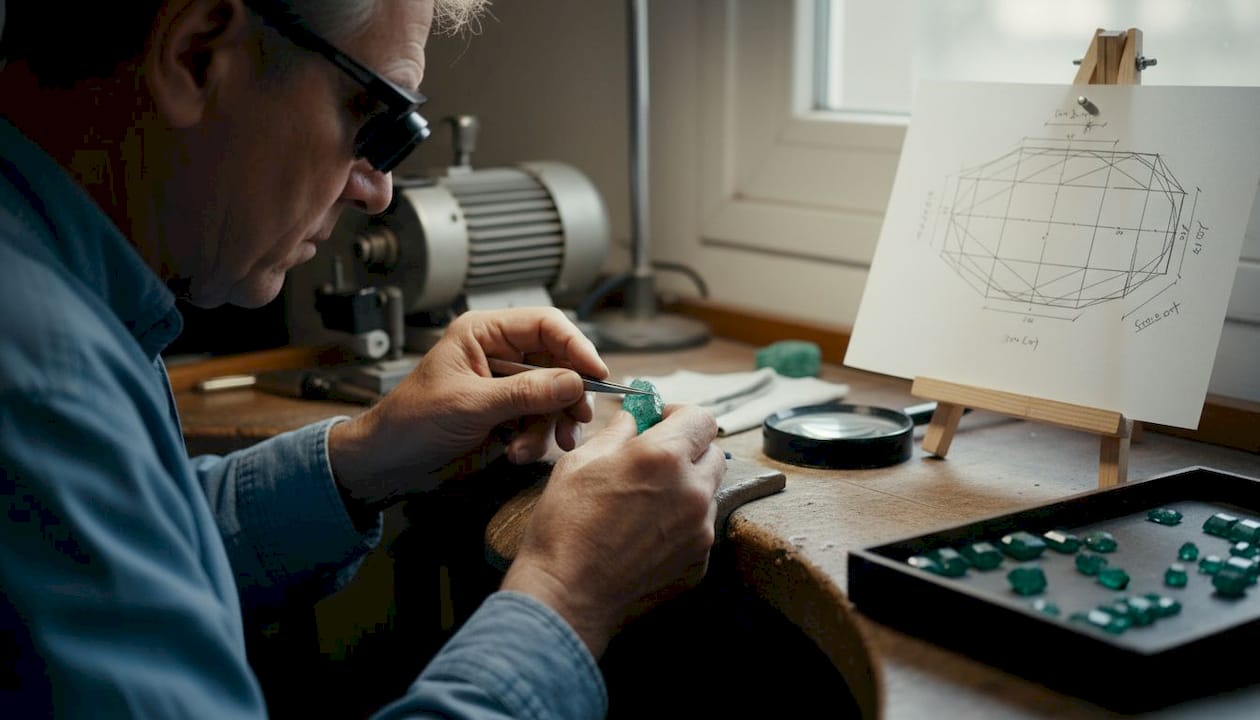
Here is how the process works. A gem cutter starts by sawing the rough stone into a workable piece. Next comes grinding, which establishes the basic form. Then faceting creates the flat, angled surfaces (called facets) that interact with light. Finally, polishing smooths every surface to a mirror finish. Each step demands precision because even a slight error in facet angle changes how light moves through the stone.
Now, the key distinctions:
- Cut refers to how facets are arranged, their angles, and the quality of the finish
- Shape refers to the outline you see from above, such as round, oval, or pear
- Size refers to the physical dimensions and carat weight
A round shape can have an excellent cut or a poor cut. Two stones of identical shape and carat weight can look completely different depending on cut quality. The well-cut stone returns light straight back to your eye. The poorly cut stone leaks light through the bottom, looking dark and lifeless.
Cut also maximizes color. For deeply saturated stones like rubies or sapphires, a skilled cutter places facets to concentrate color in the center of the gem. For lighter stones, the goal shifts toward maximizing brilliance. Browse any collection of gemstone rings and you will notice that the stones catching your eye first are almost always the best-cut ones, regardless of size.
Pro Tip: When comparing two stones of the same species and color, always ask to see them side by side in natural light. The one with better cut quality will look noticeably brighter and more alive.
Major types of gemstone cuts: Styles and features
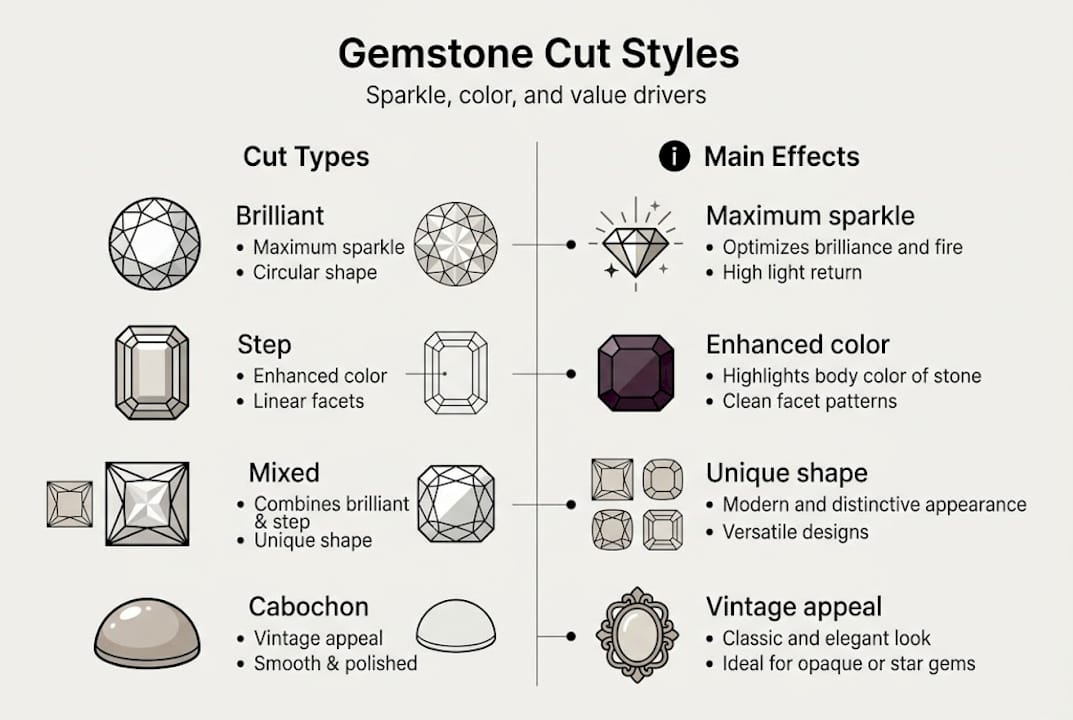
Now that you know what a cut is, let’s explore the main styles you will encounter and what makes each one special. The main cutting styles include brilliant, step, mixed, fantasy, and cabochon, and each produces a dramatically different visual result.
Brilliant cut uses triangular and kite-shaped facets arranged to maximize light return. The classic round brilliant has 58 facets. It is the most popular cut for diamonds and many colored stones because it delivers maximum sparkle. Think of it as a light engine.
Step cut uses rectangular facets arranged like staircase steps. The emerald cut is the most famous example. Step cuts emphasize color and clarity over raw sparkle. They have a sophisticated, architectural look that suits buyers who prefer elegance over flash.
Mixed cut combines a brilliant-style crown (top) with a step-style pavilion (bottom). This gives you some sparkle plus good color saturation. Many sapphires and rubies are mixed cut because it flatters their natural color.
Fantasy cut uses non-traditional, often concave facets to create sculptural effects. These are artistic statements. They are unique but harder to evaluate and appraise.
Cabochon is a smooth, domed polish with no facets at all. It is used for opaque stones and for gems that show special optical effects like star sapphires or cat’s-eye chrysoberyl.
| Cut style | Best for | Key visual effect | Buyer consideration |
|---|---|---|---|
| Brilliant | Diamonds, white sapphires | Maximum sparkle | Best light performance |
| Step | Emeralds, aquamarines | Color and clarity | Shows inclusions clearly |
| Mixed | Rubies, sapphires | Color plus sparkle | Versatile and popular |
| Fantasy | Collector pieces | Sculptural, unique | Hard to appraise |
| Cabochon | Opals, star stones | Glow, optical effects | No cut grade applies |
For buyers exploring affordable gemstone ring tips, brilliant cuts tend to offer the best visual impact per dollar. Step cuts reward buyers who prioritize color and love a clean, graphic look.
Pro Tip: Fantasy and cabochon cuts have real charm, but they can be difficult to resell or appraise. If investment value matters to you, stick with brilliant or mixed cuts in recognized styles.
How cut affects gemstone brilliance, color, and value
Understanding the styles is only the beginning. Here is how cut really changes what your eyes and wallet see.
Light entering a gemstone either bounces back to your eye or leaks out the bottom. The difference comes down to facet angles calculated against the stone’s refractive index (how strongly it bends light). When angles are correct, light reflects internally and exits through the top. When angles are too shallow or too steep, light escapes through the sides or base. The result is a dark, dull stone.
Three visual effects come from a well-executed cut:
- Brilliance: The return of white light, creating overall brightness
- Fire: The splitting of white light into rainbow colors, visible as colored flashes
- Scintillation: The pattern of sparkle and contrast when the stone or light source moves
For round brilliant diamonds, the GIA grades cut on seven performance factors including brightness, fire, scintillation, weight ratio, durability, polish, and symmetry, on a scale from Excellent to Poor. Cutting a rough stone to ideal proportions typically reduces original weight by about 50%, which is why well-cut stones cost more per carat.
| Proportion | Ideal range | Effect if off |
|---|---|---|
| Table size | 54-57% | Too large: less fire; too small: less brilliance |
| Depth percentage | 59-62.5% | Too deep or shallow: light leaks |
| Crown angle | 34-35 degrees | Affects fire and face-up brightness |
Cut impacts value most among all the 4Cs. A poor cut dulls even a high-color, high-clarity stone.
For the impact of gemstone cuts on engagement ring choices, this matters enormously. You can read more about applying this knowledge in our engagement ring buying tips guide. Never sacrifice cut quality to gain carat weight. A smaller, excellently cut stone will look larger and brighter than a bigger, poorly cut one.
Special cases: Vintage, economic, and artistic gemstone cuts
With the science and styles in mind, not all gemstone cuts fit into neat categories. Let’s explore the special cases.
Vintage cuts like the old mine cut and rose cut were designed for a different era. Cutters working before electric light prioritized yield and fire under candlelight), not the precise light return valued today. Old mine cuts have a cushion-like shape with a high crown and small table. Rose cuts are flat on the bottom with a domed top covered in triangular facets. Both have romantic, soft sparkle that many buyers find more personal than modern precision.
Economic cuts are a reality of the gem trade. When rough stone is expensive or irregularly shaped, cutters sometimes prioritize retaining carat weight over achieving optimal proportions. These stones may look slightly dark or off-center. They cost less per carat but deliver less beauty per dollar.
Fantasy and artistic cuts, as noted by traditional vs. modern cutting philosophies, represent a rebellion against standardization. Indian and European cutting traditions historically emphasized artistry and yield. Modern precision cutting optimizes optics. Neither approach is wrong, but they serve different buyers.
Inclusions (internal flaws) also dictate cut choice. A cutter may choose a shape that hides a flaw near the edge or select a cabochon finish to mask internal cloudiness while showcasing a star effect.
- Does the vintage cut have a thin girdle (the narrow band around the middle) that could chip?
- Is the fantasy cut from a reputable cutter with documentation?
- Does the economic cut still meet your minimum brightness standard in person?
- Has the stone been viewed in daylight, incandescent light, and fluorescent light?
For buyers drawn to vintage engagement rings, the character of an old mine or rose cut can be genuinely irreplaceable. Just follow our choosing engagement rings guide to make sure the setting protects the stone properly.
Pro Tip: Always examine vintage and artistic cuts under magnification and in multiple light sources. Thin girdles chip easily, and some fantasy cuts are fragile. Ask your jeweler about the best protective setting style.
How to choose the right gemstone cut for your jewelry
Understanding all your options, here is how to make an informed choice the next time you buy jewelry.
- Choose your gem type and intended use. Hard stones like diamonds and sapphires suit active wear. Softer stones like opals need protective settings regardless of cut.
- Determine your style preference. Do you want maximum sparkle (brilliant), sophisticated color (step), or something unique (fantasy or vintage)?
- Weigh brilliance against size. A well-cut smaller stone beats a poorly cut larger one visually. Decide what matters more to you.
- Check the cut grade and grading report. For round brilliant diamonds, GIA reports give you objective cut quality data. For other shapes, look at polish and symmetry grades.
- Match the cut to your setting and lifestyle. Pointed cuts like marquise or princess need protective prongs. Cabochons suit bezel settings.
Common mistakes buyers make:
- Focusing only on carat weight and ignoring cut grade entirely
- Buying online without viewing the stone in multiple lighting conditions
- Assuming all round stones are well cut
- Skipping the grading report to save money, then regretting it later
- Choosing a delicate fantasy cut for an everyday ring
For detailed help with your budget, our engagement ring budgeting guide walks you through allocating spend across the 4Cs. And if you want more style options, the affordable gemstone rings guide covers customization ideas across price points.
Rethinking gemstone cuts: What jewelry guides often overlook
Most guides focus on optics and grades, and that information is genuinely useful. But here is what we think gets missed in most of those conversations.
A cut is not just a technical specification. It is a decision made by a human being, often under economic pressure, sometimes with artistic vision, and always with the rough stone’s natural character as a constraint. When you hold an old mine cut sapphire, you are holding a stone shaped by a cutter who never owned a laser or a computer. That history is part of the object.
The industry pushes buyers toward excellent cut grades because they are measurable and marketable. But some of the most beloved pieces in our customers’ collections are vintage cuts with soft, warm sparkle that no modern round brilliant can replicate. Explore vintage engagement ring examples to see what we mean.
Pro Tip: Let the science guide your floor (never buy a poor cut), but let your emotional response set the ceiling. A stone that moves you is worth more than a perfect grade on paper.
Excellent cut is vital for value and light performance. But personality, story, and the way a stone makes you feel are what make a piece irreplaceable. Use the grades as a filter, not a finish line.
Explore your perfect cut at SuperJeweler
You now know more about gemstone cuts than most buyers ever learn. Put that knowledge to work.

At SuperJeweler, we carry a wide range of cuts across our full jewelry collection, from brilliant-cut shop gemstone rings to classic diamond wedding bands and affordable engagement rings in styles ranging from modern round brilliants to vintage-inspired designs. Every piece ships free worldwide, and our team is ready to help you find or customize the exact cut that fits your vision and budget. Browse with confidence knowing exactly what you are looking for.
Frequently asked questions
What is the difference between gemstone cut and shape?
Gemstone cut refers to the arrangement of facets and the quality of the finish, while shape is simply the outline of the stone, such as round, oval, or pear. A gemstone cut) determines how light performs inside the stone, while shape is purely visual geometry.
Why does gemstone cut affect value so much?
A superior cut releases more brilliance and beauty from the stone, making it look better and boosting its price. As the GIA confirms, cut impacts value more than any other quality factor because a poor cut dulls even a high-color, high-clarity gem.
Are all gem cuts graded the same way as diamonds?
No. Only round brilliant diamonds receive formal GIA cut grades because they have standardized proportions. For fancy shapes, grading focuses mainly on polish and symmetry rather than an overall cut score.
What is a cabochon cut, and when is it used?
A cabochon is a smooth, domed polish with no facets, used for opaque stones or gems that display special optical effects. Cabochon cuts are ideal for opals, star sapphires, and cat’s-eye stones where a flat faceted surface would obscure the effect.
How much weight is lost in gemstone cutting?
Cutting a rough stone to ideal proportions typically reduces original weight by about 50%, which is a major reason why well-proportioned, brilliantly cut stones command higher prices per carat.
Recommended
- Diamond Cut in Engagement Rings: Maximizing Sparkle
- Diamond shape impact: choosing the ideal engagement ring
- Role of cut in diamond quality: maximize sparkle in 2026
- Diamond Cut: The Secret to Sparkling Love
