TL;DR:
- Selecting a diamond requires prioritizing cut quality, as it has the greatest impact on brilliance and sparkle.
- Buy only certified diamonds with a GIA report, and verify the laser inscription for authenticity.
Selecting the perfect diamond feels overwhelming when you are staring down terms like “VS2 clarity,” “Excellent cut grade,” and “fluorescence” without a clear framework for what actually matters. Most buyers spend hours reading conflicting advice online and still walk away unsure whether they picked the right stone. This guide cuts through the noise with a structured, step by step diamond selection process built specifically for people buying engagement rings, wedding bands, or any meaningful diamond purchase. You will learn what to prioritize, what to skip, and how to buy with confidence.
Table of Contents
- Key takeaways
- Step by step diamond selection: what you need before you start
- Evaluating the 4Cs in order of impact
- How to shortlist, verify, and finalize your choice
- Common mistakes during diamond selection
- What to expect after making your choice
- My take on buying diamonds beyond the 4Cs
- Find your perfect diamond at Superjeweler
- FAQ
Key takeaways
| Point | Details |
|---|---|
| Cut quality comes first | Cut has the greatest impact on sparkle and should be your top filtering criterion. |
| Certification is non-negotiable | Only buy a diamond with a GIA or equivalent grading report and verify the laser inscription. |
| Eye-clean beats high grades | VS2 to SI1 clarity often looks identical to flawless diamonds at normal viewing distances. |
| Shape affects your color and clarity standards | Step cuts like emerald and Asscher require higher clarity and color grades than round brilliants. |
| Online buying is safe with a process | Validate the certificate, request video inspection, and confirm return policy before purchasing. |
Step by step diamond selection: what you need before you start
Before you start comparing stones, two decisions will anchor every choice you make: your purpose and your budget. Buying for an engagement ring is different from buying a fashion piece. The ring will be worn daily, scrutinized up close, and expected to last decades. That context shapes every trade-off in your diamond selection process.
Set your budget as a real number, not a vague range. Once you have it, protect roughly 15 to 20 percent for the setting, which directly affects how your stone looks and how certain inclusions are hidden. A prong or bezel setting, for example, can conceal inclusions near the girdle, which means your clarity requirements may be more flexible than you think.
Next, get your documentation baseline right. Only purchase a diamond that comes with a grading report from GIA (Gemological Institute of America) or another recognized lab. Certification is not a luxury. It is the only objective record of what you are actually buying.
Before shopping, familiarize yourself with these foundational items:
- The 4Cs: Cut, Color, Clarity, and Carat. These are the universal grading framework for diamonds.
- Cut styles: Brilliant cuts (round, princess, oval) maximize sparkle. Step cuts (emerald, Asscher) prioritize elegance and transparency.
- Eye-clean concept: A diamond that shows no visible inclusions to the naked eye at arm’s length. This standard, not the lab grade, is what you actually see every day.
- Loupe or video inspection: If buying online, insist on 360-degree video or high-resolution imagery before committing.
- Shape preferences: The shape affects setting options, finger coverage, and which color and clarity grades are acceptable.
Pro Tip: Before you visit a store or browse online, write down your top two priorities from this list: cut, size, color, clarity, or budget. You cannot maximize all five. Knowing your top two makes every trade-off decision faster and easier.
| Resource | Purpose |
|---|---|
| GIA grading report | Objective documentation of the 4Cs and diamond characteristics |
| 10x loupe or jeweler’s magnifier | Physical inspection of inclusions and laser inscription |
| 360-degree online video | Visual appraisal of sparkle and surface characteristics |
| Return policy documentation | Protection if the stone does not meet expectations on arrival |
Evaluating the 4Cs in order of impact
This is the core of your diamond buying guide. Most advice tells you to consider all four Cs equally. That is wrong. Work through them in order of visual impact.
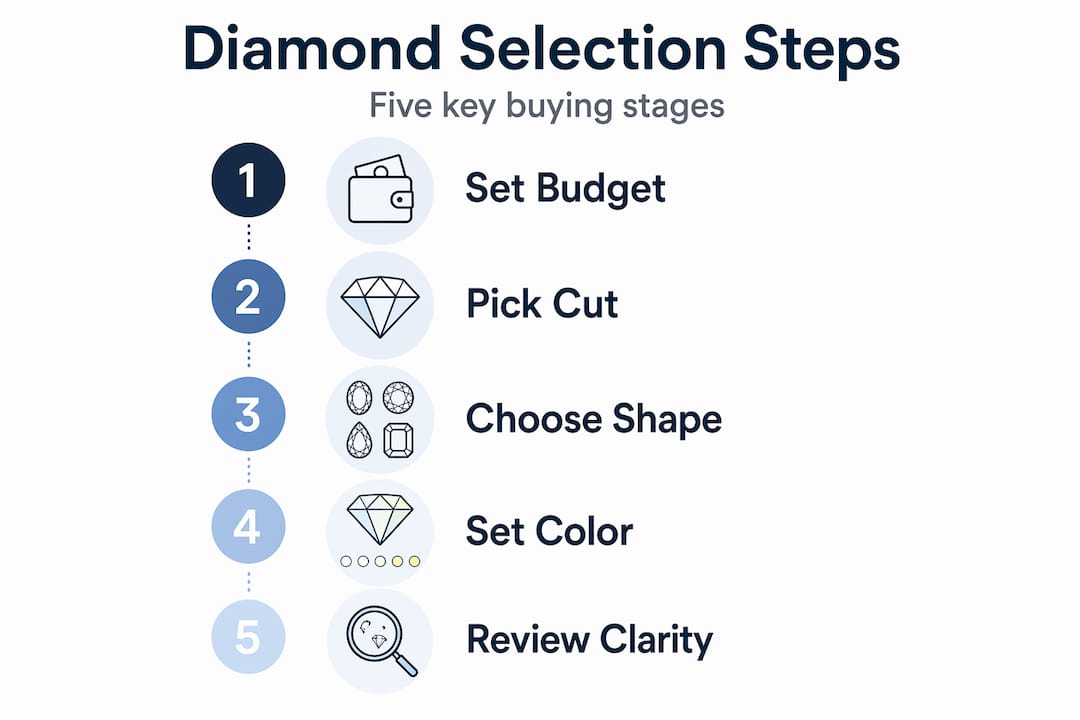
Step 1: Start with cut
Cut quality drives brilliance more than any other factor. A poorly cut two-carat diamond will look dull next to a perfectly cut one-carat stone. For round brilliants, the GIA grades cut from Excellent to Poor. Start by filtering for Excellent or Very Good grades only. For fancy shapes (ovals, cushions, pears), there is no official GIA cut grade, so you rely on proportions, polish, and symmetry ratings listed on the report.
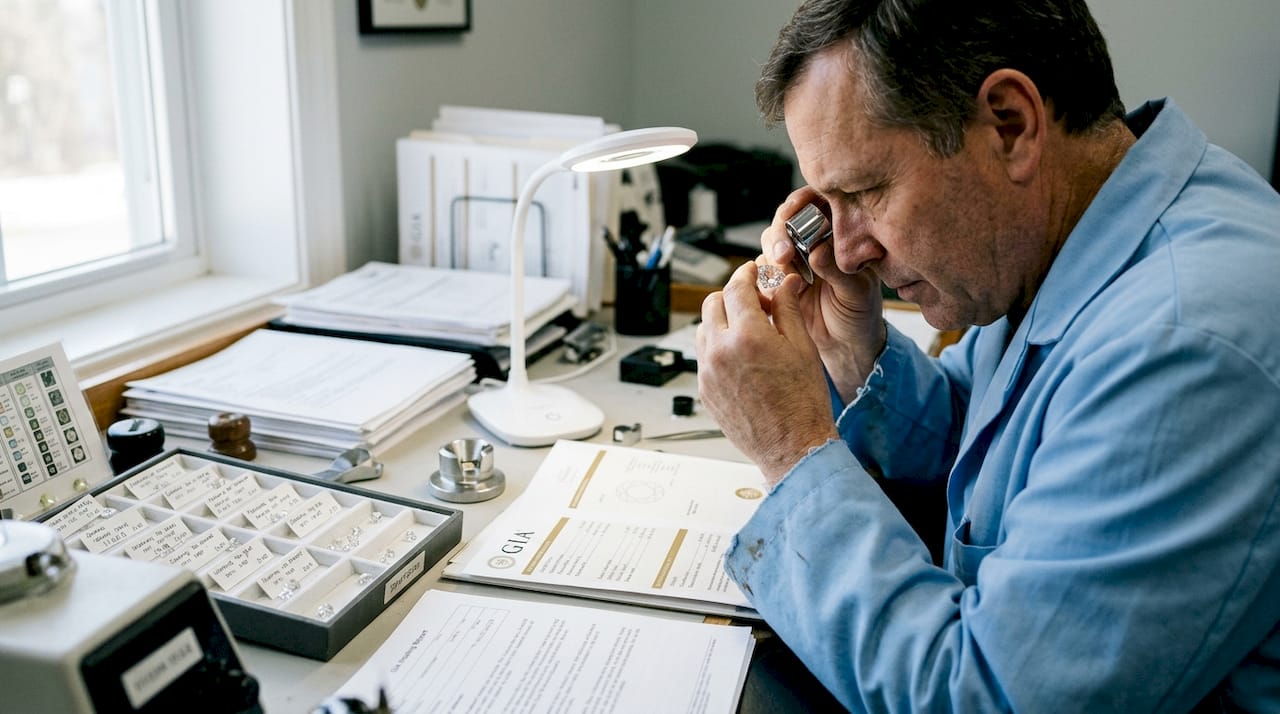
The cut grade on a GIA report is derived from evaluating face-up appearance, design proportions, and craftsmanship. This three-part evaluation is why two stones with the same grade can still look different. Always pair the certificate with video to confirm light performance.
Step 2: Choose your shape
Once you have committed to prioritizing cut quality, choose the shape that fits the aesthetic you want. This decision also determines your next two steps because brilliant and step cuts behave very differently. Brilliant cuts scatter light in many directions and mask inclusions well. Step cuts display a hall-of-mirrors effect that highlights clarity and color, making any flaw more visible. You can explore how shape affects brilliance in more detail before finalizing your choice.
Step 3: Set your color standard
Color grading runs from D (colorless) to Z (light yellow). For brilliant cuts, G through I is the sweet spot. The cut’s sparkle masks any warmth in the stone. For step cuts like emerald or Asscher, you need to move up to F or G because the open facets reveal body color more readily. Yellow gold settings naturally warm a stone, so an H or I color can look white in that metal, saving you money without any visual compromise.
Step 4: Decide on clarity
VS2 to SI1 clarity covers the eye-clean range for most brilliant cut diamonds. Within that range, the stones look identical to flawless under normal viewing conditions. For step cuts, aim for VS2 and above because inclusions are more exposed under those large open facets.
Pro Tip: For any SI1 stone, always request a video or in-person inspection. Some SI1 diamonds are perfectly eye-clean; others have one visible dark crystal that sits right in the center of the table. The grade alone will not tell you which you have.
Step 5: Factor in carat weight last
Price increases exponentially with carat weight because larger diamonds are rarer. But carat measures weight, not size or beauty. A 0.95-carat Excellent cut round will look nearly identical in diameter to a 1.00-carat stone, often at a 15 to 20 percent lower price. Buying just below round numbers (0.90, 0.95, 1.45) is one of the most effective tips for buying diamonds on a budget without visible compromise.
| Factor | Brilliant cuts (round, oval, princess) | Step cuts (emerald, Asscher) |
|---|---|---|
| Color recommendation | G to I | F to G |
| Clarity recommendation | SI1 to VS2 | VS2 to VS1 |
| Cut grade priority | Excellent or Very Good | Excellent proportions, high polish and symmetry |
| Inclusion tolerance | High (sparkle masks flaws) | Low (open facets reveal flaws) |
How to shortlist, verify, and finalize your choice
Narrowing to a shortlist requires discipline. Use this sequence to avoid decision paralysis.
- Filter by cut first. Use Excellent or Very Good cut grades to reduce your pool immediately. This alone eliminates the majority of diamonds from consideration.
- Match your color and clarity ranges to the shape you chose in the previous step. Apply the table above as your starting filter.
- Request inspection footage. For online purchases, ask for a 360-degree video or loupe-level close-up. No reputable seller will refuse this.
- Validate the certificate. Confirm the report number matches what is listed on the stone and check that the diamond’s measurements, fluorescence, polish, and symmetry all match the report.
- Verify the laser inscription. The laser inscription on the girdle is the only physical link between the stone and its GIA report. Confirm it matches using a 10x loupe when the diamond arrives. This step confirms authenticity and prevents fraud.
- Confirm return policy before purchase. A reputable seller offers at minimum a 30-day return window with no-questions-asked exchanges.
When buying lab-grown diamonds, the same process applies. Certification is equally important, and lab-grown diamond guides can help you understand grading differences specific to lab stones.
Pro Tip: When comparing prices online, use smart comparison methods to check whether an apparent deal reflects actual value or just a weaker clarity or cut grade buried in the listing details.
A structured online purchase process that includes setting your budget, filtering by cut, validating the certificate, and confirming inspection rights on receipt minimizes virtually all the risks that make buyers nervous about buying diamonds online.
Common mistakes during diamond selection
Even informed buyers fall into predictable traps. Here is where the diamond selection process breaks down most often.
- Prioritizing carat over cut. A large diamond with a Poor or Fair cut grade looks smaller and duller than a smaller diamond with an Excellent cut. You are paying for weight, not beauty.
- Skipping inscription verification. A certificate without inscription matching is no protection at all. The report could belong to a different stone entirely.
- Trusting grade alone over visual appraisal. Certificates do not capture naked-eye beauty. Two VS2 diamonds can look completely different depending on where inclusions sit and how the cut handles light.
- Ignoring the setting’s effect. Bezel settings hide edge inclusions that would otherwise require a higher clarity grade. Buying a higher clarity grade for a stone that will sit in a bezel setting wastes money.
- Overlooking return rights. Always confirm the seller’s return and exchange policy in writing before paying. A no-return policy on a diamond purchase is a red flag.
“The biggest mistake buyers make is treating the grading report as the final word on beauty. The certificate tells you what the stone is. Your eyes tell you whether you love it.”
Pro Tip: If a diamond you receive does not match its certificate or appears to have visible inclusions that were not disclosed, document it with photos before contacting the seller. Most reputable retailers resolve this quickly when you have clear evidence.
What to expect after making your choice
When you follow a disciplined diamond selection checklist, the outcome is confidence, not just a piece of jewelry. A well-cut diamond in the VS2 to SI1 clarity range, graded G to I in color, will look stunning in person and remain beautiful under daily wear.
The most critical factor for daily visual experience is still cut quality. In every lighting environment, a well-cut stone returns light to your eye in a way that a higher-clarity, lower-cut stone cannot match.
A smaller, well-cut diamond outperforms a larger, poorly cut one in every lighting condition you will actually encounter: restaurant candlelight, office fluorescents, and sunlight.
The trade-offs you made using this process were intentional and informed. That is fundamentally different from making compromises out of confusion. You can verify your stone’s authenticity, understand its characteristics, and compare it to its grading report with confidence.
My take on buying diamonds beyond the 4Cs
I have reviewed hundreds of diamonds, and the single most under-appreciated factor is cut. Buyers obsess over color and clarity grades, spending real money chasing a VS1 over a VS2, when the cut is Fair or Good. The difference is invisible. The cut difference is not.
My practical advice: start every search by filtering for Excellent cut and never compromise on it. Then use color and clarity to fine-tune your budget. The role of cut in diamond quality is not theoretical. You can see it immediately when you compare two stones side by side.
I also think buyers underestimate how much shape changes the rules. Step cuts are beautiful, but they demand stricter color and clarity standards. If your budget is tighter, a round brilliant is the most forgiving choice because it tolerates lower clarity and color grades while still delivering extraordinary sparkle.
Finally, trust your eyes. The certificate is a reference document, not a beauty score. After you have done the work of verifying cut, color, clarity, and certification, let your visual reaction be the final vote.
— Andrew
Find your perfect diamond at Superjeweler
Following this guide gets you to the right specifications. Superjeweler helps you find the stone that actually meets them. Their certified engagement ring collection spans a wide range of cuts, shapes, and price points, with detailed product information that supports the verification steps covered here.
If budget is a priority, Superjeweler’s selection of affordable diamond rings includes real, certified diamonds under $1,000. For buyers interested in lab-grown options, Superjeweler carries an extensive range of lab-grown diamond rings at exceptional value. Free worldwide shipping, flexible return policies, and expert customer service make it straightforward to buy with the confidence this guide is designed to give you.
FAQ
What does “eye-clean” mean in diamond grading?
An eye-clean diamond shows no visible inclusions to the naked eye at a normal viewing distance of about 10 to 12 inches. VS2 and SI1 grades are typically eye-clean in brilliant cut diamonds, though SI1 stones should always be visually confirmed before purchase.
Which diamond quality factor matters most?
Cut quality has the greatest impact on how beautiful a diamond looks. A poorly cut diamond with high clarity and color grades will look less brilliant than a well-cut stone with moderate grades.
How do I verify a diamond is authentic?
Match the laser inscription on the diamond’s girdle to the GIA report number using a 10x loupe. This is the only reliable physical proof that the stone in your hand corresponds to the certificate you received.
Is it safe to buy diamonds online?
Yes, when you follow a structured process: confirm the GIA certificate, request video footage of the stone, verify the inscription on arrival, and purchase only from sellers with a clear return policy.
Should I buy a natural diamond or a lab-grown diamond?
Both are real diamonds with identical physical and optical properties. Lab-grown diamonds typically cost significantly less per carat. The choice depends on your values and budget, not on diamond quality.
Recommended
- How to verify diamond quality: a step-by-step guide 2026
- Step-by-step engagement ring buying guide for couples
- Step-by-Step Guide to Buying Lab-Grown Diamonds Online
- How to Choose an Engagement Ring Step by Step Easily
