Clearance jewelry is inventory a retailer wants to move, usually to make room for new styles, and it can be a genuinely good buy when you check four things first: the real price history, the metal and stones, the paperwork, and the return terms. A markdown tells you what the seller wants. It tells you nothing about the quality of the piece. This guide shows you how to judge that quality yourself.
TL;DR
- Clearance usually means discontinued, overstocked, seasonal or older-collection pieces. It does not automatically mean flawed.
- Be wary of permanent “50% off” claims. The sale price may simply be the normal price elsewhere.
- Before paying, confirm the metal stamp, whether each stone is natural, lab-grown or imitation, and whether it has been treated.
- Read the return, warranty and final-sale terms first. Clearance policies are often tighter than regular ones.
- Ask for an itemized receipt and, for significant stones, an independent lab report.
Table of Contents
- In this guide
- What clearance jewelry actually is
- Why jewelry gets marked down
- How to tell a real discount from a fake one
- The quality checklist: metal, stones, craftsmanship, condition
- Fine jewelry versus fashion jewelry
- Return, exchange and warranty terms
- When to buy clearance
- Our perspective
- Shopping our clearance sale
- A quick pre-purchase checklist
- FAQ
- Sources
In this guide
- What clearance jewelry actually is
- Why jewelry gets marked down
- How to tell a real discount from a fake one
- The quality checklist: metal, stones, craftsmanship, condition
- Fine jewelry versus fashion jewelry
- Return, exchange and warranty terms
- When to buy clearance
- Our perspective
- Shopping our clearance sale
- FAQ
- Sources
What clearance jewelry actually is
Clearance is the last stop for a product in a retailer’s assortment. The piece may be discontinued, left over from a seasonal run, overstocked, or part of an older collection the store is replacing. In most cases the jewelry itself is perfectly sound. The store simply needs the shelf space, the cash, or both.
That is different from a regular sale. A regular sale discounts items that stay in the line and will return to full price. Clearance discounts items that are leaving. The difference matters in three ways:
- Selection is limited. Once a size, stone shape or metal is gone, it is usually gone for good.
- Prices tend to fall in steps. Markdowns often deepen over time if a piece does not sell.
- Terms can be stricter. Final-sale labels are more common on clearance than on full-price items.
Fine-jewelry retailers have long handled this on a schedule. JCK reported that one U.S. retailer moved pieces that had sat unsold for roughly one to 18 months through retirement-case markdowns, starting at an average of 30% off and cutting further if needed. The takeaway for you: a first markdown of around a third is ordinary inventory management, not a sign of trouble.
Why jewelry gets marked down
Knowing the reason behind a markdown helps you judge whether the piece suits you. These are the most common causes:
- Discontinued designs. A manufacturer or designer stops a style. Remaining units are cleared.
- Seasonal inventory. Holiday, Valentine’s Day or Mother’s Day collections often get discounted once the occasion passes.
- Overstock. A retailer bought more of a style than it sold.
- Collection changes. New metals, stone cuts or trends replace older ones.
- Single or odd pieces. One earring pair left in a finish, or a ring in a size that rarely sells.
- Display or return stock. Occasionally a piece has been handled. This should be disclosed, so ask.
None of the first five say anything about durability or materials. A discontinued 14k gold necklace is the same 14k gold necklace it was last season. That is the opportunity in clearance: the same quality at a lower price, if you verify what you are buying.
How to tell a real discount from a fake one
A percentage on a tag is only as meaningful as the price it is measured against. Jewelers of America advises shoppers to be cautious about retailers that constantly advertise very deep discounts, noting that a discount of 50% or more may actually reflect the average retail price elsewhere. In other words, the “original price” may be inflated.
Use these tests before you trust a markdown:
- Compare the exact piece, not a similar one. Match metal type and karat, stone type, size, shape and quality grade. A lower price on a lower-grade stone is not a discount.
- Check the price over time. If the “was” price has been the same on the product page for months and nothing ever sells at it, treat it with suspicion.
- Look for permanent sales. A store that is always 60% off is really selling at its everyday price.
- Price the materials. For gold, the metal weight and karat set a baseline. For diamonds and colored stones, a comparable stone with a lab report gives you a yardstick.
- Ask what the percentage is off. Retail list price, a previous price, or a competitor’s price are three very different things.
If a clearance price is real, you should be able to explain it: the style is discontinued, the season is over, the stock is overstocked. If you cannot explain the discount, slow down.
The quality checklist: metal, stones, craftsmanship, condition
Clearance should never mean skipping due diligence. The same checklist that applies to full-price jewelry applies here, and a few items matter even more.
Metal
The Federal Trade Commission’s buying guide tells shoppers to check metal markings and make sure the receipt records the details they relied on. GIA likewise recommends looking for the maker’s mark and the metal-quality stamp. In practice:
- Find the karat stamp (10k, 14k, 18k) or a fineness mark such as 925 for sterling silver or PT or 950 for platinum.
- Look for a maker’s or manufacturer’s mark near the stamp.
- Confirm the product description states the metal and karat in words, not only in the stamp.
- Ask whether the piece is solid, plated or filled. Plated and filled items are priced differently and wear differently.
Stones
The FTC guide advises asking whether gemstones are natural, laboratory-created or imitation, and whether they have been treated. Treatments such as heating or fracture filling are common in colored gemstones and affect value and care. A clearance listing should say what it is.

For diamonds, the 4Cs (cut, color, clarity, carat) are your pricing language. If you are weighing diamonds on markdown, our guide to judging clearance diamond quality walks through what to look at. If the stone is lab-grown, our breakdown of color grades for lab diamonds helps you avoid paying for a grade you cannot see. Fluorescence can also shift price, and we cover when it matters in this fluorescence pros and cons guide.
For a significant stone, GIA suggests requesting an independent laboratory report. If you are buying lab-grown, see how the major labs compare in our piece on lab-grown diamond certification.
Craftsmanship and condition
GIA also recommends examining the stones and the metal for damage. With clearance, whether you are in a store or looking at photos, check these points:
- Prongs and settings. Prongs should be even and hold the stone snugly, with no gaps.
- Clasps and hinges. Bracelets and necklaces should open, close and lock firmly.
- Solder joints and seams. Look for rough or discolored joints.
- Surface. Scratches are normal on handled display pieces but should be disclosed.
- Stone alignment. Matched stones in earrings should look alike in color and size.
- Fit. Check whether a ring can be resized. Some designs, such as full eternity bands or certain tension settings, are hard to resize, which matters when clearance leaves you with a limited size range.
When you buy online, look for multiple clear photos, a complete spec list and a seller who answers questions before you pay.
Fine jewelry versus fashion jewelry
The same markdown means different things depending on what the piece is made of. Here is how to adjust your checks:
| Check | Fine jewelry (gold, platinum, diamonds, gemstones) | Fashion jewelry (base metals, plating, glass or synthetic stones) |
|---|---|---|
| Main value driver | Metal weight, karat, stone quality | Design and trend |
| What to verify | Karat or fineness stamp, stone identity and treatment, lab report for significant stones | Base metal, plating type, nickel-free claims if you have sensitive skin |
| Typical lifespan | Decades with care, and it can be repaired or resized | Often limited, as plating wears down |
| Is a deep discount reasonable? | Yes if the reason is clear and the specs match comparable pieces | More often, since the item has little material value |
| Paperwork worth asking for | Itemized receipt, lab report, warranty terms | Receipt and return terms |
The practical rule: the more a piece costs, the more documentation you should expect. A fashion earring at a low price needs only a sensible return policy. A diamond ring on clearance needs a receipt that lists the metal, karat, stone details and weight, and ideally a grading report.
If you are comparing new clearance against pre-owned, it also helps to know the vocabulary. Our guide to estate jewelry versus vintage explains how those terms are used.
Return, exchange and warranty terms
This is where clearance purchases most often go wrong. Clearance is frequently labeled final sale, which can mean returns, exchanges or store credit are limited or not allowed at all. That does not mean something is wrong with the piece. It means the retailer wants it gone and is not taking it back. You are carrying more of the risk, so confirm the terms before you pay.
The Better Business Bureau advises you to read the refund, warranty and guarantee policies carefully, including how long you have to return the item. For online orders, the FTC adds that you should research the company, review its refund and return policies, and look for a street address or phone number.
Before you click buy, answer these questions:
- Is the item final sale, or can it be returned? For how many days?
- Who pays return shipping, and is the item insured in transit?
- Are refunds issued to the original payment method, or only as store credit?
- Does a warranty or lifetime guarantee apply to clearance items, and what does it cover?
- Can the piece be resized or repaired, and at what cost?
- Will the receipt itemize the metal, karat, stone type, treatment status and weight?
Jewelers of America also recommends checking return policies, warranties, credentials, itemized receipts and independent lab reports for diamonds or colored gemstones. Screenshot or save the product page and the policy text at the time of purchase.
If you plan to pay over time, read the terms closely. Our guide on jewelry layaway plans lists four terms to check. And if you are ordering across borders, see international jewelry shipping for packing, insurance and customs.
When to buy clearance
Clearance runs on retail rhythms. Holiday and seasonal collections tend to be marked down after the occasion. Year-end and early-year periods often bring inventory clearing as stores reset assortments. Big shopping events can also surface deep markdowns, though that is where the “was” price deserves the most scrutiny. We compare the calendar in detail in our guide to the best time to buy jewelry in the U.S..
Some tactics that help:
- Know what you want first. Decide on metal, stone, budget and size before browsing. Clearance rewards focused shoppers.
- Shop early for popular sizes. Common ring sizes sell out first.
- Do not buy a gift you cannot return unless you are sure of size and taste. If it is a final-sale piece, choose items that are easy to wear for anyone, such as studs, tennis bracelets or chain necklaces.
- Compare two or three comparable pieces. A quick spec comparison takes minutes and shows whether the markdown is real.
Our perspective
Clearance is the part of jewelry shopping where knowledge pays off the most. The same 14k gold and the same diamond can be priced very differently depending only on where the piece sits in a retailer’s calendar. That is the real opportunity.
We built SuperJeweler around lower prices by sourcing directly and passing savings on, so our clearance section follows the same idea: pieces from our selection that we want to move, priced to move, with the specs listed so you can compare. We back our jewelry with a lifetime guarantee and a 60-day money-back guarantee, and we ship free worldwide. Terms can differ by item, so we encourage you to read the details on each product page before you check out.
Our advice is simple. Decide what you want, compare the specs, check the paperwork, and then let the markdown do its work. A good clearance purchase is one you would be happy to make at the full price, and are happy to get for less.
Andrew
Shopping our clearance sale
If you want to put this checklist to use, our Clearance Sale collects discounted pieces from across our selection, so you can browse markdowns in one place and compare their listed specifications.
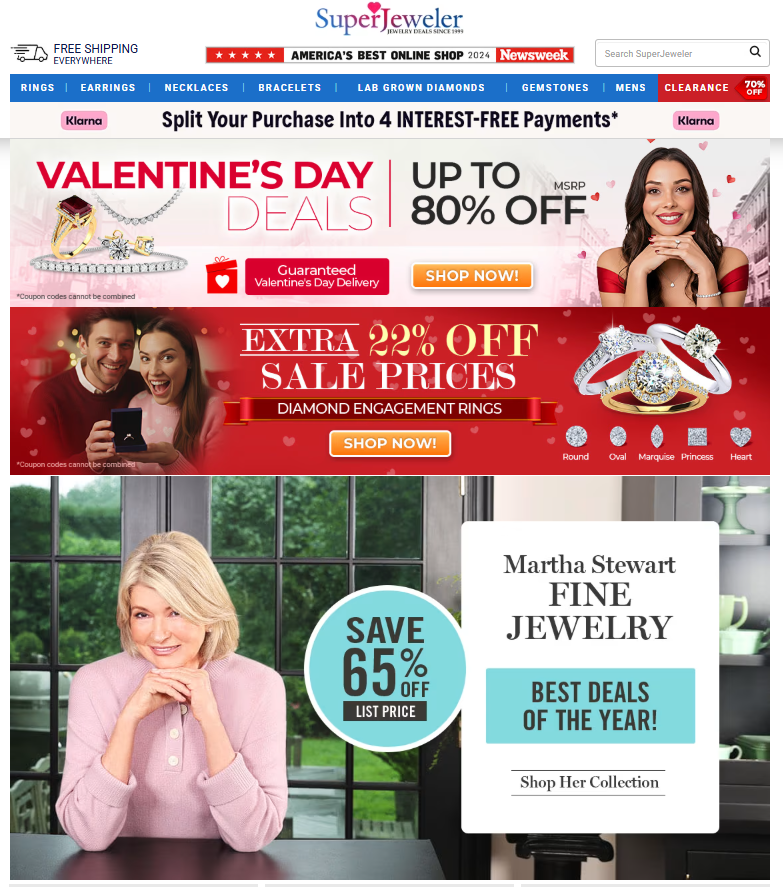
You can also narrow your search by category if you already know what you want: rings, wedding bands, earrings, necklaces and bracelets. If you prefer gemstones, our gemstone jewelry collection is a good starting point, and our lab-grown diamonds offer another way to get larger or higher-grade stones for the budget. If you are weighing colored stones, our overview of the advantages of gemstone jewelry explains what to expect from them.
Start at SuperJeweler and browse with your checklist in hand.
A quick pre-purchase checklist
Print it or save it to your phone:
- The listing names the metal and karat, and the piece carries a matching stamp.
- Stones are identified as natural, lab-grown or imitation, with treatments disclosed.
- Weight and dimensions are listed, and match comparable pieces.
- A lab report is available for any significant diamond or colored stone.
- The return window, final-sale status and warranty are clear in writing.
- The receipt will itemize everything you relied on when buying.
- The seller has a physical address or phone number and reachable customer service.
- The discount makes sense: you can explain why this piece is on clearance.
FAQ
Is clearance jewelry lower quality?
Not by default. Clearance jewelry is usually discontinued, overstocked, seasonal or from an older collection, and the reason is about inventory rather than materials. Quality varies by piece, so check the metal stamp, the stone details and the condition the same way you would at full price.
Can you return clearance jewelry?
Sometimes, but many clearance items are designated final sale, which can limit or rule out returns, exchanges and store credit. Read the policy on the product page and the checkout terms before paying, and confirm how long the return window lasts if one exists.
How do I know if a clearance discount is real?
Compare the exact specifications with similar pieces elsewhere and be cautious of constant, very deep discounts. Jewelers of America notes that a markdown of 50% or more can simply match the typical retail price. If you can explain why the item is discounted, the deal is more likely to be genuine.
Should I ask for a lab report on a clearance diamond?
For any significant diamond or colored gemstone, yes. GIA recommends requesting an independent laboratory report, and Jewelers of America lists it among the documents to check. A report confirms what the stone is and its grades, so you can compare price against quality fairly.
Is clearance a good time to buy an engagement ring?
It can be, if you find the right setting and stone and the terms are clear. Because clearance stock is limited and may be final sale, make sure of the ring size, the style and the specs before buying, and keep the itemized receipt and any lab report.
Sources
- Jewelry Shopping FAQs, Jewelers of America
- All That Glitters… How to Buy Jewelry, U.S. Federal Trade Commission
- Ten Tips for Buying Jewelry, GIA
- BBB Tip: Buying and selling jewelry, Better Business Bureau
- Out With the Old, In With the New Inventory, JCK
Recommended
- Clearance Diamonds: How to Judge Quality Before You Buy
- Best Time to Buy Jewelry in the U.S.: January to May or Black Friday?
- Jewelry Layaway Plans: 4 Terms Shoppers Should Check Before Paying
- Size or Sparkle: How Buyers Choose Between Oval and Round Diamonds
