TL;DR:
- Clarity measures internal inclusions and external blemishes affecting a gemstone’s appearance.
- Higher clarity grades increase price but often do not impact visual beauty for most buyers.
- Understanding gemstone-specific clarity standards helps select the best stone for style and budget.
Most people assume that a higher clarity grade automatically means a more beautiful gem. That’s not quite right. Two stones sitting side by side can have different clarity grades and look completely identical to the naked eye. Clarity is one of the most misunderstood factors in jewelry buying, and chasing a perfect grade can cost you thousands of dollars you didn’t need to spend. Understanding what clarity actually means, how it varies across gem types, and when it truly matters will help you shop smarter, get more for your budget, and walk away with a piece you’ll love for a lifetime.
Table of Contents
- What is gemstone clarity?
- How clarity affects the beauty and value of gems
- Comparing clarity across different gemstones
- Using clarity to select the right jewelry
- Our take: The overlooked art of clarity in real-life jewelry choices
- Find your perfect gemstone: Shop by clarity, color, and style
- Frequently asked questions
Key Takeaways
| Point | Details |
|---|---|
| Clarity defined | Clarity measures the absence of inclusions and blemishes in gemstones. |
| Value implications | Higher clarity can raise prices, but eye-clean gems offer the best value. |
| Different standards | Clarity importance varies; diamonds are judged more strictly than colored stones. |
| Practical buying tips | You can save by focusing on clarity only where it visually matters most. |
What is gemstone clarity?
Before you can use clarity as a shopping tool, you need to know what it actually measures. Gemstone clarity refers to the presence and visibility of internal inclusions and external blemishes within a stone. Think of it as a window into the gem’s natural history.
Inclusions are internal features formed during the gem’s growth process. These can be tiny crystals trapped inside, small fractures called feathers, or cloudy patches called clouds. Blemishes, on the other hand, are surface irregularities such as scratches, nicks, or pits. Both affect how light travels through a stone, though their impact varies widely depending on size, location, and type.
For diamonds, the Gemological Institute of America (GIA) uses a standardized clarity scale:
| Clarity grade | Description |
|---|---|
| FL / IF | Flawless / Internally Flawless |
| VVS1 / VVS2 | Very Very Slightly Included |
| VS1 / VS2 | Very Slightly Included |
| SI1 / SI2 | Slightly Included |
| I1 / I2 / I3 | Included (visible to naked eye) |
Colored gemstones use a different approach. The GIA groups them into three clarity types. Type I stones (like aquamarine and topaz) are expected to be nearly inclusion-free. Type II stones (like sapphires and rubies) typically have some inclusions. Type III stones (like emeralds) almost always contain visible inclusions and are graded accordingly.
Common inclusions you might encounter include:
- Needles: Thin, elongated mineral crystals
- Pinpoints: Tiny white or black dots
- Feathers: Small fractures that resemble a feather shape
- Clouds: Groups of tiny inclusions that create a hazy area
- Crystals: Mineral particles trapped during growth
Pro Tip: A stone graded VS2 by a certified lab is almost always eye-clean, meaning you won’t see inclusions without magnification. For most buyers, this grade offers excellent beauty at a noticeably lower price than VVS or flawless grades.
For a deeper look at how these grades are assigned, the diamond grading guide breaks down the full evaluation process step by step.
How clarity affects the beauty and value of gems
Now that you know what clarity means, let’s see how it actually affects what you’ll see and what you’ll pay.
Clarity plays a direct role in how a gem handles light. Inclusions can interrupt the path of light as it bounces inside the stone, reducing brilliance (the white light return) and scintillation (the sparkle you see when the stone moves). A heavily included stone may look dull or lifeless compared to a cleaner one. However, the key word is “heavily.” Minor inclusions that sit outside the stone’s center or are masked by the setting rarely affect visual performance at all.
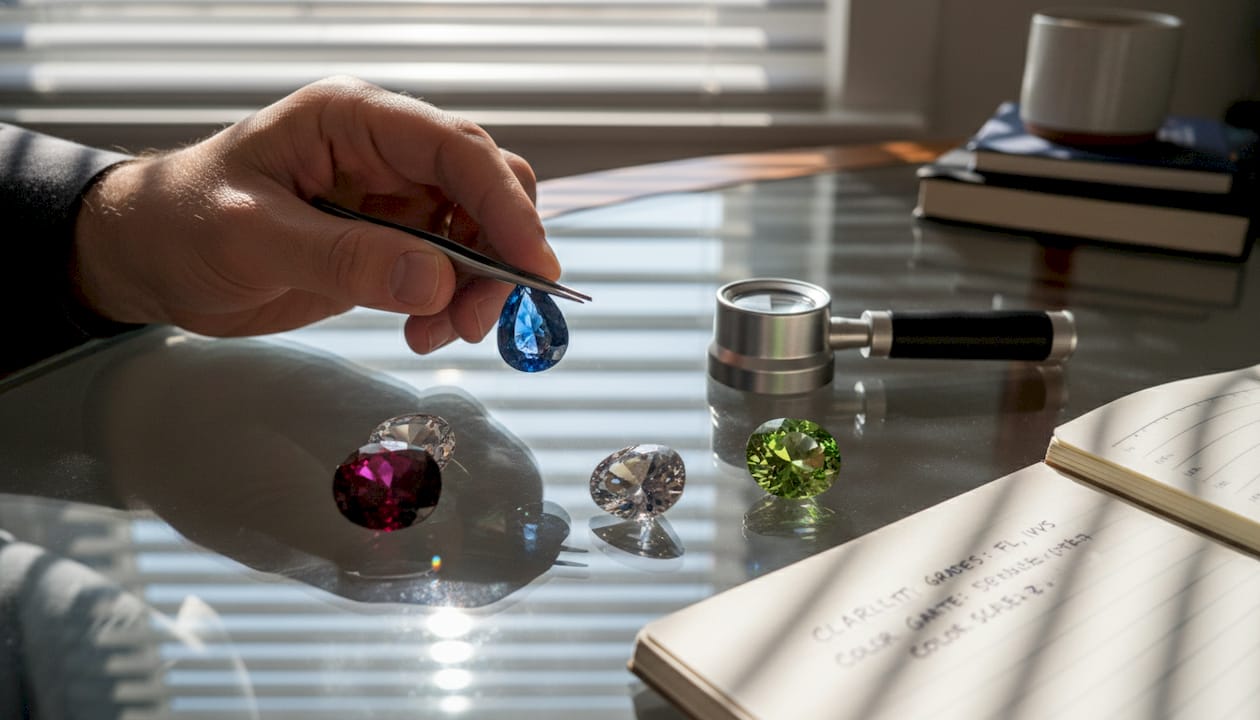
Clarity can significantly impact a gemstone’s market value and perceived brilliance. The price difference between grades can be dramatic. Moving from a VS1 to a VVS1 diamond of the same carat and cut can add 15 to 25 percent to the price, even though most people cannot tell them apart without a loupe.
Here’s a quick comparison of how clarity grades translate into real-world impact:
| Clarity grade | Visible to naked eye? | Price impact | Best for |
|---|---|---|---|
| FL / IF | No | Very high premium | Collectors, investment pieces |
| VVS1 / VVS2 | No | High premium | Those who want near-perfection |
| VS1 / VS2 | No | Moderate | Best value for most buyers |
| SI1 | Rarely | Lower | Budget-conscious buyers |
| SI2 / I1 | Sometimes / Yes | Lowest | Fashion jewelry, non-center stones |
Here’s how to think about when clarity should be your top priority:
- Solitaire settings: The stone is fully exposed, so inclusions are easier to spot.
- Step-cut diamonds (emerald cut, Asscher cut): These cuts have large, open facets that act like windows into the stone, making inclusions more visible.
- High-transparency colored stones: Aquamarine and white topaz show inclusions more readily than opaque or deeply colored gems.
- Investment or heirloom pieces: If the piece is meant to hold long-term value, higher clarity adds to resale potential.
Pro Tip: Brilliant-cut diamonds (like round or cushion cuts) hide inclusions better than step cuts because their facet pattern creates more light scatter. If you’re working with a tighter budget, a brilliant cut at SI1 can look just as stunning as a VS2 step cut at a much lower price. Explore your options among gemstone rings to see how cut and clarity interact across styles.
Comparing clarity across different gemstones
Clarity doesn’t mean the same thing for every stone. Let’s compare the standards across the most popular types.
Diamonds are judged under 10x magnification by trained graders, and the scale is strict. A single pinpoint inclusion can drop a diamond from IF to VVS1. This level of scrutiny makes sense because diamonds are colorless or near-colorless, meaning there’s nothing to distract the eye from an inclusion.
Colored gemstones are evaluated differently. Some colored gemstones, like emeralds, nearly always have inclusions, and transparency and saturation may matter more than flawless clarity. In fact, the French term jardin (meaning garden) is used affectionately to describe the internal landscape of an emerald. A perfectly clean emerald is actually so rare that it can command a higher price per carat than a flawless diamond.
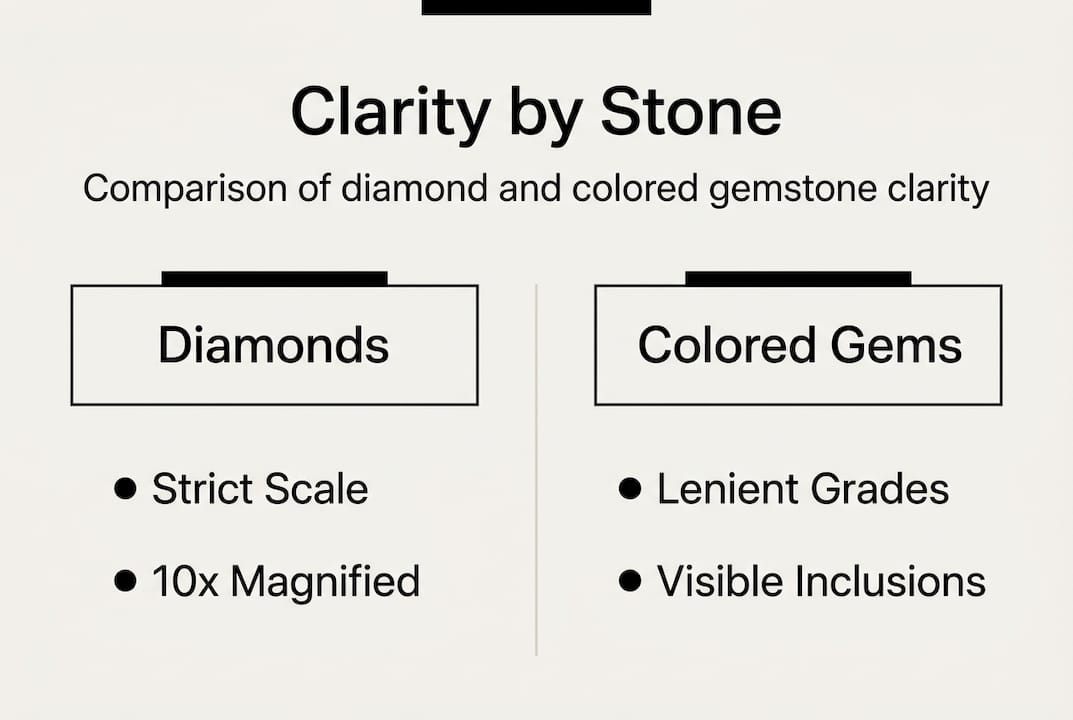
Here’s how clarity priorities shift by gem type:
| Gemstone | Clarity expectation | What matters more |
|---|---|---|
| Diamond | Very strict | Clarity and cut |
| Sapphire | Moderate | Color and saturation |
| Ruby | Moderate | Color depth and hue |
| Emerald | Lenient | Transparency and color |
| Aquamarine | Strict | Clarity and color |
| Tanzanite | Moderate | Color and pleochroism |
“An included emerald with rich green color and good transparency is far more desirable than a cleaner stone with weak, washed-out color.”
Key takeaways by gem type:
- Rubies and sapphires: Color is king. A vivid, saturated ruby with minor inclusions outperforms a pale, clean stone every time.
- Emeralds: Expect inclusions. Focus on color richness and how transparent the stone looks face-up.
- Aquamarine and blue topaz: These Type I stones should be eye-clean. Inclusions here are a red flag.
- Tanzanite: Look for strong blue-violet color. Minor inclusions are acceptable if color is exceptional.
If you’re drawn to blue gemstones like sapphire or aquamarine, clarity expectations differ significantly between the two. Similarly, pink gemstones like morganite and pink sapphire each carry their own clarity norms. You’ll find a wide range of options in gemstone earrings and gemstone necklaces that showcase these differences beautifully.
Using clarity to select the right jewelry
With these differences in mind, here’s how you can use clarity as a practical tool to get the jewelry that’s right for you.
Shopping for a gem based on clarity alone is like buying a car based only on horsepower. It’s one important factor, but it works together with cut, color, carat weight, and setting to create the full picture. Here’s a step-by-step approach:
- Set your priority: Is this an engagement ring center stone, a fashion piece, or a gift? The stakes for clarity are higher for a solitaire engagement ring than for a side stone or pendant.
- Choose your gem type first: Once you know the gem, you know the clarity expectations. Don’t apply diamond standards to an emerald.
- Go eye-clean as your baseline: For most buyers, a stone that shows no inclusions to the naked eye is the sweet spot. You get the look of a flawless stone without the premium price.
- Consider the setting: Bezel and halo settings can mask inclusions near the girdle (the outer edge of the stone). Prong settings leave more of the stone exposed.
- Review in natural light: Always look at a stone in daylight or near a window, not just under bright store lighting, which flatters every gem.
Buyers can save significantly by understanding when flawless clarity is unnecessary for the setting or wearer’s needs. A VS2 diamond in a halo setting, for example, looks identical to a VVS1 in the same setting, but the price difference can be hundreds or even thousands of dollars.
Pro Tip: If you’re shopping for a round brilliant diamond, an SI1 grade is often the best value. The cut’s facet pattern hides most inclusions naturally. For step cuts, move up to VS2 or VS1 for peace of mind.
For buyers exploring lab grown diamond jewelry, clarity grades are assigned using the same GIA scale as natural diamonds, so all the same rules apply. You can also browse shopping gemstone rings to compare clarity options across a wide range of styles and budgets.
Our take: The overlooked art of clarity in real-life jewelry choices
Here’s something the industry doesn’t say loudly enough: a clarity grade on paper is not the same as the beauty of a gem on your hand.
We’ve seen buyers spend hours agonizing over the difference between a VVS2 and a VS1, only to hold both stones under natural light and admit they look identical. The grade exists for graders, not for wearers. What matters in real life is how the stone looks in the lighting you actually live in, whether that’s your office, a restaurant, or a sunny afternoon outside.
Our honest advice? Stop chasing perfection on the certificate. Instead, spend that extra budget on a better cut or a larger carat weight. A well-cut VS2 diamond will outshine a poorly cut VVS1 every single time because cut controls how light moves through the stone.
We also think buyers underestimate how much the setting does the work. A thoughtfully designed piece can make an SI1 stone look like it belongs in a museum. If you want inspiration for how design and gemstone choice come together beautifully, affordable gemstone gifts show just how stunning well-chosen stones can be at every price point. Trust your eyes, not just the numbers.
Find your perfect gemstone: Shop by clarity, color, and style
Ready to put your clarity knowledge to work? Here’s where to start your search.
At SuperJeweler, we make it easy to find stunning jewelry across a full range of clarity grades and budgets. Whether you’re looking for a brilliant solitaire or a colorful gemstone centerpiece, you’ll find options that match your priorities.

Browse our selection of cheap engagement rings to find eye-clean diamonds at prices that leave room for the rest of your celebration. If you want the clarity benefits of a lab-created stone, our lab grown diamonds collection offers exceptional grades at a fraction of the cost of mined diamonds. And if color is calling you, explore gemstone rings to see how sapphires, emeralds, rubies, and more look across a spectrum of clarity and color combinations.
Frequently asked questions
What does clarity mean for gemstones?
Gemstone clarity means how free a stone is from visible inclusions or blemishes, both of which can affect appearance and market value.
Is higher clarity always better when buying an engagement ring?
Not necessarily. Inclusions invisible to the naked eye rarely affect beauty, so paying a premium for top clarity grades is often unnecessary for most buyers.
Which gemstones have the strictest clarity standards?
Diamonds are held to the strictest standards. Emeralds usually have inclusions and are judged far more leniently than diamonds on clarity.
How do I balance clarity with color and cut when selecting a gemstone?
Start by avoiding eye-visible inclusions, then balance clarity, color, and cut to find the combination that delivers the best overall look and value for your budget.
Are lab grown diamonds different from natural diamonds in terms of clarity?
Lab grown diamonds offer higher clarity more affordably because the controlled growth process produces fewer inclusions than natural formation underground.
Recommended
- Gemstone Rings | SuperJeweler
- How to verify diamond quality: a step-by-step guide 2026
- How to verify diamond authenticity: guide for buyers
- Diamond grading explained: your guide to quality and value
