Buying a diamond ring is one of the most emotionally charged purchases you’ll ever make. The moment doubt creeps in about whether that sparkling stone is genuine, the joy can quickly turn to anxiety. Counterfeits and misrepresented stones are real concerns, and with diamond prices ranging from hundreds to tens of thousands of dollars, the stakes couldn’t be higher. This guide walks you through every verification method available, from reading a grading certificate to running quick at-home checks, so you can shop with total confidence and zero second-guessing.
Table of Contents
- Understanding diamond types and authenticity risks
- Essential tools and requirements for diamond verification
- Step-by-step: How to verify diamond authenticity
- Troubleshooting and avoiding common mistakes
- What most buyers overlook in diamond verification
- Find authentic diamond jewelry with confidence
- Frequently asked questions
Key Takeaways
| Point | Details |
|---|---|
| Lab reports are essential | Always request and verify a grading report from trusted labs for the most reliable diamond authenticity check. |
| Use multiple methods | Combine certification, inscriptions, tester tools, and home checks for best results. |
| Watch for red flags | Beware missing certificates, unclear seller info, and reluctance to let you test the stone. |
| Home tests have limits | At-home methods can help spot obvious fakes but aren’t foolproof for simulants or lab-grown diamonds. |
| Small stones need extra care | Small diamonds are less likely to be certified, so rely on multi-step verification. |
Understanding diamond types and authenticity risks
Before you can verify anything, you need to know exactly what you’re verifying. Not every sparkling stone in a jewelry store is a diamond, and not every diamond is the same type. There are three main categories buyers encounter.
Natural diamonds form deep in the earth over billions of years. Lab-grown diamonds are created in controlled environments but are chemically identical to natural diamonds, while simulants like cubic zirconia and moissanite are not diamonds at all. Knowing this distinction matters enormously when you’re trying to verify what you’ve bought or what you’re about to buy.
You can explore lab grown diamond jewelry as a legitimate and increasingly popular option, but the key is always knowing what you’re purchasing upfront. A deeper look at lab vs natural diamonds can help clarify the differences in origin, value, and certification requirements.
Here’s a quick comparison of the three main stone types:
| Stone type | Real diamond? | Certified? | Common use |
|---|---|---|---|
| Natural diamond | Yes | Usually | Engagement rings, fine jewelry |
| Lab-grown diamond | Yes | Often | Engagement rings, fashion jewelry |
| Cubic zirconia | No | Rarely | Fashion, costume jewelry |
| Moissanite | No | Sometimes | Budget engagement alternatives |
The most common risks buyers face include receiving a simulant sold as a natural diamond, buying a stone with inflated quality claims, or purchasing without any grading documentation. Watch for these warning signs:
- Vague or evasive answers from the seller about the stone’s origin
- No grading certificate or only a store-issued appraisal
- Pricing that seems too good for the stated carat weight and quality
- Reluctance to allow independent testing
Pro Tip: An appraisal from a jeweler is not the same as a grading report from an independent lab. Appraisals assign monetary value; grading reports confirm what the stone actually is.
Certificates matter most because they come from neutral third parties with no financial stake in the sale. Without one, you’re essentially taking the seller’s word for it.
Essential tools and requirements for diamond verification
Once you understand what you’re looking for, it’s time to gather the right tools. Verification isn’t a single step. It’s a layered process, and each layer adds confidence.
The most important document you can have is a grading report from a recognized independent lab. The primary method to verify authenticity is obtaining a report from labs like GIA (Gemological Institute of America), AGS (American Gem Society), or IGI (International Gemological Institute). These reports confirm whether the stone is genuine and detail the 4Cs: cut, color, clarity, and carat weight.

The IGI grading process is rigorous and internationally recognized, making it a solid benchmark for buyers purchasing lab-grown stones in particular. Each certificate includes a unique report number and, for most certified stones, a laser inscription on the girdle (the thin edge of the diamond) that matches the report number.
Here’s a breakdown of useful verification tools:
| Tool | What it detects | Approximate cost | Reliability |
|---|---|---|---|
| GIA/AGS/IGI certificate | Diamond type, 4Cs | Included with purchase | Very high |
| Diamond tester (thermal) | Simulants vs. diamond | $20 to $80 | High for CZ, fails on moissanite |
| Dual tester (thermal + electrical) | Moissanite vs. diamond | $50 to $150 | High |
| 10x loupe | Inclusions, laser inscription | $15 to $40 | Medium (skill required) |
| UV flashlight | Fluorescence check | $10 to $25 | Low (supplementary only) |
For a thorough walkthrough of what each certificate element means, reviewing diamond quality verification can save you from misreading a report. You can also cross-reference certificate details to understand what legitimate documentation should include.
Pro Tip: Always verify a certificate’s report number on the issuing lab’s official website before finalizing any purchase. GIA, IGI, and AGS all offer free online report lookups.
Home tests alone, like the fog test or water drop test, are not reliable enough to stake a major purchase on. They work as a quick first filter, but nothing replaces a certified report.
Step-by-step: How to verify diamond authenticity
You have your tools. Now here’s how to use them in the right order.
- Request the grading certificate first. Before anything else, ask for the grading report. If the seller doesn’t have one, that’s your first red flag.
- Verify the report number online. Go directly to the lab’s website (GIA, IGI, or AGS) and enter the report number. Confirm the details match the stone being sold.
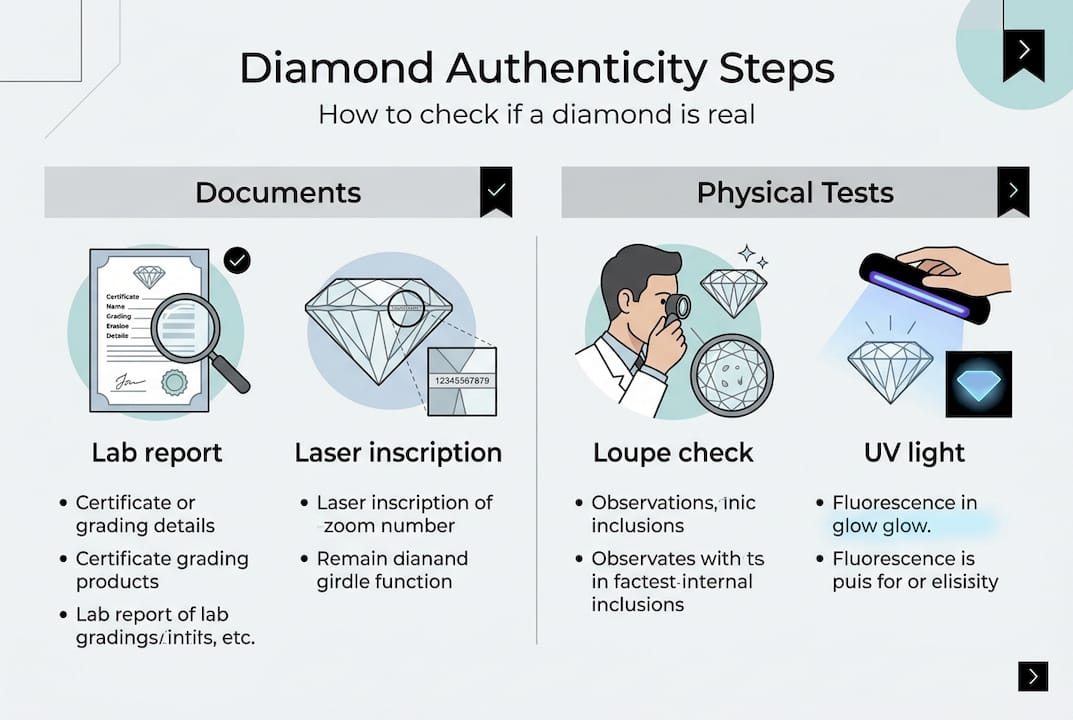
- Check the laser inscription. Using a 10x loupe, examine the girdle of the diamond. The report number should be engraved there in tiny text. If it’s missing or doesn’t match, stop.
- Use a diamond tester. Diamond testers using thermal conductivity reliably detect simulants like cubic zirconia but fail on moissanite. A dual tester adds electrical conductivity testing to catch moissanite as well.
- Inspect under UV light. About 25 to 35 percent of natural diamonds fluoresce blue under UV light. This doesn’t confirm authenticity on its own, but combined with other checks, it adds useful data.
- Run home screening tests as a supplement. The fog test clears in under one second for real diamonds, but this is unreliable for quality fakes. The water drop test (a real diamond disperses light differently) and the newspaper test (you can’t read text through a real diamond) are similarly limited.
Here’s a quick comparison of verification methods:
| Method | Accuracy | Best for | Limitation |
|---|---|---|---|
| Lab certificate | Highest | All diamond types | Cost, time if not included |
| Laser inscription check | Very high | Certified stones | Not all stones are inscribed |
| Dual tester | High | Moissanite detection | Requires skill |
| UV light | Low to medium | Supplementary check | Not definitive |
| Home tests | Low | Obvious fakes only | Fails on quality simulants |
Pro Tip: When buying a lab grown diamond ring, always confirm the certificate specifies “laboratory-grown” explicitly. A lab grown diamond explained resource can help you understand what language to look for on a report.
Never rely on a single test. The strongest verification combines a valid lab report, a confirmed laser inscription, and at least one physical test.
Troubleshooting and avoiding common mistakes
Even careful buyers run into confusing situations. Here’s how to handle the most common ones.
One of the biggest mistakes buyers make is over-relying on home tests. The fog test, water drop test, and newspaper test were designed for obvious simulants. A high-quality moissanite or even a well-cut cubic zirconia can pass some of these checks. If you’re spending significant money, home tests are a starting point, not a conclusion.
Misunderstanding tester results is another common pitfall. A basic thermal tester will read moissanite as a diamond because moissanite conducts heat similarly. Only a dual tester that also checks electrical conductivity will catch this. If your tester gives a positive result but you have no certificate, don’t assume you’re done.
Edge cases add another layer of complexity. Small diamonds often go uncertified, especially those under 0.3 carats, because the certification cost can exceed the stone’s value. Type IIb diamonds, which are extremely rare and contain boron, may actually fail standard electrical tests. Advanced screeners like DiamondProof provide around 95% accuracy for these tricky cases.
Watch for these red flags when dealing with any seller:
- No grading certificate or only an in-house appraisal
- Vague answers about where the stone was sourced
- Reluctance to allow independent testing before purchase
- Pricing significantly below market rate for the stated quality
- Pressure to decide quickly without time to verify
As noted in diamond certification guidance, missing certificates, unclear seller information, and reluctance to allow testing are the clearest signals that something is wrong.
“If a seller can’t provide a grading report from GIA, AGS, or IGI, treat the stone as unverified regardless of what any other test shows.”
If you’ve already purchased a stone and results are confusing, take it to a certified gemologist (a professional trained in gemstone identification) for a professional opinion. Understanding lab diamond benefits can also help you decide whether a lab-grown stone with full certification is actually the smarter purchase for your budget.
What most buyers overlook in diamond verification
Most shoppers focus heavily on the sparkle and the price, then treat verification as an afterthought. That’s the wrong order. The single most overlooked safeguard in diamond buying is the laser inscription check. Buyers who know to ask for a certificate often forget to physically confirm that the inscription on the stone matches the report number. A dishonest seller could theoretically provide a real certificate for a different stone entirely.
A multi-method approach using certification plus UV and loupe gives the most reliable results. No single test, not even a lab report, is completely foolproof without cross-referencing the physical stone. The report number on the certificate, the laser inscription on the girdle, and the online database entry should all match perfectly.
Another thing experienced buyers know: online verification matters as much as the paper certificate. Certificates can be forged. The lab’s own database cannot. Always verify through the issuing lab’s website directly. Our step-by-step diamond guide walks through exactly how to do this without needing any technical background.
The bottom line is this: insist on documentation, verify it independently, and use physical tests as confirmation rather than proof.
Find authentic diamond jewelry with confidence
Now that you know how to verify a diamond, the next step is finding a retailer you can trust from the start.

At SuperJeweler, every diamond and lab grown diamond comes with transparent certification and clear documentation so you never have to guess. Whether you’re searching for cheap engagement rings that don’t compromise on quality or browsing our full selection of wedding bands, you’ll find verified, authentic options backed by our warranty and return policy. We believe buying a diamond should feel exciting, not stressful. Shop with confidence knowing exactly what you’re getting.
Frequently asked questions
Can at-home tests reliably tell if a diamond is real?
At-home tests like the fog and water drop can catch obvious fakes but aren’t reliable for lab-grown diamonds, moissanite, or high-quality simulants. Always pair them with a certified grading report.
What is the best method to verify diamond authenticity?
The most reliable method is obtaining a lab certification and report check from GIA, AGS, or IGI, then confirming the laser inscription on the stone matches the report number in the lab’s online database.
Do diamond testers distinguish lab-grown diamonds from natural?
Testers cannot distinguish lab-grown from natural because both share identical thermal and electrical properties. Only a grading certificate specifying origin can make that distinction.
Are small diamonds always certified?
Small diamonds under 0.3 carats are often sold without certification because the cost of grading can exceed the stone’s value, so extra physical checks are especially important for melee and accent stones.
What are red flags when buying a diamond?
Red flags include no certificate, vague seller information, pricing well below market rate, and any reluctance to allow independent testing before you complete the purchase.
Recommended
- How to verify diamond quality: a step-by-step guide 2026
- Understand diamond certification to buy with confidence
- How to identify quality diamonds for engagement rings
- Diamond necklace buying tips: quality & value in 2026
