Every diamond tells a story, but not every story is one you’d want to wear. The global diamond trade has long been tied to questions of exploitation, environmental damage, and armed conflict. Conflict-free certification exists to change that narrative, but the label means less than most shoppers assume. This guide breaks down exactly what conflict-free means, how certification actually works, where it falls short, and why lab-grown diamonds are quietly rewriting the rules for ethical jewelry buyers.
Table of Contents
- Defining conflict-free diamonds
- How conflict-free diamond certification works
- Beyond conflict-free: Ethical jewelry standards
- Lab-grown diamonds: The ethical and environmental alternative
- How to choose the right conflict-free or ethical diamond
- Find your ethical diamond jewelry
- Frequently asked questions
Key Takeaways
| Point | Details |
|---|---|
| Conflict-free defined | A conflict-free diamond is certified not to fund violent conflict, with global standards ensuring traceable sourcing. |
| Certification matters | Look for Kimberley Process or RJC certifications to ensure ethical sourcing beyond conflict-free status. |
| Lab-grown advantages | Lab-grown diamonds are always conflict-free and have a significantly lower environmental footprint. |
| Ethical buying tips | Ask about certifications, audits, and renewable energy use when choosing diamonds for maximal ethical impact. |
Defining conflict-free diamonds
The term “conflict-free” has a very specific legal meaning. A conflict-free diamond is one certified by the Kimberley Process Certification Scheme (KPCS) as not being a rough diamond sold by rebel movements to finance armed conflict against legitimate governments. That definition comes directly from U.S. Customs and Border Protection.
Here is what the KPCS certification actually guarantees:
- The diamond was not used to fund rebel or insurgent warfare
- The rough diamond was exported with an official government-issued KP certificate
- The shipment passed through member countries only
- Trade records were maintained at each step of the supply chain
What it does not guarantee is equally important. KPCS certification says nothing about fair wages, safe working conditions, child labor, or environmental destruction. A diamond can be 100% conflict-free under KPCS rules and still come from a mine with serious human rights violations.
“A conflict-free diamond is one certified by the Kimberley Process Certification Scheme (KPCS) as not being a rough diamond sold by rebel movements to finance armed conflict against legitimate governments.” — U.S. Customs and Border Protection
Over 80 countries participate in the KPCS, covering nearly all global rough diamond production. That scale is impressive, but the scope of what the certification covers remains narrow.
How conflict-free diamond certification works
The Kimberley Process is a joint government, industry, and civil society initiative launched in 2003. Its core mechanism is a paper-based certificate system that tracks rough diamonds from mine to export. The KPCS requires participating countries to issue certificates for rough diamond shipments, verifying they are conflict-free, with physical inspections and trade limited to members only.
Here is how the certification process unfolds step by step:
- A rough diamond is mined in a participating country.
- The government issues a tamper-resistant KP certificate for the shipment.
- The diamond can only be traded between KP member countries.
- Importing countries verify the certificate before accepting the shipment.
- Internal controls track the diamond through cutting, polishing, and sale.
Key statistic: As of 2026, the KPCS covers 99% of world production, making it the most widely adopted diamond trade standard on the planet.
| Certification feature | Details |
|---|---|
| Launch year | 2003 |
| Participating countries | Over 80 |
| Global production covered | ~99% |
| Certificate type | Government-issued, tamper-resistant |
| Trade restriction | Members only |
| Scope | Rough diamonds only |
Critics point out that the KP only covers rough diamonds, meaning a stone can lose its traceable chain once it enters cutting and polishing. Independent watchdog groups have also flagged enforcement gaps in several producing nations. The system works best when governments are transparent and motivated to comply, which is not always the case.
Beyond conflict-free: Ethical jewelry standards
The Kimberley Process was a landmark achievement, but the jewelry industry has moved toward broader ethical frameworks since its launch. The Responsible Jewellery Council (RJC) Code of Practices addresses human rights, labor conditions, and environmental impact through mandatory third-party audits. This is a significant upgrade from KPCS, which relies heavily on self-reporting by member governments.
Here is what the RJC Code covers that KPCS does not:
- Human rights: Prohibition of forced labor, child labor, and discrimination
- Labor standards: Safe working conditions, fair wages, and freedom of association
- Environmental management: Waste reduction, water use, and biodiversity protection
- Business ethics: Anti-bribery, anti-money laundering, and transparent reporting
- Supply chain due diligence: Traceability from mine to retail
Third-party audits are the backbone of RJC certification. An independent auditor visits the business, reviews records, and interviews workers before issuing a certificate. This makes RJC significantly harder to game than a paper-based government certificate.
Pro Tip: When shopping for ethical diamonds, ask your jeweler for both their KPCS documentation and their RJC membership status. A retailer with both is operating at a much higher standard than one with KPCS alone. You can also explore top lab-grown diamond jewelry as an alternative that sidesteps many of these concerns entirely.
The RJC currently certifies over 1,500 member businesses across the jewelry supply chain, from miners to retailers. Membership is voluntary, but consumer demand is making it increasingly hard to ignore.
Lab-grown diamonds: The ethical and environmental alternative
Lab-grown diamonds are not a compromise. They are chemically, physically, and optically identical to mined diamonds. The only difference is where they come from. And that difference matters enormously for anyone who cares about ethics or the environment.
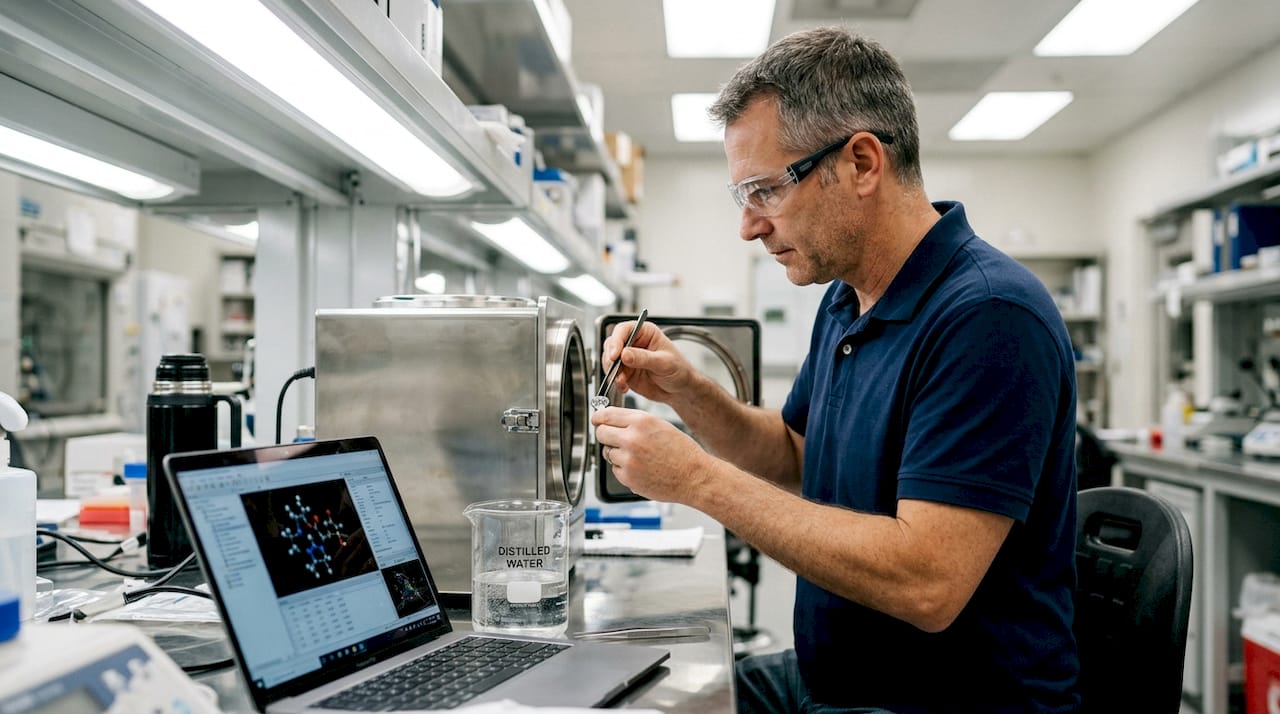
Because lab-grown diamonds are created in controlled facilities using either High Pressure High Temperature (HPHT) or Chemical Vapor Deposition (CVD) processes, they require no mining whatsoever. That means no displaced communities, no dangerous mine conditions, and no funding of conflict. They are inherently conflict-free, with no certification required to prove it.
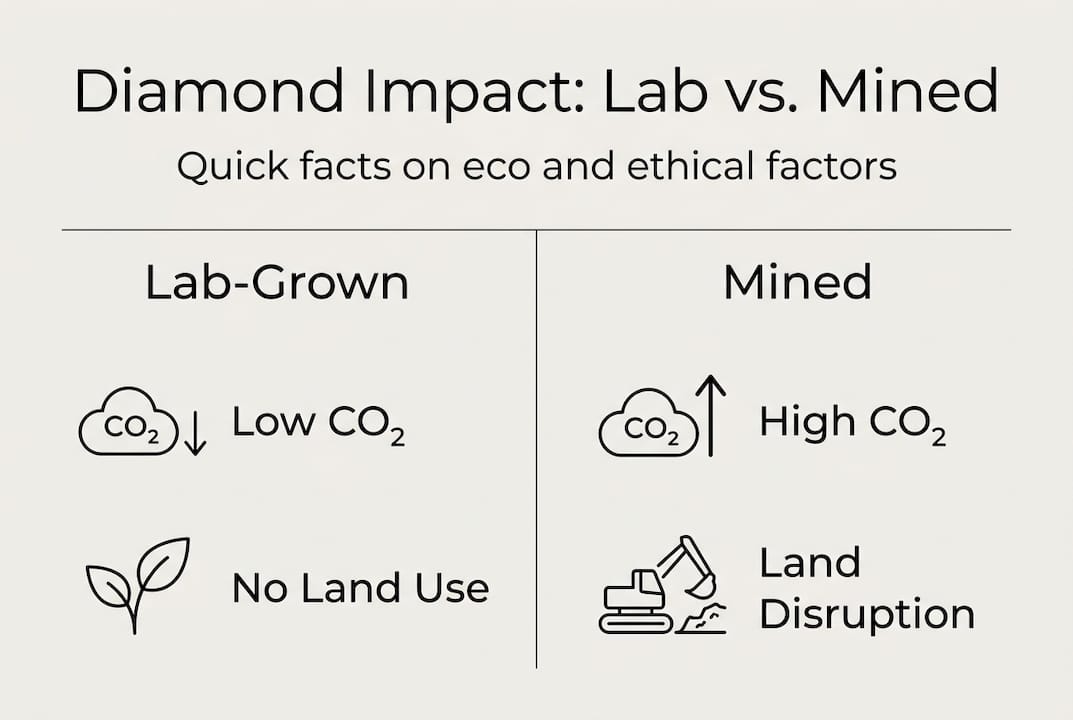
The environmental numbers are striking. Lab-grown diamonds produce 80-97% less CO2 than mined diamonds, with some producers generating as little as 6kg of CO2 per carat compared to roughly 160kg for a mined stone. They also cause no land disruption and use significantly less water.
| Factor | Lab-grown diamond | Mined diamond |
|---|---|---|
| CO2 per carat | ~6 kg (renewable energy) | ~160 kg |
| Land disruption | None | Significant |
| Water use | Lower | Higher |
| Conflict risk | None | Possible |
| Certification needed | Not required | KPCS required |
| Cost | 50-80% less | Higher |
Pro Tip: The environmental benefit of lab-grown diamonds is maximized when the production facility runs on renewable energy. When browsing sustainable lab diamonds, look for producers who disclose their energy sources.
The practical benefits for buyers are just as compelling:
- You get a larger, higher-quality stone for the same budget
- No ethical due diligence required on your part
- Identical sparkle, hardness, and durability to mined diamonds
- Growing resale market as lab-grown becomes mainstream
For engagement ring shoppers, lab-grown engagement ring deals offer a way to get a stunning ring without the ethical trade-offs. The full range of lab-grown diamonds available today covers every shape, size, and style you could want. You can also browse lab-grown diamond jewelry beyond rings, including earrings, pendants, and bracelets.
How to choose the right conflict-free or ethical diamond
Knowing what certifications exist is only half the battle. The other half is knowing how to apply that knowledge when you are actually shopping. Here is a practical framework for making the most ethical choice possible.
- Ask for KPCS documentation. Any reputable retailer selling mined diamonds should be able to provide proof that their stones are Kimberley Process certified. If they cannot, walk away.
- Check for RJC membership. KPCS covers conflict only. RJC covers labor, environment, and human rights. A retailer with RJC certification is operating at a higher ethical standard.
- Ask about the mine of origin. Some retailers can trace diamonds to specific mines with strong ethical records. This level of transparency is rare but worth seeking out.
- Consider lab-grown as your default. If you want to skip the certification maze entirely, lab-grown diamond rings remove all sourcing uncertainty. There is no conflict risk, no environmental trade-off, and no need to verify a paper trail.
- Do not assume “conflict-free” means fully ethical. This is the most common mistake buyers make. Conflict-free is a floor, not a ceiling. It tells you the diamond did not fund a war. It says nothing about the workers who mined it.
Pro Tip: If a jeweler uses the phrase “conflict-free” as their only ethical credential, that is a signal to ask more questions. The environmental edge clearly favors lab-grown diamonds, especially when renewable energy is used in production. Mined diamonds are improving with better regulations, but the inherent disruption of mining cannot be fully eliminated.
For buyers who still prefer mined diamonds, the combination of KPCS plus RJC certification plus traceable origin is the gold standard. For everyone else, lab-grown is simply the easier, cleaner, and increasingly affordable choice. You can find a curated selection of ethically sourced options at top lab-grown diamond jewelry to compare styles and prices.
Find your ethical diamond jewelry
You now have the knowledge to shop with real confidence. Whether you want a certified conflict-free mined diamond or a lab-grown stone that sidesteps sourcing concerns entirely, the right choice is the one that aligns with your values and your budget.

At SuperJeweler, we carry a wide selection of lab-grown diamond jewelry that gives you stunning quality without the ethical guesswork. From everyday pendants to show-stopping engagement rings, every piece is designed to make accessible luxury feel effortless. Browse our [lab-grown engagement ring deals](https://www.superjeweler.com/huge-lab-grown-diamond engagement ring deals) to find the perfect ring at a price that makes sense, backed by free worldwide shipping and a satisfaction guarantee.
Frequently asked questions
Are conflict-free diamonds guaranteed to be ethically sourced?
No. Conflict-free diamonds avoid funding armed conflict, but the RJC Code of Practices addresses the broader ethical issues like labor rights and environmental impact that KPCS does not cover. Always look for additional certifications beyond KPCS.
What certification should I look for in conflict-free diamonds?
Start with KPCS certification for conflict-free assurance, then look for RJC membership to confirm the retailer also meets standards for labor, human rights, and environmental practices.
How does the environmental impact of lab-grown diamonds compare to mined diamonds?
Lab-grown diamonds generate 80-97% less CO2 per carat, use less water, and cause zero land disruption compared to mined diamonds, making them the clear environmental choice.
Can I trust jewelry retailers to offer genuinely conflict-free diamonds?
Yes, if they provide KPCS certificates and hold RJC certification backed by third-party audits. Both together give you strong assurance that the diamonds are conflict-free and sourced to a higher ethical standard.
Recommended
- Understand diamond certification to buy with confidence
- Lab-Grown Diamonds: Affordable Luxury With Ethics
- Top 5 Lab-Grown Diamond Jewelry Options in 2026 for Eco-conscious Couples Seeking Affordable, Ethical Engagement Rings
- Lab-Grown Diamond: Affordable, Ethical, and Real
