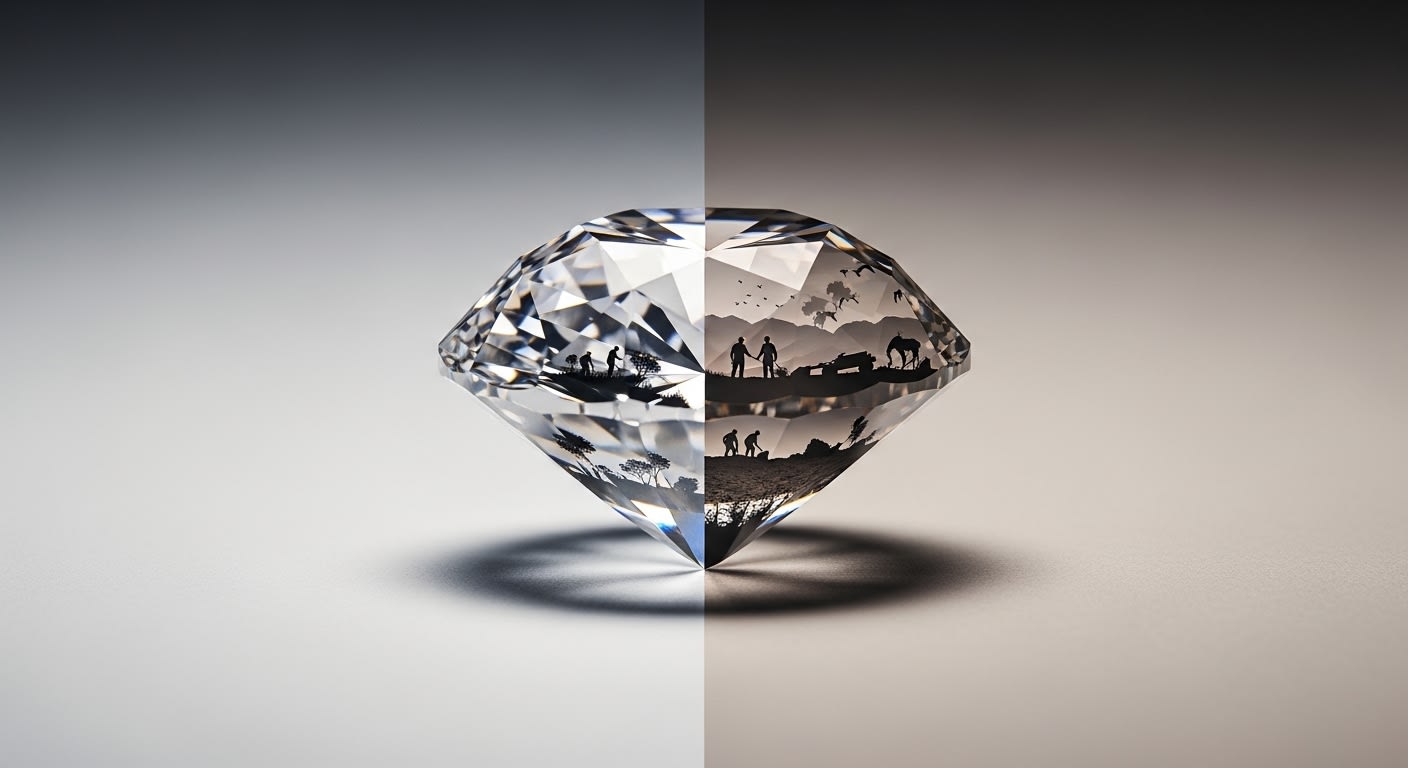
Most people assume that buying a diamond labeled “conflict-free” means they’ve made a fully ethical choice. That assumption is understandable, but it’s only part of the story. A conflict-free diamond is one that hasn’t financed rebel movements or violence, but the certification system behind that label has real gaps that every conscious buyer should understand. This guide walks you through the official definitions, the flaws in current certification, and the practical steps you can take to make a purchase you’ll feel genuinely good about.
Table of Contents
- Defining conflict-free diamonds
- How the Kimberley Process works and where it falls short
- Beyond conflict-free: Evolving standards for ethical diamonds
- How to ensure your diamond purchase is truly ethical
- Shop ethical diamond and gemstone options with confidence
- Frequently asked questions
Key Takeaways
| Point | Details |
|---|---|
| Definitions matter | Not all conflict-free diamonds meet broader ethical standards—look beyond labels. |
| Certification has limits | Kimberley Process covers only part of the ethical puzzle, missing labor and environmental concerns. |
| Ethical shopping tips | Ask for detailed certification, consider lab-grown options, and research retailer policies. |
| Industry is evolving | More retailers now offer traceable, fully ethical diamonds and gemstones. |
Defining conflict-free diamonds
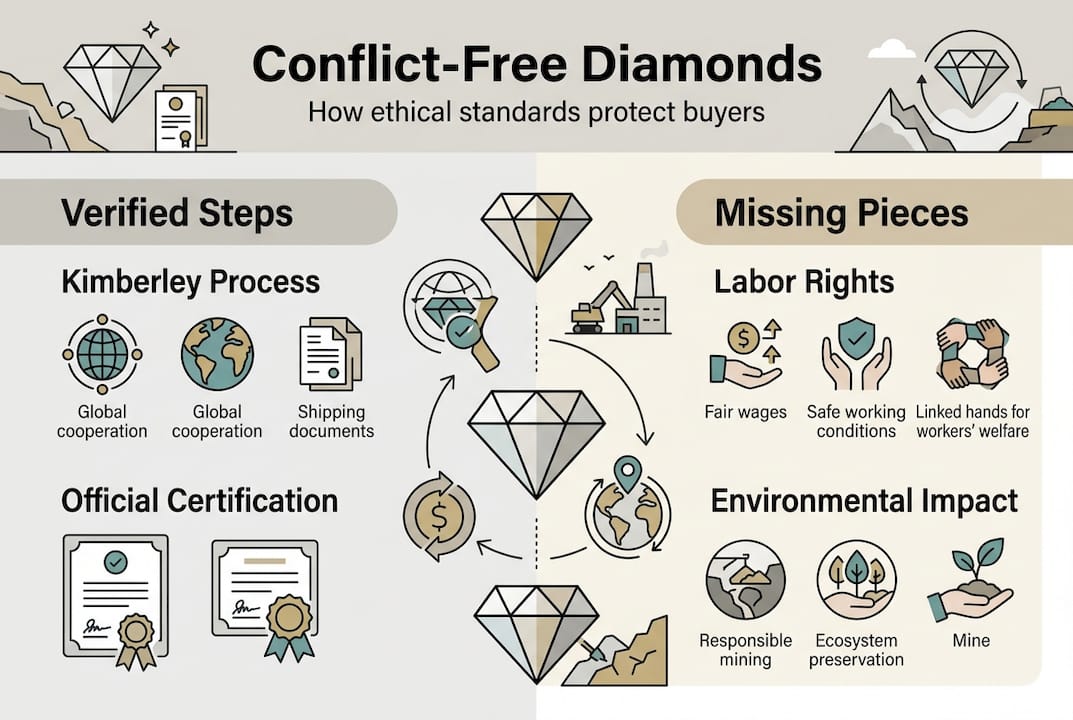
The term “conflict-free” has a specific, legal meaning rooted in international trade policy. According to the official definition, a conflict-free diamond is a rough diamond that has not been used by rebel movements to finance conflict. This definition was formalized through the Kimberley Process Certification Scheme, a joint initiative launched in 2003 involving governments, the diamond industry, and civil society organizations.
The KPCS requires participating countries to certify that diamond shipments are conflict-free before they can be exported or imported. Every rough diamond must travel with a government-issued certificate. The goal was to cut off the funding pipeline that fueled devastating civil wars in countries like Sierra Leone and Angola during the 1990s.
Here’s a quick breakdown of what the Kimberley Process does and doesn’t cover:
| What the KP covers | What the KP does NOT cover |
|---|---|
| Rough diamond trade between countries | Polished or cut diamonds |
| Rebel-funded conflict diamonds | State-perpetrated violence |
| Government-certified shipments | Labor rights or fair wages |
| Cross-border smuggling prevention | Environmental damage from mining |
For ethical jewelry buyers, this table is eye-opening. The label “conflict-free” tells you something important, but it doesn’t tell you everything. Our guide to conflict-free diamonds breaks this down further if you want a deeper look at what the certification actually guarantees.
“A conflict-free diamond is a rough diamond that has not been used by rebel movements to finance conflict.” — U.S. Customs and Border Protection
Key facts every buyer should know:
- The Kimberley Process covers rough diamonds only, not the polished stones you see in jewelry stores
- Certification happens at the country level, not the individual stone level
- Over 80 countries participate in the KPCS, but participation doesn’t guarantee perfect compliance
- The label says nothing about worker safety, environmental impact, or fair pay
How the Kimberley Process works and where it falls short
Now that you know the formal definition, it’s critical to examine the process and its flaws to shop with eyes wide open. The Kimberley Process was a genuine breakthrough when it launched. Before 2003, conflict diamonds were estimated to make up as much as 4% of the global diamond trade. The KPCS dramatically reduced that number. But the system has serious structural weaknesses that have grown harder to ignore.
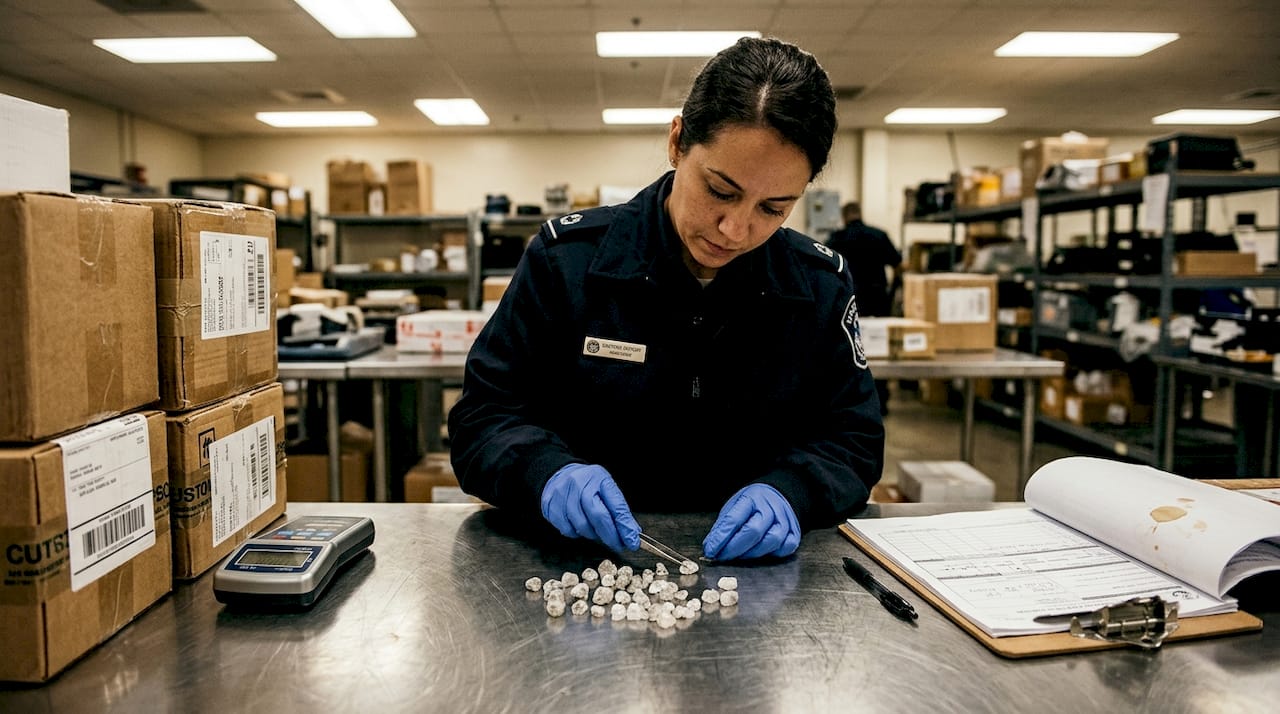
The most significant gap is scope. The KP only regulates rough diamonds, meaning uncut stones moving between countries. Once a diamond is cut and polished, it falls outside the system entirely. This creates an obvious vulnerability: polished diamonds are unregulated by the Kimberley Process, and smuggling can mix illicit stones into legitimate supply chains, while state-perpetrated violence may still pass as conflict-free.
Here’s how the Kimberley Process compares to what ethical consumers actually need:
| Standard | Kimberley Process | What ethical buyers need |
|---|---|---|
| Covers rough diamonds | Yes | Yes |
| Covers polished diamonds | No | Yes |
| Addresses labor rights | No | Yes |
| Tracks environmental impact | No | Yes |
| Prevents state violence | No | Yes |
| Verifies individual stone origin | No | Yes |
The criticism from advocacy groups is pointed. NGOs call the KP greenwashing and urge far more due diligence, while the industry continues to hail it as a success. That gap in perspective matters when you’re making a purchase decision.
Here are the most commonly cited failures of the Kimberley Process:
- Polished diamonds are excluded from certification requirements entirely
- Smuggling routes allow conflict stones to be mixed with certified batches
- State violence is not classified as “conflict” under the KP definition
- Self-reporting by governments creates obvious conflicts of interest
- No independent audits are required at the mine level
Pro Tip: When shopping for diamonds, ask your retailer specifically whether their stones are certified beyond the Kimberley Process. A retailer who can’t answer that question clearly may not have done the supply-chain work you deserve. Check out our resource on understanding diamond certification to know exactly what questions to ask.
Beyond conflict-free: Evolving standards for ethical diamonds
Understanding the Kimberley Process’s limits, it’s time to explore how the industry is pushing toward even higher ethical ground. A growing number of companies and organizations now operate under what’s called “Beyond Conflict Free” standards. These go further by tracing a diamond’s full origin, verifying fair labor practices, and assessing environmental protections at the mine level.
Two of the most recognized frameworks are the Responsible Jewellery Council (RJC) and Rapaport GreenSource. The RJC audits companies across the entire jewelry supply chain, covering human rights, labor standards, environmental practices, and business ethics. Rapaport GreenSource sets broader ethical benchmarks that include origin tracking and community impact, going well beyond what the Kimberley Process requires.
“Beyond Conflict Free standards require companies to trace diamond origin, verify fair labor, and assess environmental protections at the source.”
Here’s what to look for when a retailer claims to go beyond conflict-free:
- Full supply-chain traceability: Can they tell you which mine the stone came from?
- Third-party audits: Is the claim verified by an independent organization like the RJC?
- Labor standards: Are miners paid fairly and working in safe conditions?
- Environmental accountability: Does the mining operation meet recognized environmental standards?
- Community benefit: Does the local community benefit from the mining activity?
Lab-grown diamonds are increasingly the go-to choice for buyers who want to sidestep these concerns entirely. Because they’re created in controlled environments, lab-grown diamonds offer traceability and completely bypass the mining-related conflicts that make natural diamond sourcing so complicated. If you’re curious about the full picture, our post on ethical lab-grown diamond options is a great starting point.
Pro Tip: Lab-grown diamonds are chemically and physically identical to mined diamonds. You get the same sparkle, the same hardness, and the same beauty, without the ethical uncertainty. For many buyers in 2026, that trade-off is an easy one. Learn more about why lab diamonds matter for conscious consumers.
How to ensure your diamond purchase is truly ethical
With these advanced standards in mind, here’s how you can protect your ethics and your investment when buying any diamond. The process doesn’t have to be overwhelming. A few focused questions and a clear checklist will take you a long way.
Follow these steps before you buy:
- Ask for documentation: Request the Kimberley Process certificate and any additional third-party certifications. A reputable retailer will have these ready.
- Look for RJC or GreenSource affiliation: RJC and Rapaport GreenSource audits go beyond conflict-free to evaluate labor, community impact, and environmental standards.
- Research the retailer’s sourcing policy: Check their website for a clear, specific ethical sourcing statement. Vague language is a red flag.
- Ask about stone origin: Can the retailer tell you which country or region the diamond came from? Ideally, which mine?
- Consider lab-grown alternatives: If full traceability matters to you, lab-grown diamonds remove the mining variable entirely.
Here’s a quick checklist to use when evaluating any diamond retailer:
- Does the retailer have a published ethical sourcing policy?
- Are their diamonds certified beyond the Kimberley Process?
- Do they offer lab-grown options with clear origin information?
- Can they provide documentation on request?
- Are they affiliated with the RJC or a similar independent body?
Pro Tip: Don’t be shy about asking hard questions before you buy. A retailer who takes ethics seriously will welcome the conversation. If they seem evasive or can’t point you to specific diamond certification documentation, that tells you something important about their supply chain. Also explore our lab-grown diamond guides for a full breakdown of what to expect from ethical alternatives.
Shop ethical diamond and gemstone options with confidence
Ready to put your knowledge into practice? At SuperJeweler, we believe that buying beautiful jewelry and buying responsibly should never be in conflict. Our collections are built around giving you real choices, whether you’re drawn to natural diamonds with verified sourcing or you want the peace of mind that comes with a lab-grown stone.

Browse our lab grown diamonds collection to find stunning, ethically produced options at prices that won’t make you compromise. If you’re shopping for a ring, our lab-grown diamond engagement ring deals offer exceptional value with full transparency. And if you’re working with a budget, our cheap engagement rings section proves that ethical and affordable can absolutely go hand in hand. Every purchase comes with free worldwide shipping and our satisfaction guarantee.
Frequently asked questions
Are conflict-free diamonds genuinely ethical?
Conflict-free diamonds avoid funding rebel violence, but the label doesn’t address labor rights, environmental damage, or state-perpetrated harm. NGOs criticize the KP as too narrow, so look for broader certifications like the RJC for a more complete ethical picture.
Can lab-grown diamonds be considered conflict-free?
Yes, and they go further than that. Lab-grown diamonds are produced without mining and bypass mining-related conflicts entirely, making them one of the most traceable and ethically straightforward options available today.
What certifications should I look for besides conflict-free?
Seek diamonds certified by the Responsible Jewellery Council or those with full supply-chain traceability through programs like Rapaport GreenSource. RJC and GreenSource standards cover labor, community impact, and environmental practices that the Kimberley Process ignores.
Do all jewelers follow the Kimberley Process?
Most reputable jewelers adhere to the Kimberley Process, but compliance isn’t foolproof. The KP is widely adopted but relies heavily on self-reporting, so always ask for documentation and look for additional third-party verification before you buy.
Recommended
- What is a conflict-free diamond? Your guide to ethical jewelry
- Lab-Grown Diamond: Affordable, Ethical, and Real
- Understand diamond certification to buy with confidence
- Top 5 Lab-Grown Diamond Jewelry Options in 2026 for Eco-conscious Couples Seeking Affordable, Ethical Engagement Rings
