TL;DR:
- A round brilliant diamond features 57 or 58 facets designed to maximize light reflection, brightness, fire, and scintillation. Its precise proportions and high cut grading are essential for optimal sparkle and are standardized by the GIA, which accounts for about 60% of diamond sales. Focusing on cut quality and proportions offers better value than size, and high-quality images or certificates help confirm a stone’s performance.
A round brilliant diamond is a circular-shaped stone cut with 57 or 58 precisely angled facets, engineered from the ground up to return the maximum amount of light to your eye. It is the most scientifically optimized diamond shape ever developed, and it remains the most popular choice for engagement rings by a wide margin.
Three facts to know before you read further:
- Facet count: 57 facets when the culet is pointed; 58 when a small flat culet facet is present
- Design purpose: every angle and proportion is calculated to maximize brightness, fire, and scintillation
- Cut grading: the GIA is the only major lab that issues an official Cut Grade specifically for round brilliants
Table of Contents
- What is a round brilliant diamond?
- Tolkowsky and the origin of the modern cut
- How a round brilliant creates sparkle
- Ideal proportions and the GIA Cut Grade
- Hearts & Arrows imaging explained
- How the round brilliant shape affects price
- Practical buying checklist
- Key Takeaways
Table of Contents
- What does a round brilliant diamond look like inside?
- How did the round brilliant cut come to exist?
- How does a round brilliant actually create sparkle?
- What proportion ranges and cut grades should you target?
- What do Hearts & Arrows photos actually tell you?
- How does the round brilliant shape affect what you pay?
- Practical checklist for choosing a round brilliant
- Key Takeaways
- A note on what actually matters when you buy
- Round brilliant engagement rings at Superjeweler
- Authoritative sources and further reading
What does a round brilliant diamond look like inside?
The round brilliant has a clear physical structure that every buyer should be able to read on a certificate or diagram. Once you know the parts, proportion numbers stop being abstract.
The four main zones
- Table: the large flat facet on top, the diamond’s “window” to the world
- Crown: the upper portion between the table and the girdle, home to the star and bezel facets
- Girdle: the narrow band around the widest point; it separates crown from pavilion and is where the diamond is held in a setting
- Pavilion: the lower cone-shaped section; its angles are the single biggest driver of light return
- Culet: the very bottom point (or tiny flat facet if present); a large culet looks like a dark circle when you look straight down through the table
The facet inventory
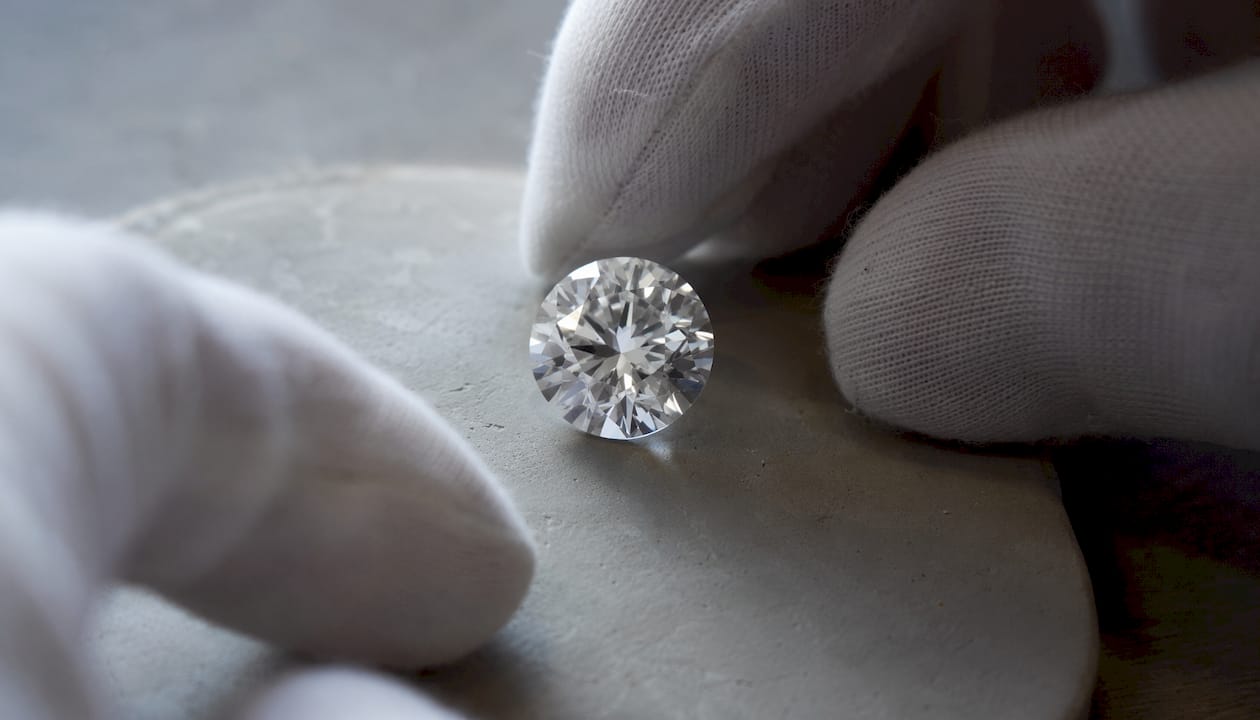
A standard round brilliant has 57 facets: 1 table, 8 star facets, 8 bezel (kite) facets, and 16 upper-girdle (upper half) facets on the crown; 8 pavilion main facets and 16 lower-girdle (lower half) facets on the pavilion. Add a flat culet and the count reaches 58. Those 57 or 58 surfaces are not decorative. Each one is positioned at a specific angle to redirect light along a calculated path.
Pro Tip: When reviewing a GIA certificate, check the “Faceting Style” line to confirm you’re looking at a standard round brilliant and not a modified brilliant, which uses a different facet arrangement.
How did the round brilliant cut come to exist?
The story starts in 1919, when a 21-year-old Belgian-American engineer named Marcel Tolkowsky published a mathematical treatise called Diamond Design. Using geometry and optics, Tolkowsky calculated the crown and pavilion angles that would balance light reflection and dispersion inside a round stone. His “ideal” proportions, roughly a 53% table, 35% crown height, and 40.75° pavilion angle, became the theoretical foundation for every well-cut round brilliant made since.
That model was a starting point, not a final answer. Through the mid-20th century, diamond manufacturers refined cutting machinery and techniques, gradually tightening tolerances and expanding the range of proportion combinations that could produce a beautiful stone. The real standardization breakthrough came when the GIA completed a 15-year research program and published its comprehensive cut-grading framework, which used computer modeling validated by observation tests with actual diamonds. That research confirmed that multiple proportion sets can produce an attractive round brilliant, but it also identified the combinations that produce visual problems like the “fisheye” (a washed-out ring of reflection) or “nail-head” (a dark center).
The result: the round brilliant became the only shape with a standardized official cut grade, which is why quality comparisons are far easier for rounds than for any fancy shape. That grading infrastructure, more than anything else, explains why rounds account for roughly 60% of diamonds sold for engagement rings.
How does a round brilliant actually create sparkle?
Light performance in a round brilliant comes from three distinct phenomena, and understanding the difference between them helps you evaluate what you see in photos, videos, and in person.
GIA defines the three components this way:
- Brightness: the total white light returned to your eye from both the surface and the interior of the stone
- Fire: the dispersion of that light into spectral colors, the flashes of red, orange, and blue you see at certain angles
- Scintillation: the pattern of light and dark areas, and the flashes that appear as the diamond or the light source moves
The physics behind the sparkle
When light enters through the table or crown facets, it slows and bends (refraction). A well-cut pavilion then bounces that light back up through the crown (total internal reflection) rather than letting it leak out the bottom. As light exits through the crown facets, it separates into its spectral components (dispersion), producing fire. The round brilliant’s circular symmetry means this process happens evenly across the entire face-up view, which is why no other shape matches it for consistent, all-direction sparkle.
Signs of good light performance in photos or video:
- Even, balanced bright areas across the face-up view with no large dark patches
- Lively contrast between bright and dark zones (too uniform means low scintillation)
- Visible color flashes, especially near the edges of the crown
- No gray or washed-out ring around the center (that is the fisheye effect)
Pro Tip: Proportion tradeoffs are real. A slightly deeper pavilion (around 43°) tends to increase fire at the cost of some face-up brightness. A very large table (above 60%) spreads brightness but can mute fire. Neither is automatically wrong, but knowing the tradeoff helps you decide what you value most in a stone.
The role of cut in diamond quality goes deeper than most buyers realize. A poorly cut stone with G color and VS1 clarity will look duller than a well-cut stone with I color and SI1. Cut is the one variable that controls all three sparkle components simultaneously.
What proportion ranges and cut grades should you target?
The GIA Cut Grade is the most useful single number on a round brilliant certificate. It exists only for standard round brilliants because the round is the only shape for which GIA has completed the research needed to assign a reliable overall grade. The scale runs from Excellent to Poor, and it incorporates brightness, fire, scintillation, weight ratio, durability, polish, and symmetry into a single verdict.
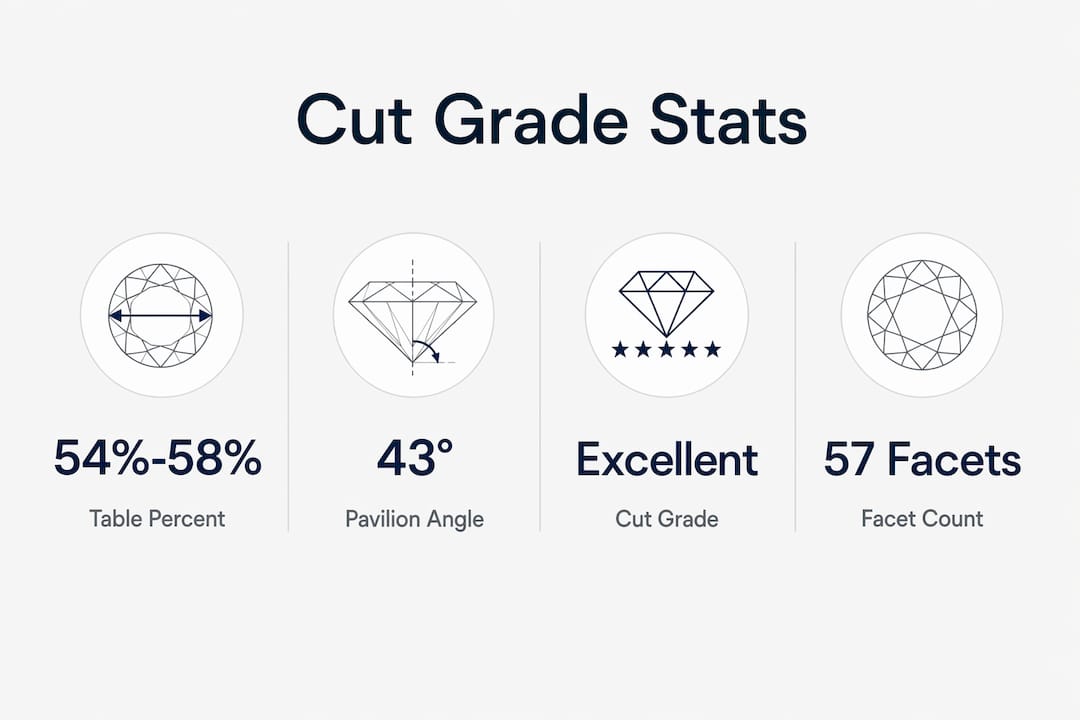
Recommended proportion ranges for round brilliants
| Proportion | Recommended range | Notes |
|---|---|---|
| Table % | 54%–58% | Above 62% risks muting fire |
| Total depth % | 59%–62.5% | Below 58% or above 64% causes fisheye or nail-head |
| Crown angle | 34°–35° | Works with pavilion angle; pairs matter |
| Pavilion angle | 40.6°–41° | The most critical single angle for light return |
| Girdle thickness | Thin to slightly thick | Very thin risks chipping; very thick hides weight |
| Culet | None to very small | Medium or larger appears as a dark circle face-up |
GIA’s cut research confirms that many proportion combinations can produce an attractive stone, so these ranges are practical targets rather than rigid rules. What matters is how the proportions interact as a system.
Cut grade priorities on a certificate:
- Target GIA Excellent or Very Good cut as a baseline
- Check polish and symmetry separately; both should be Excellent or Very Good
- Confirm the culet is listed as “None” or “Very Small”
- Flag any depth below 58% or above 64% for further scrutiny
One figure worth remembering: GIA gemologists advise that an Excellent-cut round brilliant can make a lower-color or lower-clarity stone appear more attractive than a poorly cut stone with better grades on paper. Cut governs everything the eye actually sees.
Expert buyers sometimes filter beyond GIA Excellent for a tighter proportion set to avoid borderline cases. The “fisheye” and “nail-head” effects described in GIA’s research can technically occur within the Excellent range if proportions sit at the outer edges. Requesting light-performance images (more on that below) is the practical way to confirm a specific stone performs well.
What do Hearts & Arrows photos actually tell you?
Hearts & Arrows (H&A) refers to a specific optical pattern visible in a precisely cut round brilliant when viewed through a special viewer or photographed with a dedicated scope. Looking down through the pavilion, you see eight symmetrical heart shapes; looking down through the table, you see eight arrow shafts. The pattern only appears when the facets are aligned with very high optical symmetry.
What H&A evidence tells you:
- The stone was cut to extremely tight tolerances, typically tighter than the average GIA Excellent
- Facet-to-facet alignment is consistent around the full 360° of the stone
- The cutter prioritized optical precision over maximizing carat weight from the rough
What H&A evidence does not tell you:
- It does not replace a GIA Cut Grade; a stone can display H&A and still have proportions that reduce brightness
- It does not guarantee the stone will look better to the naked eye than a well-cut non-H&A stone
- Marketing materials sometimes use the term loosely; ask for actual scope images, not just a label
Practical guidance: treat H&A imaging as a useful confirmation tool, not a primary filter. Start with GIA Excellent cut, then request scope images or video for any stone you are seriously considering. If the images show a clean, symmetrical pattern, that is a positive signal. If a seller cannot provide them, that is worth noting.
How does the round brilliant shape affect what you pay?
Round brilliants carry a real price premium over fancy shapes. That premium is driven by two factors: consistently higher consumer demand and the fact that cutting a round from rough diamond crystal wastes more material than cutting most fancy shapes.

That premium is not irrational. The standardized grading, the depth of the secondary market, and the timeless style all support it. But it does mean that buyers on a fixed budget face a genuine tradeoff.
Cut grade versus carat weight
An Excellent-cut slightly smaller round brilliant will typically look livelier and appear nearly as large face-up as a poorly cut larger stone, because a deep or shallow cut hides weight in the profile rather than spreading it across the face. GIA’s research specifically flags “over-weight” diamonds, where proportions cause the stone to appear smaller in diameter than its carat weight suggests. Buying a well-cut slightly smaller stone is almost always the better value.
Published retail price guides show that a 1 ct round brilliant can range from roughly $3,000 to $16,000+ depending on cut, color, clarity, and certification. That variance is enormous, and it is almost entirely explained by cut and color grade. Large market datasets tracking thousands of 1 ct round listings confirm that median prices cluster in the middle of that range for GIA-certified stones with Excellent cut and G–H color.
Practical prioritization:
- If budget is tight, drop one color grade (e.g., from G to H) before dropping cut grade
- Clarity grades of SI1 or VS2 are often eye-clean in round brilliants; you rarely need VS1 or above
- Lab-grown round brilliants offer the same cut quality and light performance at significantly lower prices; Superjeweler’s lab-grown diamond rings are worth comparing if budget is a primary concern
For a broader look at how shape affects face-up size and perceived value, the shape-by-shape guide on the Superjeweler blog walks through the tradeoffs in detail.
Practical checklist for choosing a round brilliant
Use this when comparing listings, reviewing certificates, or talking to a seller.
Certificate checklist
- Cut grade: GIA Excellent or Very Good (Excellent preferred)
- Table %: 54%–58%
- Total depth %: 59%–62.5%
- Crown angle: 34°–35°
- Pavilion angle: 40.6°–41°
- Polish: Excellent or Very Good
- Symmetry: Excellent or Very Good
- Culet: None or Very Small
- Girdle: Thin to slightly thick
Questions to ask the seller
- Can you provide light-performance images or video of this specific stone?
- Is the stone eye-clean at normal viewing distance (12–18 inches)?
- What is the return policy, and is the GIA certificate included?
- For lab-grown stones: what type of growth process (CVD or HPHT) and is it certified?
Decision flow (four steps)
- Inspect the certificate — confirm cut, proportions, polish, symmetry, and culet against the ranges above
- Request images or video — look for even brightness, lively contrast, and no fisheye or dark center
- Confirm certification and return policy — GIA certificate should accompany the stone; verify the return window
- Buy — if the stone passes steps 1–3 and fits your budget, you have done the work
One heuristic that holds up consistently: if your budget forces a choice between one full color grade and the cut grade, keep the Excellent cut. Color differences between adjacent grades (G vs. H, H vs. I) are nearly invisible in a well-cut round brilliant once it is set in white gold or platinum.
For a full engagement ring buying process, the step-by-step engagement ring guide covers everything from setting style to metal choice.
Key Takeaways
A round brilliant diamond’s cut grade is the single most important number on its certificate, and prioritizing GIA Excellent cut over small gains in color or clarity will consistently produce a more beautiful stone.
| Point | Details |
|---|---|
| Facet count | 57 or 58 precisely angled facets, designed to maximize brightness, fire, and scintillation |
| Cut grade first | GIA Excellent or Very Good cut governs all light performance; never sacrifice it for a color or clarity upgrade |
| Proportion targets | Table 54%–58%, depth 59%–62.5%, pavilion angle 40.6°–41° are the core ranges to verify |
| Price premium | Round brilliants cost about 20–35% more per carat than comparable fancy shapes due to higher demand and the greater waste of rough during cutting |
| Superjeweler option | Superjeweler offers both natural and lab-grown round brilliant engagement rings, with GIA-certified options across a wide price range |
A note on what actually matters when you buy
Most buyers walk into this decision focused on carat weight. It is the number that sounds impressive, the one that comes up in conversation. But carat weight is the least useful number on a certificate when you are trying to predict how a stone will look on a hand.
The round brilliant’s entire design history, from Tolkowsky’s 1919 calculations to GIA’s 15-year research program, is an argument for one thing: proportions determine beauty, not size. A 0.90 ct stone cut to ideal proportions will outperform a 1.10 ct stone cut for weight retention in almost every lighting condition. The fisheye effect, the nail-head effect, the washed-out center that makes a diamond look like glass rather than fire, all of these come from proportion choices made at the cutting wheel, not from the rough’s original size.
The H&A pattern is real and worth understanding, but it is a refinement, not a requirement. Start with GIA Excellent, verify the proportions, ask for images, and trust what you see. The certificate is a tool, not a guarantee. Your eyes are the final judge.
Round brilliant engagement rings at Superjeweler
Superjeweler carries engagement rings across a wide range of budgets, with GIA-certified round brilliants available in both natural and lab-grown options. The concrete advantage here is price: Superjeweler’s direct-to-consumer model cuts out the traditional retail markup, which means the budget you would spend on a mediocre stone elsewhere often gets you an Excellent-cut stone here.

For buyers open to lab-grown, Superjeweler’s lab-grown diamond deals offer the same cut quality and GIA-equivalent certification at a fraction of the natural diamond price. Every order ships free, and Superjeweler’s return policy and warranty give you a real safety net on a significant purchase.
Start here: filter by cut grade “Excellent,” set your carat and budget range, and request stone images before you commit. If you have questions about a specific listing or certificate, Superjeweler’s team can walk you through the proportions.
Authoritative sources and further reading
Prices fluctuate with market conditions, currency, and certification source. The figures cited in this article are estimates based on published guides and market data; always verify current pricing with a certified seller.
- GIA Diamond Cut Grade: Six Things to Know — the definitive explanation of what the GIA Cut Grade measures and why it exists only for round brilliants
- GIA: Brightness, Fire, and Scintillation — GIA’s own definitions of the three light-performance components
- GIA: How to Select a Round Diamond Engagement Ring — practical buying guidance from GIA gemologists
- GIA: A Foundation for Grading the Overall Cut Quality of Round Brilliant Cut Diamonds — the peer-reviewed research paper behind GIA’s cut grading system
- GIA 4Cs: Cut Overview — GIA’s consumer-facing explanation of the 4Cs with cut detail
- 1 Carat Round Natural Diamond Prices (CaratRadar) — live market data tracking price ranges across thousands of 1 ct round listings
Recommended
- Diamond shape impact: choosing the ideal engagement ring
- Diamond Upgrade Ring Options: Your 2026 Buyer’s Guide
- How to Choose an Engagement Ring Step by Step Easily
- Step-by-step engagement ring buying guide for couples
