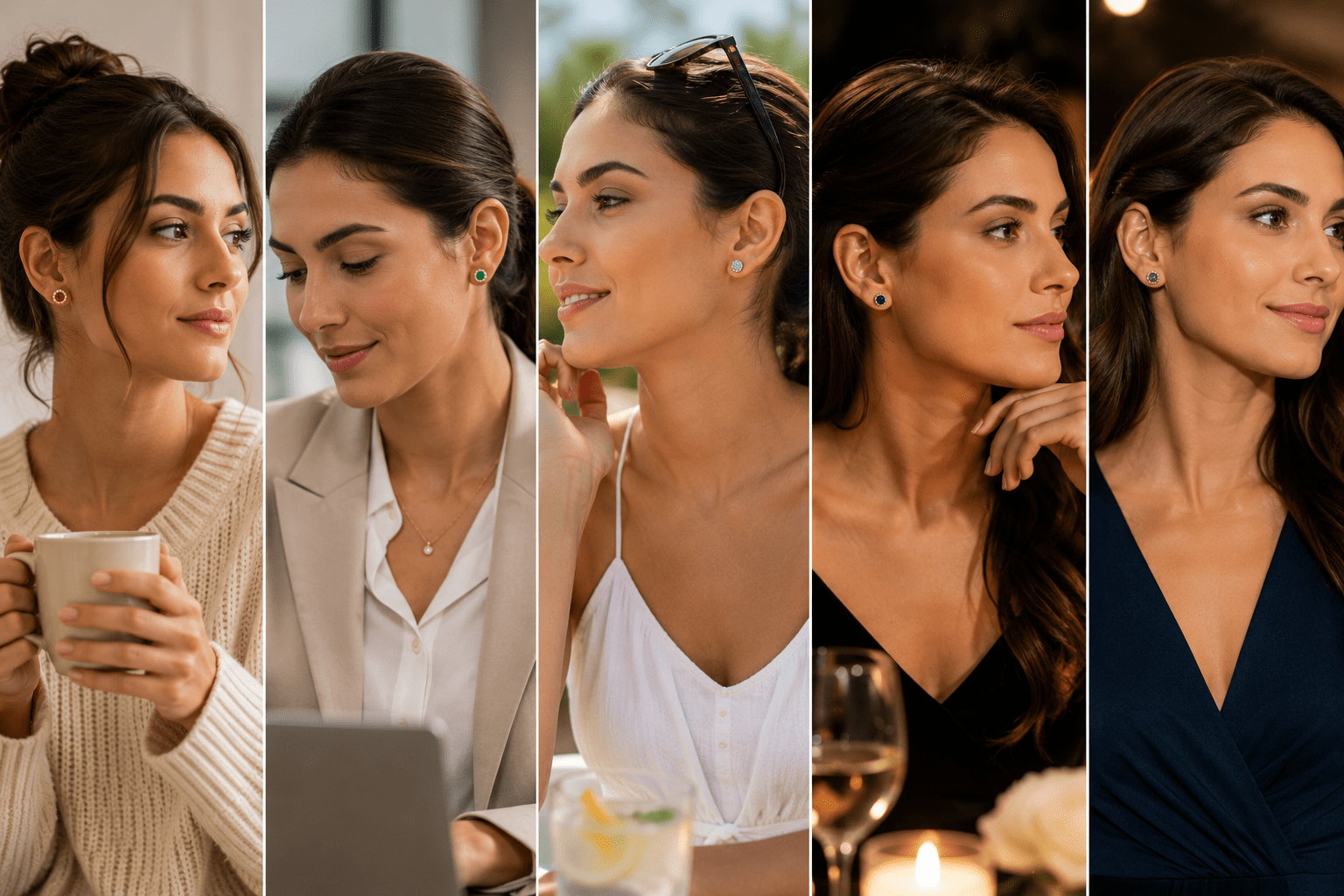
Birthstone earrings offer real, concrete advantages: personal meaning tied to your birth month, a built-in color palette that works across outfits, and a gifting shortcut that removes all the guesswork. They also happen to be one of the smartest placements for softer gemstones. Pearls, opals, and turquoise take far fewer knocks in an ear than on a finger, which means earrings extend the life of stones that would scratch or chip in a ring. The advantages of birthstone earrings go well beyond sentiment: the rest of this guide covers how to shop smart, what each month’s stone looks like in an earring setting, how to keep pieces looking new, and where to buy with confidence.
Key Takeaways
Birthstone earrings combine personal meaning, color versatility, and practical durability in a format that works for daily wear and gifting alike.
| Point | Details |
|---|---|
| Earrings protect softer stones | Pearls, opals, and turquoise last longer in earrings than rings. |
| Personalization drives wear | Multi-stone family pieces increase how often wearers actually put the piece on. |
| Setting choice matters | Bezel settings protect softer stones; prong settings suit harder gems like diamond and sapphire. |
| Care is stone-specific | Avoid ultrasonic cleaners for emeralds, pearls, opals, and turquoise; hand-clean instead. |
| Superjeweler for buying | Superjeweler offers birthstone earrings across all twelve months with personalization and clear return policies. |
Table of Contents
- What are birthstones and where did the tradition come from?
- What are the real advantages of birthstone earrings?
- How do you choose birthstone earrings that last?
- Birthstones by month: what you need to know for earrings
- How to care for birthstone earrings so they last
- Where should you buy birthstone earrings?
- What birthstone earrings taught me about buying jewelry
- Superjeweler’s birthstone earring collection is worth a look
- Sources
What are birthstones and where did the tradition come from?
A birthstone is a gemstone linked to a specific birth month in modern Western tradition. The concept is older than most people realize. Ancient Hebrew, Hindu, and Roman cultures all connected gems to celestial cycles and protective powers, though the specific month-to-stone assignments varied widely across those traditions. Hindu astrology, for instance, ties gems to planetary bodies rather than calendar months, producing a system called Navaratna (nine gems) that differs entirely from the Western monthly list.
The Western list we use today was standardized in the early 20th century by jewelry trade organizations, and it has been updated several times since to reflect both cultural shifts and, frankly, market demand. Tanzanite was added as a December option in 2002. Spinel joined August in 2016. The list currently allows multiple stones per month, giving buyers real flexibility.
That dual nature, mineral fact plus human story, is exactly why birthstone jewelry stays relevant across generations while trend-driven pieces come and go.
What are the real advantages of birthstone earrings?
The benefits of birthstone jewelry are well documented by wearers and retailers alike, but earrings specifically add a layer of practical advantage that other jewelry formats often do not match. Here’s what actually matters:
- Personal symbolism and identity. Wearing your birth month’s stone is a quiet, visible statement about who you are. It doesn’t shout, but people notice. A pair of sapphire studs on a September birthday carries more meaning than any generic gold hoop.
- Color versatility for everyday styling. Birthstones cover nearly the full color spectrum, from garnet’s deep red to aquamarine’s pale blue to peridot’s bright green. That range means you can coordinate gemstone earrings with outfits the way you’d choose a scarf or a bag, with the added bonus that the stone has a story behind it.
- Giftability with built-in personalization. The birth month does the selection work for you. A gift buyer who knows someone’s birthday already knows the stone, which removes the paralysis of choosing from hundreds of options. Multi-stone family pieces, like a mother’s earrings set with each child’s stone, increase how often the piece gets worn because the emotional stakes are higher.
- Heirloom and sentimental value. A piece tied to a specific person’s birth month accumulates meaning over time. Wearers who put on the same stone regularly develop a personal ritual around it, and that ritual keeps the piece relevant across changing style trends.
- Daily-wear practicality. Studs and huggies are low-profile and comfortable for long wear, which is why earrings are one of the most popular formats for everyday birthstone jewelry. A small bezel-set stud can go from a morning meeting to a dinner out without adjustment.
- Psychological and mindfulness benefits. The reported benefits here are real but not clinical. Wearing a stone as a tactile anchor, something you touch or notice throughout the day, can increase confidence, calm, and focus through ritual and association rather than any mystical property. Think of it as a wearable reminder of intention.
- Conversational value. A distinctive colored stone in an ear draws questions. That’s a small social advantage that a plain metal earring rarely provides.
Pro Tip: If you’re drawn to softer stones like opal, pearl, or moonstone, choose earrings over rings. Earrings avoid the constant abrasion and impact that a ring faces daily, so your stone stays beautiful far longer. For guidance on pearl care specifically, see June birthstone pearl jewelry at Superjeweler.
How do you choose birthstone earrings that last?
Buying birthstone earrings well comes down to five decisions. Get these right and you’ll avoid the most common regrets.
Match the stone to how you’ll actually wear it
Hardness matters more than most buyers realize. Diamonds, rubies and sapphires, and topaz handle daily wear well. Amethyst and aquamarine are suitable for regular earring wear with normal precautions. Opal, turquoise, and pearl are softer and need gentler handling, but they’re still excellent earring choices because ears don’t take the mechanical abuse that hands do.
Choose the right setting and metal
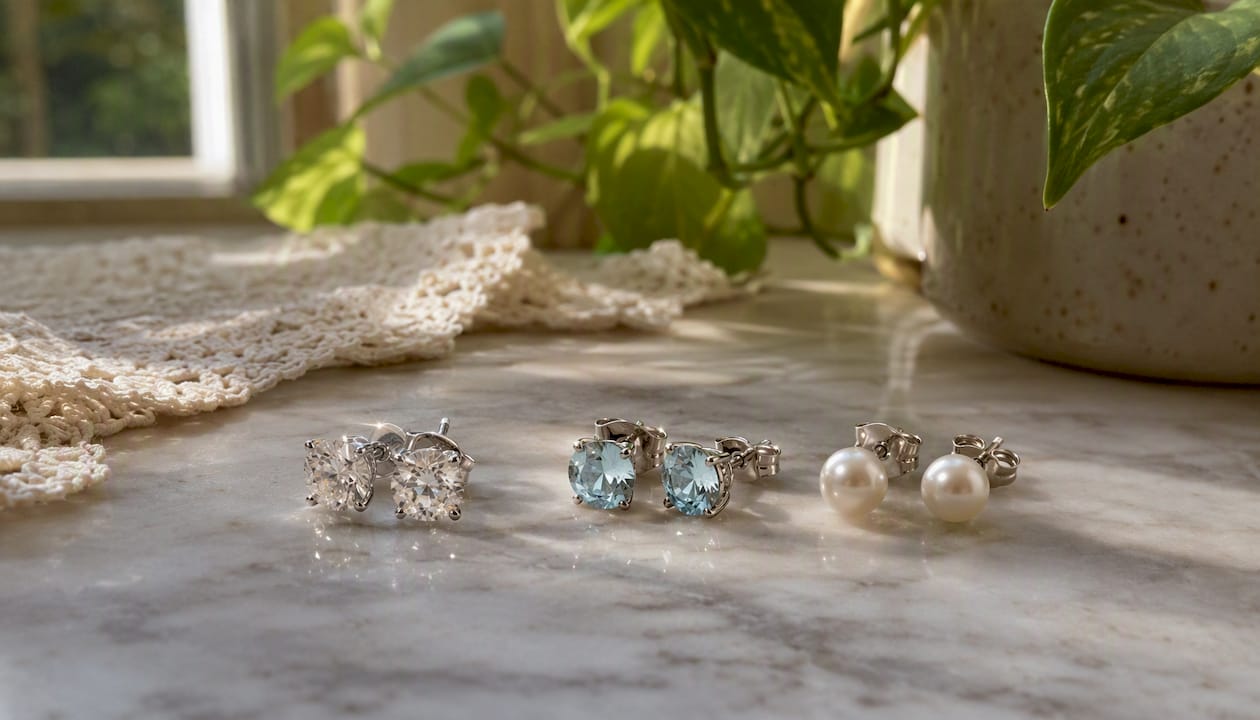
Bezel settings wrap the stone’s edge in metal, protecting it from chips. Prong settings show more of the stone but leave the girdle exposed. For softer stones, bezel or halo settings add meaningful protection. For metals, 14k or 18k gold (yellow, white, or rose) and platinum are the most durable options. Sterling silver works well but tarnishes faster. For children or anyone with sensitive skin, hypoallergenic metals like 14k gold or surgical-grade sterling silver are the right call.
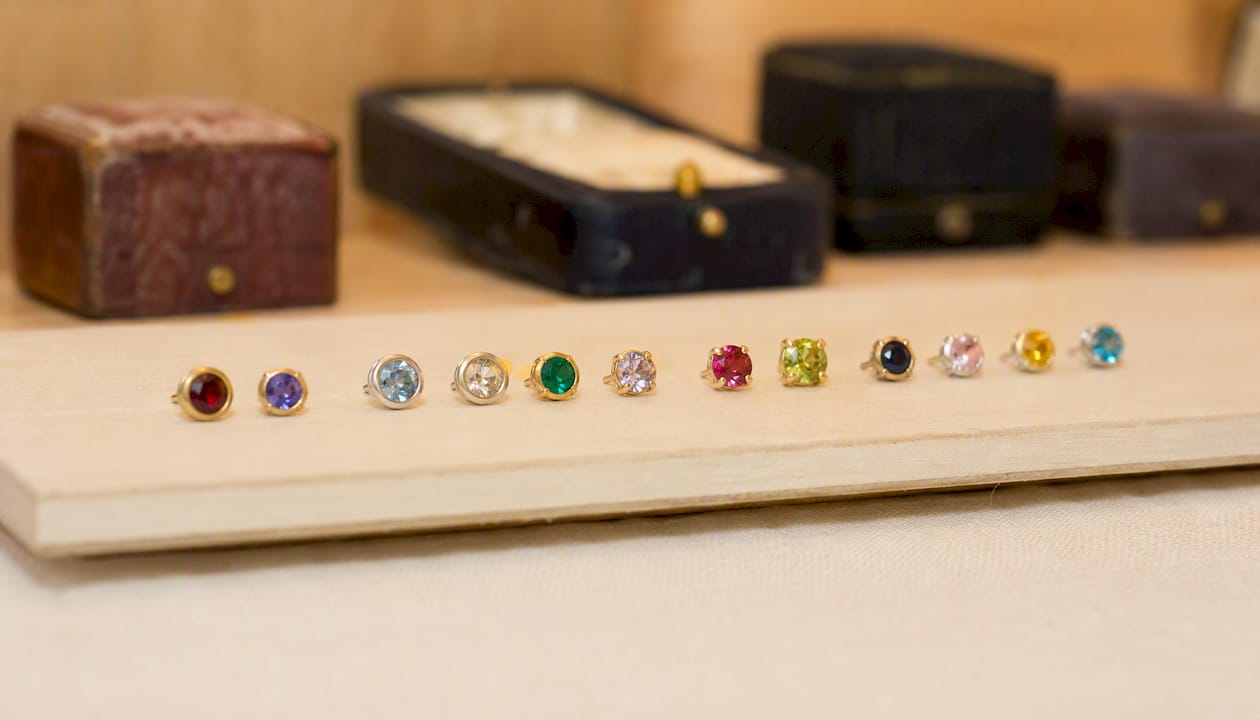
Backing style matters too. Screw backs and latchback closures are more secure than butterfly backs for valuable stones, especially for travel or active days.
Ask the right questions before you buy
Any reputable seller should answer these without hesitation:
- Is the stone natural, lab-grown, or simulated? (A lab-grown stone is chemically identical to natural; a simulant is a different material that looks similar.)
- Has the stone been treated? Emeralds are almost always fracture-filled with oil or resin. Rubies are often heat-treated. Disclosure is standard practice among honest sellers.
- What is the return and warranty policy?
- For stones over a few hundred dollars, is there a gemological certificate (GIA, AGS, or similar)?
Expect standard in-stock orders to arrive within a few days to two weeks. Custom work, engraving, or personalized multi-stone pieces typically add one to three weeks to that timeline, and holiday periods extend it further.
Budget by stone type
Semiprecious studs in silver or gold-filled settings start under $50. Fine gemstone earrings in 14k gold, like sapphire or ruby studs, typically run $150–$600 depending on carat weight and quality. Diamond birthstone earrings span a wide range based on cut and clarity. Lab-grown stones offer the same visual quality at a lower price point, which is worth knowing if budget is a constraint.
Red flags to walk away from
No treatment disclosure, no return policy, vague descriptions like “gemstone color” without naming the actual stone, and pressure to buy without time to compare are all signs to look elsewhere.
Birthstones by month: what you need to know for earrings
The table below covers each month’s primary birthstone, color, Mohs hardness relevant to earring durability, and a quick styling note.
The table listing birthstones, their colors, Mohs hardness values, and styling tips is removed due to unsupported exact numeric hardness ranges.
A few stones deserve extra attention. Pearls, opals, and turquoise all sit below 7 on the Mohs scale, which means everyday dust and grit can scratch them. Earrings are genuinely the better placement for these stones. Diamonds, rubies, and sapphires, all at 9 or above, are the workhorses of daily-wear earrings and need no special format consideration.
How to care for birthstone earrings so they last
Most birthstone earrings respond well to the same basic routine. The exceptions are worth knowing before you cause accidental damage.
- Clean gently after wearing. A soft-bristled toothbrush, mild dish soap, and warm water handle most buildup safely. Rinse thoroughly and pat dry with a lint-free cloth. Do this weekly for pieces you wear daily.
- Skip ultrasonic and steam cleaners for treated or porous stones. Emeralds (fracture-filled), opals, pearls, turquoise, and any stone with visible inclusions can crack or lose their treatment under ultrasonic vibration or steam heat. Stick to hand cleaning for these.
- Store pieces separately. Diamonds scratch everything else. Keep each pair in its own soft pouch or compartment. A secure home jewelry storage solution is worth considering if you’re building a collection with valuable pieces.
- Take earrings off before swimming, sleeping, or heavy activity. Chlorine degrades metal prongs and can bleach or dry out pearls and opals. Sleeping in earrings bends posts and loosens settings over time.
- Keep pearls and opals away from humidity extremes. Pearls can dehydrate and crack in very dry conditions; opals can craze (develop surface cracks) with sudden temperature swings. Store them in a slightly humid environment, away from heating vents.
- Check settings monthly. Run a fingernail gently around the stone. If it catches on a prong, the prong is bent. If the stone wiggles, the setting is loose. Both need a jeweler’s attention before the stone falls out.
- See a jeweler for chips, loose stones, or bent posts. Home repairs on fine jewelry almost always make the problem worse. A jeweler can re-tip a prong or re-set a stone for a fraction of what replacement costs.
Where should you buy birthstone earrings?
A trustworthy seller clears a short checklist: clear product descriptions that name the stone and its origin, explicit disclosure of any treatments, a stated return policy, warranty coverage, and real customer photography (not just renders). For higher-value pieces, a gemological certificate from GIA or a comparable lab adds meaningful assurance.
Superjeweler checks those boxes with a broad gemstone jewelry collection that includes birthstone earrings across price points, personalized multi-stone options, and personalized jewelry for gift buyers who want something more specific than a standard pair. The site lists return policies and warranty terms clearly, which matters when you’re buying a stone you haven’t seen in person.
For standard in-stock earrings, expect delivery within a few business days to two weeks depending on your location. Personalized or engraved pieces typically add one to three weeks. If you’re buying for a birthday or holiday, order at least three weeks ahead to avoid the rush.
What birthstone earrings taught me about buying jewelry
There’s a tendency to overthink birthstone jewelry, to treat it as either purely sentimental or purely decorative, when the best pieces are both at once. The most useful shift in perspective is thinking about placement first. A stone you love but that scratches easily belongs in an earring, not a ring. That single decision, driven by Mohs hardness rather than aesthetics, keeps pieces looking good for decades instead of years.
The other thing worth saying plainly: personalization compounds over time. A pair of studs set with a child’s birthstone means something the day you give it. Ten years later, it means considerably more. That’s not marketing language; it’s just how meaning accumulates around objects we wear regularly. Choosing a piece with that trajectory in mind is the difference between jewelry that gets worn and jewelry that sits in a drawer.
Superjeweler’s birthstone earring collection is worth a look
Superjeweler carries birthstone earrings across every price point, from affordable semiprecious studs in sterling silver to fine gemstone drops in 14k gold. The gemstone earrings category covers all twelve months, and the personalized jewelry section lets you build multi-stone pieces that combine family birthstones in a single design. Every purchase comes with a clear return policy and warranty terms, so you’re not buying blind.

If you’re buying as a gift and want to add a personal touch beyond the stone itself, the personalized jewelry options at Superjeweler include engraving and custom configurations. Browse the collection and filter by birth month to find the right pair, or start with the full gemstone earring selection and narrow from there.
Sources
- History of Birthstones | International Gem Society
- Birthstones by month: meanings, history & folklore | Farmers’ Almanac
- Why birthstone earrings are your new daily essential | Pikumil
- The deeper meaning behind wearing birthstone jewelry | Mood by Rae
