Ethical sourcing means choosing suppliers and vendors who meet defined standards for labor rights, environmental responsibility, and honest governance throughout the supply chain. It sits at the intersection of people, planet, and accountability. According to IBM’s overview of ethical sourcing, organizations embed it inside corporate social responsibility programs precisely because it manages legal, reputational, and operational risk all at once.
Three core elements define what ethical sourcing covers in practice:
- Labor: fair wages, safe working conditions, no child or forced labor
- Environment: responsible use of natural resources, reduced emissions, biodiversity protection
- Transparency: honest disclosure, anti-corruption policies, traceable supply chains
Key Takeaways
Ethical sourcing covers labor rights, environmental responsibility, and honest governance across every tier of a supply chain, not just the supplier you buy from directly.
| Point | Details |
|---|---|
| Definition covers three pillars | People, planet, and governance together define ethical sourcing; missing any one pillar is a gap. |
| U.S. legal obligations are real | The California Transparency in Supply Chains Act requires disclosure from qualifying companies; the UFLPA bans goods made with forced labor from entering the U.S. |
| Certifications have defined limits | FSC, Fairtrade, and Sedex each cover a specific scope; combine them with audits and worker engagement for a complete picture. |
| Remediation beats termination | When a breach is found, investigating root causes and supporting supplier improvement protects workers better than cutting ties immediately. |
| Lab-grown diamonds reduce sourcing risk | For jewelry shoppers, lab-grown stones eliminate the mining step and its associated labor and environmental risks. |
Table of Contents
- What ethical sourcing actually covers
- Ethical vs. responsible vs. sustainable sourcing
- What unethical sourcing looks like in practice
- Why organizations adopt ethical sourcing
- Standards and certifications that verify ethical sourcing
- U.S. legal and disclosure obligations you need to know
- How to build an ethical sourcing program step by step
- How to measure and report progress credibly
- How ethical sourcing applies to jewelry and diamonds
- Why Superjeweler takes ethical sourcing seriously
- Sources
Table of Contents
- What ethical sourcing actually covers
- Ethical vs. responsible vs. sustainable sourcing
- What unethical sourcing looks like in practice
- Why organizations adopt ethical sourcing
- Standards and certifications that verify ethical sourcing
- U.S. legal and disclosure obligations you need to know
- How to build an ethical sourcing program step by step
- How to measure and report progress credibly
- How ethical sourcing applies to jewelry and diamonds
- Why Superjeweler takes ethical sourcing seriously
- Key Takeaways
- Useful sources
What ethical sourcing actually covers
Ethical sourcing spans three dimensions: people, planet, and governance. Each one has a defined scope, and understanding where the boundaries sit helps buyers and organizations ask the right questions.
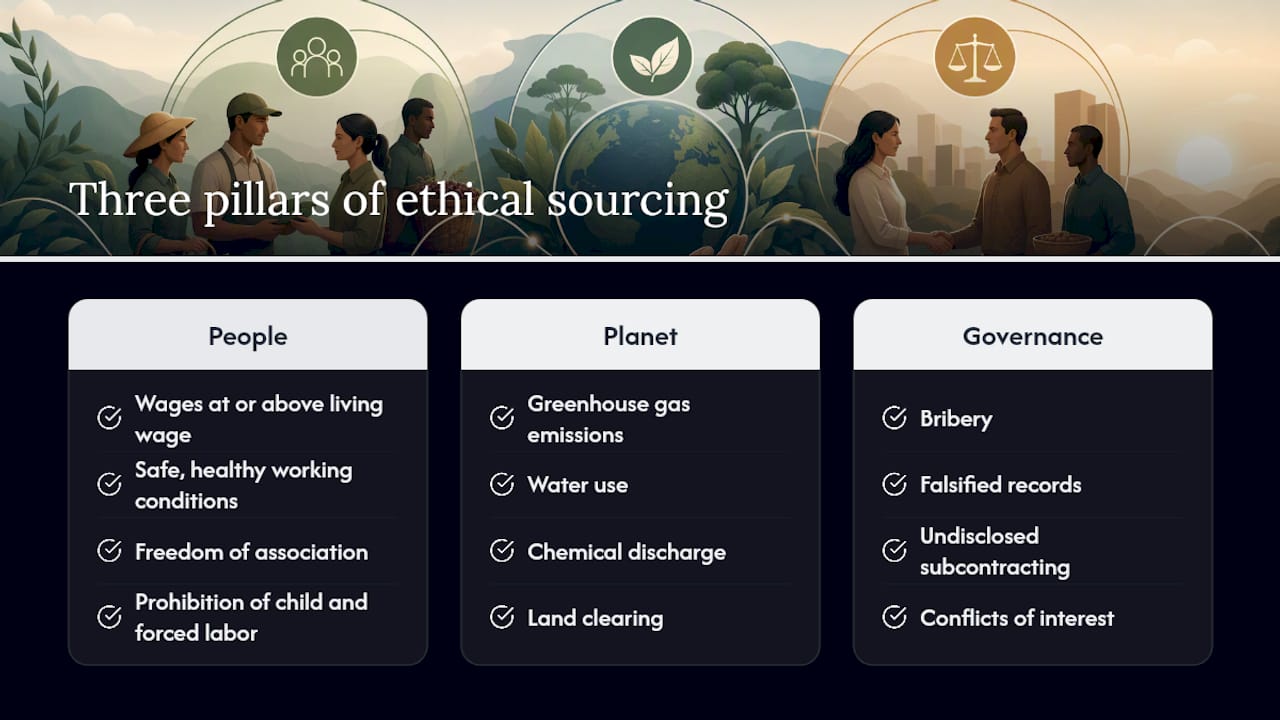
People covers the full range of labor rights: wages at or above a living wage, safe and healthy working conditions, freedom of association, and the absolute prohibition of child and forced labor. The UN Guiding Principles on Business and Human Rights set the international baseline that most credible programs reference.
Planet addresses how production affects natural systems: greenhouse gas emissions, water use, chemical discharge, land clearing, and biodiversity loss. A garment factory that dumps dye effluent into a river is a planet failure. A timber supplier that clears old-growth forest without certification is another.
Governance covers the less visible risks: bribery, falsified records, undisclosed subcontracting, and conflicts of interest. A supplier who passes an audit on paper but routes orders to an uncertified sub-supplier at night is a governance failure.
The scope question that trips most organizations up is tier depth. Most buyers have direct contracts with tier-1 suppliers, the factories or farms they buy from directly. But the real risk often lives deeper. A garment brand may know its tier-1 factory well, yet have no visibility into the spinning mill (tier 2) or the cotton farm (tier 3) that feeds it. IBM notes that credible programs invest in supply-chain mapping beyond tier 1, especially for high-risk inputs like mined gems, cotton, and cocoa.
A quick illustration: a coffee roaster’s tier-1 supplier is a trading company. The trading company buys from cooperatives (tier 2), which source from smallholder farms (tier 3). Child labor and wage violations, if they exist, almost always surface at tier 3, not tier 1. The CIPS Ethics Guide makes the point directly: conventional purchasing pressures like aggressive price negotiations and short lead times can drive poor conditions at exactly those deeper tiers, because the cost pressure gets passed down the chain.
Ethical vs. responsible vs. sustainable sourcing
These three terms appear together constantly, and they are not interchangeable, even though they overlap.
Ethical sourcing is the broadest frame. It covers social, environmental, and governance standards together, treating them as inseparable. A program that protects workers but ignores toxic waste discharge is not fully ethical. Fit Small Business describes ethical sourcing as the umbrella that combines all three dimensions under one commitment.
Responsible sourcing tends to emphasize compliance and risk management. It asks: “Are we meeting our legal and contractual obligations?” It often focuses on due diligence processes, supplier codes of conduct, and audit trails. Responsible sourcing is the operational mechanism; ethical sourcing is the value system behind it.
Sustainable sourcing narrows the lens to long-term environmental and economic viability. Can this supply chain keep producing without depleting the resource base? Sustainable sourcing is a subset of the broader ethical picture, focused on continuity and ecological impact.
A short comparison:
- Ethical sourcing: people + planet + governance, all three together
- Responsible sourcing: compliance-focused, risk-management orientation
- Sustainable sourcing: environmental and economic longevity, often narrower in scope
In practice, many organizations use all three phrases. The safest approach is to ask what specific standards a supplier or brand is actually meeting, not which label they use.
What unethical sourcing looks like in practice
Recognizing red flags is half the battle. The most common warning signs in supply chains include:
- Workers paid below the local minimum wage or denied overtime pay
- Excessive working hours with no rest days, especially during peak seasons
- Child labor in agriculture, mining, or garment production
- Forced labor through debt bondage or withheld identity documents
- Dangerous conditions: no protective equipment, blocked fire exits, toxic chemical exposure
- Bribery of inspectors or falsified audit records
- Undisclosed subcontracting to facilities that have never been assessed
- No grievance mechanism for workers to report problems safely
The business consequences of missing these signals are serious. Legal penalties under U.S. and international law, import bans on goods made with forced labor, consumer boycotts, and operational disruption from factory shutdowns all follow from sourcing failures. TechTarget’s supply chain analysis frames ethical sourcing primarily as risk management: implementing it reduces legal, operational, and reputational exposure simultaneously.
A typical discovery scenario: An audit at a tier-2 textile mill reveals workers clocking 80-hour weeks during peak orders, with no overtime premium paid. The root cause is not the mill owner’s greed alone. The buyer’s own purchasing team placed a last-minute order with a two-week lead time at a price that left no margin for compliant labor costs. The Ethical Trading Initiative’s buying guide is explicit: buyer behavior, not just supplier behavior, creates the conditions for abuse.
Why organizations adopt ethical sourcing
The business case is clearer than it used to be. Organizations that treat ethical sourcing as a cost center are increasingly in the minority.
Primary benefits include:
- Risk reduction: fewer supply disruptions from factory shutdowns, import bans, or labor strikes
- Regulatory compliance: meeting U.S. and international disclosure requirements before they become mandatory
- Brand trust: consumers and retail partners increasingly screen suppliers on ethical criteria
- Supply quality and continuity: stable, fairly treated workforces produce more consistent output
- Access to markets: some retailers and government contracts now require supplier ethical-sourcing credentials as a condition of doing business
Consumer behavior is moving in one direction. Statista’s tracking of U.S. consumer ethical purchasing trends shows growing interest in transparency and eco-conscious choices, with certifications and brand commitments influencing buying decisions across multiple product categories.
The market signal is real for jewelry specifically. Shoppers who once accepted “conflict-free” as a sufficient claim now ask about full supply-chain traceability, labor conditions at the mine, and whether a lab-grown alternative eliminates the risk entirely. Retailers who can answer those questions hold a genuine competitive position. Those who cannot are increasingly exposed, both to consumer scrutiny and to the regulatory pressure described in the next section.
Standards and certifications that verify ethical sourcing
No single certification covers everything. Each standard has a defined scope, and buyers who treat any one label as a complete guarantee are taking a shortcut that can backfire. FSC’s purchasing guide makes this point clearly: certifications vary in what they certify, and combining them with deeper due diligence is best practice.
| Standard / Platform | Scope | Typical use cases | Key limitation |
|---|---|---|---|
| FSC (Forest Stewardship Council) | Responsible forest management and chain of custody | Timber, paper, wood-based packaging | Covers forestry only; no labor or mining scope |
| Fairtrade / Fairtrade USA | Fair prices and terms for producers in developing countries | Coffee, cocoa, cotton, gold, flowers | Producer-price focus; audit depth varies by commodity |
| Sedex | Supplier data platform for labor, health & safety, environment, business ethics | Apparel, food, electronics supply chains | Platform for sharing data, not a certification body itself |
| ILO Conventions | International labor standards: minimum age, forced labor, freedom of association | Benchmark for any sector’s labor compliance | Framework, not a certification; requires interpretation |
| ISO 20400 | Sustainable procurement principles and process guidance | Procurement policy, supplier specifications | Guidance standard, not a product or supplier certification |
ISO 20400 is worth calling out specifically. It gives procurement teams a structured framework for integrating ethical behavior, respect for human rights, and sustainability into sourcing decisions. It does not certify suppliers; it certifies the quality of a buyer’s own procurement process.
Third-party certification helps most when the standard’s scope matches the specific risk. FSC is the right tool for a paper buyer; it tells you nothing about the labor conditions in a garment factory. For complex supply chains, the Ethical Trading Initiative recommends combining certifications with worker engagement, trade-union input, and active remediation plans rather than treating a certificate as a closed case.
U.S. legal and disclosure obligations you need to know
The U.S. regulatory picture is fragmented compared to the EU, but several requirements carry real teeth.
The California Transparency in Supply Chains Act (SB 657) applies to retailers and manufacturers doing business in California with annual worldwide gross receipts over $100 million. Covered companies must disclose on their websites what they are doing across five areas: verification, auditing, certification, internal accountability, and training. The law does not require companies to have a perfect supply chain. It requires them to be honest about what they are and are not doing. Failure to publish a compliant disclosure exposes companies to injunctive action by the California Attorney General.
IBM’s analysis of ethical sourcing regulation identifies this law, alongside the UK Modern Slavery Act, as a primary driver of corporate ethical-sourcing programs in the last decade. The compliance logic is straightforward: companies that already run credible programs find the disclosure easy. Companies that do not have programs scramble to build one when the disclosure deadline arrives.
The Uyghur Forced Labor Prevention Act (UFLPA), effective June 2022, creates a rebuttable presumption that goods produced in the Xinjiang Uyghur Autonomous Region of China are made with forced labor and are therefore prohibited from U.S. import. Importers must provide clear and convincing evidence to the contrary to get goods released. This law has direct operational consequences for apparel, electronics, and solar supply chains.
Practical implications for U.S. buyers:
- Publish a supply chain transparency statement on your website, even if not legally required
- Document your supplier assessment process, not just the results
- Keep records of corrective actions taken when problems are found
- Review your top-spend suppliers against the UFLPA Entity List maintained by U.S. Customs and Border Protection
The OECD Guidelines for Multinational Enterprises recommend that companies prepare disclosures aligned with recognized standards and seek external assurance to strengthen credibility. That guidance applies whether or not a specific law requires it.
How to build an ethical sourcing program step by step
Getting started does not require a large team or a big budget. It requires a clear sequence.
- Adopt a written policy and supplier code of conduct. Define your non-negotiables: minimum labor standards, environmental requirements, anti-corruption expectations. The code of conduct should reference ILO core conventions as the baseline.
- Map your supply chain. Identify your top-spend suppliers and the product categories with the highest inherent risk (mining, agriculture, textiles). Go at least to tier 2 for high-risk categories.
- Conduct a risk assessment. Score suppliers by country risk, sector risk, and relationship depth. Prioritize audits and engagement where risk is highest, not just where it is most convenient.
- Embed requirements in contracts. Include a supplier code of conduct as a contractual exhibit. Add audit rights, corrective action timelines, and termination clauses for repeated non-compliance.
- Onboard new suppliers with a self-assessment questionnaire. Ask about labor practices, environmental permits, subcontracting policies, and grievance mechanisms before placing the first order.
- Conduct audits. Use third-party social audits for high-risk suppliers. Supplement with unannounced visits and worker interviews where possible.
- Remediate, do not just terminate. When a breach is found, investigate the root cause. The Ethical Trading Initiative’s guidance is clear: cutting off a supplier immediately often harms the workers you are trying to protect. Work with the supplier on a corrective action plan with a fixed timeline.
- Report publicly. Publish an annual transparency statement covering what you assessed, what you found, and what you did about it.
Practical supplier questions to ask during onboarding:
- Do you have a written health and safety policy? When was it last reviewed?
- What is your policy on working hours and overtime compensation?
- Do you use subcontractors? Are they assessed against the same standards?
- How do workers raise concerns without fear of retaliation?
- Can you provide documentation of your last third-party audit?
Red flags in supplier responses:
- Reluctance to allow unannounced audits
- Inability to name the farms or factories in their own supply chain
- Pricing that is mathematically incompatible with legal labor costs in the production country
Pro Tip: Review your own purchasing terms before auditing suppliers. Short lead times and last-minute order changes are among the most common drivers of overtime violations. The CIPS Ethics Guide identifies aggressive procurement behavior as a direct cause of labor abuses downstream.
How to measure and report progress credibly
A program without measurement is just a policy document. The KPIs that actually indicate a functioning ethical sourcing program are:
- Percentage of strategic suppliers assessed against the code of conduct
- Percentage of total procurement spend covered by assessments
- Number of corrective action plans opened and closed within agreed timelines
- Worker grievance resolution rate and average resolution time
- Percentage of high-risk suppliers with third-party audit coverage
| Audit approach | Strengths | Limitations |
|---|---|---|
| Supplier self-assessment | Low cost, scalable, good for initial screening | Self-reported; limited reliability without verification |
| Third-party social audit | Independent verification, standardized scoring | Can be gamed; snapshot in time; worker interviews often constrained |
| Unannounced audit | Harder to manipulate; catches real conditions | More expensive; requires supplier contract rights |
| Remote monitoring / worker survey tools | Scalable, ongoing signal; worker voice | Requires digital access; data quality varies |
Credible public reporting goes beyond listing certifications. It describes what was assessed, what problems were found, and what was done. The OECD Guidelines recommend external assurance of responsible business conduct disclosures to strengthen credibility. A transparency statement that only reports good news is a red flag, not a trust signal. Real programs find problems. What separates credible programs from performative ones is what they do next.
How ethical sourcing applies to jewelry and diamonds
Jewelry is one of the most supply-chain-intensive consumer product categories. A single ring can involve gold from a mine in West Africa, diamonds from southern Africa or a laboratory, and finishing work in multiple countries. Each step carries distinct ethical sourcing risks.
Mined diamonds carry the most scrutiny. The Kimberley Process Certification Scheme was created to exclude conflict diamonds from the market, but its definition of “conflict” is narrow. It covers diamonds funding rebel movements against recognized governments, but not diamonds mined under dangerous labor conditions, with child labor, or in areas with severe environmental damage. A Kimberley Process certificate is a necessary baseline, not a complete ethical guarantee.

Lab-grown diamonds eliminate the mining step entirely, removing the most acute human rights and environmental risks associated with extraction. They are chemically and physically identical to mined diamonds. For shoppers whose primary concern is supply-chain ethics, lab-grown diamonds represent the most direct way to sidestep mineral-sourcing risk. Superjeweler’s lab-grown diamond collection is a practical starting point for buyers who want that assurance built in from the start.
What to look for as a shopper:
- A conflict-free declaration that goes beyond the Kimberley Process and addresses labor and environmental standards
- Traceability documentation showing where the stone originated
- Third-party certification for gold or other metals (e.g., Fairtrade Gold, Responsible Jewellery Council certification)
- A retailer’s published sourcing policy, not just a marketing claim
Understanding what conflict-free jewelry really means is worth the five minutes it takes. The gap between a marketing claim and a verified standard is wider than most shoppers realize. Similarly, understanding diamond certification helps you distinguish a grading report (which covers quality) from an ethical sourcing declaration (which covers origin and conditions).
Fairtrade Gold is one of the few certifications that directly addresses artisanal and small-scale mining communities, covering fair prices, safe working conditions, and environmental standards at the mine level. It is still relatively rare in U.S. retail, but its presence in a retailer’s supply chain is a meaningful signal. For consumers who want to understand how ethical claims work across product categories, the same logic applies whether you are buying skincare with cruelty-free claims or a diamond ring: ask what standard is being met, who verified it, and what happens when a violation is found.
Why Superjeweler takes ethical sourcing seriously
At Superjeweler, the sourcing conversation is not separate from the shopping experience. Customers buying an engagement ring or a gift are making a values statement as much as a financial one, and they deserve accurate information to make that choice well.

Superjeweler’s lab-grown diamond jewelry collection gives shoppers a direct path to stones with no mining footprint. For customers who prefer mined stones, conflict-free sourcing guidance is available across the site. The goal is transparency: clear product descriptions, honest certification language, and no inflated claims about what a single label guarantees.
If you are shopping for an engagement ring and want to factor ethical sourcing into your decision, start with the lab-grown diamond category or ask about the specific origin documentation available for any stone. Superjeweler’s team can walk you through what the certifications on a given piece actually cover.
Sources
Primary sources used in this article, organized for readers who want to verify claims or go deeper:
- OECD Guidelines for Multinational Enterprises on Responsible Business Conduct
- Guide to buying responsibly – Ethical Trading Initiative
- Fsc
Recommended
- Step by Step Jewelry Buying: Your Complete 2026 Guide
- Why Consider Lab-Grown Gems for Ethical Luxury
- Gemstone Buying Process: A Complete Guide for 2026
