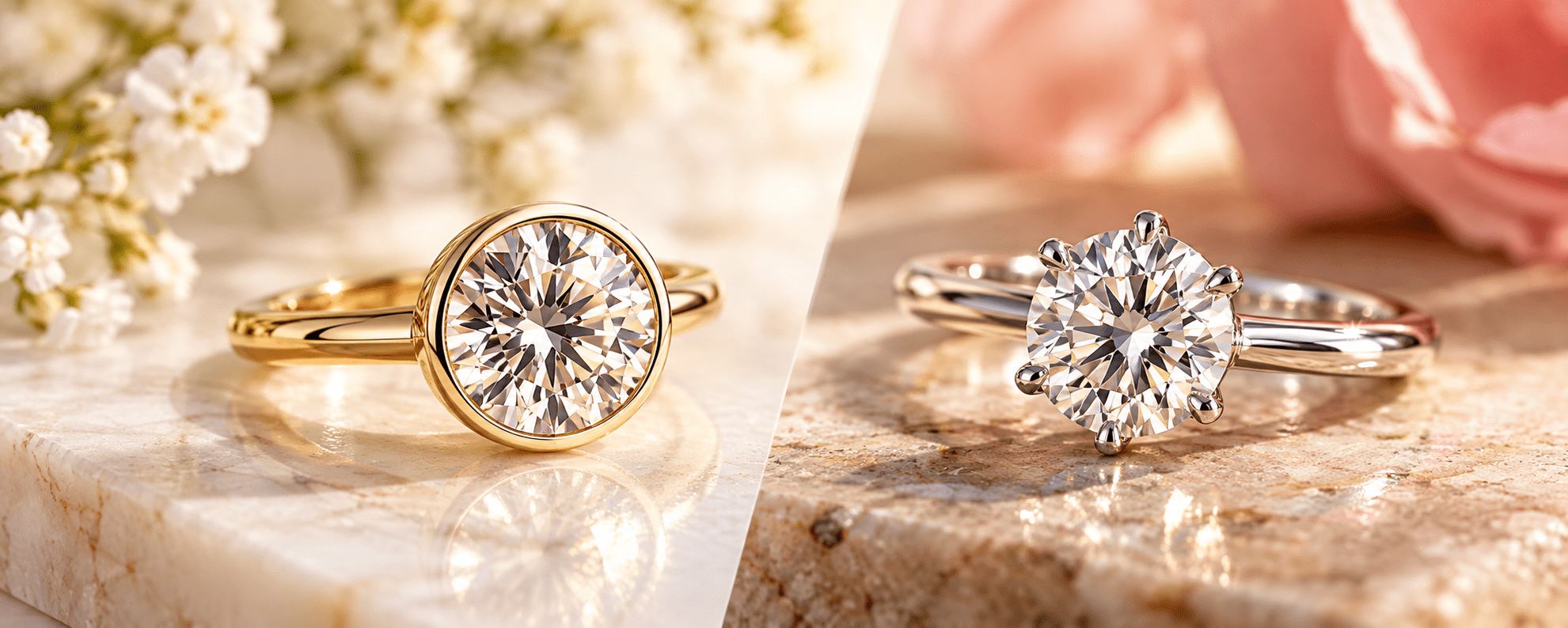
Choose a bezel setting if you work with your hands, play sports, or want a snag-free ring you barely think about. Choose a prong setting if maximum sparkle and a classic silhouette matter more than daily armor. Both hold a diamond securely when built correctly, but they trade off differently on light performance, maintenance, and resizing cost, which the rest of this guide breaks down in detail.
TL;DR:
- Bezels cost more upfront because they use more metal and require more hand-finishing labor to shape around the stone.
- Resizing a bezel is more complex and usually more expensive than resizing a prong setting, which is generally quicker and easier.
- Bezel settings are ideal for active lifestyles, especially for corner-vulnerable shapes like emerald or asscher cuts, due to their full protection.
- Prong settings provide maximum brilliance by allowing most light to enter the diamond from all angles, making them the classic choice for focused sparkle.
- Six-prong settings on larger stones increase security without significantly reducing brilliance, according to expert recommendations.
Table of Contents
- Bezel vs Prong Setting: What a Bezel Actually Is
- Bezel vs Prong: How a Prong Setting Compares
- Sparkle, Security, and Cost Side by Side
- How to Choose Between Bezel and Prong
- Maintenance and Longevity You Should Plan For
- Which Diamond Shapes Pair Best With Each Setting
- What Bezels and Prongs Cost Over Time
- Balancing Sparkle and Security
- Browse Bezel and Prong Options at Superjeweler
- Sources
- FAQ
Bezel vs Prong Setting: What a Bezel Actually Is
A bezel setting surrounds the diamond with a continuous metal rim instead of individual metal claws. Jewelers make two main versions: a full bezel wraps the entire stone, while a partial or half bezel leaves the sides open and only rings the front and back. Both styles protect the diamond’s edges from chips and reduce the odds of the stone snagging on clothing, hair, or gloves.
That protection comes with real trade-offs. The metal rim blocks some side light from entering the stone, which can mute brilliance compared to an open setting. It can also make a diamond look roughly 10 to 20% smaller than the same stone in a prong mount, since the rim covers part of the visible surface.
Where bezels shine:
- Active hands: nurses, teachers, gardeners, and anyone who washes dishes constantly benefit from the low-profile, snag-resistant design.
- Corner-vulnerable shapes: emerald, asscher, and princess cuts have sharp corners that chip easily, and a bezel guards those points.
- Easier upkeep: fewer crevices mean less trapped soap scum and lotion buildup.
The trade-off is cost. Bezels use more metal and require more hand-finishing labor, and resizing them later is more technically involved than resizing a prong ring.
Bezel vs Prong: How a Prong Setting Compares
A prong setting holds the diamond with small metal claws, typically four or six, leaving most of the stone exposed to light from every angle. That open architecture is exactly why prong settings remain the standard for engagement rings: more surface area exposed to light produces noticeably more brilliance than a bezel mount.
Four prongs create a lighter, more minimal look and expose slightly more of the stone. Six prongs cover more of the girdle and distribute pressure across more contact points. GIA recommends six prongs on larger center stones specifically because the extra contact points improve security without meaningfully dimming the sparkle.
What prongs deliver:
- Maximum brilliance: light enters from nearly every direction, which is why prong mounts photograph so well.
- The classic profile: this is the silhouette most people picture when they think “engagement ring.”
- Simpler resizing: most jewelers can resize a prong ring in a single visit without disturbing the stone’s setting geometry.
The exposed girdle is also the weak point. Prong tips wear down at predictable contact points over years of wear and need periodic re-tipping, and a caught prong can bend, loosen, or snag on a sweater at the worst possible moment.
Sparkle, Security, and Cost Side by Side
| Factor | Bezel Setting | Prong Setting |
|---|---|---|
| Appearance/brilliance | Softer, contained sparkle; stone can look smaller | Maximum light return and brilliance |
| Security/impact resistance | Very high; rim shields edges and girdle | Strong with 6 prongs; more vulnerable with only 4 |
| Snag risk | Low, smooth profile | Higher, exposed claws catch fabric and hair |
| Maintenance frequency | Occasional rim polishing, less corrective work | Periodic inspection and re-tipping needed |
| Resizing complexity | More involved, often costlier | Usually straightforward at most jewelers |
| Relative cost | Higher metal and labor cost upfront | Typically lower upfront cost |
For a larger center stone where security is the priority, GIA’s guidance on six-prong mounts is worth following if you still want an open, prong-style look. For someone who wants to stop thinking about their ring during a workout, a bezel wins outright. There’s no universally “better” option here. It’s a trade-off between visible sparkle and passive, built-in security, and the right answer depends entirely on how you live day to day.
How to Choose Between Bezel and Prong
Work through these questions before you settle on a setting:
- How often do your hands touch water, dirt, or equipment? Daily manual work or frequent glove use points toward a bezel or half-bezel.
- Do you play sports or exercise with your ring on? If you can’t remove it consistently, prioritize a snag-free bezel.
- What shape is your diamond? Emerald, asscher, and cushion cuts benefit from bezel corner protection; round, oval, and princess cuts are built to show off in a prong mount.
- How important is maximum sparkle to you? If brilliance is non-negotiable, lean prong, and consider six prongs on a larger stone for added security.
- What’s your resizing timeline? If your ring size might change (common in the first year of marriage), factor in that prong resizing is typically faster and cheaper.
When you talk to a jeweler, ask directly how the prongs are soldered, how the bezel rim is formed and finished, what the warranty covers, and how often they recommend inspection. Vague answers on any of those points are a warning sign.
Red flags to watch for:
- Thin, uneven prongs that already look filed down in-store.
- A bezel rim with visible gaps or an uneven edge around the stone.
- Any seller who can’t explain their maintenance or inspection policy.
Pro Tip: Bring your ring in for a professional check every six months if you wear it daily, especially with prongs. Catching a thinning prong before it fails costs far less than replacing a lost stone.
For a full walkthrough of the buying process, Superjeweler’s step-by-step engagement ring guide covers budget, certification, and setting choices together.
Maintenance and Longevity You Should Plan For
Jewelers checking a ring at a routine inspection focus on three things: prong thickness, “mushrooming” where a prong tip flattens from repeated contact, and bezel rim integrity where the metal meets the stone. Prongs wear at predictable contact points and need targeted repair over a ring’s lifetime, while bezels distribute pressure more evenly and typically require less frequent corrective work, though a bezel resize is often more technically involved than a prong resize.
- Platinum holds its shape longer under wear than gold, making it a common choice for prong tips that see heavy use.
- Bezel settings trap less debris and are easier to keep clean since there’s no gap under the stone for soap or lotion to collect.
- Insure any ring above a few thousand dollars, and keep inspection receipts as documentation.
Quick fact: GIA’s own guidance notes that adding two more prongs meaningfully increases girdle protection on larger stones, which is why six-prong mounts show up so often on stones over two carats.
Which Diamond Shapes Pair Best With Each Setting
Emerald, asscher, and cushion cuts have prominent corners that chip under impact, so a bezel or half-bezel gives those edges real protection while still showing off their geometric lines. Round, oval, and princess cuts are cut specifically to maximize light return, and a prong mount lets that light in from every angle instead of blocking it at the rim.
- Best for bezels: emerald, asscher, cushion (corner protection matters most).
- Best for prongs: round, oval, princess (brilliance matters most).
- Hybrid options: a half-bezel protects the sides while opening the top for light, and a low-profile prong setting reduces snag risk without sacrificing sparkle. Browse unique ring setting examples if you want a style that splits the difference.
What Bezels and Prongs Cost Over Time
Bezels typically cost more upfront because they use more metal and demand more hand-finishing labor to form a clean, even rim around the stone. Resizing one later often means sending the ring back to a skilled setter, since the bezel has to be carefully reshaped around the stone rather than simply stretched or compressed.
Prongs are usually the cheaper option out of the gate, and most jewelers can resize a prong ring quickly without disturbing the setting. If you’re unsure of your size, confirm it carefully before choosing a bezel. A prong ring gives you more room to adjust after the fact without a major cost jump.

Balancing Sparkle and Security
If your hands do real work every day, a bezel or half-bezel will outlast a prong setting with far less babying. If sparkle is the whole point and you’re willing to get inspections every six months, prongs earn their reputation. Either way, factor maintenance and insurance into your budget before you buy, not after something bends. Browse engagement rings if you’re ready to compare both styles side by side.
— Andrew
Browse Bezel and Prong Options at Superjeweler
You can find access to both setting styles without the markup a traditional jewelry store adds for the same craftsmanship. Whether you’ve decided on a snag-free bezel for daily wear or a classic prong mount built for maximum brilliance, you can compare real options instead of guessing from a catalog photo.

Start by browsing Rings to see current bezel and prong styles across metals and price points, or explore lab-grown diamond options if you want a larger center stone without the larger price tag. Every piece ships with Superjeweler’s guarantee coverage, and if you’re unsure about sizing before you commit to a bezel, reach out for sizing guidance before you check out. Buying the right setting the first time beats resizing it later.
Sources
Key claims in this guide draw on GIA’s prong security guidance, Diamonds.pro’s bezel education, and Superjeweler’s prong setting guide.
- How to Decide: Four Prongs versus Six Prongs for Your Engagement Ring — GIA
- Diamonds
- Prong vs Bezel Setting: 7 Costly Mistakes Buyers Make — Moissanite by Aurelia
FAQ
Is a Bezel Setting More Secure Than Prongs?
Yes, in terms of impact resistance and snag protection. A continuous metal rim shields the diamond’s edges far better than exposed claws, though a well-made six-prong setting still offers strong security for most everyday situations.
Which Setting Is Better for Earrings, Prong or Bezel?
Bezel settings are generally the better fit for earrings because they get bumped and caught on hair, scarves, and clothing far more than a ring does. The snag-free profile matters even more on an earring you’re not consciously protecting throughout the day.
Is a Bezel Setting More Expensive?
Usually, yes. Bezels require more metal and more hand-finishing labor to form a clean rim around the stone, and resizing them later tends to cost more than resizing a prong ring. Prong settings are typically the lower-cost option upfront.
Is a Bezel Setting Timeless?
Bezel settings have stayed in steady rotation for decades and read as both modern and vintage depending on the metal and stone shape. They’re not a passing trend. Pairing one with an emerald or cushion cut, in particular, gives it a look that has held up across generations of ring design.
Recommended
- How to Customize Engagement Ring for a Perfect Fit
- Prong Setting Explained: Your Complete Jewelry Guide
