Channel settings win on protection: the diamonds sit flush between two metal rails, so there’s nothing raised to snag or chip during daily wear. Pavé settings win on sparkle, spreading dozens of small stones across a surface with almost no visible metal, but the tiny beads holding each diamond demand more careful handling. If you’re rough on your jewelry or wear a ring every day at work, lean channel. If you want maximum brilliance for a piece you’ll treat a little more gently, pavé is the better call.
TL;DR:
- Channel settings are more durable and better suited for daily wear due to their protective rails that shield stones from impact and snagging.
- Pavé settings offer higher brilliance with minimal metal between stones but require more frequent inspections and maintenance to prevent damage or loosening.
- Micro-pavé is the most delicate variation, providing increased sparkle but demanding expert setting work and careful handling over time.
- The cost of pavé rings tends to be higher because of labor-intensive setting processes and potential repair needs, especially with micro-pavé styles.
- For active lifestyles or rough hands, a channel setting generally provides the safest long-term protection, while pavé excels in sparkle for special occasions or controlled environments.
Table of Contents
- Channel Setting vs. Pavé Setting: What Each One Actually Is
- What a Pavé Setting Actually Involves
- Channel vs. Pavé: The Trade-Offs That Actually Decide Your Purchase
- How to Choose the Right Setting for Your Lifestyle
- Cleaning and Caring for Channel and Pavé Rings
- Workmanship Signals That Predict How Long Either Setting Will Last
- Where These Settings Actually Came From
- What Each Setting Typically Costs
- Which Gemstones Work Best in Each Setting
- Rings, Bands, and Beyond: Where You’ll See Each Style
- The Skills and Tools Behind Each Setting
- Three Ways to Think About This Decision
- Shop Channel and Pavé Styles at Superjeweler
- Sources
- FAQ
Channel Setting vs. Pavé Setting: What Each One Actually Is
Before you can weigh channel vs pavé setting against your own lifestyle, it helps to know what’s physically happening under each stone.
How a channel setting holds stones
A channel setting seats diamonds edge to edge inside a groove cut between two parallel metal rails, with no metal separating one stone from the next. The rails themselves do the work of security, gripping each stone’s girdle (the widest part of the diamond) along its sides rather than from above. Jewelers typically build these in 14k or 18k gold or platinum, and rail thickness matters more here than in almost any other setting style: thin rails flex under impact, while properly proportioned rails resist bending for decades.
The workmanship detail that separates a good channel setting from a mediocre one is bearing conformity, meaning the groove has to match the exact shape and girdle profile of each stone. The GIA notes that channel settings protect side stones effectively because the metal walls act as a physical barrier, which is why this style shows up constantly in:
- Wedding bands meant for daily wear
- Eternity rings with stones running the full circumference
- Men’s rings and pieces exposed to regular impact
Pro Tip: Run your fingertip across a channel-set band before buying. If you feel any edge or lip where metal meets stone, the bearing wasn’t cut precisely and the setting may loosen faster than it should.
What a Pavé Setting Actually Involves
Pavé setting technique packs many small diamonds tightly together, each held by tiny metal beads or micro-prongs raised from the surface, creating the “paved” look the name describes. Because so little metal shows between stones, pavé-style jewelry reads as almost solid sparkle from a few feet away.
There’s real variation within the category:
- Standard pavé: small stones set with visible beads, moderate density
- Micro-pavé: extremely small stones (often under 1mm) set under a microscope, producing a “diamond-dusted” texture
- Bright-cut pavé: channels cut and polished around each stone to bounce extra light before the bead is raised
Jewelers also draw on French versus English bead-setting traditions, which differ in bead count and placement and change both the look and the strength of the finished piece. The trade-off is consistent across all these variants: less visible metal means more brilliance, but also less structural support per stone. Brides’ guide to pavé settings points out that this delicacy is why pavé rings often get flagged for more cautious wear than solitaire or channel styles.
Channel vs. Pavé: The Trade-Offs That Actually Decide Your Purchase
Here’s where the decision gets concrete. Security, sparkle, and long-term cost don’t move together, so the setting that wins one category usually gives something up in another.
| Factor | Channel Setting | Pavé Setting |
|---|---|---|
| Security/durability | High. Rails shield stones from both sides. | Moderate. Beads or prongs are more exposed to snagging. |
| Sparkle/metal visibility | Lower visible brilliance; more metal shows | High brilliance; minimal metal visible |
| Maintenance needs | Occasional inspection; rails rarely need repair | More frequent inspection; beads can wear or catch |
| Best uses/who it fits | Active wearers, manual work, daily bands | Special-occasion pieces, statement rings, sparkle-first buyers |
| Typical cost considerations | Labor moderate; repairs are less frequent | Labor-intensive setting; bead re-setting adds to lifetime cost |
On security, the difference comes down to exposure. A channel stone has metal on two sides at all times. A pavé stone typically has metal touching it at only a few small points, so a hard knock against a door frame or gym equipment is far more likely to bend a bead loose than to damage a channel rail.
On sparkle, pavé’s advantage is almost purely geometric. Spreading small diamonds across a wider surface, with minimal metal between them, increases the total reflective area visible to the eye. Some jewelers also use pavé along the shank or basket of a ring to make the center stone look larger without changing its actual carat weight, since the surrounding brilliance draws the eye outward.
On wearability, ask yourself how your hands spend most of the day. Channel settings tolerate desk work, driving, and light household tasks well. Pavé settings are riskier around rough fabric, gym equipment, or gardening, where a snagged bead can pop a stone loose without you noticing until later.
When you’re evaluating photos online, GIA’s quality-assurance benchmarks point to the same red flags in both styles: visible gaps between stone and metal, thin or unevenly cut rails, and beads that look flattened or poorly defined under magnification.
How to Choose the Right Setting for Your Lifestyle
Run through this checklist before you commit to either style:
- Assess your daily hands-on activity. Manual labor, gym sessions, or frequent hand-washing point toward channel.
- Decide your center-stone priority. If the ring’s main job is maximizing perceived sparkle around a modest center stone, pavé pulls more visual weight.
- Set a budget envelope that includes future upkeep. Pavé rings tend to need more frequent professional check-ins over the years.
- Think about how often you’ll want repairs versus how often you’ll tolerate them. Channel rails rarely need touch-ups; pavé beads occasionally do.
When you’re talking to a jeweler or reading a product listing, ask directly: What metal and rail thickness is used? How are the stones set and inspected before shipping? What’s the warranty and repair policy if a stone loosens?
Watch for these red flags regardless of style: visible gaps between stone and metal, rails or prongs that look sharp or unusually thin, beads that appear uneven or under-formed, and any listing that skips warranty or inspection information entirely.
As a rule of thumb, active lifestyles and desk jobs with a lot of hand use both lean toward channel for peace of mind, while occasional wearers who save a piece for dinners out and special events can enjoy pavé’s brilliance without worrying about daily wear and tear.
Pro Tip: If you can’t decide, ask about hybrid designs. Plenty of rings use a channel-set band with a pavé halo around the center stone, giving you rail protection where your hand takes the most abuse and sparkle where it matters visually.
Cleaning and Caring for Channel and Pavé Rings
Both settings respond well to the same gentle routine: soak the piece in warm water with a few drops of mild dish soap, loosen debris with a soft-bristled brush, then rinse thoroughly and air dry. The American Gem Society recommends this exact combination as safe for most diamond jewelry.
Avoid toothpaste, bleach, and ammonia-based cleaners, especially on pavé pieces where the abrasive texture can loosen small beads over time. Never clean over an open drain, and skip ultrasonic cleaners on delicate micro-pavé unless a jeweler confirms the piece can handle the vibration.
On inspection cadence: check your ring visually about once a month for any looseness or damaged prongs, and get a professional inspection and cleaning at least once a year, more often if you notice snagging on clothing or hair. Channel repairs usually involve re-cutting or re-tightening the rail; pavé repairs more often mean re-setting or replacing individual beads, which can be a slower, more delicate process for a jeweler to complete correctly.
Workmanship Signals That Predict How Long Either Setting Will Last
Craftsmanship, not the setting name on a tag, ultimately decides whether a ring holds up. Before buying, check for:
- Bearing conformity: the groove or seat matches the stone’s exact shape, with no visible daylight underneath
- Rail or prong thickness: substantial enough to resist bending, not filed down for a sleeker look
- Bead finish and count: clean, rounded beads rather than flattened or inconsistent ones
- Metal selection: platinum and 18k gold hold their shape under stress better than softer alloys
GIA’s benchmarks on setting quality note that poor bearing fit is one of the most common causes of stone loss over a ring’s lifetime, more so than the setting style itself. When you’re shopping online, zoom into product photos and look specifically for gaps, uneven beads, or rails that look thin relative to the stone size. Retailers that offer warranty coverage and professional inspection services give you a safety net if a workmanship issue surfaces after purchase.
Where These Settings Actually Came From
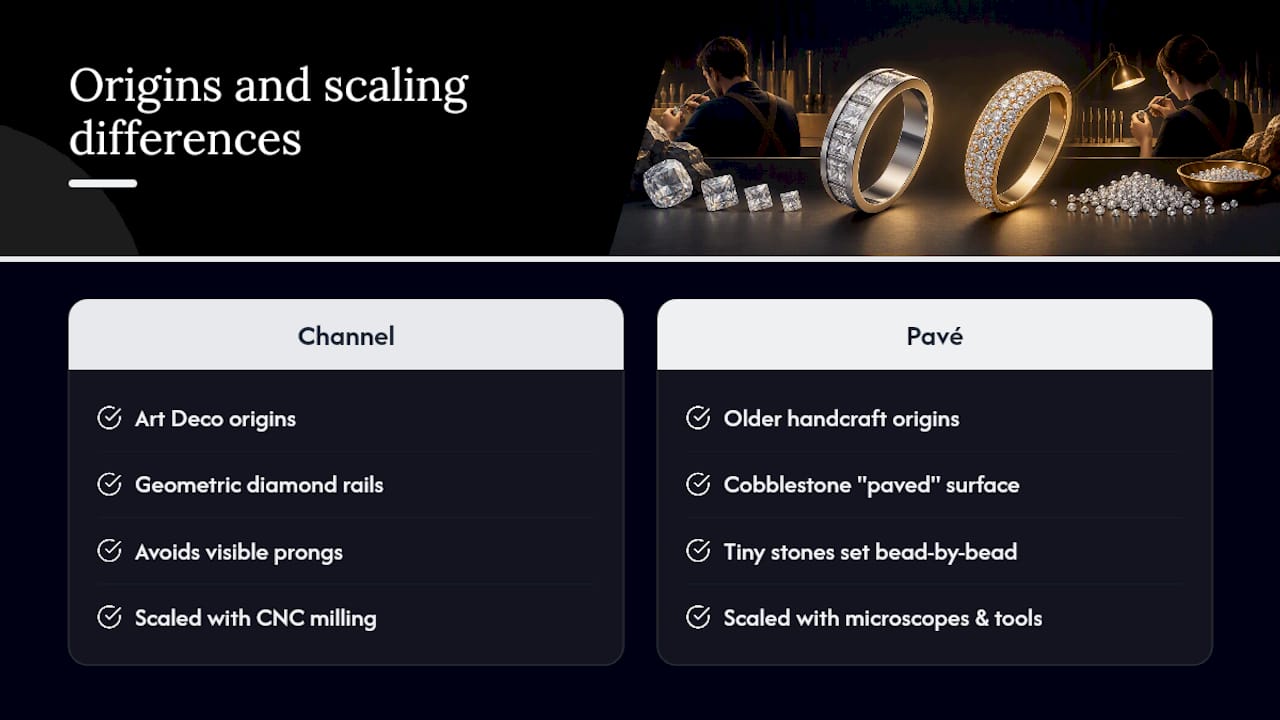
Channel setting techniques trace back to early twentieth-century jewelry making, when Art Deco designers wanted geometric lines of diamonds without visible prongs breaking up the pattern. The style suited the era’s love of clean, architectural symmetry, and it became a staple of wedding bands once manufacturers figured out how to cut consistent grooves at scale.
Pavé setting has older roots. The word itself comes from the French term for “paved,” describing surfaces covered edge to edge in cobblestone-like fashion. Jewelers were hand-setting tiny stones this way well before mass production, but the technique stayed rare and expensive because it demanded painstaking bead-by-bead work under magnification. Micro-pavé, in particular, only became commercially practical once high-powered microscopes and precision tools let setters work with stones smaller than a grain of sand.
Both styles evolved alongside changes in diamond cutting and metal alloys. As cutting technology improved and small stones became more consistently sized, pavé settings became easier to standardize. Channel setting, meanwhile, benefited from more precise CNC milling, which let manufacturers cut rail grooves with far tighter tolerances than a hand tool ever could. Today, both techniques appear across price points, from entry-level bands to high-end designer pieces, a shift from their origins as labor-intensive specialty work.
What Each Setting Typically Costs
Channel settings generally involve less labor per stone because the rails do most of the structural work, and stones are placed in a continuous line rather than individually beaded. That efficiency tends to keep channel-set pieces more budget-friendly relative to the number of stones involved, though rail cutting still requires precision machining.
Pavé setting is inherently more labor-intensive. Each stone needs its own beads or prongs raised and shaped by hand or with fine tools, and micro-pavé in particular requires microscope-assisted work that takes considerably longer per stone. That labor cost gets passed along, which is part of why pavé rings often carry a higher price relative to total carat weight than a comparable channel design.
Repair costs follow a similar pattern over the life of the piece. A channel rail rarely needs attention beyond periodic inspection, keeping long-term maintenance costs low. Pavé rings, especially micro-pavé, are more likely to need occasional bead re-setting, and each repair visit adds a small but real cost over the years. When you’re comparing two rings at a similar sticker price, factor in that a pavé piece may ask more of your wallet down the road, not just at checkout.
Which Gemstones Work Best in Each Setting
Diamonds dominate both channel and pavé work because their hardness (a 10 on the Mohs scale) holds up to the pressure of tight metal contact without chipping. But other stones fit differently depending on the setting.
Channel settings pair well with sapphires and rubies, which share diamond’s high hardness and can tolerate the same edge-to-edge rail pressure. Softer stones like opal or pearl are a poor match for channel work since the rails apply consistent lateral pressure that can crack or crush anything below roughly 7 on the hardness scale.
Pavé settings are more forgiving of stone variety because the beads apply pressure at just a few small points rather than continuous contact. Still, most pavé work sticks to diamonds, sapphires, and occasionally small rubies, since fragile stones set at that scale are especially vulnerable to the pressure of bead-setting tools. Colored gemstone pavé does exist, particularly in fashion jewelry, but it’s less common in fine bridal pieces where diamonds remain the standard.
Rings, Bands, and Beyond: Where You’ll See Each Style
Channel setting shows up most often in wedding bands and eternity rings, where a continuous line of stones needs to survive years of daily contact. It also appears in men’s rings, tennis bracelets, and some watch bezels, anywhere a low-profile, snag-resistant row of stones makes sense.
Pavé setting turns up on engagement ring shanks, halos around center stones, and dangle earrings, where its job is pure visual impact rather than structural bulk. You’ll also see pavé on pendant bails, bracelet links, and the undersides of rings (a detail called “pavé on the basket” that adds sparkle you notice only when the ring catches light from below). Because pavé style jewelry works at such small scale, it’s common on delicate pieces like stacking rings and thin tennis bracelets, where a channel setting’s rail thickness would look bulky.
The Skills and Tools Behind Each Setting
Cutting a channel setting starts with precisely milling the groove between two rails, typically using a jeweler’s saw, graver, and increasingly, CNC equipment for consistent depth and width. The setter then seats each stone and burnishes the rail edges over the girdle to lock it in place, a process that demands accuracy since even a slightly uneven groove leaves a visible gap.
Pavé work relies on different tools entirely: a beading tool or graver to raise tiny metal beads, a loupe or microscope for standard and micro-pavé respectively, and enormous patience, since a single ring might involve dozens of individually placed stones. Setters need steady hands and years of practice to get bead height and spacing consistent, which is part of why skilled pavé setters are harder to find than general bench jewelers. Micro-pavé in particular is considered one of the more demanding specialties in the trade, reserved for setters with advanced training and the fine motor control to work reliably at that scale.
Three Ways to Think About This Decision
If you’re active and rarely take your ring off, channel is the safer long-term bet. If sparkle is the whole point and you’re comfortable with a bit more upkeep, pavé delivers real brilliance. If you’re torn, a hybrid piece with a channel-set band and pavé accents often gives you both.
Whatever you choose, prioritize workmanship over trend. A well-built channel ring will outlast a poorly set pavé one regardless of which style looks better in a photo.
— Andrew
Shop Channel and Pavé Styles at Superjeweler
Superjeweler carries both channel and pavé styles across wedding bands and rings, so you can compare rail-set security against pavé sparkle side by side instead of guessing from a single listing.

Every piece ships with detailed warranty and return information available before purchase, and customer service can assist with questions about setting details, metal thickness, and repair policies. If a channel-set band feels safer for your daily routine, or a pavé-accented diamond bridal set feels like the sparkle you want for a special piece, both are a click away. Browse the current selection, compare setting styles directly on the product pages, and reach out to customer service if you want help matching a setting to how you actually plan to wear the ring day to day.
Sources
- Side Stone Settings for Engagement Rings | GIA 4Cs
- Pavé-Set Engagement Rings: The Complete Guide
- Jewelry gemstone cleaning methods | American Gem Society
- Quality assurance benchmarks: setting a pear-shaped center stone | GIA
FAQ
Which pavé setting is best?
Standard pavé offers the best balance of sparkle and durability for everyday special-occasion wear, while micro-pavé delivers the most brilliance but is the most delicate variant, best suited to pieces you wear occasionally or protect with a strong warranty.
Do channel-set diamonds sparkle?
Channel-set diamonds sparkle less than pavé because more metal is visible between and around the stones. What channel settings sacrifice in brilliance, they make up for in durability during daily wear.
Does a pavé setting make a diamond look bigger?
Pavé around a center stone can make it appear larger by surrounding it with continuous brilliance that draws the eye outward, even though the center stone’s actual carat weight stays the same. This effect is especially strong with hidden halo designs, according to Brides’ guide on pavé rings.
Which type of pavé setting is the most secure?
Standard pavé, with slightly larger beads and stones, tends to be more secure than micro-pavé because there’s more metal holding each stone. Micro-pavé’s tiny beads and stones are more vulnerable to snagging and require more frequent professional inspection.
What’s the safest setting for an everyday wedding band?
Channel setting is generally the safer choice for an everyday wedding band because the rails protect stones from both sides against impact. If you want some sparkle without giving up that protection, look at diamond wedding bands that combine a channel-set band with smaller pavé accents.
Recommended
- What Is Pavé Setting? Your Complete Jewelry Guide
- What Is a Pavé Setting? Your Complete Guide
- Diamond Earring Care Tips: Proven Steps to Keep Them Sparkling
