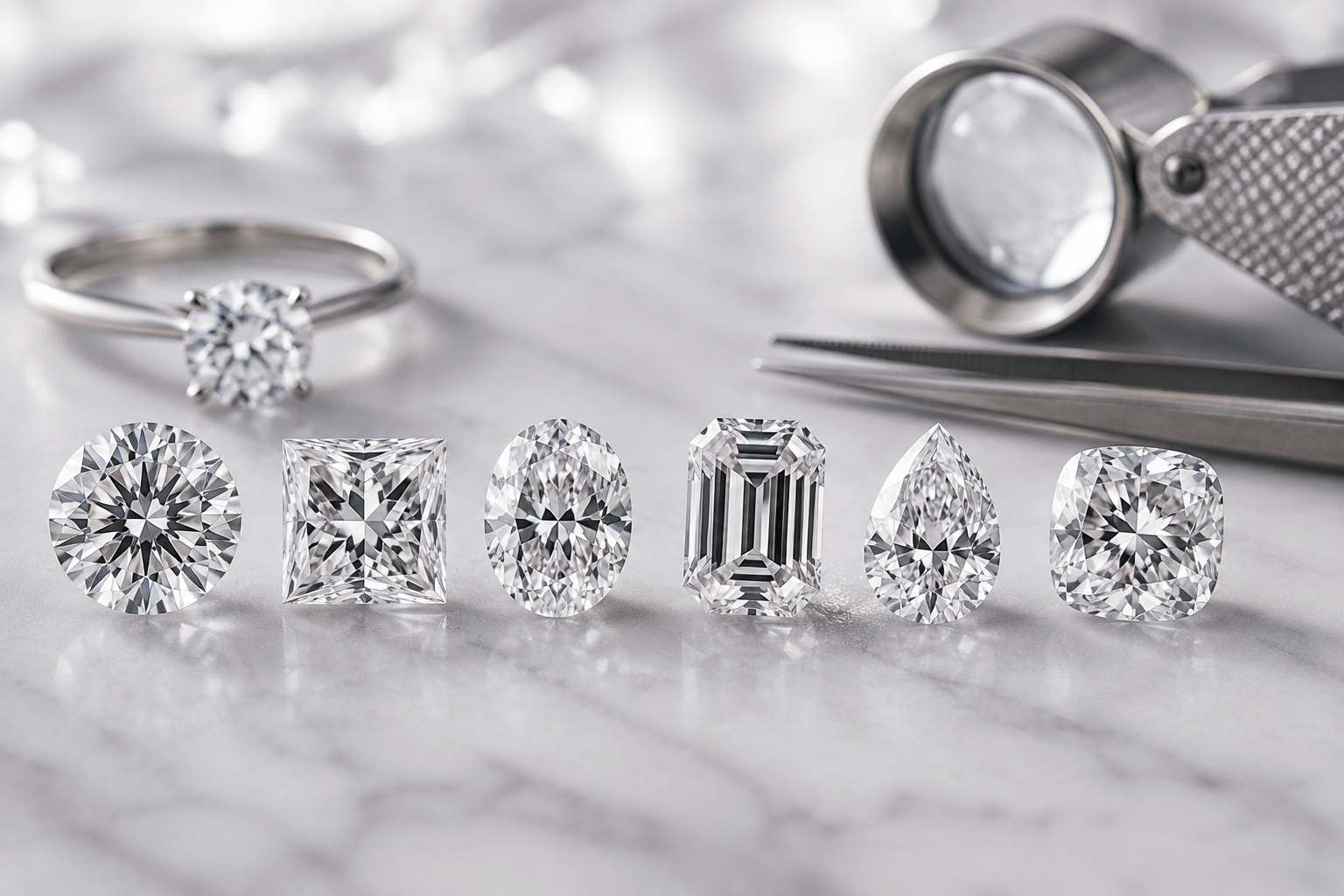
Shape is a diamond’s silhouette — the outline you see when you look at it from above. Cut is the technical quality of how a cutter arranged the facets, proportions, symmetry, and polish to control how light moves through the stone. Shape tells you what a diamond looks like; cut tells you how well it performs. Both matter, but they answer completely different questions.
- Common shapes: round, oval, princess, cushion, emerald, pear, marquise, radiant, Asscher, heart
- What cut affects: brightness (how much white light returns to your eye), fire (colored light flashes), and scintillation (the sparkle pattern as the stone moves)
The GIA (Gemological Institute of America) separates these two concepts clearly in its grading standards, and retailers like Tiffany & Co. and Superjeweler both use this framework to help shoppers evaluate diamonds. Getting the distinction right before you shop saves money and prevents regret.
Key Takeaways
Shape sets the style; cut quality determines how much that diamond actually sparkles — and for round brilliants, GIA’s grading makes cut the single most verifiable quality factor you can compare before buying.
| Point | Details |
|---|---|
| Shape = silhouette | Shape is the stone’s outline (round, oval, cushion, etc.) — a style choice with no quality grade. |
| Cut = light performance | Cut controls brightness, fire, and scintillation through proportions, symmetry, and polish. |
| Round brilliants are gradeable | GIA assigns a cut grade (Excellent to Poor) only for round brilliants; fancy shapes have no single equivalent. |
| Elongated shapes look larger | Oval, marquise, and pear cover more finger surface, giving more apparent size per carat than round. |
| Superjeweler for verified options | Superjeweler offers certified diamonds filtered by shape and cut, with lab-grown options and a clear return policy. |
Table of Contents
- What is diamond shape, and why does it matter for your ring?
- What is diamond cut, and what does a cut grade mean?
- How shape and cut work together to create what you actually see
- How to prioritize cut vs. shape when you’re buying
- Quick reference: shape chart and cut-grade summary
- Practical shopping tips from a retailer perspective
- The one thing most buyers get backwards
- Where Superjeweler makes the search easier
- Sources
What is diamond shape, and why does it matter for your ring?
Shape is the stone’s outline when viewed face-up. It is a style decision, not a quality metric. No shape is objectively better than another; the right one is the one you love and that fits your lifestyle.
GIA describes shape as either “round” or “fancy,” with fancy covering every non-round outline. Here is how the most common shapes differ in practice:
| Shape | Visual character | Styling note |
|---|---|---|
| Round | Circular, symmetrical | Most popular; maximizes sparkle |
| Princess | Square with sharp corners | Modern, geometric look |
| Cushion | Rounded square or rectangle | Soft, vintage feel |
| Oval | Elongated ellipse | Slims the finger; looks larger face-up |
| Emerald | Rectangular with cut corners | Long, open facets; understated elegance |
| Pear | Teardrop | Elongates the hand; points toward fingertip |
| Marquise | Football-shaped | Maximizes apparent size per carat |
| Radiant | Rectangular with brilliant facets | Combines emerald outline with round sparkle |
| Asscher | Square step-cut | Art Deco style; hall-of-mirrors effect |
| Heart | Heart silhouette | Romantic; requires skilled cutting to look symmetrical |
Elongated shapes like oval, marquise, and pear tend to look larger than a round diamond of the same carat weight because they cover more finger surface. A 1-carat oval can appear noticeably bigger face-up than a 1-carat round. That size perception is a real budget lever — you can read more about it in Superjeweler’s guide to diamond shape impact on ring aesthetics.
Pro Tip: Pointed shapes like pear and marquise are vulnerable at their tips. If you choose one, ask for a prong or bezel setting that protects those points — a chip there is expensive to repair.
What is diamond cut, and what does a cut grade mean?
Cut is not the shape. It is the quality of the craftsmanship: how precisely the facets were placed, how well the proportions direct light, and how cleanly the stone was polished. A poorly cut diamond leaks light through the bottom or sides and looks dull regardless of its shape. A well-cut stone returns light straight back to your eye.
GIA’s retailer-facing materials describe cut quality through three measurable components:
- Proportions: table size, depth percentage, crown angle, pavilion angle
- Symmetry: how precisely facets align and mirror each other
- Polish: the smoothness of each facet surface
These three factors together produce the three visual effects shoppers actually see: brightness, fire, and scintillation.
GIA grades cut for round brilliant diamonds on a five-point scale: Excellent, Very Good, Good, Fair, and Poor. The American Gem Society (AGS) uses a parallel system with its own Ideal grade at the top. For round brilliants, always look for GIA Excellent or AGS Ideal if sparkle is your priority.
Round brilliant diamonds have 58 facets arranged specifically to maximize light return — more than any other cutting style. That facet architecture is why a well-cut round outperforms most other shapes in measured brightness. Tiffany & Co.’s “True” cut, for example, combines step and brilliant elements to produce a distinct light pattern, illustrating how cut style shapes the visual result even within a single outline.
Fancy shapes and cut grades: Most non-round diamonds — cushion, oval, emerald, pear — do not have a single standardized cut grade from GIA. Shoppers must evaluate proportions, symmetry ratings, and ideally light-performance images to judge cut quality for these shapes.
How shape and cut work together to create what you actually see
Shape and cut are not independent choices. Master cutters analyze the rough stone to decide which cutting style both preserves the most weight and produces the best appearance — so the two decisions are made simultaneously at the source. By the time a diamond reaches a retailer, its shape and cut style are inseparable.
The clearest way to see this: a round brilliant and an emerald-cut diamond are both “diamonds,” but they look nothing alike under light. The round brilliant’s 58 facets scatter light in every direction, producing intense sparkle. The emerald’s long, rectangular step-cut facets create broad flashes and a mirror-like “hall of mirrors” effect rather than scintillation. Neither is wrong — they just produce different visual experiences.
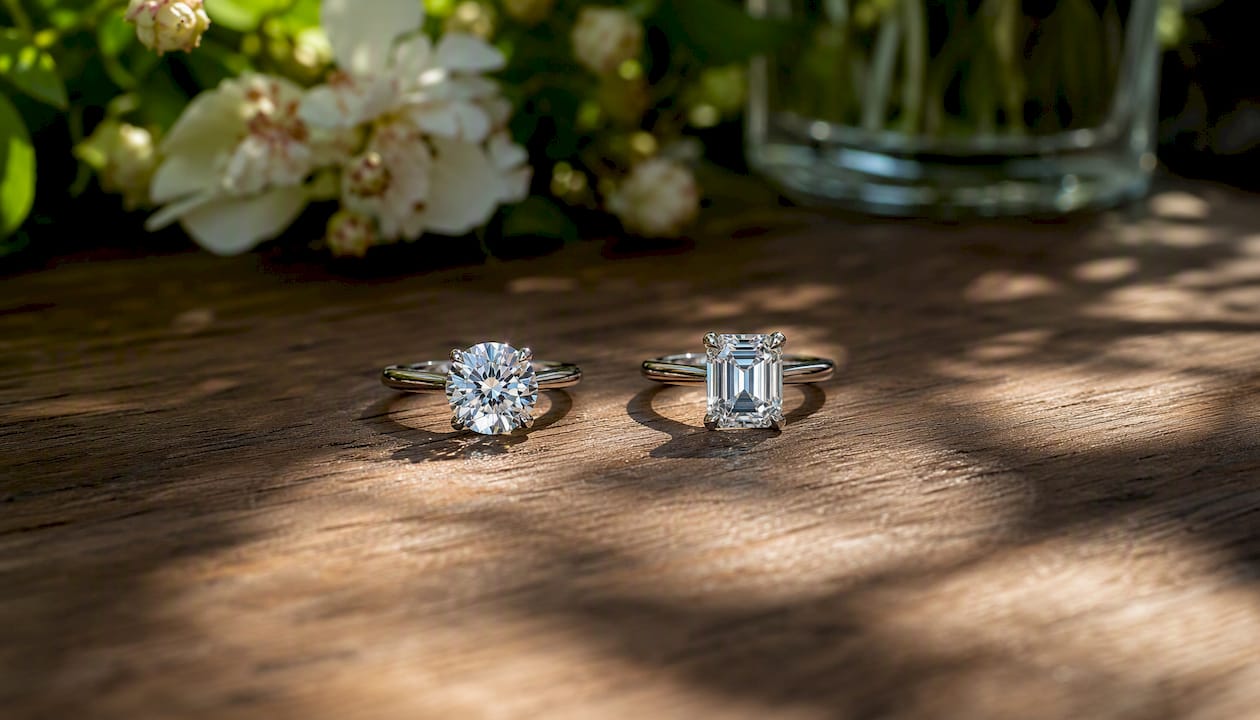
Two diamonds with the same shape can look very different depending on cut quality. A poorly cut oval leaks light and looks glassy or dark in the center. A well-cut oval of the same carat weight glows. Shape sets the stage; cut determines the performance.
A real-world example: Meghan Markle’s engagement ring features a large cushion-cut center diamond flanked by two round diamonds. That combination shows how different shapes read differently in the same setting — the cushion’s soft, rounded square contrasts with the rounds’ circular brilliance, creating visual depth.
Quick rules for pairing shape with desired look:
- Maximum sparkle: round brilliant with GIA Excellent cut
- Maximum apparent size for budget: oval or marquise, well-cut
- Understated elegance: emerald or Asscher with step-cut facets
- Vintage romance: cushion with a halo setting
- Modern edge: princess or radiant
How to prioritize cut vs. shape when you’re buying
Start with shape. Style is personal and lasting — you will look at this ring every day, so pick the silhouette you genuinely love. Then lock in cut quality within your budget.
Decision framework:
- Choose your shape first. Browse options in person or with face-up photos online. Elongated shapes (oval, pear, marquise) give more visual size per dollar.
- Set a cut-quality floor. For round brilliants, do not go below GIA Very Good. For fancy shapes, request symmetry ratings and light-performance images.
- Adjust carat to hit your budget. A 0.90-carat round with an Excellent cut outsparkles a 1.10-carat round with a Good cut. Carat is the easiest place to flex.
- Check the certificate. GIA and AGS certificates report table percentage, depth, and symmetry for round brilliants. For fancy shapes, these proportions still matter even without a single cut grade.
- View the stone in multiple lights. Fluorescent office light, natural daylight, and candlelight all reveal different things. Ask for video if buying online.
- Confirm the setting suits the shape. Pointed shapes need protective prongs; step cuts show inclusions more readily, so clarity matters more for emerald and Asscher shapes.
Pro Tip: For fancy shapes, ask the retailer for ASET (Angular Spectrum Evaluation Tool) images or Ideal-Scope images. These light-performance visuals show where a stone leaks light — far more useful than proportions alone.
A practical approach used across the industry is to pick shape for style, then secure the best cut quality your budget allows. That sequence rarely leads to regret. You can also explore Superjeweler’s detailed guide on how to pick diamond shape for additional help matching shape to finger type and setting style.
Quick reference: shape chart and cut-grade summary
Common shapes at a glance
Cut-grade language on certificates
| Diamond type | GIA cut grade available? | What to look for |
|---|---|---|
| Round brilliant | Yes (Excellent to Poor) | Aim for Excellent or Very Good |
| Fancy shapes (all others) | No single standard grade | Check symmetry, polish, table %, depth % |
For round brilliants, a GIA certificate lists the cut grade directly. For fancy shapes, the certificate reports symmetry and polish ratings (Excellent to Poor) but no combined cut grade. Ask your retailer to explain the proportions or provide light-performance imagery.
Practical shopping tips from a retailer perspective
Buying a diamond online requires a different checklist than buying in a store. Superjeweler’s approach to diamond cut in engagement rings emphasizes three things: read the certificate, request visual proof, and verify the return policy before you commit.
GIA retailer guidance stresses that cut data — proportions, symmetry, polish — should be presented clearly to buyers, not buried in fine print. If a retailer cannot show you that data, that is a signal to look elsewhere.
Online shopping checklist:
- Request the GIA or equivalent certificate and read the cut, symmetry, and polish grades
- Ask for face-up photos and video under multiple lighting conditions
- Compare stones of the same shape side-by-side using face-up images, not just carat weight
- Check the retailer’s return window and warranty terms before purchasing
- For fancy shapes, ask specifically about table percentage and depth percentage
Superjeweler lets you filter engagement rings by diamond shape and offers both mined and lab-grown diamond options with certified stones, free shipping, and a clear return policy. Lab-grown diamonds carry the same cut grades and shape options as mined stones, often at significantly lower prices — worth considering if budget is a constraint.
Pro Tip: When comparing two diamonds of the same shape online, always look at face-up photos at the same scale. Carat weight does not tell you how a stone looks on a finger — face-up area does, and that varies by shape and cutting style.
The one thing most buyers get backwards
Most shoppers walk in fixated on carat weight. They want a “1-carat diamond” and treat that number as the goal. The shape and cut become afterthoughts — which is exactly the wrong order of operations.
Shape is a permanent style decision. A round brilliant and a cushion are not interchangeable; they read completely differently on a hand and in a setting. Pick the one you love before you think about size. Then, within your budget, push cut quality as high as you can — especially for round brilliants, where GIA’s grading makes the quality difference measurable and verifiable.
One naming trap worth flagging: terms like “cushion cut” or “emerald cut” are common in everyday language, but in trade usage “cut” there refers to the shape name, not the faceting quality. A diamond described as “cushion cut” tells you the outline; it says nothing about whether the stone was cut well. Always ask separately about cut quality, whatever shape name is on the label.
Where Superjeweler makes the search easier
Knowing the difference between cut and shape is step one. Finding a well-cut stone in the shape you love, at a price that makes sense, is step two — and that is where Superjeweler’s filters do the work for you.

Superjeweler carries certified diamonds across every major shape, with options for both mined and lab-grown stones at prices that reflect the actual market rather than retail markup. Every purchase comes with free worldwide shipping, a warranty, and a return policy — so you are not locked into a decision you made from a photo alone. If you are just starting out, the engagement rings under $1,000 category is a practical place to see how shape and cut interact across real price points. Ready to browse by shape? Start at Superjeweler’s engagement ring collection and use the shape filter to narrow your options.
Sources
- Guide to Diamond Shapes for Engagement Rings – GIA 4Cs
- Diamonds Cut and Shape : Ultimate Guide – Only Natural Diamonds
- Diamond cut vs diamond shape: what’s the difference? – A Diamond is Forever
- Retailer
- All About Meghan Markle’s Engagement Ring (and the Special Detail That Honors the Late Princess Diana)
Recommended
- Advantages of Different Diamond Shapes: 2026 Buyer’s Guide
- Advantages of Different Diamond Cuts: Shape-by-Shape Guide
