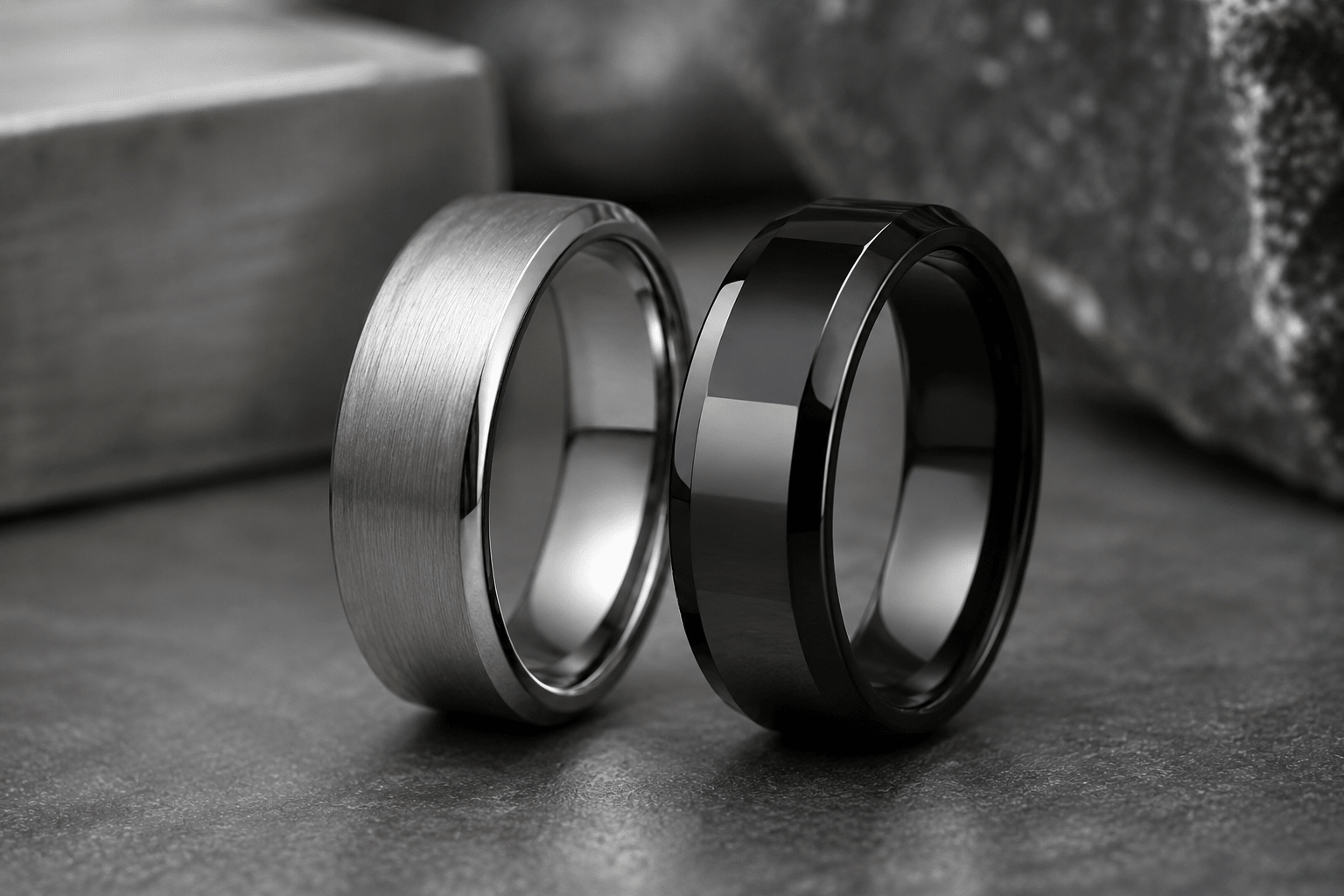
Pick tungsten if you want a ring that resists scratches for decades and never loses its polish. Pick titanium if you’d rather have a lighter, more forgiving ring that bends instead of shattering and won’t fight you in an emergency. That’s the whole decision in one sentence, and almost everything else in this comparison flows from those two facts.
Tungsten carbide rates roughly 8.5 to 9 on the Mohs hardness scale, close to a sapphire. Titanium rates moderately on the Mohs hardness scale closer to a pocketknife blade. That gap explains almost every tradeoff below, including one buyers rarely think about until it’s urgent: a published emergency-removal study found that freeing a trapped tungsten ring with locking pliers takes a mean of 23.1 seconds, but it destroys the ring and can throw off sharp fragments. Superjeweler carries both metals in its men’s wedding band collection, so you’re not choosing in the abstract. You’re choosing between two real, ready-to-ship options.
Here’s a fast read on who tends to lean which way:
- Choose tungsten if you want a formal, mirror-polished band that stays scratch-free for years and you don’t mind that it can never be resized.
- Choose titanium if you work with your hands, play contact sports, or want a ring you can forget you’re wearing.
- Choose titanium if you have sensitive skin or a nickel allergy, since it’s biocompatible and rarely triggers a reaction.
Pro Tip: If your job involves machinery, climbing, or anything where a ring could get caught, ask about emergency removal before you fall in love with a finish. It’s a five-second question that can matter for the rest of your life.
Key Takeaways
The right ring metal depends on whether you value a permanently scratch-free surface or a lighter, more forgiving ring that survives impact and emergencies better.
| Point | Details |
|---|---|
| Tungsten wins on hardness | Rated roughly Mohs 8.5–9, it resists nearly all daily scratching but cannot be resized. |
| Titanium wins on toughness | It bends rather than shatters and is generally safer to remove in an emergency. |
| Allergy-prone buyers should default to titanium | It’s biocompatible, while some tungsten binders contain cobalt or nickel. |
| Emergency removal favors titanium | Standard cutting tools handle titanium; tungsten often requires pliers that destroy the ring. |
| Superjeweler carries both metals | Its men’s wedding band collection lets you compare titanium and tungsten finishes side by side before buying. |
Table of Contents
- Titanium vs Tungsten Ring: Full Comparison at a Glance
- What Titanium and Tungsten Rings Are Actually Made Of
- How Hard Is Tungsten vs Titanium, Really?
- Which Ring Is More Likely to Crack, Bend, or Break?
- Does Weight Change How a Ring Feels Day to Day?
- Color, Finish, and How Each Metal Ages
- Is Titanium or Tungsten Better for Sensitive Skin?
- Resizing, Repair, and What Happens If You’re Trapped
- Everyday Care: Cleaning, Showers, and Chemicals
- What Do Titanium and Tungsten Rings Typically Cost?
- Titanium vs Tungsten: Quick Pros and Cons
- How to Choose: A Buyer’s Checklist
- The Evidence Behind the Hardness and Safety Claims
- A Practical Checklist Before You Buy
- The Real Question Isn’t Which Metal Is Stronger
- Where to Find the Right Band at Superjeweler
- Sources
Titanium vs Tungsten Ring: Full Comparison at a Glance
| Dimension | Titanium | Tungsten Carbide |
|---|---|---|
| Hardness / scratch resistance | Mohs ~6; will show fine scratches over years | Mohs ~8.5–9; resists nearly all daily scratching |
| Durability / brittleness | Ductile; bends or dents rather than breaking | Brittle; can crack or shatter on a sharp impact |
| Weight / comfort | Very light, often barely noticeable on the hand | Dense and substantial; some wearers love the heft, others find it heavy |
| Appearance / finish | Polished, brushed, matte, anodized colors, black coatings | High polish, brushed, black (often via coating), wood or carbon fiber inlays |
| Hypoallergenic / skin sensitivity | Generally hypoallergenic and biocompatible | Usually safe, but cobalt or nickel binders in some blends can trigger reactions |
| Resizing & repairability | Difficult but sometimes possible; can be cut off safely | Cannot be resized; typically must be destroyed to remove |
| Maintenance / care | Low maintenance; occasional polishing restores shine | Very low maintenance; rarely needs polishing |
| Price / value | Mid-range, often less than platinum or gold | Often the most affordable of the durable metals |
| Emergency removal | Cuttable with standard tools in most cases | Requires specialized techniques; often destroys the ring |
The single tradeoff to remember: tungsten wins on hardness, titanium wins on toughness. Hardness keeps a surface scratch-free. Toughness keeps the ring from failing catastrophically when it takes a real hit.
What Titanium and Tungsten Rings Are Actually Made Of
Titanium rings are typically made from commercially pure titanium or a titanium alloy like Grade 5 (Ti-6Al-4V), the same family of alloys used in aerospace parts and surgical implants. It’s a lightweight metal on its own, no blending required, and jewelers shape it through forging and precision machining.
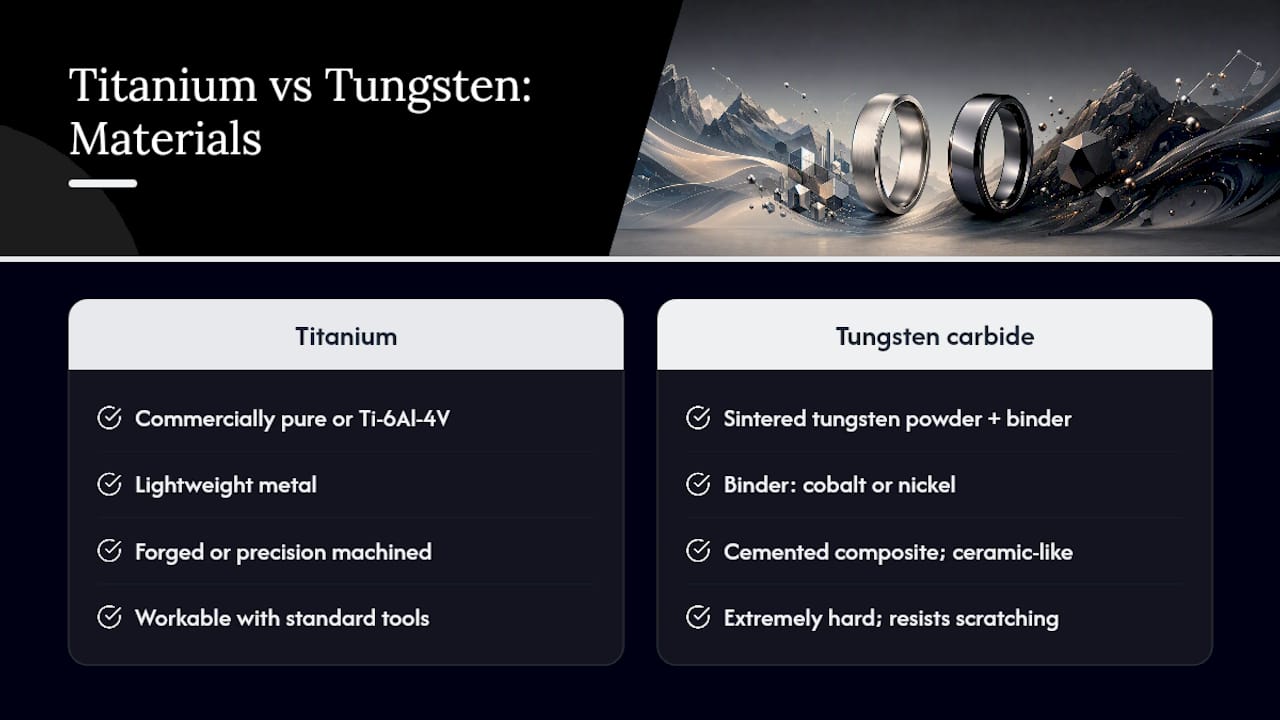
Tungsten rings aren’t pure tungsten at all. Pure tungsten is too brittle to wear, so manufacturers sinter tungsten powder with a metal binder, usually cobalt or nickel, to create tungsten carbide, a cemented composite closer in behavior to ceramic than to a traditional metal. That’s a meaningful distinction: when someone says “tungsten ring,” they almost always mean tungsten carbide.
Manufacturing methods diverge sharply from there. Titanium gets forged or machined into shape using standard metalworking tools, which keeps tooling costs manageable and leaves room for inlays, engraving, and color anodizing. Tungsten carbide, because it’s so hard, has to be pressed into shape from powder and finished with diamond grinding, since conventional cutting tools can’t touch it. That’s also why tungsten rings rarely come with deep engraving or intricate inlays; the material fights back against anything but a diamond-tipped tool.
The hardness that makes tungsten carbide nearly impossible to scratch is the same property that makes it nearly impossible to shape without industrial-grade equipment. You’re not paying for simplicity. You’re paying for precision grinding on a material that resists being altered at all.
Practical fallout: coatings and colors on tungsten (black finishes, for example) are usually applied rather than integral to the metal, while titanium can be anodized in a range of colors through an electrochemical process that changes the oxide layer directly.
How Hard Is Tungsten vs Titanium, Really?
The Mohs scale ranks minerals and materials from 1 (talc, crumbles under a fingernail) to 10 (diamond, the hardest natural substance known). Tungsten carbide lands at roughly 8.5 to 9. Titanium rates moderately on the Mohs hardness scale, similar to hardened steel.
In daily terms, a Mohs 9 ring will shrug off contact with countertops, car keys, and most tools without a mark. A Mohs 6 ring will pick up fine surface scratches over months and years of wear, especially from harder materials like quartz countertops or sandy surfaces. That’s not a defect. It’s physics.
Here’s where people get confused: hardness measures scratch resistance, not overall strength. A material can be extremely hard and still fail catastrophically under the right kind of force, which is exactly what happens to tungsten carbide when it takes a sharp impact instead of a scrape.
Finish also changes what you notice day to day. A brushed or matte titanium band hides fine scratches far better than a high polish, because the texture already scatters light unevenly. A brand-new tungsten ring straight out of the box looks flawless for a reason most people never think about: at Mohs 9, almost nothing you touch all day is hard enough to leave a mark.
Pro Tip: If a pristine, mirror finish matters to you more than anything else, go with tungsten and a high polish. If you’d rather not think about scratches at all, a brushed titanium finish does double duty: it resists showing wear and it’s easier to repair if it ever needs attention.
Which Ring Is More Likely to Crack, Bend, or Break?
Tungsten carbide behaves like a hard ceramic. It resists scratching almost completely, but a sharp, focused impact, a hammer strike, a fall onto concrete at the wrong angle, a car door slam, can cause it to crack or shatter rather than dent. That’s brittle fracture, and it’s the direct tradeoff for that scratch-proof surface.
Titanium fails differently. Because it’s ductile rather than brittle, it absorbs impact by bending or denting instead of snapping apart. A titanium band that takes a hard hit might come out of the encounter slightly out of round, which a jeweler can often correct. A tungsten band that takes the same hit might come out in two pieces, which no jeweler can fix.
- Tungsten cannot be resized under any circumstance; the material can’t be stretched, cut, and rejoined the way softer metals can.
- Tungsten cannot be welded or soldered for repairs, so any damage usually means full replacement.
- Titanium can sometimes be resized, though it requires specialized equipment most local jewelers don’t keep on hand.
- Titanium’s ductility means minor dents and bends are often correctable rather than permanent.
If your weight fluctuates, if you’re not sure this is your final ring size, or if you tend to bump your hands against things, that non-resizable quality in tungsten deserves more weight in your decision than most buyers give it.
Does Weight Change How a Ring Feels Day to Day?
Tungsten carbide is dense, roughly 15.6 grams per cubic centimeter compared to titanium’s 4.4. Translated to the hand, a tungsten band feels substantial, almost like it has presence. Some people specifically want that; a ring that feels light can feel cheap to them.

Titanium goes the opposite direction. It’s light enough that longtime wearers often say they forget it’s on their finger, which matters if you’ve never worn jewelry before and aren’t sure how you’ll adjust. For people who work with their hands all day, that difference in fatigue over an eight-hour shift adds up.
Width and profile shift the equation too. A wide, thick tungsten band amplifies the heavy feel; a slim titanium band amplifies the “barely there” feel. If you’re between the two metals, trying a similar width and profile in each material, rather than comparing a slim titanium sample to a chunky tungsten one, gives you a fairer sense of the real difference.
Pro Tip: Can’t get to a store? Hold a nickel (about 5 grams) versus three stacked quarters (about 17 grams) in your palm. That rough ratio approximates how a titanium band compares to a similarly sized tungsten one on your finger.
Color, Finish, and How Each Metal Ages
Both metals offer more visual range than people expect walking in.
Titanium takes color through anodizing, an electrochemical process that shifts the oxide layer to produce blues, purples, and other tones without adding paint or plating. It also comes in polished, brushed, and matte finishes, and its natural gray tone reads as a modern, understated alternative to white gold.
Tungsten typically stays in the gray-to-black spectrum. Black finishes usually come from a coating process rather than a color baked into the base material, and manufacturers frequently add inlays like wood grain, carbon fiber, or a thin precious-metal strip down the center for contrast, since tungsten’s hardness makes fine detail work difficult otherwise.
Here’s the aging difference that matters most: titanium develops a soft patina over years of wear, a subtle dulling that many people find attractive and that a jeweler can buff out if you want the original shine back. Tungsten stays close to its factory finish for the life of the ring, which is either its biggest selling point or completely beside the point depending on whether you like the idea of a ring that shows its history.
Pro Tip: If you choose a coated or plated finish on either metal, ask how the coating holds up over time and whether your retailer offers replating. A coating is a surface layer, not a permanent property of the metal underneath.
Is Titanium or Tungsten Better for Sensitive Skin?
Titanium is one of the most biocompatible metals used in jewelry, which is why it also shows up in surgical implants and pacemakers. It doesn’t contain nickel, and reactions to pure titanium or common titanium alloys are rare.
Tungsten itself is generally inert, but tungsten carbide rings aren’t pure tungsten. The binder holding the carbide together is often cobalt, and some manufacturers use nickel instead. Both of those binders can trigger a reaction in people with known metal sensitivities, even though the tungsten content itself isn’t the problem.
If you’ve ever had a reaction to a nickel-containing earring or watch band, that history matters more than the word “tungsten” on the label. Ask what binder was used before you assume the ring is safe for your skin.
Reputable retailers will list the binder composition on request, and some tungsten rings are specifically marketed as cobalt-free for buyers with known sensitivities. If a listing doesn’t specify, that’s worth a quick question to customer service before you buy, not after your finger reacts.
Resizing, Repair, and What Happens If You’re Trapped
This is the part of the comparison most articles skip, and it’s the one that matters most in a real emergency.
Tungsten carbide cannot be resized, full stop. The material can’t be stretched, cut down, and rejoined the way gold or platinum can, and if it ever needs to come off in a hurry, the AJEM study on ring removal found that locking pliers remove it significantly faster than the umbilical tape technique, but the pliers method fractures the ring and can send small fragments flying.
Titanium sits in a more flexible middle ground. Resizing it is difficult and not every local jeweler has the equipment, but it’s not impossible the way it is with tungsten. In an emergency, titanium can usually be cut with standard ring-cutting tools that hospitals and fire departments already carry, without the fragmentation risk that comes with fracturing a ceramic-like material.
- Tell any first responder or ER staff what your ring is made of before they try to remove it; standard ring cutters often can’t handle either metal, and tungsten specifically needs a different approach.
- If you’re removing a tungsten ring yourself in a non-emergency (swelling from a flight, for example), the umbilical tape technique is slower but keeps the ring intact.
- If speed matters more than preserving the ring, locking pliers work faster on tungsten, but expect the ring to be destroyed and treat it as a safety procedure, not a DIY project, given the risk of flying fragments.
Everyday Care: Cleaning, Showers, and Chemicals
Neither metal demands much upkeep, but a few habits protect the finish either way.
For both titanium and tungsten, warm water, a soft cloth, and mild dish soap handle routine cleaning. Avoid chlorine-based pool chemicals and harsh household cleaners with bleach, since prolonged chemical exposure can affect surface finishes and, on plated or coated rings, accelerate wear.
Can you wear either ring in the shower? Yes, both hold up fine to water exposure day to day. Swimming pools are the bigger concern, less because of the metal itself and more because chlorine can dull certain coatings and plated finishes over repeated exposure. If your ring has a black PVD coating or any applied color, treat pool time the way you’d treat any coated jewelry: rinse it after and don’t scrub it with abrasive cleaners.
Titanium rarely needs polishing since its natural finish holds up well, though a jeweler can restore full shine to a brushed or matte piece if you ever want a fresh look. Tungsten essentially never needs polishing under normal conditions since its hardness keeps the factory finish intact for years.
Pro Tip: If your ring has any inlay, wood, carbon fiber, or a plated color strip, keep it away from harsh chemicals entirely rather than just minimizing exposure. Inlays are the one part of either ring that behaves like a softer material and can degrade over time.
What Do Titanium and Tungsten Rings Typically Cost?
Tungsten rings are often one of the more affordable options in the durable-metal category, with quality bands frequently available around $200, despite the labor-intensive powder-sintering and diamond-grinding process behind them. That affordability comes down to the raw material itself being relatively inexpensive, even though shaping it is expensive.
Titanium tends to land in a similar mid-range price bracket, generally well below platinum and often below traditional gold, making it an accessible choice for buyers who want durability without a premium price tag.
The real cost conversation isn’t the sticker price, though. It’s what happens years later. If a tungsten ring cracks or your finger size changes, you’re buying a replacement outright since resizing and most repairs aren’t options. If a titanium ring dents or needs resizing, a jeweler may be able to correct it, which can mean a repair bill instead of a full replacement, though not every jeweler has the equipment for titanium work.
- Factor the “no resizing” reality into your budget for tungsten. If your weight or ring size might change, plan for a possible future purchase, not a future repair.
- Ask your retailer directly about warranty coverage for cracks or damage, since policies vary by brand and material.
Titanium vs Tungsten: Quick Pros and Cons
Tungsten carbide
- Exceptional scratch resistance that keeps a polished look for years.
- Often more affordable than comparable durable metals.
- Heavier feel that some wearers associate with quality.
- Cannot be resized and may crack or shatter on a hard impact.
- Best for buyers who prioritize a permanent, low-maintenance shine over flexibility.
Titanium
- Lightweight and comfortable for all-day wear, including active jobs.
- Generally hypoallergenic and safe for sensitive skin.
- Bends rather than shatters and can sometimes be resized or repaired.
- Will show fine scratches and develop a patina over time.
- Best for buyers who value comfort, safety, and long-term flexibility over a permanently flawless surface.
How to Choose: A Buyer’s Checklist
- Rate your lifestyle honestly. If you work with your hands, play sports, or worry about safety in an accident, lean titanium. If your daily routine is low-impact, tungsten’s scratch resistance becomes the bigger draw.
- Check for allergy history. If you’ve reacted to nickel or cobalt jewelry before, ask about tungsten binder composition or default to titanium.
- Confirm the resizing policy before you buy. If there’s any chance your size will change, tungsten’s no-resize limitation should weigh heavily in your decision.
- Try on a similar width and profile in both metals. Weight perception changes dramatically with band thickness, so compare like with like.
- Ask about coatings and inlays. If a finish or color is applied rather than integral to the metal, ask how it holds up and whether replating is available.
- Review the warranty and return window. A wedding ring selection guide can help you compare fit and style questions before you commit either metal to a final purchase.
Online, look closely at product specs: material grade for titanium, binder type for tungsten, coating details, and stated resizing policy. In-store, ask to try on a comparable weight and width in each metal before deciding.
Pro Tip: If you’re on the fence, ask about ordering a lower-cost sample ring in your size first. A short trial run in the right width tells you more about comfort than any spec sheet, especially before committing to a tungsten band you can never resize.
The Evidence Behind the Hardness and Safety Claims
The technical claims in this comparison rest on two main sources: published Mohs hardness data and a peer-reviewed emergency-removal study, not marketing copy from any single brand.
The Mohs figures come from materials-engineering references that test tungsten carbide at roughly 8.5 to 9 and titanium at roughly 6, using the same scratch-resistance scale jewelers and geologists have relied on for two centuries. The emergency-removal figures come from an AJEM comparison study that timed two removal techniques on tungsten carbide rings under controlled conditions.
| Measurement | Value | Source |
|---|---|---|
| Tungsten carbide Mohs hardness | ~8.5–9 | Xometry materials guide |
| Titanium Mohs hardness | ~6 | Xometry materials guide |
| Ring removal, locking pliers (mean) | 23.1 seconds | AJEM ring removal study |
| Ring removal, umbilical tape (mean) | 23.1 seconds | AJEM ring removal study |
The pliers method wins on speed by a wide margin, but speed comes at the cost of the ring itself and a real risk of fragment injury. That tradeoff belongs in the buying decision, not just in a hospital’s protocol manual.
That safety data matters beyond the emergency room. It tells you something concrete about how the two metals behave under stress: one shatters, one bends, and that single fact should carry as much weight in your decision as how the ring looks on your finger.
A Practical Checklist Before You Buy
Before finalizing either metal, verify a short list of specs directly with the retailer rather than assuming.
- Confirm the exact titanium grade or the tungsten binder metal (cobalt vs nickel), since both affect durability and allergy risk.
- Ask whether any color or black finish is a coating, and what the replating process looks like if it wears.
- Get the resizing policy in writing, especially for tungsten, where the answer is almost always no.
- Check the warranty length and what it actually covers: cracks, defects, or only manufacturing issues.
- Review the return window in case the fit or feel isn’t right once you’ve worn it for a few days.
Favor retailers who list manufacturing details like alloy grade and binder composition rather than vague marketing language. It’s a small transparency signal, but it tells you the seller understands the product beyond the sales page. Browsing Superjeweler’s filters for men’s tungsten and titanium wedding rings lets you compare cobalt-free tungsten options and specific titanium finishes side by side before you commit.
The Real Question Isn’t Which Metal Is Stronger
Most comparisons frame this decision as “which metal wins,” and that framing misses the point. Tungsten and titanium aren’t competing on the same axis. One optimizes for a surface that never shows wear. The other optimizes for a ring that survives a bad day without becoming shrapnel.
What people tend to underestimate is how much the emergency-removal question should weigh into an otherwise aesthetic decision. Buyers spend hours comparing finishes and almost no time asking what happens if the ring needs to come off fast, at a job site, in a car accident, during a medical emergency. That’s backwards. A ring you wear every day for decades will statistically spend far more time on your hand during ordinary life than in a crisis, but the crisis scenario is the one where the wrong choice actually hurts you.
My honest read: for most everyday buyers, especially anyone active or working with their hands, titanium’s combination of toughness, comfort, and biocompatibility makes it the safer default. Tungsten earns its place for people who specifically want a formal, low-maintenance ring and understand, going in, that it’s a one-size-forever commitment. Neither choice is wrong. Just make sure you’re choosing based on how you actually live, not just how the ring photographs in a showcase.
Where to Find the Right Band at Superjeweler
Whichever way you’re leaning, Superjeweler stocks both metals under one roof, so you’re not stuck cross-shopping five different sites to compare finishes, widths, and prices. The men’s tungsten and titanium wedding ring collection lets you filter by material, finish, and price side by side, with clear warranty and return details listed on every product page so you know exactly what you’re committing to before checkout.

If you’re also shopping for the engagement ring side of the equation, Superjeweler’s engagement rings under $1,000 and lab-grown diamond deals pair well with a durable titanium or tungsten band without blowing your overall budget. For couples who want a coordinated look, browsing diamond wedding bands alongside the metal options gives you a sense of how a diamond accent band might complement a plain tungsten or titanium ring on the other hand.
Worldwide shipping and a clear return window mean you can order a size to try on at home before locking in your final choice, which matters most for tungsten given its no-resize policy. Start by browsing the men’s wedding band category, note the specs and warranty terms on any ring you like, and reach out to customer service if a listing doesn’t specify binder composition or coating details. That one question can save you a headache years down the road.
Sources
- Titanium vs. Tungsten: What Are the Key Differences? | Xometry
- A comparison of two techniques for tungsten carbide ring removal – AJEM
- Tungsten Wedding Bands: Pros and Cons of This Trendy Metal
- An Engineer’s Guide to Titanium vs. Tungsten | Rapmaf
Recommended
- Engagement Ring Metal Comparison: Your Complete Guide
- Ring metals guide: 7 top choices for your perfect band
- White Gold vs Platinum: Key Differences for Jewelry Buyers
