SI1 is the safer choice for most engagement ring buyers because it delivers eye-clean appearance far more consistently than SI2. SI2 can still be a smart buy, but it’s a gamble unless you audit the stone carefully. Cut, setting, and where the inclusions actually sit inside the diamond matter more than the letter grade itself.
TL;DR:
- SI1 diamonds are more reliably eye-clean than SI2, with about 70 to 80 percent of SI1s appearing flawless to the naked eye.
- The grade for clarity depends on inclusion type, size, location, and contrast, which can vary widely even within the same grade.
- Brilliant cuts like round, cushion, and radiant hide inclusions better than step cuts such as emerald or Asscher, influencing clarity choice by shape.
- SI2 stones can offer significant savings but only if carefully inspected through videos, clarity plots, and high-resolution photos.
- The setting and inclusion placement can conceal flaws, with bezel and prong settings better at hiding edge or girdle inclusions.
Table of Contents
- SI1 vs SI2 at a Glance
- Why Are SI1 and SI2 Graded Differently?
- Does Diamond Shape Change How Visible Inclusions Are?
- How Do You Decide Between SI1 and SI2?
- Can a Ring Setting Hide an Included Diamond’s Flaws?
- What Should You Check Before Buying an SI-Grade Diamond?
- What Retail Experience Teaches About Buying SI Grades
- Ready to Compare Clarity Grades on Real Stones?
- Where to Verify Clarity Grading Standards
- Sources
- FAQ
SI1 vs SI2 at a Glance
Before you dig into grading reports, it helps to see how these two grades stack up side by side. SI1 and SI2 both sit in the “slightly included” range of the GIA clarity scale, which means every stone in either category has inclusions visible under 10x magnification. The gap between them shows up in how often those inclusions bother the naked eye.
- Eye-clean likelihood: SI1 round brilliants come back eye-clean roughly 70 to 80 percent of the time; SI2 lands closer to 40 to 60 percent, a much less reliable range.
- Typical inclusions: SI1 stones tend to carry smaller, lighter feathers, crystals, or clouds. SI2 stones more often include larger or darker crystals, denser clouds, or feathers that reach the surface.
- Price gap: Moving from SI1 to SI2 typically saves 10 to 20 percent on an otherwise identical stone, sometimes more depending on shape and carat weight.
- Where savings hold up: The discount is real when the SI2 you pick is genuinely clean-looking. It disappears fast if you end up trading down to a smaller diamond just to compensate for a stone you’re unhappy with.
The honest takeaway: SI1 buys you consistency, and SI2 buys you a discount that only pays off if you shop carefully. For a deeper look at how clarity interacts with the other 4Cs, see how color and clarity trade off with each other in ring buying decisions.
Why Are SI1 and SI2 Graded Differently?
Every clarity grade the GIA assigns comes from examining a diamond under 10x magnification and scoring it on five factors: the number of inclusions, their size, their relief (how much they stand out against the diamond), their nature (feather, crystal, cloud, and so on), and their location inside the stone. That grading protocol is why the GIA 4Cs framework remains the reference point jewelers and appraisers use worldwide.
Two diamonds can both carry an SI1 grade and still look completely different face-up. A grader is measuring what’s visible under magnification, not what a shopper notices from three feet away. A small cluster of light-colored crystals near the girdle might earn the same grade as a slightly larger cloud sitting dead center under the table, even though only one of those stones will bother you at the altar.
Eye-clean rates back this up. Industry estimates put SI1 round brilliants at roughly 73 to 80 percent eye-clean, while that same SI1 grade in an emerald cut can drop to 25 to 38 percent eye-clean, because step cuts expose inclusions that a brilliant cut would scatter and hide.
What actually separates a good SI1 from a rough one:
- Inclusion type: pinpoints and small feathers read as nearly invisible; dark crystals and clouds do not.
- Size relative to the diamond: the same inclusion looks worse in a 0.50 carat stone than in a 2-carat stone, simply because it takes up more of the visible surface.
- Color and contrast: white or colorless inclusions blend into the diamond; dark or black ones stand out immediately.
- Location: inclusions near the girdle or under a prong are easier to miss than anything centered under the table.
Does Diamond Shape Change How Visible Inclusions Are?
Yes, dramatically. Shape is arguably a bigger lever than clarity grade when it comes to what you’ll actually see day to day.
Round brilliants, cushions, and radiants cut with lots of small facets scatter light in every direction. That scattering effect breaks up your eye’s ability to focus on any single point inside the stone, which is exactly why round SI1 and even round SI2 diamonds so often pass as eye-clean. Brilliant and mixed cuts mask inclusions better than step cuts simply because of how their facets bend light.
Step cuts behave the opposite way. Emerald and Asscher cuts use large, open, flat facets that work almost like a window into the stone. There’s no light scatter to hide behind, so inclusions in step cuts become far more obvious than the same inclusions would be in a brilliant cut of equal size and color.
- Round, cushion, and radiant cuts: SI1 is a safe bet; SI2 can work if you inspect carefully.
- Emerald and Asscher cuts: aim for VS2 or better; SI grades are risky here regardless of price.
- Larger carat weights (roughly 1.5 carats and up): inclusions take up more visual real estate, so even an SI1 deserves a closer look before you commit.
For more on how each shape handles light and clarity, this shape-by-shape cut guide breaks down which silhouettes are the most forgiving.
Pro Tip: If you’ve fallen for an emerald or Asscher cut, put your budget toward clarity instead of carat weight. A slightly smaller VS2 will almost always outperform a larger SI1 in that shape.
How Do You Decide Between SI1 and SI2?
Your priorities should drive the decision more than the grade name on the certificate. Here’s a simple framework:
- Appearance is your top priority and you want zero guesswork. Choose SI1 in a brilliant or mixed cut shape. It’s the closest thing to a guaranteed eye-clean stone without paying VS prices.
- You’re on a tight budget and willing to inspect multiple stones. SI2 can work, but only in round, cushion, or radiant cuts, and only after reviewing a 360-degree video and the GIA plot diagram.
- You’ve found a step cut you love. Skip SI2 entirely and push your budget toward VS2 or higher. Step cuts don’t forgive included stones the way brilliants do.
Before you buy anything at the SI level, request the following from the seller: a GIA report (not a lab-specific or in-house grading), a 360-degree video of the actual stone, face-up photos taken without heavy retouching, and a clear return policy in case the stone doesn’t look eye-clean once it’s in hand.
Certain inclusion patterns should rule out an SI2 stone entirely: a dark crystal sitting under the table, a feather that reaches the surface (which can also affect durability), any step cut shape, and carat weights above roughly 1.5 where inclusions become easier to spot.
Pro Tip: Ask the seller to point out the inclusion on the video, not just show you the stone spinning. If they can’t or won’t, that’s a signal to move on to a different listing.
Can a Ring Setting Hide an Included Diamond’s Flaws?
Setting choice does real work here, more than most buyers realize. Where an inclusion sits relative to your setting’s prongs determines whether you’ll ever actually see it.
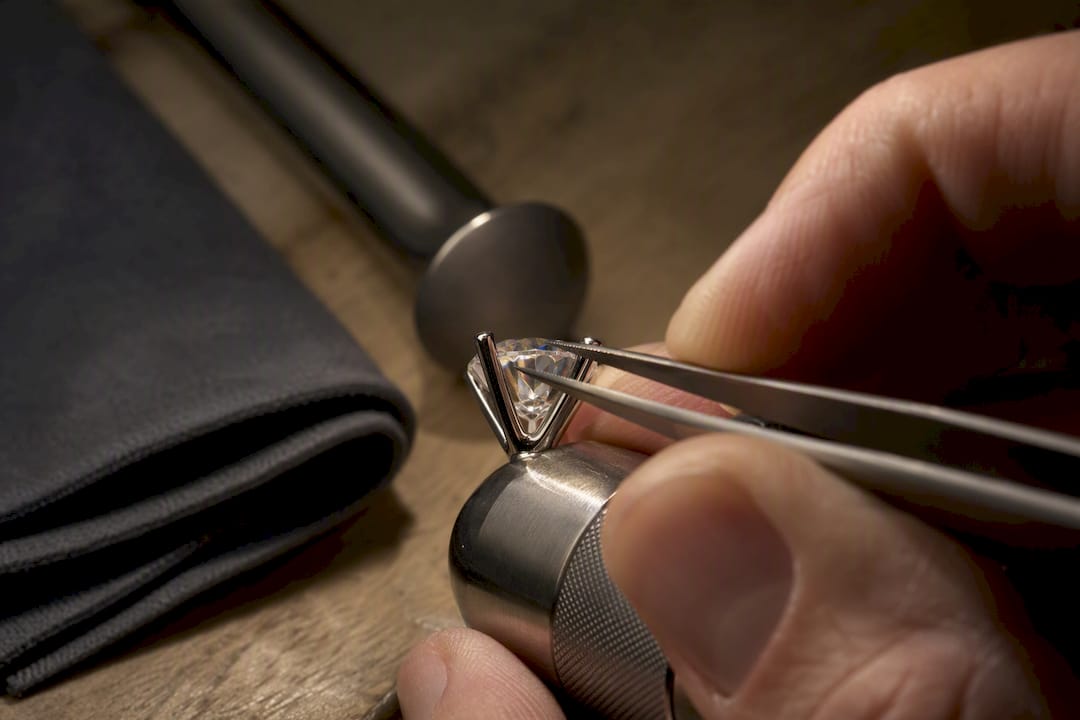
Inclusions near the girdle, the edge where a prong will sit, are often the easiest to conceal. A well-placed prong can physically cover a small feather or crystal that would otherwise be visible from certain angles. Bezel settings go a step further, wrapping metal fully or partially around the stone’s edge, which hides even more of the outer inclusion zone than prongs alone.
Halo settings and multi-stone designs offer a different kind of cover. Surrounding your center stone with smaller accent diamonds draws the eye outward, so minor inclusions in the center stone get less scrutiny simply because there’s more sparkle competing for attention.
- Prong settings: conceal edge and girdle inclusions reasonably well.
- Bezel settings: conceal even more of the outer stone, ideal for pairing with a lower clarity grade.
- Halo and pave settings: distract from small inclusions without physically hiding them.
- Solitaire settings: offer the least concealment since the entire stone is exposed to view.
None of this helps with a central inclusion under the table. No setting on earth hides something sitting directly beneath where you’re staring at your own ring every day, which is exactly why table inclusions should be a dealbreaker regardless of how the ring is mounted.
What Should You Check Before Buying an SI-Grade Diamond?
Treat this like due diligence, not a formality. Here’s the checklist that separates a smart SI purchase from a regretted one:
- Request the GIA certificate number and look it up independently on GIA’s own report-check tool rather than trusting a screenshot.
- Ask for a 360-degree video of the actual stone, filmed under normal lighting rather than a jeweler’s loupe light that can make everything sparkle harder than it will on your hand.
- Get the GIA clarity plot, the diagram showing exactly where each inclusion sits. This tells you more than the grade alone ever will.
- Look at face-up photos taken without diffused studio lighting tricks, ideally alongside a ring or hand for scale.
- Confirm the return window in writing before you pay. A seller confident in their stone won’t hesitate to offer one.
Reject a stone immediately if you spot a dark crystal positioned under the table, a feather that reaches the diamond’s surface (this can be a durability concern, not just a cosmetic one), or a dense cloud that visibly dulls the stone’s brilliance in photos or video.
On pricing, be skeptical of anything that seems too good to be true. SI1 to SI2 price gaps typically run 10 to 20 percent for comparable stones. If a listing offers a 40 or 50 percent discount over a similar SI1, there’s usually a reason, often a larger or darker inclusion that isn’t obvious in the listing photos. That kind of gap deserves extra scrutiny, not extra excitement.
One encouraging shift for online shoppers: high-resolution video and detailed face-up imagery have made remote SI2 auditing genuinely possible, something that used to require an in-person loupe inspection just a few years ago. Genuinely eye-clean SI2 stones do exist. They tend to have small, light-colored inclusions positioned off-center, closer to the pavilion than the table, and finding one usually means screening several listings rather than settling for the first one that fits your budget.
What Retail Experience Teaches About Buying SI Grades
Buyers who get this right almost always do one thing consistently: they ask for the video and the plot before they ask about the price. A GIA report tells you what a stone is graded, but the video and plot tell you what you’re actually going to see on your finger. Return options and detailed imagery allow shoppers to audit an SI1 or SI2 diamond remotely in a way that approximates in-person inspection, without needing a loupe or a gemology background. In-person inspection still has its place if you’re torn between two similar stones, but rigorous imagery closes most of that gap for online buyers.
— Andrew
Ready to Compare Clarity Grades on Real Stones?
Once you know what you’re looking for, the fastest way to compare SI1 and SI2 side by side is to filter real inventory instead of theorizing over grading charts. Superjeweler’s engagement ring categories let you sort by clarity grade, shape, and price, so you can put everything in this guide into practice without guessing at what’s actually available.

Many listings include GIA reports, detailed imagery, and return policies to help buyers verify the appearance of a stone after purchase. If your budget favors value over size, the engagement rings under $1,000 collection is built around real diamonds at accessible price points, and the lab-grown diamond engagement rings category offers another way to stretch your budget toward a higher clarity grade without stretching your price ceiling. Browse by shape, request the GIA report on any stone you’re considering, and reach out to Superjeweler’s support team if you want a second set of eyes on a video before you buy.
Where to Verify Clarity Grading Standards
For definitive language on how clarity grades are assigned, the GIA 4Cs clarity page is the authoritative source graders and appraisers reference worldwide. For eye-clean statistics broken down by shape and grade, Diamond Critics’ SI clarity breakdown offers useful benchmarks. For hands-on buying advice specific to SI1 versus SI2 decisions, YourDiamondTeacher’s SI1 vs SI2 guide walks through real examples worth reviewing before you shop.
Sources
FAQ
Why Do Some Buyers Avoid SI-Clarity Diamonds?
Some buyers avoid SI grades because inclusions are visible under magnification and, in lower-quality SI2 stones, can sometimes be seen with the naked eye. With careful selection, most SI1 stones and many SI2 stones in brilliant cuts still look completely clean to the eye.
Are SI1 Diamonds Worth Buying for an Engagement Ring?
Yes. SI1 diamonds are eye-clean roughly 70 to 80 percent of the time in round brilliant cuts, making them one of the best value points for engagement rings without sacrificing appearance.
Is a G or H Color SI1 or SI2 Diamond a Good Choice?
G or H color paired with SI1 clarity is generally a strong, balanced combination for most shoppers, since both grades sit in ranges where flaws are hard to spot in a mounted ring. Pairing G or H with SI2 works best in round or cushion cuts, where careful inspection confirms the stone is eye-clean.
Is SI2 a Bad Diamond Grade?
SI2 isn’t inherently bad, but it’s inconsistent. Some SI2 stones are genuinely eye-clean, especially in round cuts, while others show visible inclusions, so the grade alone doesn’t guarantee appearance the way SI1 more reliably does.
Does Diamond Shape Really Affect Whether SI Clarity Looks Clean?
Yes. Round, cushion, and radiant cuts scatter light and hide inclusions far better than step cuts like emerald and Asscher, where the same clarity grade can look noticeably more included.
