The inner circumference of a ring, measured in millimeters, is the universal bridge between every sizing system on earth. Get that one number, either from an existing ring or a finger measurement, and you can convert to US, UK, EU, Japanese, Indian, or Brazilian sizes with the chart below. Treat every conversion as a close approximation, though, and get a jeweler to confirm the fit before you commit to a wide band, an eternity ring, or anything expensive.
TL;DR:
- Most ring size conversions rely on measuring the inner circumference in millimeters, with rounding towards the larger size for intermediate measurements to ensure comfort.
- Home measurement methods are sufficiently accurate for standard bands, but professional sizing is recommended for wide, engraved, or high-value rings to ensure proper fit.
- Ring sizes vary regionally, with the US using numeric sizes, the UK using letters, and EU sizes directly reflecting circumference in millimeters; converting accurately requires precise measurements.
- Ring size calculations are based on circumference being diameter times pi, with specific formulas to convert US sizes into metric measurements for cross-border shopping.
- Accurate online sizing tools demand proper printer calibration and verification against real objects like a credit card to prevent errors in digital measurements.
Table of Contents
- Master Ring Size Conversion Chart (US, UK, EU, and More)
- How to Measure Your Ring Size at Home
- How Does the Ring Size Math Actually Work?
- What Do US, UK, EU, and Asian Ring Sizes Actually Mean?
- When to See a Jeweler and What Resizing Involves
- Using Printable Sizers and Online Calculators Correctly
- A Jeweler’s Take on Sizing Confidence
- Shop by Your Measured Size at SuperJeweler
- Sources
- FAQ
Master Ring Size Conversion Chart (US, UK, EU, and More)
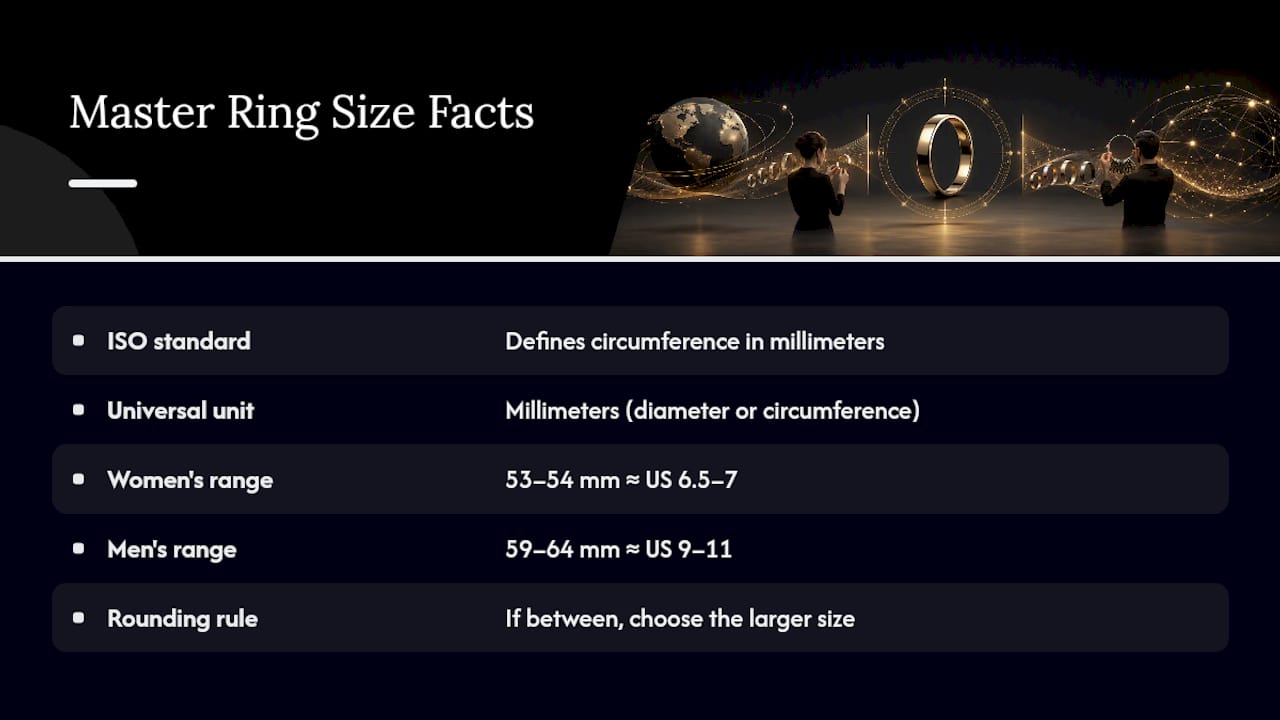
Millimeters are the one unit every sizing system can be translated through, whether a retailer lists sizes by inner diameter or inner circumference. The ISO 8653:2016 standard defines ring size by inner circumference in millimeters, and that single figure underpins most of continental Europe’s sizing.
Here’s how the major systems line up, based on a comprehensive international conversion reference:
Rounding matters more than most shoppers realize. Sizing systems don’t all step in the same increments (US moves in quarter and half sizes, EU typically moves in whole millimeters), so a converted value that lands between two rows should push you toward the larger option rather than the smaller one. A tight ring is far more uncomfortable, and often more damaging to try to force off, than a slightly loose one.
The most common range for adult women’s rings clusters around a 53 to 54 mm inner circumference, which lands at a US 6.5 to 7. Men’s rings average larger, typically in the US 9 to 11 range, or roughly 59 to 64 mm in circumference. If you’re shopping for a gift and only know “it’s a medium sized hand,” these two ranges are the safest starting bet, though nothing replaces an actual measurement.
How to Measure Your Ring Size at Home
You have two paths to a reliable millimeter figure: measure a ring that already fits, or measure the finger itself. Both work, but they call for slightly different techniques.
- Measure an existing ring’s interior. Lay the ring flat on a ruler or use calipers, and measure straight across the inside edge, not the outside of the band. Measure twice, from two different angles, since bands aren’t always perfectly round.
- Measure finger circumference with a paper strip. Cut a thin strip of paper, wrap it snugly around the base of the finger, mark where it overlaps, then lay it flat against a ruler to get the circumference in millimeters.
- Use a reusable plastic ring sizer if you have one. These give you a size reading directly and tend to be more consistent than paper across multiple attempts.
- Cross-check diameter against circumference. Multiply diameter by pi (3.14159) to confirm it matches your circumference measurement, and use whichever number the SuperJeweler measurement guide or your chosen chart calls for.
- Measure in the evening, at room temperature, after normal activity. Fingers swell with heat and shrink with cold, so a morning measurement in a cold house can run a full size smaller than an evening reading.
- Account for knuckle size. If your knuckle is noticeably bigger than the base of your finger, size for a spot that lets the ring pass over the knuckle without being loose once it’s on.
- Take at least three readings and use the median, not the first number you get.
Pro Tip: Measure your dominant hand’s ring finger separately from your non-dominant hand. Most people’s hands differ by a quarter to a half size, and that gap is exactly the kind of thing a paper strip catches that guessing never will.
Home methods are perfectly fine for a standard band on a budget purchase. For wide bands, eternity settings, or anything with a four-figure price tag, get a professional measurement before you order. Retail sizing guides consistently recommend this step for exactly that reason: the margin for error on an expensive or hard-to-resize ring is much smaller.
How Does the Ring Size Math Actually Work?
Circumference equals diameter multiplied by pi. A ring with a 17.3 mm interior diameter has a circumference of 17.3 × 3.14159, which comes out to roughly 54.3 mm, matching a US size 7. That’s the whole conversion engine behind every chart you’ll see.
For converting US sizes directly into ISO circumference or diameter, Wikipedia’s technical summary gives two formulas worth keeping handy: circumference in millimeters equals 2.55 times the US size plus 36.5, and diameter in millimeters equals 0.8128 times the US size plus 11.63. Plug in a US size 7 and you get a circumference right around 54.35 mm, which lines up with the chart above.
German (DE) sizes are given in diameter millimeters, so multiplying a DE size by pi gets you to the equivalent EU or French size, since EU sizing equals circumference directly. When a result falls between two available sizes, round up. Wider bands need to go up further still, sometimes a half size more, because more metal touching the skin makes a ring feel tighter than a thin band at the same numeric size.
What Do US, UK, EU, and Asian Ring Sizes Actually Mean?
Every region built its own scale, and knowing the logic behind each one makes cross-border shopping far less confusing.
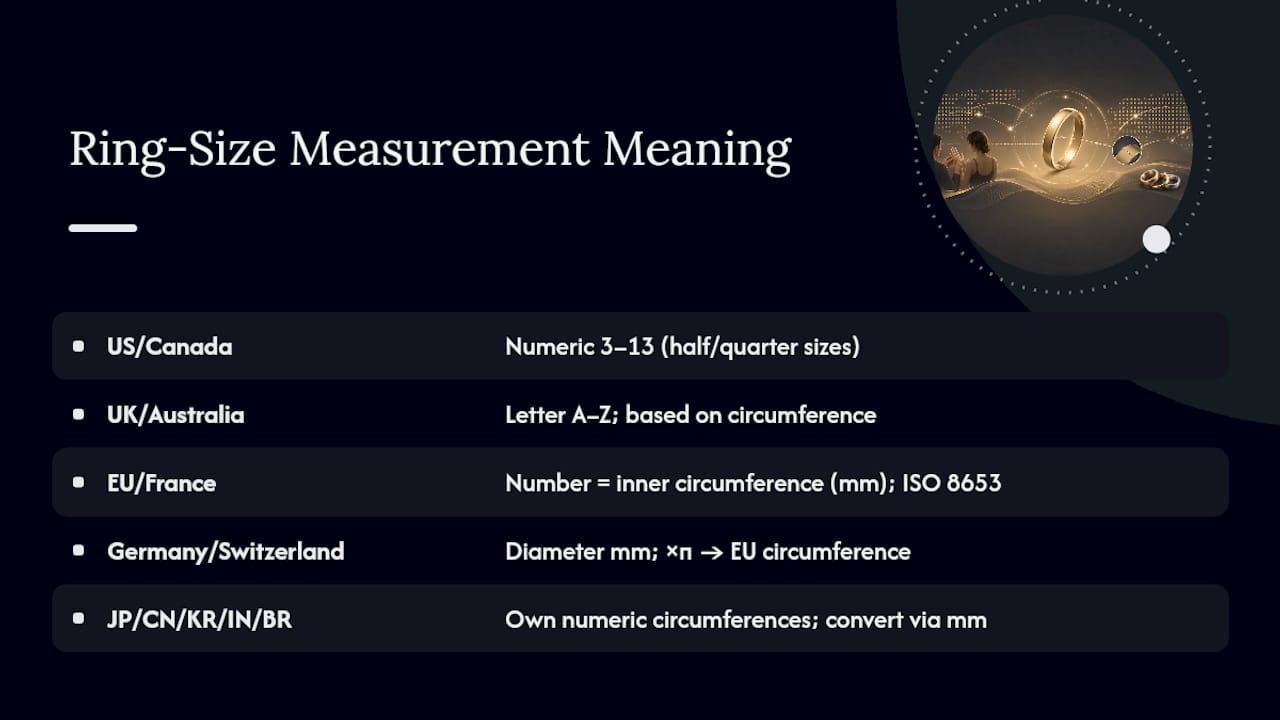
The US and Canadian system uses a single numeric scale, typically running from 3 to 13 with half and quarter sizes available at most retailers, and the two countries use identical numbers.
The UK and Australian system uses letters, from A up through Z plus fractional half sizes, based on circumference in millimeters. There’s no shortcut formula here that beats using a chart, since the letter jumps aren’t evenly spaced against the metric scale.
The EU and French system is the most literal: an EU 53 simply means a 53 mm inner circumference. This ties directly back to ISO 8653:2016, which defines sizing by circumference in the first place.
Germany and Switzerland measure by diameter in millimeters rather than circumference, so a DE 54 is not the same number as an EU 54. Multiply the DE figure by pi to land on the equivalent EU size.
Japan, China, and Korea use their own numeric circumferential scales that don’t map one-to-one onto US or EU numbers, which is why the millimeter bridge matters most when shopping from a JP, CN, or KR retailer. India and Brazil each run separate numeric scales as well, and both convert cleanly once you have a circumference in millimeters to start with.
When to See a Jeweler and What Resizing Involves
Get professional confirmation if your home measurements vary by more than a quarter size between attempts, if you’re sizing for a wide band, an eternity setting, or heavily engraved metal, or if the ring is a significant purchase you can’t easily return.
Resizing itself is routine for most gold, platinum, and silver bands, typically completed within a few days for a modest fee. Eternity rings with stones set all the way around, and certain alternative metals like tungsten or titanium, often can’t be resized at all because of how the metal or the stone-setting is constructed. Knowing this before you order saves a returned package and a second shipping wait. A jeweler’s confirmation, even for a routine order, closes the small gap that a paper strip and a kitchen ruler can’t quite guarantee.
Using Printable Sizers and Online Calculators Correctly
Printable sizers are only accurate if the print itself is true to scale, and most printer default settings quietly shrink or stretch a page by a few percent.
- Set your printer to “actual size” or “100% scale,” never “fit to page,” before printing any sizing chart.
- Confirm the print is accurate by measuring a known object on the same page, like a credit card, which is always 85.6 mm long.
- Calibrate on-screen sizers the same way, by holding a ruler or bank card up to the screen at the size the tool claims.
- Ask a retailer for a free reusable plastic ring sizer if one is offered. It sidesteps printer scaling problems entirely.
- Reject any chart or tool that won’t let you verify its scale against a real object before you trust the number it gives you.
A Jeweler’s Take on Sizing Confidence
Most sizing complaints trace back to one thing: people forget that band width and profile change fit. A flat 2mm band and a domed 8mm band at the identical numeric size will feel different on the same finger. Measure, cross-check with the math, round up when unsure, and get valuable or wide rings confirmed in person.
— Andrew
Shop by Your Measured Size at SuperJeweler
Browsing by size is a practical next step once you’ve got a number, rather than guessing from a photo. Ring categories are organized so you can shop styles like the 7.5 diamond eternity ring, the 8.5 size option, or the 5.5 eternity band directly by the number you just measured, rather than sorting through an entire catalog by hand.

If you’re shopping for an engagement ring and want to see what fits a budget as well as a finger, the engagement ring collection covers real diamonds at accessible price points. Wide bands and eternity styles have specific resizing limitations, so it’s advisable to verify sizing options and policies before ordering. Measure first, then browse the engagement ring category with that number in hand.
Sources
FAQ
What size is a 7 in a ring?
A US size 7 has an inner diameter of about 17.3 mm and an inner circumference of about 54.4 mm, which converts to roughly a UK N, an EU 54, and a JP/CN/KR size 14.
How do I size my ring at home?
Measure the inner diameter of a ring that already fits, or wrap a paper strip around your finger to get circumference, then check that reading against a conversion chart or convert it using the diameter times pi formula.
What is 7 inches in ring size?
A finger circumference of 7 inches converts to about 177.8 mm, which is far larger than any standard ring size chart covers. If you meant 7 centimeters (70 mm), that’s still well beyond typical finger sizes, so double check whether you’re measuring in inches, centimeters, or millimeters before converting.
What is a size 9 ring in inches?
A US size 9 has an inner diameter of roughly 18.9 mm, which converts to about 0.74 inches, or an inner circumference of about 59.5 mm, roughly 2.34 inches around.
Can I trust a printed ring size chart from any website?
Only if you verify the print scale first. Print the chart at “actual size,” then confirm accuracy by measuring a credit card on the same page, which should read exactly 85.6 mm long.
Recommended
- Diamond Eternity Ring | Ring Size 5.5
- Diamond Eternity Ring | Ring Size 6
- Diamond Eternity Ring | Ring Size 7
- Diamond Eternity Ring | Ring Size 8
