For a natural diamond, especially anything you’d want to resell or an engagement ring center stone, GIA is the safer default because dealers and the secondary market price its grades as accurate. For lab-grown diamonds, IGI is a perfectly reasonable choice and usually the better value, since it lets you buy more size and clarity for less money. The trade-off is simple: GIA costs more and holds its value better; IGI costs less and grades a bit more generously.
TL;DR:
- GIA certification is preferred for natural diamonds intended for resale or value retention, due to its strict grading standards and industry trust.
- IGI offers a more generous and faster grading process, making it better suited for budget-conscious buyers of lab-grown diamonds who prioritize size and clarity.
- IGI tends to grade natural diamonds about one color and one clarity grade more lenient than GIA, often leading to a discounted market price.
- For round brilliants, GIA’s “Excellent” cut grade ensures optimal sparkle, unlike IGI, which provides less assurance on cut quality.
- Always verify diamond certificates through official databases, and be cautious of reports without inscribed report numbers or independent verification.
Table of Contents
- IGI vs GIA: What Each Certification Actually Means
- Head-to-Head: Grading Strictness, Cut, and Where the Gap Matters
- How Certificate Choice Changes What You Actually Pay
- How to Choose: A Practical Checklist Before You Buy
- Finding Certified Diamonds That Match Your Budget and Goals
- Author Perspective: Matching the Certificate to the Buyer
- Start Browsing Certified Diamonds at Superjeweler
- Where to Verify a Diamond Report Yourself
- Sources
- FAQ
IGI vs GIA: What Each Certification Actually Means
The “igi vs gia” question really comes down to who graded your stone and how strictly. Both are gemological laboratories that issue diamond grading reports, but they built their reputations in different lanes, and that history still shapes how the trade treats their paperwork today.
What is GIA and why does it set the standard?
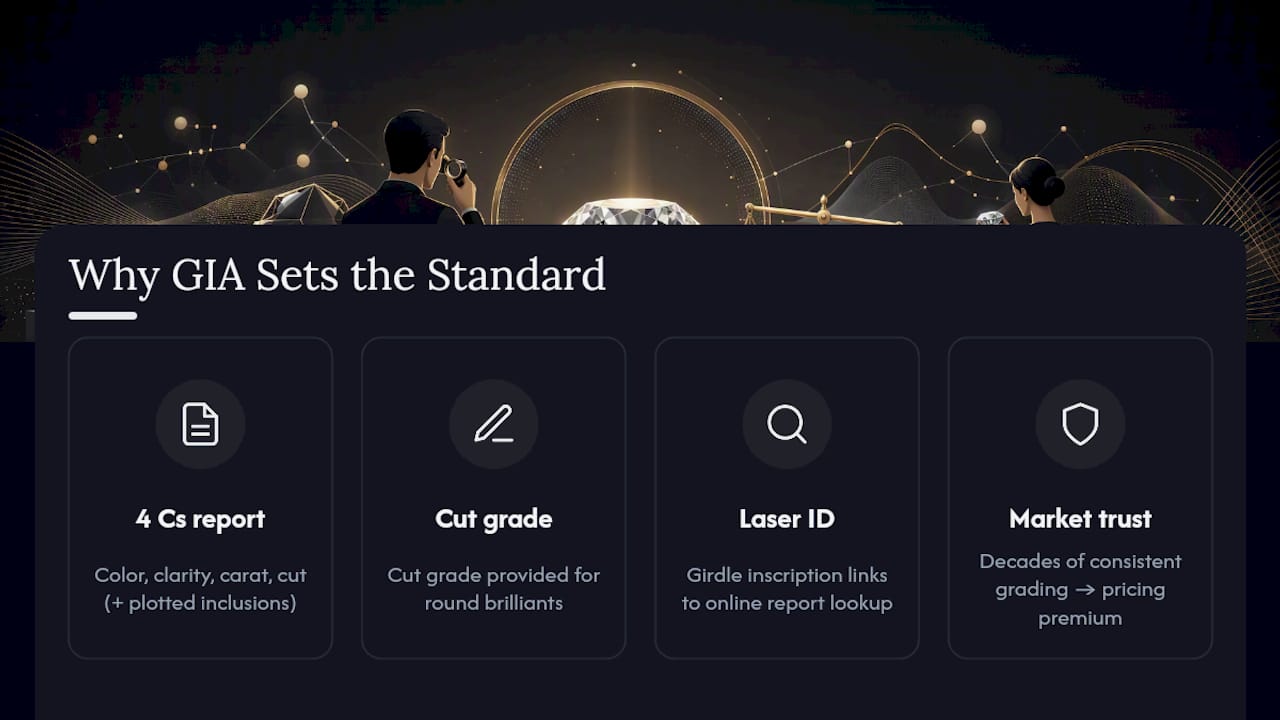
The Gemological Institute of America created the modern 4 Cs framework that the entire diamond industry still uses, and it operates as the reference lab that other labs get measured against. A GIA report lists color and clarity grades, carat weight, and a cut grade for round brilliants, plus a plotted diagram showing exactly where inclusions sit inside the stone.
Every GIA-graded diamond over a certain size gets a laser inscription on its girdle, a tiny serial number invisible to the naked eye that matches the report number. You can punch that number into GIA’s online database and pull up the original report instantly, which matters more than most buyers realize until they try to resell a stone with no way to verify it. That verification layer, combined with decades of consistent grading, is why jewelers and secondary markets price GIA-certified natural diamonds at a premium over identical stones graded elsewhere. Buyers aren’t just paying for a piece of paper. They’re paying for a grade the entire industry agrees to trust without re-checking it.
What is IGI and where does it fit in the market?
The International Gemological Institute has operated for decades and built the infrastructure to grade diamonds at serious volume, which made it the lab of choice as lab-grown diamond production scaled up. IGI reports cover the same basic categories as GIA, color, clarity, cut, carat weight, plus laser inscriptions and online lookup on IGI’s own database.
IGI didn’t become the dominant lab-grown certifier by accident. It built out grading capacity for lab-grown stones early, while other labs were still treating the category as a niche, and that head start turned into market share that analysis shows accounts for roughly two-thirds of online diamond listings today, most of it lab-grown supply. Retailers gravitate toward IGI for lab-grown inventory partly because of faster turnaround and lower certification costs, savings that get passed down to the shopper. For a lab-grown stone you plan to wear rather than flip, an IGI report from a reputable seller does the job it needs to do.
Head-to-Head: Grading Strictness, Cut, and Where the Gap Matters
Here’s where the “igi vs gia certification” comparison gets concrete. The differences aren’t uniform. They cluster in specific bands, and knowing where matters more than memorizing a general rule.
Trade practice and independent reviews consistently describe IGI as grading many natural diamonds about one color grade and one clarity grade more generously than GIA would assign the same stone. That’s not a scandal. It’s a documented tendency that experienced dealers routinely adjust for by mentally translating an IGI grade down a notch before pricing a natural stone. A diamond IGI calls G/VS1 might trade at what the market considers an H/SI1 price once a GIA-trained buyer runs the numbers.
Cut grading is a separate issue entirely, and it matters most for round brilliants. GIA is the only major lab whose “Excellent” cut grade specifically confirms proportions that maximize light return and sparkle in round diamonds. If you’re buying a round stone and brilliance is the whole point, a GIA Excellent cut grade removes guesswork that an IGI cut grade doesn’t fully resolve.
Where do the two labs actually agree? At the extremes. Flawless and Internally Flawless stones look the same under any lab’s microscope, and heavily included stones at the bottom end are equally obvious to both. The real divergence, and the place a shopper needs to pay attention, sits in the middle: G through J color and VS through SI clarity, which happens to be exactly where most engagement ring diamonds live.
Before you trust any report, run through this short checklist:
- Confirm the laser inscription matches the report number under 10x magnification.
- Look up the report on the issuing lab’s own website, not a third-party seller page.
- Ask for the plotted inclusion diagram or high-magnification photos, not just the summary grade.
- Note the report’s issue date. Grading standards get refined over time.
- If a natural stone is IGI-certified, ask the seller directly how they’ve priced the grading gap.
How Certificate Choice Changes What You Actually Pay
This is where “gia vs igi lab diamonds” pricing gets genuinely interesting, because the gap between the two labs isn’t just about strictness. It changes what a stone costs you and what it’s worth later.
One retrospective study comparing dual-certified diamonds, stones graded by both labs, found IGI-graded diamonds priced about 12% cheaper on average than their GIA-listed counterparts for similar stated specs. That’s a meaningful discount, but the sample was small (29 stones), and other analyses show grading agreement varies by attribute, so treat any single dataset as a data point, not gospel.
Here’s how that plays out for an actual buyer:
- Natural diamond shoppers pay a premium for GIA on purpose. The report itself becomes part of the asset. If you ever sell or trade in the stone, a GIA certificate is what a buyer or jeweler will trust without a second appraisal.
- Lab-grown shoppers can use the gap to their advantage. Since lab-grown stones carry far less resale expectation to begin with, buying IGI-certified lab-grown lets you get meaningfully more size or clarity for the same budget, a strategy sometimes called certificate arbitrage.
- Regrading risk cuts both ways. An IGI-graded natural stone that gets resubmitted to GIA later can come back with a lower grade, which is exactly the scenario that erodes resale value if you paid IGI-adjacent prices for a GIA-level stone.
- Watch for stones priced like a bargain that are actually just accurately priced. If an IGI-certified natural diamond is priced noticeably below what a comparable GIA stone would cost, that’s often the market correctly discounting for the grading gap, not a deal you’re getting away with.
How to Choose: A Practical Checklist Before You Buy
Start by identifying what you’re actually buying and why, because the right certificate depends entirely on that answer.
Ask yourself three questions first: Is the stone natural or lab-grown? What’s your realistic price ceiling? Do you expect to ever resell or trade in this piece? A natural diamond you intend to pass down or potentially resell should lean GIA, especially in a round shape where the cut grade genuinely affects sparkle. A lab-grown stone bought purely to wear and enjoy can comfortably carry an IGI report without any real downside.
Once you’ve narrowed down a specific stone, work through this checklist before handing over your card:
- Verify the laser inscription in person or ask for a close-up photo if buying online.
- Confirm the report is current and check the issue date against the stone’s listing date.
- Request the actual plotted diagram, not just a grade summary on a sales page.
- Ask the seller plainly: who performed the grading, and can you provide the original report?
- Confirm the store’s return and regrade policy in writing before you buy, not after.
Pro Tip: If a seller can’t produce the original certificate, or only offers a photocopy with no lookup number, treat that as a hard stop. A legitimate stone always traces back to a report you can verify independently.
Finding Certified Diamonds That Match Your Budget and Goals
Various jewelry retailers carry both lab-grown and natural diamond options across engagement rings, loose stones, and bridal sets, and listings typically include certification details to help you compare. If you’re weighing color against clarity once you’ve settled on a lab, our guide on color versus clarity trade-offs breaks down which C matters more for different stone sizes.
Before checkout, it’s wise to confirm a stone’s authenticity and report details directly with customer service, especially for higher-priced pieces. Many online stores provide filters to sort by certification type, allowing you to browse specifically within lab-grown inventory or narrow down to natural stones depending on your preference.
Author Perspective: Matching the Certificate to the Buyer
If you’re buying on a tight budget and want the biggest visible stone, lab-grown with an IGI report is the practical move; you’re not paying for resale insurance you won’t use. If you’re buying something meant to last generations or hold value, a natural diamond with a GIA report, ideally with a GIA Excellent cut grade if it’s round, is worth the premium. If resale matters to you at all, even distantly, don’t cut corners on the lab. The paperwork outlives the purchase decision.
— Andrew
Start Browsing Certified Diamonds at Superjeweler
Some online retailers offer lab-grown diamonds with IGI certification and natural diamonds with GIA documentation, providing options regardless of your certification preference.

If size and value per dollar matter most, our lab-grown diamond collection includes IGI-certified stones at a fraction of what an equivalent natural diamond would run, and our huge lab-grown engagement ring deals page is a good starting point if you’re trying to maximize carat weight on a fixed budget. Shoppers who want a natural stone with the resale confidence GIA provides can start with our engagement ring collection and filter by certification. Every listing shows the certifying lab up front, so you can apply everything above the moment you start comparing stones.
Where to Verify a Diamond Report Yourself
Don’t take a seller’s word for a grade. Look up any stone directly through GIA’s report database or IGI’s verification tool, both free and searchable by report number. For a broader look at how the two labs compare across pricing and market share, Carat Hunter’s 2026 analysis is a solid outside reference.
Sources
- GIA
- IGI
- GIA vs IGI Diamond Certification in 2026 | Carat Hunter
- GIA vs IGI for Round Diamonds in 2026 | Diamond Critics
FAQ
Why is IGI so much cheaper than GIA?
IGI’s lower cost comes from faster turnaround and lower certification fees, and its grading tends to run slightly more generous than GIA’s, which combine to make IGI-certified stones price lower for similar stated specs.
What is the most respected diamond certification?
GIA is widely considered the most respected certification for natural diamonds because of its strict, consistent grading standards and the resale premium the market assigns to its reports.
Are Costco diamonds GIA certified?
Certification varies by retailer and individual listing, so always check the specific report accompanying any diamond rather than assuming a certain lab based on where it’s sold.
Does IGI certify lab diamonds?
Yes, IGI certifies both lab-grown and natural diamonds, and it has become the dominant certification lab specifically for lab-grown stones due to its early investment in grading capacity for that category.
Should I choose GIA or IGI for an engagement ring?
If the center stone is a natural diamond, especially a round brilliant, GIA gives you a cut grade and resale confidence worth the added cost; if it’s lab-grown, an IGI report from a reputable seller is a sound, budget-friendly choice.
Recommended
- Expect 30–50%: Diamond Trade In Value for U.S. Sellers
- Save about 40%: VVS vs VS for Engagement Rings and When to Upgrade
