Hearts and Arrows diamonds are round brilliants cut with such precise optical symmetry that they display eight matching arrows face-up and eight matching hearts face-down. If a seller can’t produce that proof, ask for it before you commit, or shop by proportions instead.
TL;DR:
- True Hearts and Arrows diamonds require facet alignment within fractions of a degree, making them rare and more costly due to longer cutting times and higher waste.
- Verification demands viewing high-quality images with specialized viewers and confirming certification from labs like IGI or GCAL, not just relying on standard grading reports.
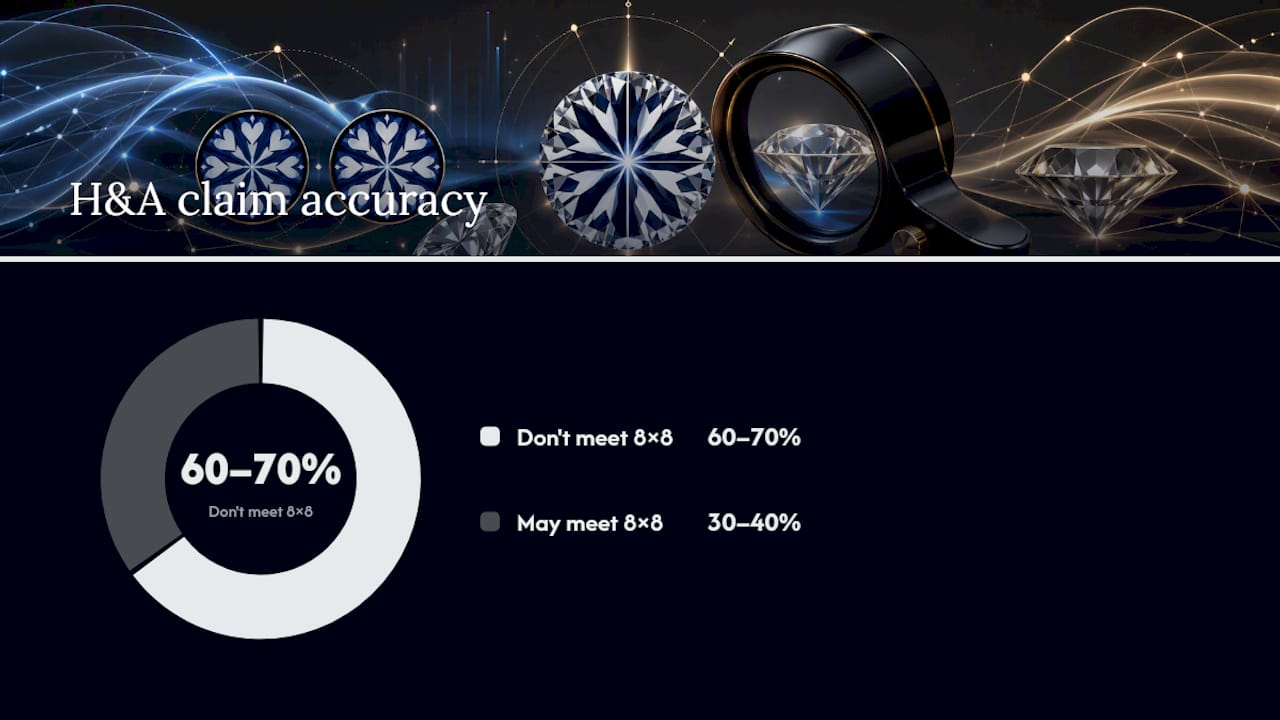
- Many diamonds marketed as H&A do not meet strict standards, with as many as 60% to 70% failing to achieve the full 8×8 pattern upon testing.
- Paying a 10% to 30% premium for certified H&A diamonds makes sense mainly for collectors or those valuing documented craftsmanship, rather than for general sparkle needs.
- Self-verification with viewer images and third-party certificates can identify “accidental” H&A stones that offer similar optical performance at a lower cost.
Table of Contents
- What Are Hearts and Arrows Diamonds?
- How Cutters Create the Hearts and Arrows Pattern
- How Do You Verify a True Hearts and Arrows Diamond?
- Is the Hearts and Arrows Premium Worth Paying?
- Buying Checklist: What to Ask Before You Pay for H&A
- Lab-Grown Versus Natural Hearts and Arrows Diamonds
- How Superjeweler Supports Verified Diamond Purchases
- When Does Paying for Hearts and Arrows Make Sense?
- Find Verified Cut Quality on Superjeweler
- Where to Learn More About Hearts and Arrows Diamonds
- Sources
- FAQ
What Are Hearts and Arrows Diamonds?
Hearts and Arrows diamonds get their name from Japanese diamond cutters who, in the 1980s, figured out how to align a round brilliant’s 57 or 58 facets with near-perfect precision. The result is a diamond that shows eight symmetrical arrows when viewed face-up through a special scope, and eight hearts when flipped face-down and viewed through the pavilion. Cutters achieve it by prioritizing facet alignment over retained carat weight, a deliberate tradeoff that increases waste from the rough and is the real reason true H&A stones cost more.
You can’t see the pattern with the naked eye. It only shows up through a dedicated Hearts and Arrows viewer, an IdealScope, or an ASET (Angular Spectrum Evaluation Tool) scope, each of which uses colored light and mirrors to reveal how light travels through the stone. Hold a true H&A diamond under one of these viewers and you’ll see eight evenly spaced arrows radiating from the center, each one the same width, length, and darkness as the other seven.
Here’s where a lot of shoppers get tripped up: optical symmetry and report symmetry are not the same thing. A GIA or AGS grading report gives a symmetry grade based on how well the facets meet at their edges. That’s a two-dimensional, meet-point assessment. Optical symmetry, the kind H&A depends on, measures how the facets are aligned in three-dimensional space relative to each other and to the light source. A diamond can earn “Excellent” symmetry on its lab report and still fail to produce a clean H&A pattern, because the meet points can be perfect while the facet angles are still slightly out of alignment.
That distinction explains why:
- A stone graded Excellent by GIA isn’t automatically an H&A diamond.
- Two diamonds with identical proportions on paper can look different under a viewer.
- H&A status has to be confirmed visually or through a specialized report, never assumed from a standard grading certificate alone.
How Cutters Create the Hearts and Arrows Pattern
Getting eight arrows and eight hearts to line up requires facets to be positioned within fractions of a degree of each other, all the way around the stone. Cutters call this azimuth alignment, and it’s unforgiving. A single facet angled even slightly off throws the whole pattern out of balance, which is why so few diamonds in any given parcel actually qualify.
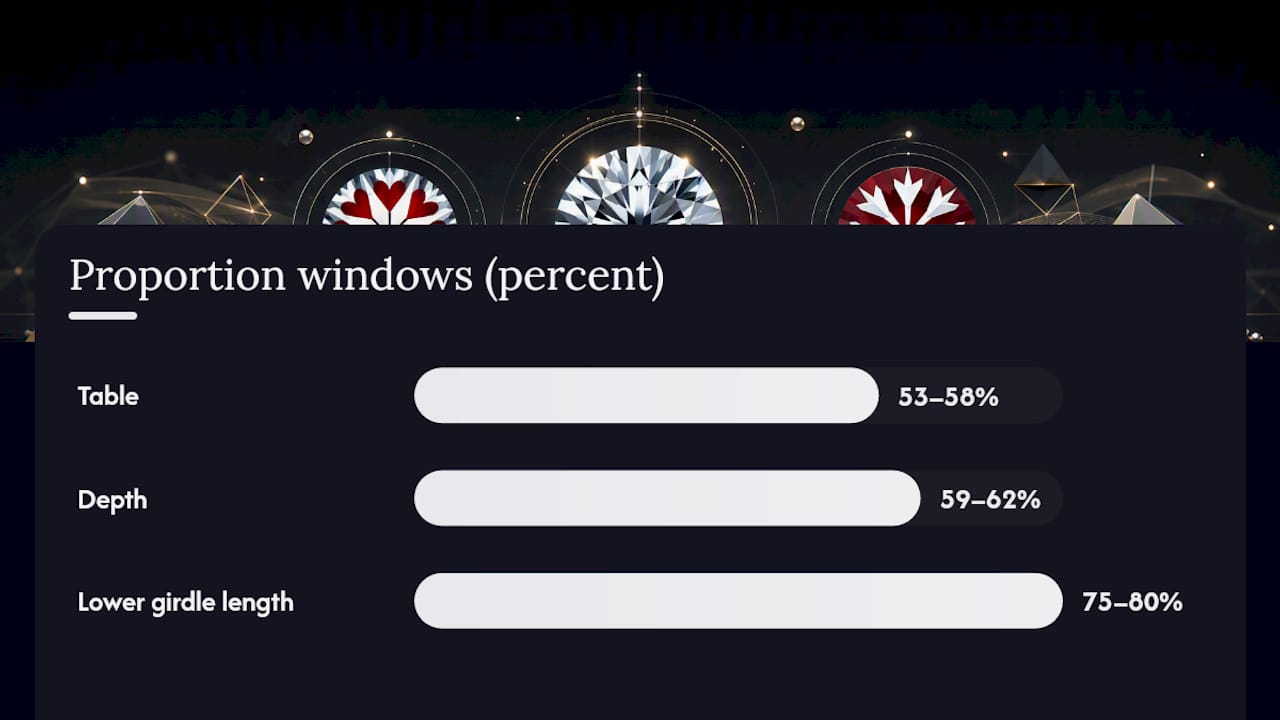
The proportion windows most commonly associated with true H&A rounds are narrow:
- Table: roughly 53% to 58%
- Depth: roughly 59% to 62%
- Crown angle: roughly 34° to 35°
- Pavilion angle: roughly 40.6° to 41°
- Lower girdle facet length: roughly 75% to 80%
Each of those numbers does a job. Table and depth percentages control how much light enters and exits the stone; get them too shallow or too deep and light leaks out the sides instead of bouncing back to your eye. Crown and pavilion angles govern the balance between brightness (white light return), fire (rainbow flashes), and scintillation (the sparkle you see when the stone moves). Lower girdle facet length affects how sharply defined the arrows appear under a scope.
Because achieving that alignment sacrifices rough weight, cutting a true H&A stone can take up to three times longer than standard cutting, and yields less finished carat weight from the same piece of rough. That labor and loss get passed straight to the price tag.
Not every attempt lands perfectly. Some diamonds show a partial pattern, sometimes called a “happy accident,” where six or seven arrows line up cleanly but one or two are slightly off. These stones often perform beautifully to the naked eye and cost less than a certified H&A, because the cutter wasn’t specifically targeting the pattern. True, full 8×8 alignment remains rare simply because it demands more precision than most cutting operations are set up to deliver consistently.
How Do You Verify a True Hearts and Arrows Diamond?
Viewer images are the first thing to ask for, and the only real substitute for seeing the stone in person. A genuine H&A pattern shows eight arrows of uniform width, length, and darkness under an H&A viewer, with no gaps, no faded shafts, and no lopsided sizing. Flip to the heart view and you should see eight hearts of matching shape and depth, evenly spaced around the pavilion. Graders look specifically for consistent shaft alignment and balanced symmetry, since the pattern repeats every 22.5 degrees around the stone, and any irregularity in that rotation shows up immediately as a crooked or missing arrow.
Certification matters just as much as the visual check. Here’s how the major labs handle it:
- IGI issues a dedicated Hearts & Arrows Report that includes actual imaging and proportion diagrams, making it one of the clearest paper trails you can request.
- AGS doesn’t issue an “H&A” label per se, but its Ideal (0) cut grade reflects the light-performance standard that true H&A stones typically meet.
- GCAL offers a “GCAL Ideal” designation with its own imaging standards worth comparing against IGI’s report.
- GIA does not certify Hearts and Arrows as a distinct grade. GIA reports symmetry and polish, but a GIA certificate alone never confirms H&A status, no matter what a listing implies.
Watch for vague language like “excellent optical symmetry” or “H&A quality” without any accompanying image or report number attached. Independent analyses suggest that a large share of stones marketed as H&A, somewhere in the range of 60% to 70% by some estimates, don’t actually meet strict 8×8 standards once tested. Request viewer images or video first, then ask which lab issued the accompanying certificate, then request either a live viewing appointment or a clear return window if you’re buying online.
Pro Tip: Ask the seller to send an ASET image alongside the H&A viewer image. The ASET shows light return through color mapping, so you can confirm the pattern isn’t just cosmetic but backed by real light performance.
Is the Hearts and Arrows Premium Worth Paying?
Verified H&A diamonds typically run 10% to 30% higher than a comparable Excellent-cut round with the same carat, color, and clarity.
That premium makes sense for specific buyers:
- Collectors who want a diamond that’s provably at the top of the cut-quality spectrum, not just visually excellent.
- Buyers concerned with resale or appraisal recognition, where a documented H&A report adds a layer of third-party proof.
- Anyone who values the craftsmanship story itself, the fact that a cutter sacrificed yield specifically to hit that alignment.
For everyone else, there’s a more practical path. Independent cut analysts point out that focusing on ideal proportions and strong light-performance scores can deliver optics that look just as good, sometimes better, without paying for the H&A branding at all. An AGS Ideal or GIA Excellent round that happens to fall inside the H&A proportion window will often throw off comparable brightness and fire, even without a formal H&A report attached. You’re paying for the performance, not the label.
Here’s the tradeoff worth sitting with: many stones sold as H&A don’t meet the strict standard, but many stones never marketed as H&A quietly do. Ask any experienced cutter, and they’ll tell you some Excellent-cut rounds land inside H&A tolerances by chance, without anyone paying to have them tested or certified that way. Finding one of those “accidental” H&A stones, verified yourself with a viewer, gets you the same optical performance without the markup.
If your priority is maximum visible sparkle for your budget, consider whether that premium is better spent elsewhere. Buyers focused on perceptible impact on the hand often see more visible improvement from putting that same money toward a larger carat weight or better color grade than from chasing the H&A label itself.
Buying Checklist: What to Ask Before You Pay for H&A
Before you agree to a premium for a Hearts and Arrows diamond, get these items in hand:
- H&A viewer images, showing both the arrow view (face-up) and heart view (face-down), with all eight patterns visibly uniform.
- ASET or IdealScope images, confirming light return and color distribution beyond what a basic viewer photo shows.
- A third-party certificate from IGI, AGS, or GCAL that specifically documents optical symmetry or H&A status, not just a standard grading report.
- Laser inscription details, if available, so you can independently verify the stone matches its certificate.
- Full proportion specs, including table, depth, crown angle, pavilion angle, and lower girdle length, so you can check them against typical H&A ranges yourself.
If a seller can only offer one or two of these, treat the H&A claim as unverified rather than assuming good faith. And if the premium stretches your budget thin, it’s worth asking whether that money is better spent trading up in carat weight, color, or clarity instead of chasing a label you can’t confirm.
A few red flags should end the conversation entirely: no viewer images available on request, hedging language instead of a clear yes or no on certification, or no return policy if the pattern doesn’t match what was promised once you view the stone yourself. Superjeweler’s engagement ring buying guide walks through these same verification steps in more depth if you want a broader framework for evaluating cut quality alongside the other three Cs.
Lab-Grown Versus Natural Hearts and Arrows Diamonds
Lab-grown diamonds can be cut to the exact same optical precision as natural stones, since the H&A pattern depends entirely on facet alignment, not on how the crystal formed. That means a lab-grown round can hit the same table, depth, and angle targets as a natural H&A stone, often at a noticeably lower price for the same size and clarity.
Verification works the same way for both. IGI issues Hearts & Arrows reports for lab-grown diamonds just as it does for natural ones, and the same viewer and ASET tests apply regardless of origin. A few things to weigh when comparing the two:
- Budget stretch: Lab-grown pricing often lets you land a larger or higher-proportion H&A stone for the same money you’d spend on a smaller natural one.
- Resale expectations: Natural diamonds currently hold a different resale market than lab-grown, worth factoring in if resale value matters to you.
- Verification is identical either way: ask for the same viewer images and certification regardless of which you choose.
Superjeweler’s lab-grown diamond collection is worth a look if stretching your budget toward better proportions or a larger carat matters more to you than natural origin.
How Superjeweler Supports Verified Diamond Purchases
Buying a diamond sight-unseen means you’re trusting photos, specs, and policy. Some online jewelers back buyer trust with practical protections like return windows, warranty options, and detailed proportion data on engagement ring listings, all of which matter when you’re trying to confirm cut quality before committing.
A few resources worth starting with:
- The round brilliant diamond primer if you want to understand facet structure before comparing proportion specs.
Combined with clear return policies, these pages give you a practical way to check cut quality claims against real documentation instead of taking a listing’s word for it.
When Does Paying for Hearts and Arrows Make Sense?
I’d rather see someone buy a well-proportioned diamond they verified themselves than a branded H&A stone they took on faith. The pattern is real, the craftsmanship behind it is real, and for collectors or anyone who wants documented proof of top-tier symmetry, the premium is a fair price for that certainty. But for most buyers, light performance and proportions do more for how a ring actually looks on the hand than a label ever will. Spend the extra money on carat or color if sparkle is your goal. Spend it on H&A if the story and the paperwork matter to you as much as the sparkle does.
— Andrew
Find Verified Cut Quality on Superjeweler
Online jewelry retailers often provide ways to shop by the numbers that determine sparkle rather than relying on unverified marketing labels. Engagement ring listings may include proportion details, and shoppers can sometimes request additional viewer images or certificate copies before buying.

Start with the engagement rings collection to browse rounds by proportion, or check the lab-grown diamond selection if you want to stretch your budget toward a larger stone or tighter proportion window. If your priority is value over label, the engagement rings under $1,000 category is a solid place to compare real diamonds at accessible prices. Every purchase should ideally come backed by return and warranty policies, so if the stone doesn’t match what you were shown, you have recourse. It’s advisable to contact customer support before buying if you want additional imaging or a certificate copy sent over first.
Where to Learn More About Hearts and Arrows Diamonds
For cert criteria, IGI’s own Hearts & Arrows Report page is the clearest primary source. For buying strategy and premium analysis, CutGrade and Diamond Critics both dig into value tradeoffs. For a technical overview of the pattern itself and its history, Wikipedia’s entry on hearts and arrows is a solid starting point.
Sources
- What are Hearts & Arrows diamonds? – IGI
- The Hearts and Arrows Myth: Is It Worth the Premium? | CutGrade
- Hearts and arrows – Wikipedia
- Hearts and Arrows Diamond: Is the 2026 Premium Worth It? | Diamond Critics
- Hearts & Arrows Report — IGI
FAQ
Are Hearts and Arrows Diamonds Rare?
Yes. True 8×8 alignment demands precision most cutting operations can’t consistently hit, and cutting one can take up to three times longer than standard cutting while sacrificing more rough weight, which keeps supply limited.
What Are Hearts and Arrows in Diamonds?
Hearts and Arrows describes an optical pattern in round brilliant diamonds where precise facet alignment produces eight matching arrows viewed face-up and eight matching hearts viewed face-down through a specialized viewer.
Does GIA Certify Hearts and Arrows Diamonds?
No. GIA grades symmetry and polish on its standard reports but doesn’t issue a distinct Hearts and Arrows certification; IGI is the lab most known for dedicated H&A reports with imaging included.
How Do I Verify a Diamond Is Truly Hearts and Arrows?
Request H&A viewer and ASET images showing uniform arrows and hearts, ask which lab issued any supporting certificate, and confirm the seller offers a return window if the stone doesn’t match what was shown.
Recommended
- Expect 30–50%: Diamond Trade In Value for U.S. Sellers
- Save about 40%: VVS vs VS for Engagement Rings and When to Upgrade
- Why Diamonds Are Valuable – Insights for Couples
