Black diamonds are opaque, carbon-dense stones often treated to deepen their color, prized for bold, modern style. White diamonds are transparent, graded on brilliance and clarity, and remain the traditional choice for timeless sparkle. Choose black for contrast and edge, white for classic fire. Either way, insist on lab documentation before you buy, since treatment disclosure changes both the price and the story behind the stone.
TL;DR:
- Most black diamonds on the market are treated through heat or irradiation methods, not naturally occurring in that color, which greatly affects their price.
- Black diamonds are evaluated based on their origin and treatment status, not on the 4Cs scale used for white diamonds, often requiring lab reports to verify whether they are natural or treated.
- Treated black diamonds typically cost between $100 and $400 per carat, making them more affordable than high-quality white diamonds that depend on color, clarity, and cut.
- Black diamonds are more prone to internal stress and fracturing due to their inclusions, so protective settings and proper handling are essential for durability in everyday jewelry.
- Resale value for black diamonds, especially treated ones, is limited compared to white diamonds, so they should primarily be purchased for personal wear rather than as investment assets.
Table of Contents
- Why Black Diamonds Look Nothing Like White Diamonds
- Are Black Diamonds Natural or Treated?
- How Are Black and White Diamonds Graded Differently?
- What Drives the Price Gap Between Black and White Diamonds?
- How Durable Are Black Diamonds in Everyday Jewelry?
- Which One Fits Your Style and Occasion?
- Buying Checklist: What to Verify Before You Purchase
- An Editorial Take: Grading Confusion Is the Real Buying Risk
- Explore Black and White Diamond Options at Superjeweler
- Sources
- FAQ
Why Black Diamonds Look Nothing Like White Diamonds
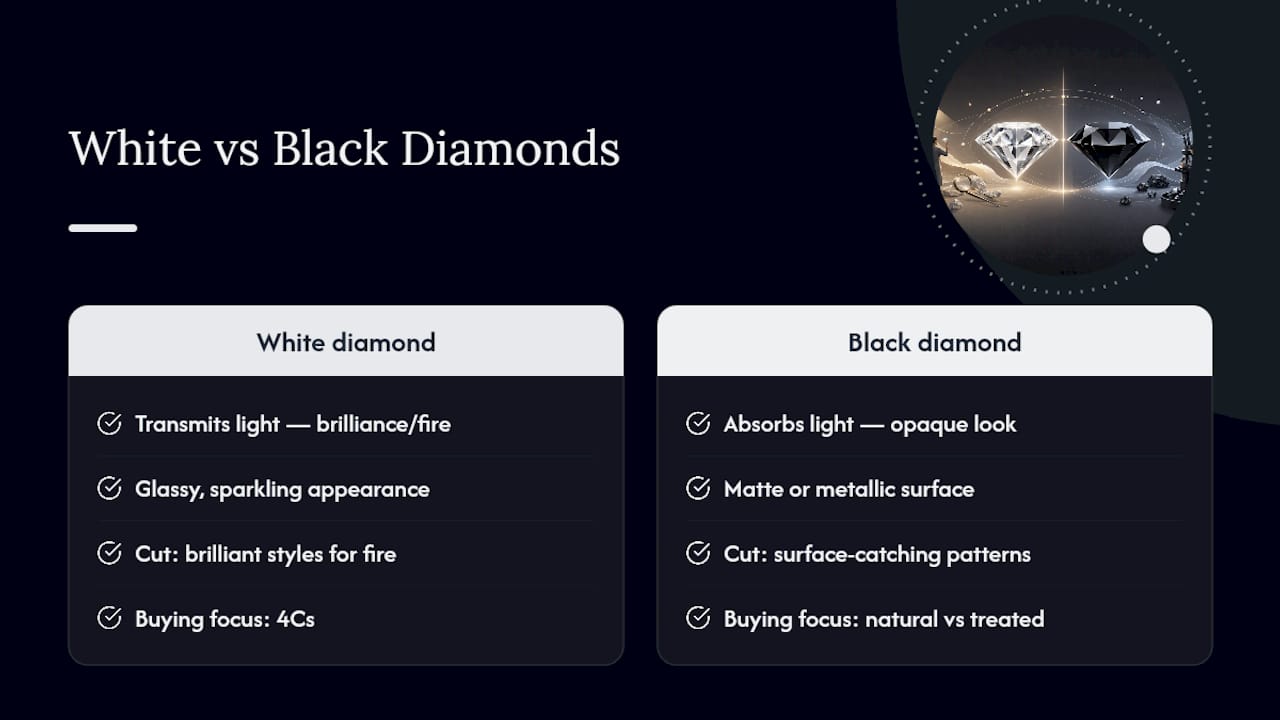
Both stones are chemically identical: pure carbon, Mohs hardness 10, the hardest natural material on Earth. What separates them is what’s trapped inside. White diamonds are largely transparent, letting light bounce through facets to create the brilliance and fire that make a solitaire ring sparkle across a room. Black diamonds are the opposite story. They’re packed with dense clusters of microscopic inclusions, mainly graphite, pyrite, and hematite, that absorb light instead of letting it pass through, according to GIA.
That’s the whole visual difference in one sentence: white diamonds transmit light, black diamonds swallow it.
The result is a matte or metallic surface rather than the glassy shine you’d expect from a diamond. Cut a black diamond into a brilliant round shape and it still won’t throw rainbow flashes the way a white diamond does, because there’s no clear internal path for light to travel and refract. That’s why jewelers increasingly cut black diamonds into rose cuts, checkerboard patterns, or flat-faceted shapes that catch light along the surface instead of trying to force brilliance that isn’t there.
Here’s what surprises most first-time buyers: hardness has nothing to do with this difference. A black diamond and a white diamond of the same carat weight score identically on the Mohs scale. The inclusions that make a black diamond opaque don’t make it softer, only visually different and, as you’ll see later, sometimes more prone to internal stress. Confusing “opaque” with “inferior material” is the single biggest misunderstanding buyers bring to this comparison, and it’s worth correcting before you even look at price tags.
If you’re comparing loose stones side by side, look past color entirely and ask what’s actually driving each one’s identity. For white diamonds, that means the 4Cs: cut, color, clarity, and carat. For black diamonds, it means asking a completely different question, covered next: is this color natural, or did a lab put it there?
Are Black Diamonds Natural or Treated?
Most black diamonds sold today are treated, not naturally colored. That single fact explains more about pricing and rarity than anything else in this comparison.
Natural black diamonds do exist, formed the same way white diamonds form deep in the Earth’s mantle, but with such a high concentration of graphite and mineral inclusions that they emerge opaque. A rarer subtype, called carbonado, is a porous, polycrystalline form of natural diamond found mainly in Brazil and the Central African Republic, believed by some researchers to have formed through entirely different geological (or even extraterrestrial) processes than typical gem diamonds. Natural Fancy Black diamonds of gem quality are uncommon enough that most jewelry-grade black diamonds on the market never started out that dark.
Instead, commercial suppliers commonly use heat treatment or irradiation to convert lower-quality, heavily included white or brown diamonds into a deep, uniform black. This isn’t a shady practice; it’s a standard, disclosed treatment in the trade, and GIA’s own buying guide treats black diamonds as a normal, common category of the market. A 2019 gemological review of Fancy White and Fancy Black diamonds confirmed that treated material dominates what labs actually see submitted for identification, and that distinguishing natural from treated color requires microscopy and lab procedures well beyond a jeweler’s loupe, per Gems & Gemology.
The practical takeaway: never take a seller’s word that a black diamond is “natural.” Ask for a lab identification report that states it in writing. If the listing doesn’t mention treatment at all, that silence is itself a red flag worth asking about directly before you buy.
How Are Black and White Diamonds Graded Differently?
White diamonds get graded on the familiar 4Cs scale: cut, color (D to Z, with D being colorless), clarity, and carat weight. That framework doesn’t apply to black diamonds at all, and expecting it to is where a lot of buyers get confused.
Black diamonds fall into a separate category called Fancy Black, part of the broader fancy-color diamond world alongside pinks, blues, and yellows. Instead of a 4Cs grading report, GIA issues a Colored Diamond Identification and Origin Report, which states whether the diamond is natural, and whether its color comes from treatment, rather than assigning a color grade on the D to Z scale, according to GIA’s fancy color buyer’s guide.
Statistic to know: GIA does not issue standard 4Cs grading reports for black diamonds at all. Every legitimate black diamond report you’ll see is an origin and identification document, not a color grade, per GIA’s colored diamond lab service.
When you’re handed a report, check for three things:
- Clear language stating “natural” or “treated” color origin, not vague marketing terms like “genuine” or “authentic.”
- Measurements and weight that match the physical stone in front of you.
- Any lab remarks about clarity characteristics, durability notes, or treatment method (commonly heat or irradiation).
Reading these reports matters more than most buyers assume. A common mistake is treating a black diamond’s paperwork as interchangeable with a white diamond’s grading report, then feeling misled when there’s no color grade listed. There isn’t one, because black diamonds are evaluated on an entirely different axis: identity and origin, not color grade.
What Drives the Price Gap Between Black and White Diamonds?
Treated black diamonds are generally the more affordable option, often landing in the $100 to $400 per carat range for commercial lab-grown or treated material, according to Jewelers Mutual. White diamond pricing varies far more widely, since it’s built on the interaction of all 4Cs rather than a single characteristic.
For black diamonds, the biggest value drivers are natural origin and color uniformity. A natural Fancy Black diamond with a documented origin report will command a real premium over treated material, though even natural black diamonds remain a niche category compared to top-grade white diamonds. Rarity here works differently than with white stones: it’s not about being colorless, it’s about being naturally, uniformly opaque without a lab ever touching it.
For white diamonds, the value stack is more familiar. Colorlessness (grades D through F), high clarity, and excellent cut quality combine to push price per carat sharply upward, especially past the one-carat threshold where price tends to jump non-linearly. You can explore how color and clarity trade off against each other when budgeting for an engagement ring, since sacrificing a grade in one area often frees up meaningful budget in another.
Resale is where the two categories diverge most sharply. White diamonds, particularly in popular carat weights and cuts, have an established secondary market with reasonably predictable depreciation. Black diamonds, especially treated ones, have a thinner resale market; buyers should think of a black diamond purchase primarily as a jewelry investment for wear and enjoyment, not as a store of resale value. That’s not a knock against black diamonds, it’s just a realistic framing that changes how much you should spend relative to your overall jewelry budget.
How Durable Are Black Diamonds in Everyday Jewelry?
A black diamond’s density of inclusions, the same feature that gives it its color, can also make it more prone to internal fracturing than a comparably sized white diamond. GIA notes that natural black diamonds with heavy inclusions and microfractures can be more brittle, which changes how they should be set and worn day to day, per its black diamond FAQ.
This doesn’t make black diamonds fragile or impractical. It does mean setting technique matters more than it would for a clean white diamond. Bezel settings, which wrap a protective metal rim around the stone’s edge, and other low-profile settings that shield the girdle from impact are generally better choices for black diamonds than high-set prong styles that leave the stone exposed on all sides.
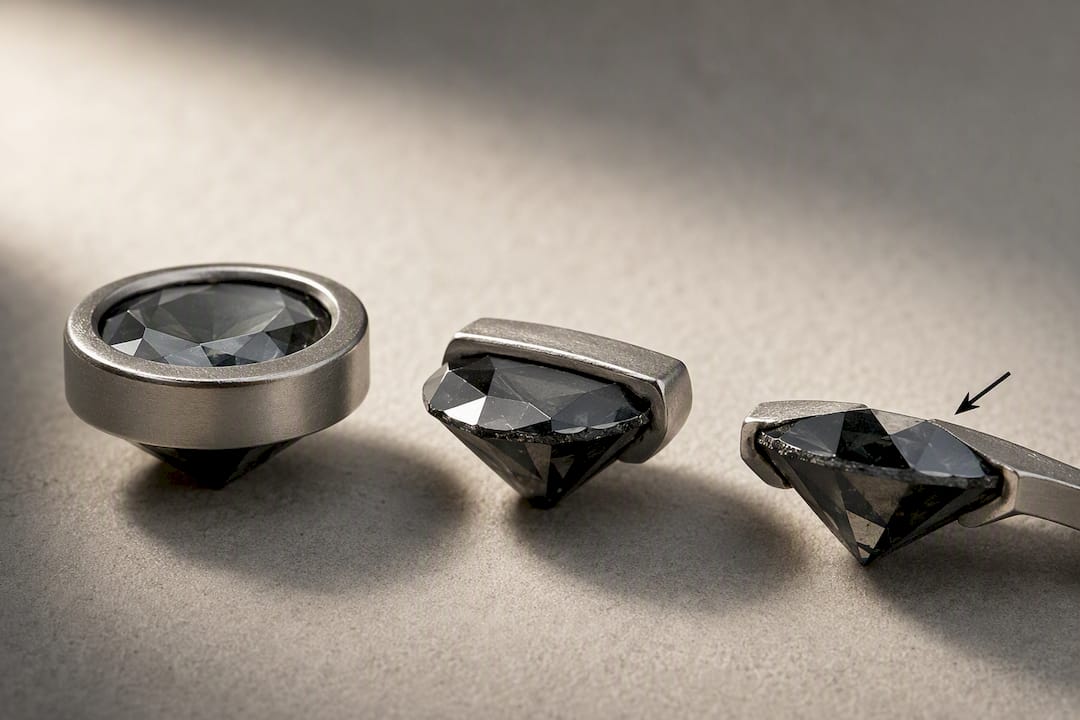
Pro Tip: Before buying a black diamond ring, ask specifically how the stone will be set, not just what metal it’s in. A skilled setter who understands black diamond brittleness will recommend a protective mounting rather than a delicate, exposed one, and that conversation tells you a lot about the seller’s expertise.
Day to day care isn’t dramatically different from any diamond. Clean it with mild soap and warm water, avoid ultrasonic cleaners if the stone has significant internal fracturing, and have a jeweler inspect the setting annually to catch loosening prongs before they cause a chip. These are the same routine inspection habits that extend the life of any diamond piece, black or white.
Before you finalize a purchase, confirm the seller’s warranty and return window in writing. Reputable online jewelers back their pieces with clear policies, and knowing you can inspect, return, or exchange a stone within a defined period, per Jewelers Mutual’s guidance, removes most of the risk from buying diamonds sight unseen.
Which One Fits Your Style and Occasion?
White diamonds carry centuries of symbolic weight: purity, commitment, permanence. They’re the default choice for traditional engagement rings and remain the safer bet if you’re buying for someone whose taste you’re not entirely sure of. Black diamonds carry a different message entirely, one associated with individuality, modern edge, and quiet confidence rather than convention.
Designers frequently use black diamonds specifically to create contrast, pairing them with white diamond accents or bright metals to make both stones pop harder than either would alone, a styling choice noted directly in GIA’s guidance on black diamonds. A black diamond halo around a white center stone, or black baguettes flanking a white solitaire, reads dramatically different from an all-white setting, even at the same carat total.
A few common pairings worth knowing:
- Engagement rings: black diamond accents around a white center stone for contrast without committing to an all-black look.
- Men’s jewelry: black diamonds set in white gold or platinum bands, a popular choice for wedding bands that skew masculine and understated.
- Fashion pieces: black diamond studs, pendants, or statement necklaces worn on their own, letting the matte finish stand in for a gemstone’s color rather than a diamond’s typical sparkle.
Neither stone is objectively “better.” The right one depends on whether you’re buying for tradition or for something that looks like nothing else in the room.
Buying Checklist: What to Verify Before You Purchase
Whether you’re leaning black, white, or still deciding, walk through these steps in order before you commit to a purchase:
- Decide your style and budget first. Black diamonds generally cost less per carat, which can free up budget for a larger center stone or a more elaborate setting.
- Request the lab report. Ask for a GIA report, either a standard 4Cs report for white diamonds or a Colored Diamond Identification and Origin Report for black diamonds.
- Confirm treatment disclosure in writing. The report should explicitly say “natural” or name the treatment method (heat, irradiation), not use vague marketing language.
- Ask about the setting. For black diamonds especially, confirm the jeweler is using a protective setting style suited to a more inclusion-heavy stone.
- Check the warranty and return policy. Confirm the return window and any lifetime warranty terms before you pay, not after.
Watch for these red flags as you shop:
- No mention of treatment status anywhere in the listing or paperwork.
- A report that doesn’t match the stone’s measurements or weight.
- Marketing language (“genuine,” “premium,” “rare”) standing in for actual lab certification.
- A seller unwilling to provide documentation on request.
If budget or ethical sourcing is your priority, lab-grown diamonds are worth considering for either color. Lab-grown stones are chemically identical to mined diamonds, come with their own clear documentation, and often cost meaningfully less than natural stones of comparable size and quality.
An Editorial Take: Grading Confusion Is the Real Buying Risk
The biggest mistake I see in how people shop for black diamonds isn’t picking the wrong color. It’s assuming the black diamond will come with the same kind of report as a white one, then feeling shortchanged when it doesn’t. That confusion is entirely avoidable, and it’s the single most useful thing this comparison can hand you.
Treatment disclosure deserves more attention than most buying guides give it. A treated black diamond isn’t a lesser product, but it should be priced and marketed as what it is. Superjeweler carries both lab-grown and traditional diamond options with documentation available on request, and if you’re ever unsure what a report is telling you, that’s a conversation worth having before checkout, not after.
— Andrew
Explore Black and White Diamond Options at Superjeweler
Superjeweler carries both traditional and lab-grown diamonds across a range of carat weights and price points, so you’re not stuck choosing between style and budget. Whether you want a classic white diamond solitaire or a bold black diamond accent piece, the goal is the same: a stone backed by real documentation, not just a product photo.

Start with Rings if you’re shopping for an engagement or fashion ring, or browse Black Diamond Earrings if you already know you want that opaque, high-contrast look in a certified stone. Budget-conscious shoppers exploring alternatives to natural black diamonds should look at Lab Grown Diamonds, which come with their own documentation and typically cost less than mined stones of similar size.
Check the warranty and return policy before purchase to understand your options for returns and protections on jewelry purchases. If a report doesn’t clearly disclose treatment status, ask before you buy. Browse the current ring collection to compare black and white diamond styles side by side.
Sources
For deeper technical detail beyond this guide, GIA’s black diamond FAQ and fancy color buyer’s guide cover formation and grading in more depth. The Colored Diamond Identification and Origin Report page explains exactly what that document contains. Jewelers Mutual’s black diamond guide offers practical buyer advice, and the Gems & Gemology review covers the gemological research behind Fancy White and Fancy Black classification.
- GIA FAQ: Black diamonds
- Black Diamond Buying Guide: What You Need to Know (GIA 4Cs blog)
- Guide to black diamonds (Jewelers Mutual)
FAQ
Is a Black Diamond More Expensive Than a White Diamond?
Generally no. Treated black diamonds, which make up most of the market, typically sell for less per carat than high-quality white diamonds, often in the range of $100 to $400 per carat for commercial material. Natural Fancy Black diamonds can command higher prices than treated ones, but they remain rare compared to top-grade white diamonds.
Why Are Black Diamonds So Cheap?
Most black diamonds sold today are treated, meaning a lower-grade white or brown diamond is heated or irradiated to achieve a uniform black color, which keeps costs down compared to rare, naturally colorless stones, according to GIA’s buying guide.
Is a Black Diamond a Real Diamond?
Yes. Black diamonds are chemically identical to white diamonds, pure carbon with a Mohs hardness of 10, but they appear opaque because of dense microscopic inclusions that absorb rather than transmit light, per GIA.
Who Should Wear a Black Diamond?
Black diamonds suit anyone drawn to a modern, bold aesthetic rather than traditional bridal sparkle, and they’re commonly used for contrast accents, men’s jewelry, and statement fashion pieces. If you want classic brilliance for a traditional engagement ring, a white diamond remains the more conventional choice, and either can be found among Superjeweler’s ring and lab-grown diamond collections.
Recommended
- Spend Less or Sell for More: IGI vs GIA for Diamond Buyers
- How to verify diamond quality: a step-by-step guide 2026
- How to identify quality diamonds for engagement rings
