Free ring resizing is worth having, but only when the policy matches the ring you are buying. Most of the value sits in the fine print: which rings are eligible, how many times you can use it, and whether the metal and setting can be resized at all. Choose a ring in a metal and style that can be adjusted, and know your size before you order. Then a resize becomes a safety net rather than a repair. At SuperJeweler we back our jewelry with a lifetime guarantee and a 60-day money-back guarantee, which is the kind of protection worth weighing next to any resizing offer.
TL;DR
- “Free resizing” usually applies to one adjustment on eligible rings. Read the policy for the number of resizes, the size range and the time window.
- Gold, platinum and silver bands can generally be resized. Titanium, cobalt, tungsten, stainless steel, plated rings and full eternity bands generally cannot.
- Resizing more than about two sizes can distort a band or weaken a setting, so the best fix for a big gap is often a different ring size.
- Measure your finger at the end of the day, in normal temperature, before you order. A correct first size saves the whole question.
- Rings with delicate pavé or intricate designs need extra care, and some should not be resized at all.
Table of Contents
- In this article
- What free ring resizing usually means
- Which rings can be resized
- Which rings cannot be resized
- How far a ring can be resized
- How long a resize takes
- What to check in a resizing policy
- When resizing is worth it
- Getting the size right the first time
- Our perspective
- Where to start at SuperJeweler
- FAQ
- Sources
In this article
- What free ring resizing usually means
- Which rings can be resized
- Which rings cannot
- How far a ring can be resized
- How long a resize takes
- What to check in a resizing policy
- When resizing is worth it
- Getting the size right the first time
- Our perspective
- Where to start at SuperJeweler
- FAQ
- Sources
What free ring resizing usually means
A jeweler resizes a ring by cutting the band and removing metal to make it smaller, or adding metal to make it larger. Sometimes a smaller adjustment is made by stretching the band. The work is done at a bench with a torch, then the ring is cleaned and polished. It is skilled labor, which is why a store that offers it at no charge is making a real promise.
When a retailer advertises “free resizing,” the promise normally has limits. Typical limits are:
- One resize. The first adjustment is free, and later ones are charged.
- Eligible rings only. The offer often covers certain collections, metals or price points, and leaves out others.
- A time window. Some policies apply for a set period after purchase, others for the life of the ring.
- A size range. Moving a ring a size or two is routine. Larger changes may be declined or charged.
- Shipping and insurance. The labor can be free while sending the ring back and forth is not.
These are the patterns to look for, not a rule that every seller follows. Every policy is different, so the page you read before buying is the only one that counts.
Which rings can be resized
The main factor is the metal. Traditional precious metals can be cut, joined and polished, so most classic rings in these metals can be adjusted:
- Yellow, white and rose gold. The most common case. A jeweler can add or remove metal and blend the join so it is hard to see.
- Platinum. Resizable, though it takes a jeweler with the right equipment, because platinum needs a higher working temperature than gold.
- Sterling silver. Generally workable, provided the ring is solid silver and not plated.
Design matters as much as metal. A plain solid band is the easiest. A solitaire engagement ring with a simple shank is usually straightforward. The more stones, patterns and engraving run around the band, the more there is to disturb.
Fit questions also come up with rings you wear together. If you stack several bands, a resize on one can change how the set sits, and our stackable rings guide covers how to size a stack so each ring works with the others.
Which rings cannot be resized
According to Jewelers Mutual, a U.S. jewelry insurer, rings that generally can’t be resized include:
- Titanium, cobalt, tungsten and stainless-steel rings
- Ceramic, resin, crystal and enamel rings
- Plated rings
- Full eternity rings
- Rings with delicate pavé settings or intricate designs
The reasons are practical. Very hard metals such as tungsten cannot be cut and soldered the way gold can. Plating would be damaged by the heat and the join. A full eternity band has stones all the way around, so there is nowhere to cut without removing stones. Pavé, where many small diamonds are set closely into the metal, can loosen when the band is heated or stretched.
If you are choosing a men’s band, this is the central trade-off. Hardness is appealing, but a very hard band gives up the ability to be resized. Our comparison of tungsten and gold wedding bands walks through that choice, and for wide bands the men’s wedding band width guide explains why bands over 4 mm may need a size up.
A quick eligibility check
- What metal is the ring? Solid gold, platinum or silver is a good sign.
- Is it plated? Plated rings should be treated as not resizable.
- Do stones go all the way around? If so, resizing is probably off the table.
- Is there pavé or a detailed pattern? Ask the jeweler before assuming.
- Is the ring engraved? Engraving may be affected if the band is cut at that spot.
How far a ring can be resized
Small changes are the safe ones. Jewelers Mutual notes that changing a ring by more than two sizes may distort the band or weaken the setting, which is the figure to keep in mind. Beyond that, the shape of the ring can drift out of round, and a stone setting that was balanced on the original band can be put under stress.
Here is what that means in practice:
| Change needed | What to expect |
|---|---|
| Up to about one size | Usually routine on a gold or platinum band |
| About two sizes | Often possible, depends on the design and the setting |
| More than two sizes | Higher risk to the band’s shape and the setting, so a different ring size may be the better path |
Sizing up a ring with a gemstone in a prong or bezel setting is the case that needs the most thought. The more the band is stretched, the more the setting may shift. A jeweler can look at the ring in person and tell you whether the stone should come out first.
Half sizes matter too. Many people sit between two sizes, and a half size can be the difference between a ring that spins and one that pinches. If you fall in between, say so when you order.
How long a resize takes
A simple resize on a plain band can be quick, while a ring with stones, engraving or a complex setting takes longer because the work needs more care and a quality check. If you must mail the ring, add transit time in both directions. Timing varies by shop and by season, so ask for an estimate in writing before you hand the ring over.
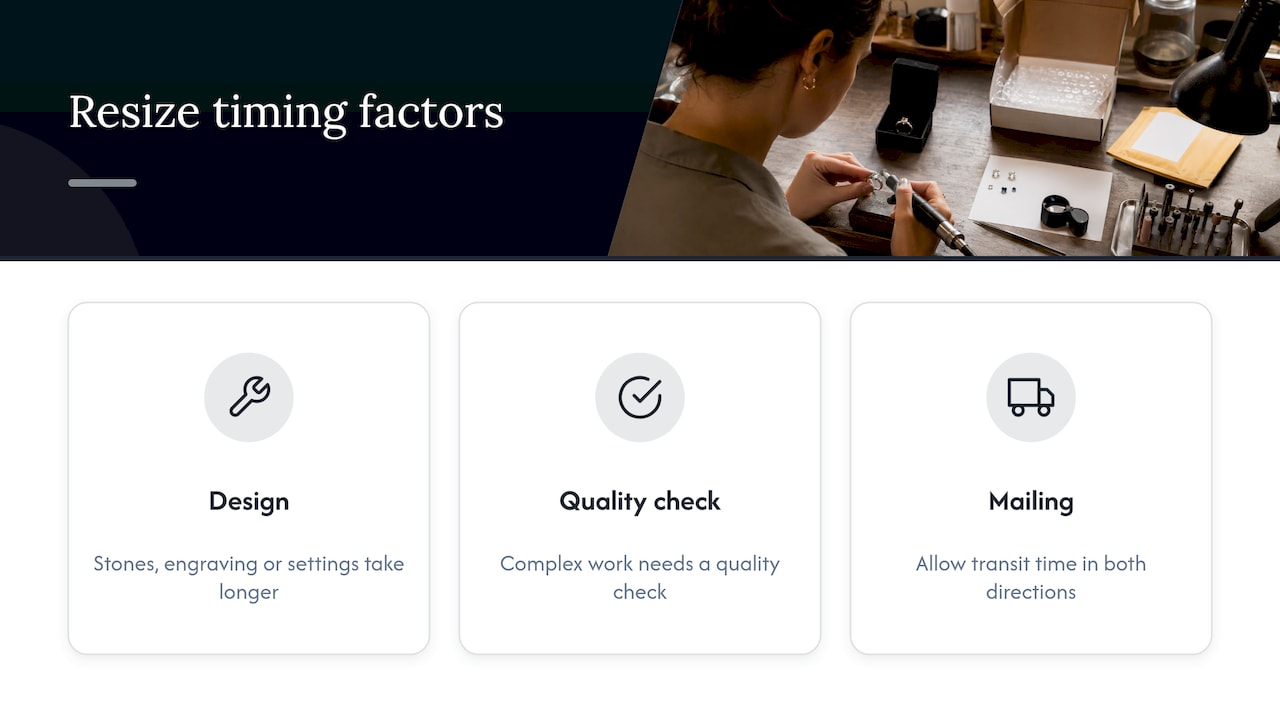
This matters most when there is a date attached. If the ring is for a proposal, a wedding or a holiday, build in time for a possible adjustment. Our engagement ring lead times guide covers how far ahead to order, and the custom ring timeline shows how the steps stack up.
For a surprise proposal, there is a practical point: you cannot ask the recipient to try the ring on. A resize after the proposal is common and easy to plan for, but you will want the ring to be in a metal and design that allows it.
What to check in a resizing policy
Before you rely on a free resize, read the policy for these points. Each one changes what “free” is worth.
- Which rings are covered. Is it every ring, or only certain collections?
- How many resizes. One, or more?
- How long it lasts. Is there a deadline after the purchase date?
- Size limits. Is there a maximum number of sizes, or does it exclude certain changes?
- Who pays for shipping. Both directions, or neither?
- Condition of the ring. Does it need to be unworn, or in original condition?
- Proof of purchase. What documents do you need?
- What happens if the ring cannot be resized. Is there an exchange or a refund?
- Insurance during transit. Is the ring covered while it travels?
The last two get overlooked most often. A policy that offers an exchange when a ring cannot be adjusted is much more useful than one that just says no. Keep your receipt and any certificate with the ring, and take photos of it before you send it anywhere.
When resizing is worth it
Resizing is worth it when the ring is a good match in every other way: the metal, the stone, the style and the price. If it is a solid gold or platinum band that is one size off, a resize is a small step and the ring will fit for years.
It is also worth it when your size has changed. Fingers can change over time, and several things can affect them: weight, pregnancy, temperature, and swelling. A ring that fit at purchase may be tight or loose later. If your size has shifted by a size or so, a resize is the standard fix.
It is less attractive in a few cases:
- The ring is made of a metal that cannot be resized. A different ring is the only route.
- The change is large. Beyond two sizes, the risk of distortion goes up.
- The ring is full of small stones. Pavé and eternity designs are the least forgiving.
- You are close to the fit, and a small accessory would do. A thin sizing insert or a ring guard can sit inside the band for a slightly loose ring. These are temporary aids, though, and a permanent fit comes from the right size.
For a ring that spins on your finger because of a wide knuckle, a half size or a design with a slightly different shank may help more than a straight resize. If you are unsure, a jeweler can look at the ring and your hand together.
Getting the size right the first time
The cheapest resize is the one you never need. A few habits make the first size more likely to be right:
- Measure at the end of the day. Fingers are usually a little larger then than first thing in the morning.
- Avoid extremes. Cold hands shrink and hot hands swell. Measure when your hands are at normal temperature.
- Consider the knuckle. If your knuckle is larger than the base of your finger, choose a size that slides over the knuckle but is not loose at the base.
- Think about band width. Wide bands feel tighter than narrow ones, so you may want to go up a half size. This is why our men’s wedding band width guide matters for anyone choosing a thick band.
- Measure more than once. Try it on several days and compare.
- Use a ring you already own. If a ring fits the same finger well, you can match its inner diameter.
If you are buying for someone else, borrow a ring they wear on the same finger and note its size. Our guide to online versus in-store engagement rings discusses how to handle sizing when you cannot try the ring on before purchase.
Timing can help too. If you are watching prices, see when to shop in our best time to buy jewelry guide, and leave room for a size adjustment if one turns out to be needed.
Earrings and hoops have their own fit rules. Rings are not the only piece where size matters. For earrings, the hoop earring size guide shows how to choose a diameter.
Our perspective
We think the best resizing plan starts before the ring is bought. A resize is skilled work, and it is kindest to the ring when the change is small and the metal is made for it. That is why we steer people toward a correct size at the start, and toward designs that suit the way they will wear the ring.
Our approach is to offer a wide selection of rings, wedding bands, earrings, necklaces and bracelets at prices we aim to keep accessible, because we source directly and pass the savings on. Every piece comes with our lifetime guarantee, and orders ship free worldwide with a 60-day money-back guarantee.
If you are choosing a ring now, we suggest you think about the metal as well as the look. Gold and platinum give you the flexibility that comes with resizing. If you prefer a very hard metal, pick the size with extra care, because that choice is made once.
Andrew
Where to start at SuperJeweler
If you are ready to choose a ring, our rings collection includes engagement and fashion styles for women and men, and our wedding bands cover everyday wear. Both are good places to compare metals and styles with fit in mind. Orders ship free worldwide, and we offer a 60-day money-back guarantee and a lifetime guarantee on our jewelry.

If you want a stone that looks great and keeps its value in your budget, the lab-grown diamonds range is worth a look, and our clearance sale is where you can find pieces at reduced prices. You can start from the SuperJeweler home page to browse everything.
FAQ
Is it worth it to resize a ring?
Yes, when the ring is solid gold, platinum or silver and the change is a size or two. A resize costs far less than replacing a ring you love, and the ring can fit for many years afterward. If the change is large or the ring has stones all the way around, a different size may serve you better.
Which rings can be resized, and which cannot?
Solid gold, platinum and sterling silver rings can generally be resized. Jewelers Mutual lists titanium, cobalt, tungsten, stainless steel, ceramic, resin, enamel and plated rings, along with full eternity bands and delicate pavé designs, as rings that generally can’t be resized.
How many sizes can a ring be resized?
One to two sizes is the usual safe range. Jewelers Mutual warns that going beyond two sizes may distort the band or weaken the setting. Ask a jeweler to look at the ring in person before you commit to a bigger change.
Will losing or gaining weight change my ring size?
It can. Weight changes, pregnancy, temperature and swelling can all alter finger size, and your ring may feel looser or tighter as a result. If the change lasts and is small, a resize is the usual answer. For a temporary change, wait and re-measure before you adjust the ring.
What should I check before I rely on free resizing?
Check which rings are covered, how many resizes are included, the time limit, and who pays for shipping. Also look at what happens if the ring cannot be resized. Keep your receipt and photograph the ring before you send it.
Sources
Recommended
- Wearable Stackable Rings: 3–5 Rings, Fit Tips, and Durable Stones
- Men’s Wedding Band Width: Why Bands Over 4 mm May Need a Size Up
- Eternity Band vs Anniversary Band: How to Choose
- Tungsten vs Gold Wedding Bands Trade 10x Hardness for Resizing
