In the United States, a ring on the right hand has no single fixed meaning. It most often says something about the wearer: independence, a personal achievement, a promise, a family or cultural tradition, or simply a piece she loves. Engagement and wedding rings traditionally go on the left ring finger here, which is why a right-hand ring reads as a separate statement. That freedom is what makes it such a good choice for a self-purchase, a milestone gift or a fashion piece.
TL;DR
- A right-hand ring is usually a personal statement, not a sign of engagement or marriage, in the U.S.
- The idea of buying a diamond ring for yourself and wearing it on the right hand was popularized by a marketing campaign in the early 2000s that tied the right hand to independence.
- In several countries, including Russia, Germany, Poland, Greece and India, a wedding ring on the right hand is the norm.
- Finger-by-finger meanings are popular symbolism, not rules. Wear the ring on the finger that fits you best.
Table of Contents
- In this article
- What a right-hand ring means in the U.S.
- Where the right-hand ring idea comes from
- What each finger on the right hand can symbolize
- When the right hand holds a wedding ring
- Promise rings, Claddagh rings and other special cases
- How to choose a right-hand ring
- Shop right-hand rings at SuperJeweler
- Our perspective
- FAQ
- Sources
In this article
- What a right-hand ring means in the U.S.
- Where the right-hand ring idea comes from
- What each finger on the right hand can symbolize
- When the right hand holds a wedding ring
- Promise rings, Claddagh rings and other special cases
- How to choose a right-hand ring
- Our perspective
- FAQ
- Sources
What a right-hand ring means in the U.S.
A right-hand ring is any ring worn on the right hand as a deliberate accent rather than as a sign of an engagement or marriage. In the U.S. and Western Europe the convention is that engagement rings go on the left ring finger, so anything on the right hand is understood differently.
That difference is useful. Because the right hand carries no required meaning, you decide what the ring stands for. Common reasons people give:
- Celebrating a promotion, graduation, business launch or other achievement
- Marking self-love, independence or a fresh start
- Honoring a family heirloom, a birthstone or a loved one
- Wearing a promise ring or a commemorative piece
- Following a cultural or religious tradition
- Adding style to a hand that is otherwise bare
Other people will read your ring through their own beliefs, culture and history, so the meaning is never universal. Your own reason is the one that counts.
Where the right-hand ring idea comes from
Much of the modern American meaning is recent. In 2004, NBC News described a diamond industry campaign that linked the right hand with independence and power. The pitch contrasted a ring on the right hand for the self with one on the left for a couple. The same report noted that the campaign encouraged women to buy diamond jewelry for themselves, and that jewelers saw growing interest in right-hand diamond rings.
The symbolism built on older ideas. The American Gem Society explains that some cultures see the right hand as the dominant hand, associated with being correct, strong and loyal. So the “strength” reading of a right-hand ring has deep roots, even though the “treat yourself” reading is a modern layer on top.
The left-hand tradition has its own story. GIA traces the left ring finger custom to the Roman belief in a vein of love running straight to the heart, an idea GIA notes has been anatomically disproven. Both hands, in other words, carry meaning because people agreed to give it to them.
What each finger on the right hand can symbolize
Finger symbolism is folk and fashion tradition, and different sources assign slightly different meanings. Treat the table as the most common associations, not a code.
| Finger | Commonly associated with | Typical ring styles |
|---|---|---|
| Thumb | Willpower, individuality, a bold personality | Wide bands, signet rings, men’s statement rings |
| Index | Confidence, leadership, ambition | Cocktail rings, gemstone rings, signets |
| Middle | Balance, responsibility, a strong sense of self | Larger gemstone or diamond rings |
| Ring | Commitment to yourself, creativity, passion, or a wedding ring in some cultures | Solitaires, bands, birthstone rings |
| Pinky | Family ties, communication, charm | Slim bands, signets, small stones |
The right ring finger
This is the finger people search about most. In the U.S. it usually signals a deep commitment to something other than a spouse: yourself, a creative pursuit or a personal passion. It is also the finger where many people wear a promise ring, a birthstone ring or a stackable band.
A solitaire diamond or a colored gemstone looks natural here, and so does a set of slim bands. If you want the look without the engagement association, a stone in a shape or color that is clearly personal, such as a birthstone, makes your intent obvious. You can browse rings for women and men and gemstone jewelry to see how different stones read on this finger.
The index finger
Often tied to authority and self-assurance. It is a popular place for a large cocktail ring or a signet, because the ring is visible when you gesture or hold a pen.
The middle finger
It sits at the center of the hand and is often associated with balance. It suits a substantial ring that you want to anchor the whole hand, since it is the longest finger and can carry weight and size comfortably.
The pinky
Pinky rings are linked with family, loyalty and personality. Signet rings and slim bands both work well, and the finger is a good choice if you already wear rings on your other fingers.
The thumb
A thumb ring tends to read as individual and unconventional. Wide, simple bands in sterling silver, gold or platinum are the usual picks, and sizing deserves extra care because the thumb joint is broad.
When the right hand holds a wedding ring
If you are reading this because you saw a wedding band on someone’s right hand, the explanation is often cultural or personal, not a sign of anything unusual.
Countries where the right hand is traditional
GIA says a right-hand wedding ring can symbolize strength, honor or cultural heritage, and that it is common in Russia, Germany, Poland, Greece and India. Some Central European and Orthodox traditions place wedding rings on the right hand too, as the American Gem Society describes. In some Jewish ceremonies the ring is placed on the right index finger, and GIA notes it may be moved afterward.
India is a special case: the American Gem Society points out that marriage there has not historically centered on rings, with toe rings for women and, in some places, iron bangles that may be coated in silver or gold, as traditional markers.
Moving a ring from right to left
Some couples switch hands at the wedding. Zola’s wedding guide, for instance, notes that in places such as Brazil and Turkey the ring may be worn on the right before the wedding and moved to the left afterward. If you are marrying into a family with such a custom, the right-hand ring can be a meaningful part of the ceremony.
LGBTQ+ history in the U.S.
In the United States, some LGBTQ+ couples wore wedding bands on the right hand to recognize their committed relationships when marriage was not legally available, according to The Zoe Report. After the 2015 Obergefell v. Hodges ruling, some couples moved their rings to the left hand, while others kept them on the right as a nod to that history. If you see a wedding band on a right hand here, it can be a personal or historical choice.
Personal preference
GIA’s guide stresses that wearing an engagement ring and wedding band together is optional, and that modern couples choose arrangements by preference. Practical reasons are common: a hand that is injured or swollen, a job that is hard on the left hand, or a design that simply looks better on the right. If you are still deciding, our guide on which hand the engagement ring goes on walks through the options.
Promise rings, Claddagh rings and other special cases
Promise rings
GIA says a promise ring generally expresses a couple’s commitment to an exclusive relationship but does not promise marriage, and that it can be worn on any finger, including the right ring finger. Choosing the right hand keeps it visibly distinct from a future engagement ring. Our guide to the promise ring finger covers which hand and finger work best.
Claddagh rings
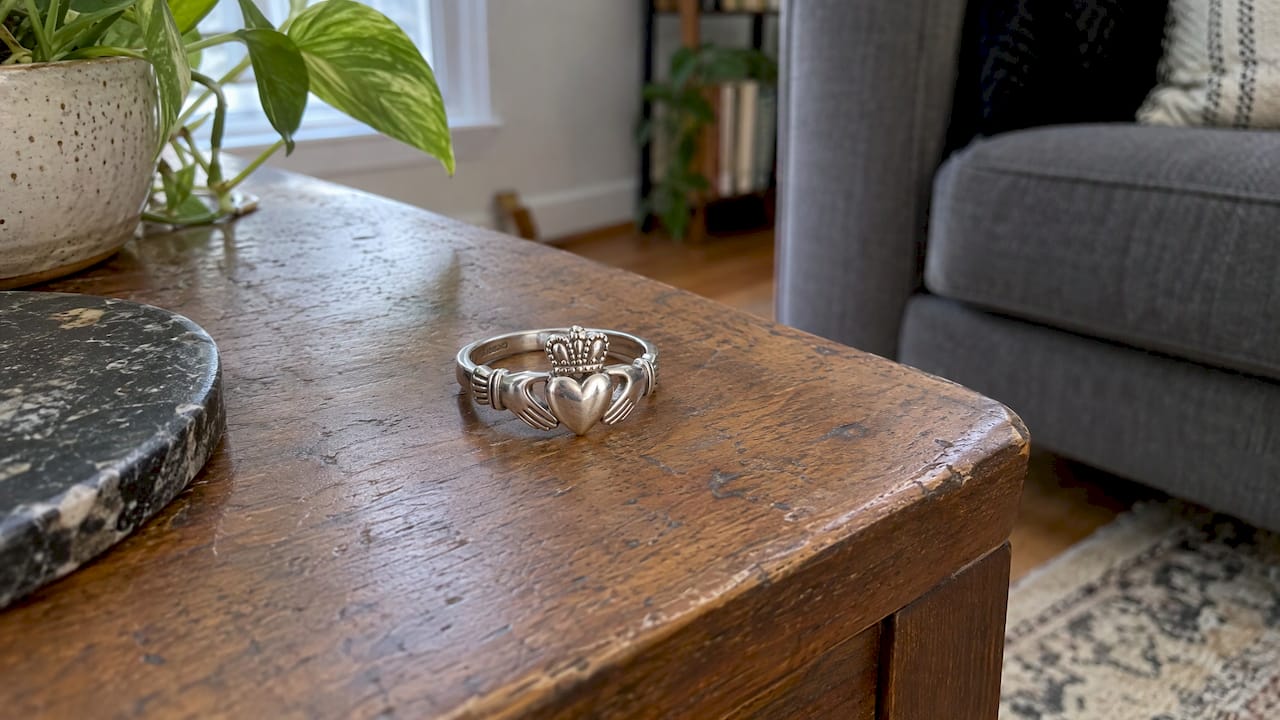
A Claddagh ring, with its heart, hands and crown, is read by the direction of the heart. According to Brides, worn on the right hand with the heart facing outward it traditionally means the wearer is looking for love, and facing inward it means the wearer is in a relationship.
Stacks and sets
A right hand is a natural home for stackable rings, since nothing needs to sit next to an engagement ring. Our stackable rings guide covers how many to wear, fit tips and durable stones.
Anniversary and eternity bands
A diamond band marking an anniversary or a milestone often goes on the right hand, so it does not compete with the left-hand set. If you are deciding between styles, see how to choose between an eternity band and an anniversary band.
How to choose a right-hand ring
Once you know what you want the ring to say, the practical choices come down to five things.
- Decide the meaning first. Independence, a milestone, a promise and a family heirloom each point to different styles. A birthstone suits a personal tribute, a diamond suits a milestone, and a signet suits family or identity.
- Pick the finger. The ring finger is the classic choice for personal commitment. The index and middle fingers suit larger statement rings. The pinky and thumb suit signets and wide bands.
- Choose the stone. Diamonds are the traditional milestone stone. Lab-grown diamonds offer the same look in a range of shapes, and colored gemstones add personality. You can explore lab-grown diamonds alongside our gemstone range.
- Match the metal to your life. If you wear the ring daily and use your right hand heavily, think about how the setting will sit against your work, keyboard and bags. Low, secure settings snag less than tall ones.
- Get the fit right. Fingers on your dominant hand and different fingers can fit differently, so size each ring for the specific finger. Wide bands usually need more room than narrow ones; our note on men’s band width and sizing explains why.
Gift buyers
A right-hand ring is a thoughtful gift for a graduation, a promotion, a birthday or an anniversary, because it carries no expectations about engagement. Choose the stone to match the occasion, such as the recipient’s birthstone, and add a note about what the ring marks. If timing matters, our lead-time guide shows how ready-to-ship and custom pieces differ.
Shop right-hand rings at SuperJeweler
We carry rings for women and men, birthstone and gemstone jewelry, lab-grown diamonds and wedding bands, so you can find a right-hand ring for almost any meaning. Start with our rings collection, or look at wedding bands if you want a plain band for a stack. Our clearance section has deals on select pieces. Our orders ship free worldwide, and we offer a 60-day money-back guarantee and a lifetime guarantee on all jewelry.

If you would rather start from the full range, our home page shows every category in one place.
Our perspective
A right-hand ring is the one ring that belongs entirely to you. Nobody has to propose, and no occasion has to come first. That is why we think of it as the most personal piece in a collection.
We design and sell our jewelry around that idea. A person can choose the stone that means something to them, the metal that suits their life and the style that feels like them, whether that is a lab-grown diamond solitaire, a birthstone ring or a slim stacking band. We source directly, and we aim to pass the savings on, so a self-purchase or a gift for someone else feels within reach rather than a stretch.
Our advice is simple. Choose the meaning first, then the finger, then the stone. If the ring means something to you, it is the right ring. And because it is a gift to yourself or someone you love, we stand behind it with a lifetime guarantee and a 60-day money-back guarantee.
Andrew
FAQ
What does a ring on the right ring finger mean?
In the U.S. it usually signals a personal commitment, such as to yourself, a passion or a milestone, or it is a promise or fashion ring. It is not the traditional engagement or wedding finger here. In countries like Germany, Poland, Greece and India, however, it can be the wedding ring finger.
Does a right-hand ring mean someone is married or engaged?
Not in the U.S., where the left ring finger is the usual place for engagement and wedding rings. Some people do wear their wedding bands on the right hand because of culture, religion, personal history or comfort, so a right-hand band is not a reliable sign either way.
What is a right-hand ring, and who wears one?
It is a ring worn on the right hand to celebrate yourself, mark an achievement or express style. Anyone can wear one: women buying a diamond ring for themselves, partners exchanging promise rings and men wearing signets or bands on the index finger, pinky or ring finger.
Which finger attracts money?
This comes from folk and astrology traditions, and different traditions name different fingers, so there is no single answer. It is best treated as a belief rather than a fact. If you like the idea, wear the ring on the finger that appeals to you and fits comfortably.
Sources
- The alluring right-hand diamond ring (NBC News)
- How to Wear Your Engagement Ring and Wedding Band (GIA)
- Promise Ring Meaning (GIA)
- Wedding Rings Around The World (American Gem Society)
- What Is the Engagement Ring Finger (Vogue)
- The History Behind LGBTQ+ Couples Wearing Wedding Bands on the Right Hand (The Zoe Report)
- Most Popular Types of Rings (Brides)
