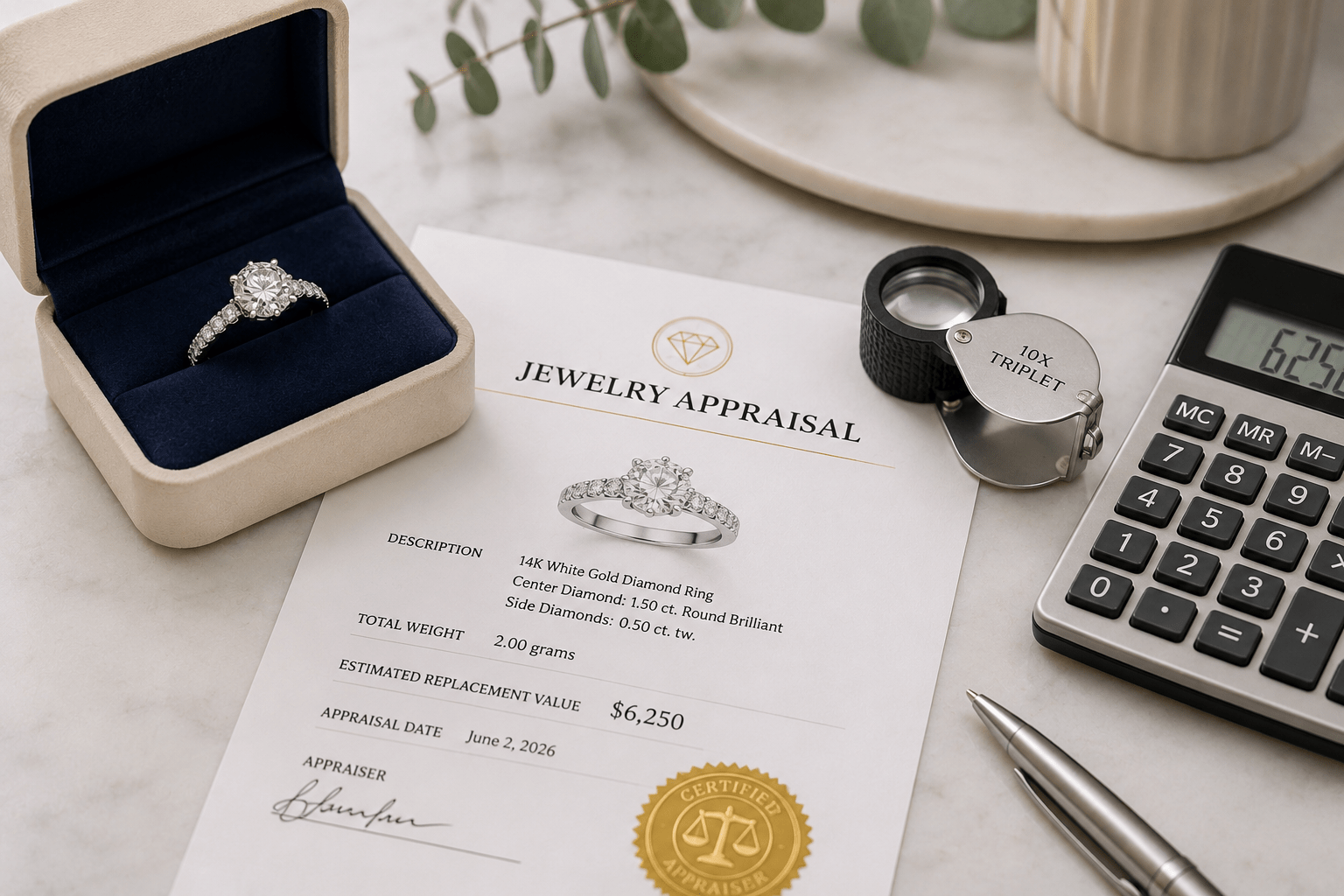
A standard jewelry appraisal cost runs $50 to $150 per item, or $50 to $150 an hour for appraisers who bill by time rather than by piece, according to Jewelers Mutual. Complex pieces, antique jewelry, or anything with multiple stones can push past that range. Online preliminary estimates are cheaper, typically $25 to $75, but most insurers won’t accept them as the sole basis for a policy.
Three names matter before you spend a dollar: the GIA (Gemological Institute of America), the ASA (American Society of Appraisers), and the FTC (Federal Trade Commission), which sets the ethical baseline for how appraisers charge.
Your next move depends on why you need the appraisal:
- Insuring a piece? Book an in-person appraisal with a credentialed appraiser. Insurers generally want a lab-backed or in-person report, not an online guess.
- Just curious about value or thinking about selling? A preliminary online estimate can tell you whether a full appraisal is worth the money.
- Settling an estate? Skip the shortcuts. Estate valuations need documentation that holds up with attorneys and tax authorities.
Key Takeaways
Jewelry appraisal cost typically runs $50 to $150 per item depending on complexity, credentials, and whether the report is for insurance, resale, or estate purposes.
| Point | Details |
|---|---|
| Typical cost range | Expect $50 to $150 per item or per hour for most professional appraisals. |
| Purpose changes the number | Insurance replacement value is usually higher than fair market resale value for the same piece. |
| Check credentials first | Look for GIA, AGS, ASA, or NAJA credentials and ask about USPAP compliance before booking. |
| Avoid percentage-based fees | A fee tied to your jewelry’s value creates a conflict of interest; insist on flat or hourly pricing. |
| Update every 2 to 3 years | Reappraisals are typically cheaper than the original and keep insurance coverage accurate. |
| Consider replacement | For outdated or damaged pieces, Superjeweler’s engagement ring and lab-grown diamond categories offer a warrantied alternative to a costly reappraisal. |
Table of Contents
- How Much Does a Jewelry Appraisal Cost, and What Determines the Type You Need?
- What Does a Jewelry Appraisal Cost by Fee Structure and Item Type?
- What Factors Push Appraisal Fees and Final Value Up or Down?
- Who Performs Jewelry Appraisals, and What Credentials Should You Check?
- What Should Be in Your Jewelry Appraisal Report?
- How Long Does a Jewelry Appraisal Take?
- Are Free Jewelry Appraisals Worth Getting?
- How Often Should You Update a Jewelry Appraisal?
- How Do You Choose a Reliable Jewelry Appraiser?
- Why Do Insurance Values and Resale Values Diverge So Much?
- What a Retailer Sees That Most Appraisal Guides Miss
- Thinking About Replacing a Piece Instead of Appraising It?
- Frequently Asked Questions
- Sources
How Much Does a Jewelry Appraisal Cost, and What Determines the Type You Need?
A jewelry appraisal is a professional’s written opinion of what a piece is worth, for a specific purpose, at a specific point in time. That last part matters more than most people realize. The exact same ring can carry three different appraised values depending on why it’s being appraised.
Insurance appraisals estimate replacement value, which is what it would cost to buy an equivalent piece at retail today. This number tends to run highest because it reflects full retail pricing.
Resale or fair market appraisals estimate what the piece would realistically sell for between a willing buyer and seller, neither one under pressure. This is almost always lower than replacement value, sometimes dramatically so.
Estate or charitable appraisals follow IRS-recognized standards and are used for inheritance, tax filings, or donation deductions.
A $10,000 replacement-value engagement ring might carry a fair market value of $4,000 to $6,000. That gap isn’t an error. It reflects the difference between retail replacement cost and what a private buyer would actually pay. Purpose also drives whether lab testing is required, which is one of the biggest swing factors in what an appraisal costs.
What Does a Jewelry Appraisal Cost by Fee Structure and Item Type?
Appraisers price their work in a handful of standard ways, and knowing which model you’re paying for helps you spot a fair quote from an inflated one.
- Per-piece flat fee: Most common for single items like a ring or pendant, typically $50 to $150.
- Hourly rate: Common for complex pieces or estate collections, generally $50 to $150 per hour.
- Project fee: Used for large collections or full estate inventories, quoted after an initial review.
- Online/remote estimate: Runs $25 to $75, useful for a quick gut check but rarely sufficient for insurance.
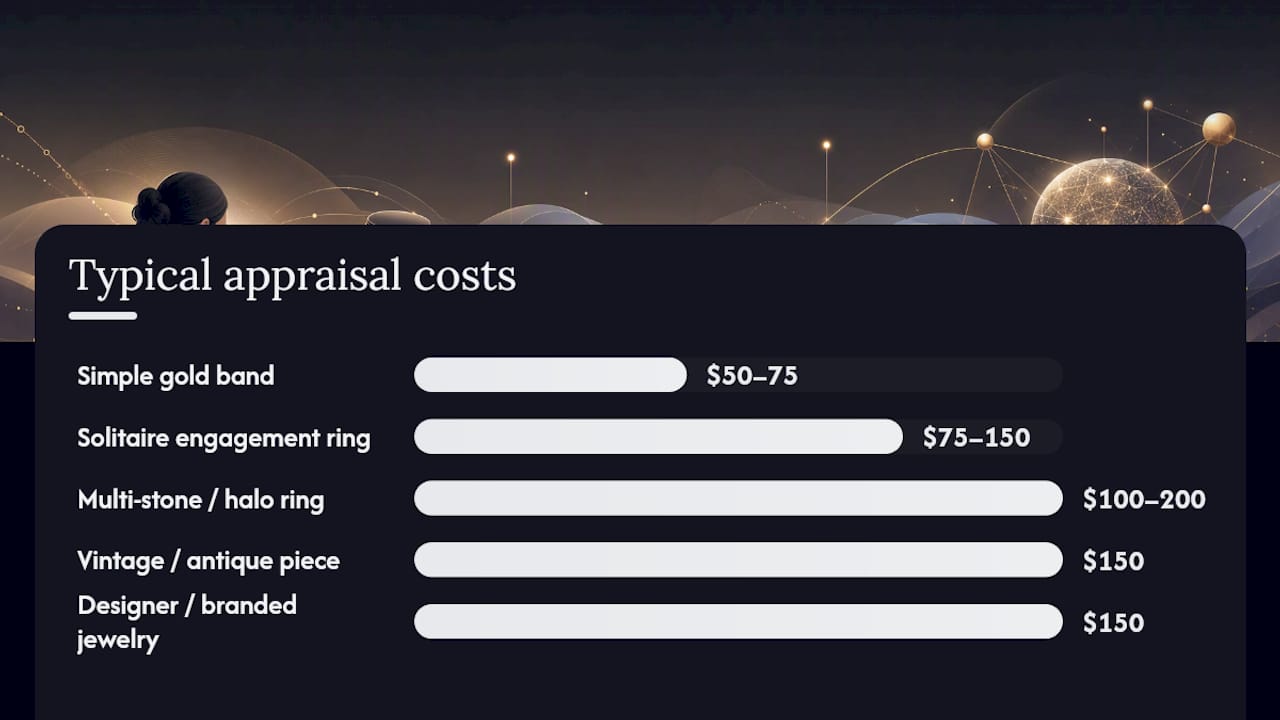
Here’s roughly what to expect for common items:
| Item type | Typical appraisal cost |
|---|---|
| Simple gold band, no stones | $50 to $75 |
| Solitaire engagement ring | $75 to $150 |
| Multi-stone or halo ring | $100 to $200 |
| Vintage or antique piece | $150 |
| Designer or branded jewelry | $150 |
Several add-ons can push the final bill higher. Lab testing to confirm a stone’s identity or origin adds cost, as does a formal diamond plot documenting inclusions and proportions. If a stone needs to be removed from its setting for accurate weighing, expect a setting/resetting charge on top. Rush turnaround, travel to your location, and extra photography for insurance documentation all add line items too.
One thing to watch closely: any appraiser who quotes you a fee based on a percentage of your jewelry’s value. The FTC’s industry guidance is explicit that appraisers shouldn’t charge that way, because it creates a direct financial incentive to inflate the number they hand you. A legitimate appraiser charges for their time and expertise, not a cut of your piece’s worth.
Pro Tip: Ask for the total cost, in writing, before you hand over your jewelry. A reputable appraiser will quote you a flat number or an hourly estimate with a cap, not a vague “we’ll see” answer.
What Factors Push Appraisal Fees and Final Value Up or Down?
Two rings that look nearly identical can cost very different amounts to appraise, and the reasons come down to a handful of variables.
- Stone count and complexity: A single solitaire takes less time to examine than a pavé band with 40 small diamonds.
- Gemstone type and size: Colored stones like sapphires or emeralds often require more specialized identification than diamonds.
- Lab analysis needs: Confirming whether a stone is natural, treated, or lab-grown adds time and sometimes a separate lab fee.
- Rarity and age: Antique and vintage pieces require research into period, maker, and comparable sales, which is labor-intensive.
- Appraiser credentials: A GIA graduate gemologist with decades of experience typically charges more than a general jeweler doing appraisals part-time.
- Location: Appraisers in major metro areas tend to charge more than those in smaller markets, similar to most professional services.
These same factors don’t just affect the fee, they affect the number that lands on your report. A rare vintage piece requiring extensive research might cost more to appraise, but that research often justifies a higher insurance value too. A common design in a saturated resale market might appraise cheaply and still come back with a modest fair market number.
Pro Tip: If you have several pieces needing appraisal, ask about batching them into one visit. Many appraisers offer a discount per additional item once they’re already set up to examine your collection, since the base research and paperwork overlap.
Who Performs Jewelry Appraisals, and What Credentials Should You Check?
Not everyone calling themselves an appraiser has the training to back it up. Look for these credentials before you hand over a piece:
- GIA (Gemological Institute of America): Graduate Gemologist (GG) certification means formal training in gem identification and grading.
- AGS (American Gem Society): Certified Gemologist Appraiser (CGA) status signals both technical skill and adherence to ethical standards.
- ASA (American Society of Appraisers): Accredited Senior Appraiser (ASA) credential requires demonstrated experience and peer review.
- NAJA (National Association of Jewelry Appraisers): Membership indicates specialization specifically in jewelry appraisal, not general antiques.
- USPAP (Uniform Standards of Professional Appraisal Practice): Compliance means the appraiser follows the recognized standard for how appraisals are researched, documented, and reported.
An appraiser who mentions USPAP compliance without being asked is usually a good sign. It means they’re following a documented methodology instead of eyeballing a number.
Red flags to walk away from: fee quotes based on a percentage of value, reports that skip photos or measurements, and any reluctance to explain how they arrived at their number. Before booking, ask directly: “Do you follow USPAP? Can I see a sample report? How do you calculate your fee?” A confident, specific answer to all three is what you want to hear.
What Should Be in Your Jewelry Appraisal Report?
A written appraisal report is the actual deliverable you’re paying for, and it needs to hold up if you ever file an insurance claim or sell the piece. The ASA’s own reporting checklist lays out what belongs in a credible document.
A complete report should include:
- Item description and unique identifiers (style, stamps, serial numbers)
- Metal type, purity, and weight
- Gemstone details: cut, color, clarity, carat weight, and treatment status
- Clear photographs of the piece from multiple angles
- The valuation method used (cost approach, market comparison, or in rare cases, income approach)
- The final appraised value and the specific purpose it was prepared for
- Date of appraisal and the appraiser’s signature and credentials
- Disclosure of any assumptions or limitations
That last item matters more than people expect. Sometimes a stone can’t be removed from its setting without risking damage, so the appraiser has to estimate its weight while it’s still mounted. A trustworthy report says so plainly, rather than presenting an estimate as an exact measurement, per GIA’s guidance on appraisal disclosures. For high-value or unusual pieces, look for extras like a diamond plot or provenance notes tracing the item’s history.
A signed, dated report with photos is what an insurance company actually wants to see if you ever file a claim. A verbal estimate or a business card with a number scribbled on it won’t hold up.
How Long Does a Jewelry Appraisal Take?
A simple piece, like a solitaire ring or a plain gold chain, can often be examined and appraised the same day, sometimes while you wait. Anything requiring lab testing, gemstone identification, or research into an antique or designer piece usually takes longer, often several days to two weeks.
Some appraisals happen entirely on the spot. Others require the appraiser to keep your item briefly for testing or comparison research. Before you leave anything behind:
- Ask for the estimated turnaround time in writing.
- Ask whether the item needs to stay with the appraiser or can be examined while you wait.
- Ask about insured shipping if you’re mailing a piece to a specialist.
- Ask whether you’ll receive a digital copy of the report in addition to any printed version.
Are Free Jewelry Appraisals Worth Getting?
Plenty of jewelers offer “free appraisals,” and the value of that offer depends entirely on what you’re getting. A quick verbal estimate at the counter is fine for satisfying curiosity about a piece of costume jewelry. It is not the same as a written, signed report an insurance company will accept.
Free estimates work reasonably well as a first screening step, especially for lower-value items where a full paid appraisal wouldn’t make financial sense. For anything you plan to insure, or anything with meaningful value, insist on a paid, in-person appraisal with a written report.
Watch for these warning signs: an appraiser who pushes you to sell the piece to them on the spot, one who won’t put a value in writing, or one who can’t explain their valuation method when asked directly.
Pro Tip: A free appraisal that comes with an immediate cash offer to buy your jewelry is a sales pitch, not an independent valuation. Get a second, paid opinion before you agree to anything.
How Often Should You Update a Jewelry Appraisal?
Industry guidance recommends updating appraisals on diamond and precious metal jewelry every two to three years, since metal and gemstone market prices shift over time and your insurance coverage can fall out of sync with actual replacement cost.
Reappraisals are typically cheaper than the original appraisal. Many appraisers offer a discounted flat rate for updating an existing report rather than starting from scratch, since the base documentation and gemstone identification are already on file. A full original appraisal at $100 might come with a $50 to $75 update fee two years later.
How Do You Choose a Reliable Jewelry Appraiser?
Run through this checklist before you commit to anyone:
- Confirmed credentials (GIA, AGS, ASA, or NAJA)
- Willingness to state USPAP compliance
- A sample report they’ll show you before you book
- A clear, flat, or hourly fee structure, never a percentage of value
- Insurance coverage for items left in their custody
- References or reviews you can actually verify
When you call, ask these questions directly:
- Do you follow USPAP standards?
- Will the report include photos and an explanation of your valuation method?
- Do you charge a flat fee, hourly rate, or percentage?
- What’s your typical turnaround time?
- Is my item insured while it’s in your possession?
If an appraiser dodges any of these, that’s your answer. Get two or three written estimates or sample reports before choosing, the same way you’d shop around for any other professional service. Comparing methodology and report quality side by side tells you more than comparing price alone. Understanding how appraisers grade and document diamonds also helps you evaluate whether a report is actually thorough.
Why Do Insurance Values and Resale Values Diverge So Much?
The gap between what your ring is insured for and what it would actually sell for isn’t a mistake, it’s built into how appraisal standards work. Professional guidance from Appraisers recognizes three approaches to valuation, and each serves a different purpose.
The cost approach estimates what it would take to replace an item at current retail prices, which is why insurance appraisals lean on it. The market data approach relies on actual comparable sales, which is why resale and estate appraisals use it instead. The income approach, borrowed from real estate and business valuation, rarely applies to personal jewelry at all.
Consider a $10,000 engagement ring. Appraised for insurance replacement, it might come back at $10,000, reflecting full retail cost of an equivalent new ring. Appraised for resale using market comparisons, that same ring might land at $4,500 to $6,000, closer to what a private buyer or a jewelry buyer would actually pay.
- Insurance appraisals protect you against total loss at retail replacement cost.
- Resale appraisals reflect real-world buyer demand, which is almost always lower.
- Estate appraisals follow IRS-recognized standards for inheritance and tax purposes.
None of these numbers is “wrong.” They’re answering different questions, which is exactly why FTC guidance pushes appraisers to state the purpose of every report clearly.
What a Retailer Sees That Most Appraisal Guides Miss
Most people booking an appraisal have never done it before, and they walk in without the one thing that speeds up the process most: documentation. If you still have the original purchase receipt, a prior appraisal, or a certificate that came with the piece, bring it. It cuts research time and often lowers the bill, since the appraiser isn’t starting from zero.
Before you book anything, get the piece cleaned and photographed. A cloudy stone or a bent prong can slow down an examination and occasionally leads to an inaccurate condition note on the report.
And be honest with yourself about the end goal. If a piece is damaged, outdated in style, or simply not something you wear anymore, a full specialty appraisal followed by a costly repair sometimes costs more than replacing it outright would. That’s not true for a family heirloom or an insurance claim. But for a ring you don’t love anymore, replacement is worth putting on the table before you spend money proving what it’s worth.
Thinking About Replacing a Piece Instead of Appraising It?
If the appraisal turns out to confirm what you already suspected, that a piece is outdated, damaged beyond a reasonable repair cost, or just not something you’d choose again, replacing it can make more financial sense than paying to document its current value. This is especially true for engagement rings and wedding bands, where styles and stone preferences change over the years.

Superjeweler carries a wide range of engagement rings, including options built around lab-grown diamonds, which deliver the same brilliance and durability as mined stones at a noticeably lower price point. For readers working with a tighter budget after an appraisal came back lower than expected, the engagement ring collection under $1,000 is worth a look. Every purchase comes backed by a warranty and return policy, so you’re not just buying a replacement, you’re buying one with protection built in. Browse the current selection and see what fits your budget before you decide whether repair, reappraisal, or replacement is the right call.
Frequently Asked Questions
How much does a jewelry appraisal cost on average?
Most professional appraisals cost between $50 and $150 per item, or $50 to $150 per hour for appraisers who bill by time. Complex, antique, or multi-stone pieces can run higher.
How much does a diamond appraisal cost specifically?
A single diamond ring typically falls in the same $75 to $150 range as other jewelry, though prices climb if the diamond requires lab verification or the setting needs to be removed for accurate weighing.
Is an engagement ring appraisal cost different from other rings?
Not inherently, but engagement rings often have more stones and higher value, which pushes them toward the higher end of typical pricing, sometimes $100 to $200 or more.
Do jewelers offer free appraisals?
Some do, but a free verbal estimate isn’t the same as a written, signed report. Insurance companies and buyers typically want documentation a free estimate doesn’t provide.
How often should I get my jewelry reappraised?
Every two to three years for diamonds and precious metals, since market values shift and insurance coverage can fall behind actual replacement cost.
Can I use an online appraisal for insurance purposes?
Usually not on its own. Most insurers require an in-person or lab-backed appraisal, since online services can’t physically test the metal or examine the stone.
Sources
For deeper reading beyond this guide, a few sources stand out. The FTC’s jewelry industry guidance covers ethical fee practices and consumer protections. Jewelers.org offers practical, consumer-facing appraisal advice. GIA’s appraisal tips explain testing limitations and disclosures in plain language, while the ASA’s reporting checklist is the closest thing to an industry standard for what a report should contain. Jewelers Mutual is a solid resource specifically for insurance-focused appraisal costs.
- Business guidance for the jewelry industry | Federal Trade Commission
- How Much Should a Jewelry Appraisal for Insurance Cost? | Jewelers Mutual
- Appraisers
- Appraisal tips | GIA 4Cs blog
