
A floating diamond setting is a ring design where the diamond appears suspended in mid-air, held by minimal or nearly invisible metal. The stone seems to hover above the band, creating an optical illusion that makes the diamond look larger and more prominent than it actually is. Designers achieve this effect through several engineering approaches, from true tension settings that grip the stone with thousands of PSI of compressive force to tension-style settings that use hidden bezels or micro-prongs tucked out of sight.
The result is a clean, contemporary look that puts the diamond front and center. Less metal means more light reaches the stone from every angle, which directly boosts its visual brilliance. For buyers who want the diamond to do all the talking, this design delivers exactly that.
At a glance:
- The diamond appears suspended with little or no visible metal holding it
- Two main engineering types exist: true tension and tension-style
- Platinum and specialized alloys are the preferred metals for structural integrity
- The design maximizes light exposure, enhancing the stone’s sparkle and apparent size
- Annual professional inspections are strongly recommended for long-term security
What is a floating diamond setting, exactly?
The term “floating diamond setting” is a descriptive, consumer-friendly phrase rather than a single standardized industry term. Jewelers and gemologists often use it interchangeably with tension setting or tension-style setting, though those two are actually different constructions. Understanding that distinction is the first step toward buying with confidence.
True tension settings rely on the metal band itself to grip the diamond. The band is engineered under extreme pressure, and the stone sits in precisely calibrated grooves cut into the metal. The compressive force, measured in thousands of PSI, holds the diamond securely without any prongs, bezels, or other visible supports. This is the purest expression of the floating concept.
Tension-style settings simulate the same look but use a different structural method. Hidden bezels or micro-prongs sit beneath or beside the stone, providing conventional support while keeping metal out of the sightline. To the naked eye, the diamond appears just as suspended, but the engineering underneath is closer to a traditional setting.
Both types maximize light exposure by removing metal from the stone’s path, which is why floating diamond jewelry consistently photographs so well and catches the eye across a room.
Design elements that define the look
The defining characteristic is open space around the stone. Where a classic prong setting has four or six metal fingers reaching up from the band, a floating design removes those fingers entirely or hides them. The band appears to flow directly into the diamond, or the stone simply sits above it with no visible connection.
- Minimal metal coverage: The girdle and pavilion of the diamond remain largely exposed
- Elevated stone position: The diamond sits higher than in most traditional settings, catching light from below as well as above
- Clean band lines: The band is typically slim and unadorned, keeping visual focus on the stone
- Preferred diamond shapes: Round brilliant and princess cuts are most common because their symmetry suits the geometric precision these settings require; oval and cushion cuts also work well
Pro Tip: If you love the floating look but want more flexibility for resizing later, ask specifically for a tension-style setting rather than a true tension setting. The hidden supports allow limited resizing, while a true tension ring typically requires remanufacturing to change the size.

How secure are floating diamond settings?
Security is the most common concern buyers raise, and it deserves a direct answer: a well-engineered floating setting is secure for daily wear, but the type of setting matters significantly.
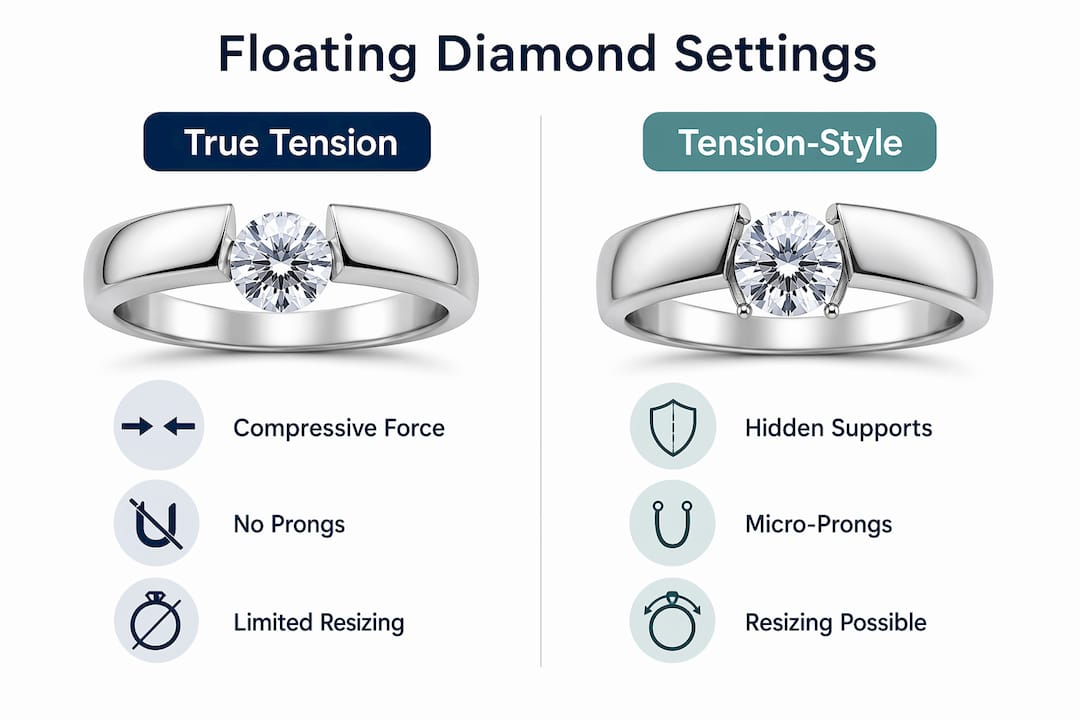
True tension settings, when manufactured correctly, are actually quite secure. The compressive force gripping the stone is substantial, and the diamond cannot shift the way it might in a worn-down prong setting. The risk comes from poor manufacturing or metal fatigue over time, which is why material choice is critical. Platinum’s density and resilience make it the preferred metal for ultra-thin bands, which are standard in floating designs. Gold alloys can work, but they require thicker band profiles to achieve comparable strength.
Tension-style settings offer strong security through their hidden supports. Because they rely on conventional holding mechanisms rather than compressive force alone, they are generally more forgiving of everyday wear and minor impacts.
Annual professional inspections are the single most important maintenance step for any floating setting. A jeweler can detect early signs of loosening before they become a problem. If you ever notice a small gap between the diamond and the metal, stop wearing the ring and take it to a professional immediately.
Security comparison at a glance:
| Setting type | Holding mechanism | Resizing | Security level |
|---|---|---|---|
| True tension | Compressive force in grooves | Requires remanufacturing | High, if engineered correctly |
| Tension-style | Hidden bezels or micro-prongs | Limited resizing possible | High, more conventional |
| Standard prong | Four to six visible prongs | Easy | Moderate to high |
| Bezel | Full metal rim around stone | Moderate difficulty | Very high |
Pro Tip: Before purchasing any floating diamond ring, ask the jeweler whether it is a true tension or tension-style design. That single question tells you what to expect for resizing, maintenance, and long-term wear.
What styles of floating diamond settings are available?
The floating concept extends well beyond a single stone on a plain band. Designers have built an entire vocabulary of variations around the suspended-stone idea, and the range is wider than most buyers realize.
- Single suspended stone: The classic version, one diamond held above a slim band with no side stones or decorative elements to compete with it
- Floating halo: A ring of smaller diamonds surrounds the center stone, but the entire cluster appears to hover above the band rather than sitting flush against it
- Floating arch: The band curves upward on both sides to cradle the diamond from below, creating a dramatic elevated effect without any visible prongs
- Bypass design: Two band ends pass each other without meeting, with the diamond suspended at the crossing point
- Multi-stone floating row: Several diamonds are set in a line along the band, each appearing individually suspended, popular in diamond wedding bands and eternity styles
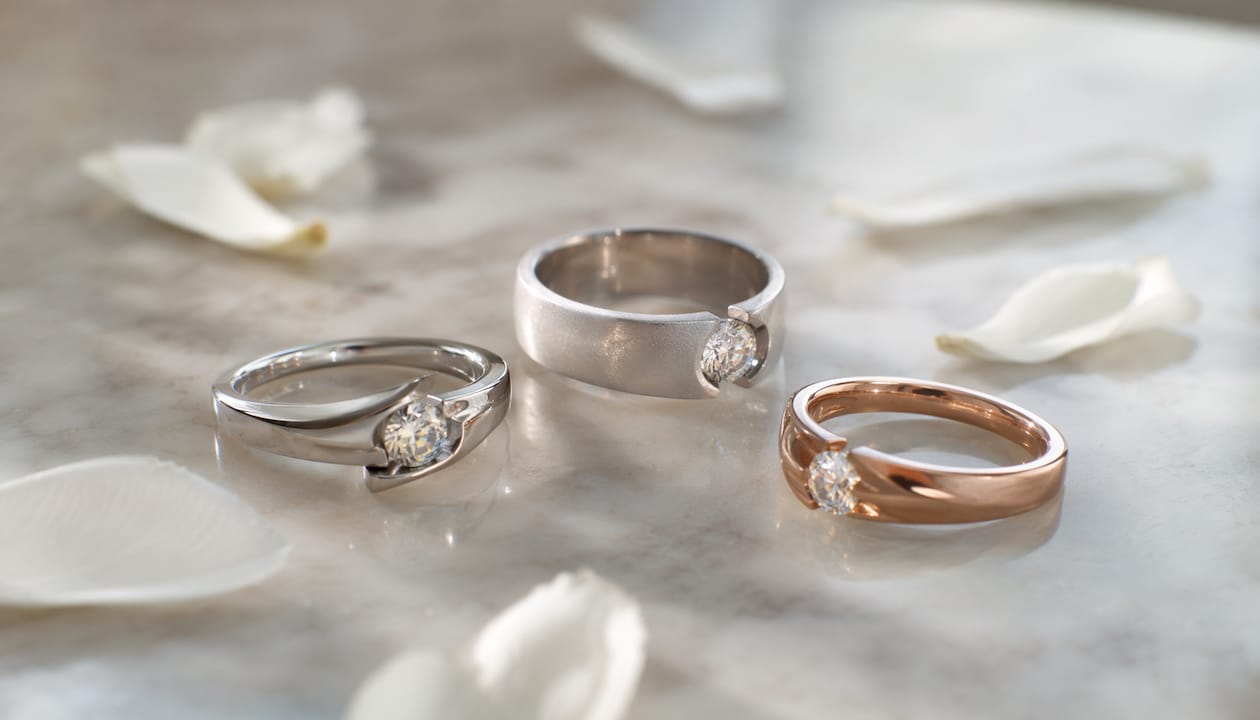
Band shape and metal finish influence the overall effect considerably. A high-polish platinum band amplifies the modern, architectural feel. A matte or brushed finish softens the look and suits buyers who prefer understated elegance. Rose gold adds warmth and a vintage edge to what is otherwise a very contemporary design.
Floating settings also appear in necklaces and pendants, where a diamond suspended on a nearly invisible wire or a very thin chain creates a similar illusion of a stone floating against the skin. Diamond necklaces in this style are among the most popular gift choices for milestone occasions.
What to consider before buying a floating diamond ring
A floating diamond ring is not the right choice for every buyer, and knowing the trade-offs before you commit saves a lot of frustration later.
Material and durability
Platinum is the gold standard for floating settings, literally and practically. Its density supports ultra-thin band profiles without sacrificing structural integrity. White gold is a viable alternative at a lower price point, but it requires rhodium plating to maintain its color and may need a slightly thicker band profile. Yellow and rose gold work best in tension-style designs where hidden supports carry more of the structural load.
Resizing
This is the biggest practical limitation. True tension rings cannot be resized without essentially remaking the ring from scratch, because any change to the band diameter alters the compressive force holding the stone. Tension-style rings allow limited resizing, typically one size up or down. If your ring size fluctuates or you are buying as a surprise, a tension-style design gives you more flexibility.
Lifestyle compatibility
Floating settings expose more of the diamond’s surface, which means more contact with everyday objects. For buyers who work with their hands, exercise frequently, or regularly handle rough materials, a bezel or six-prong setting offers more physical protection for the stone. A floating design suits an office environment or occasional wear better than a construction site.
Budget
The engineering complexity of true tension settings commands a premium. Precision manufacturing, specialized alloys, and the calibration required to achieve the correct compressive force all add to the cost. Tension-style settings are generally more affordable while delivering a nearly identical visual result.
Pro Tip: For buyers on a budget who love the floating aesthetic, a tension-style setting in white gold gives you the look at a fraction of the cost of a platinum true tension ring. The visual difference is minimal; the price difference is not.
Engineering insights that explain how floating settings actually work
The physics behind a true tension setting are worth understanding, because they explain both the appeal and the limitations of this design.
The band is manufactured with a specific internal stress built into the metal. When the diamond is set, it sits in grooves that are cut to match the stone’s exact girdle diameter. The band’s outward spring pressure grips the diamond from both sides simultaneously. This is not friction alone; it is a calibrated mechanical force that holds the stone as securely as any prong, provided the metal retains its structural properties over time.
- Metal fatigue is the primary long-term risk: Over years of wear, even platinum can develop microscopic stress points, particularly at the grooves where the diamond sits. Regular inspections catch this early.
- Groove precision is non-negotiable: A groove cut even slightly too wide reduces the compressive force and increases the risk of the stone shifting. This is why reputable jewelers use laser-cut or CNC-machined grooves rather than hand-cut ones.
- Platinum’s density makes it ideal: Its resistance to deformation under stress keeps the groove geometry stable over time, which is the core reason experts consistently recommend it over gold for true tension designs.
- Tension-style settings sidestep these physics entirely: By using hidden bezels or micro-prongs, they achieve the floating look without depending on compressive force, which is why they are easier to resize and generally more tolerant of everyday wear.
- Not all floating settings are engineered the same way: A ring marketed as a “floating” or “tension” design may be either type, and the visual difference is nearly impossible to detect without asking the jeweler directly.
The practical takeaway is straightforward. True tension settings are a genuine feat of precision manufacturing, and they reward buyers who commit to regular professional maintenance. Tension-style settings offer the same aesthetic with fewer structural constraints, making them the more practical choice for most daily-wear buyers.
Superjeweler has floating diamond rings at prices that make sense
Floating diamond rings carry a reputation for being expensive, but that is mostly a function of where you shop. Superjeweler offers a wide selection of engagement rings with floating and tension-style designs, with customizable options for diamond shape, metal type, and carat weight. The pricing reflects direct-to-consumer economics rather than retail markup, which means you get more diamond for the same dollar.

If your budget is under $1,000, Superjeweler’s affordable engagement ring collection includes real diamond options in settings that deliver the suspended-stone look without the premium price tag. Every purchase comes with a warranty and a return policy, so you are not taking a risk on a ring you have not seen in person. Free worldwide shipping means the ring arrives at your door, not at a jewelry counter where a salesperson is watching you decide.
Key Takeaways
A floating diamond setting creates a suspended-stone illusion through either true tension engineering or hidden supports, and the type you choose determines resizing options, maintenance needs, and long-term security.
| Point | Details |
|---|---|
| Two distinct types exist | True tension uses compressive force; tension-style uses hidden bezels or micro-prongs for a similar look. |
| Platinum is the preferred metal | Its density supports ultra-thin bands and maintains groove geometry over time, critical for true tension designs. |
| Resizing is limited | True tension rings require remanufacturing to resize; tension-style rings allow limited adjustment. |
| Annual inspections are necessary | A jeweler should check for stone movement or groove wear every year to prevent loss. |
| Superjeweler offers accessible options | Customizable floating diamond engagement rings are available at competitive prices with warranty and free shipping. |
Recommended
- Diamond Trends 2026: Styles, Shapes & Smart Choices
- Diamond Upgrade Ring Options: Your 2026 Buyer’s Guide
- Engagement Ring Hidden Halo Styles: 2026 Design Guide
- Diamond Wedding Bands | SuperJeweler
