A solitaire setting holds one center gemstone on a plain or minimally adorned band, with no side stones, halos, or decorative clusters. That’s the whole concept. According to GIA’s diamond education resource, a solitaire places full visual focus on a single diamond, which is precisely why it has dominated engagement ring design for well over a century.
Three things to know before you read further:
- The stone is the star. Every design decision in a solitaire setting exists to showcase one gem, not the metalwork around it.
- The style is genuinely timeless. Solitaires don’t follow trends the way halo or pavé rings do, so the ring you buy today won’t look dated in 20 years.
- Pairing is simple. A plain or lightly detailed band sits flush against most wedding bands without a custom fit.
GIA and Natural Diamonds both confirm the solitaire’s enduring popularity for engagement rings, and Superjeweler carries a wide range of solitaire styles to match different stones, budgets, and lifestyles.
Key Takeaways
A solitaire setting holds one center stone on a plain or minimally adorned band, and the right style depends on the wearer’s lifestyle, preferred stone shape, and how the ring will pair with a wedding band.
| Point | Details |
|---|---|
| What a solitaire setting is | One center stone, no side stones or halos; the band is plain or minimally decorated. |
| Most popular style | Round brilliant accounts for ~53% of engagement ring stones; ~25% of engaged buyers receive solitaires (GIA/TheKnot). |
| Choosing by lifestyle | Active wearers should choose bezel or low-profile settings; prong settings maximize brilliance for lower-activity lifestyles. |
| Care and maintenance | Clean weekly at home; have prongs inspected professionally at least once a year. |
| Superjeweler | Offers solitaire engagement rings across all setting styles, shapes, and budgets, including lab-grown options. |
Table of Contents
- What is a solitaire setting? The main styles compared
- Why buyers keep choosing solitaire rings
- Which diamond shapes work best in solitaire settings
- How to choose the right solitaire setting for your lifestyle
- Solitaire variations and how they compare to halo settings
- Care and maintenance for solitaire settings
- The history and evolution of the solitaire setting
- Customization options: metals, bands, and personal touches
- Superjeweler’s solitaire and engagement ring selection
- Sources
Table of Contents
- What is a solitaire setting? The main styles explained
- Why buyers keep choosing solitaire rings
- Which diamond shapes work best in solitaire settings
- How to choose the right solitaire setting for your lifestyle
- Solitaire variations and how they compare to halo settings
- Care and maintenance for solitaire settings
- The history and evolution of the solitaire setting
- Customization options: metals, bands, and personal touches
What is a solitaire setting? The main styles compared
A solitaire setting is defined by one rule: one stone, nothing else competing for attention. GIA lists four primary solitaire setting styles — prong, cathedral, bezel, and tension — and each one holds the stone differently, which changes how it looks, how much light it catches, and how well it survives daily wear.
Prong setting uses thin metal claws (typically four or six) to grip the stone at its girdle. More of the diamond is exposed to light, which maximizes brilliance. The classic six-prong silhouette, popularized by Tiffany & Co. in 1886, remains the most recognized solitaire design in the world. Four prongs give a slightly more modern, geometric look and expose even more of the stone’s surface.
Cathedral setting arches the metal shank up on either side of the stone, creating a raised profile that resembles the arched supports of a cathedral ceiling. The elevation adds drama and makes the center stone appear larger, though the raised profile can catch on fabric and clothing more easily than a low-profile option.
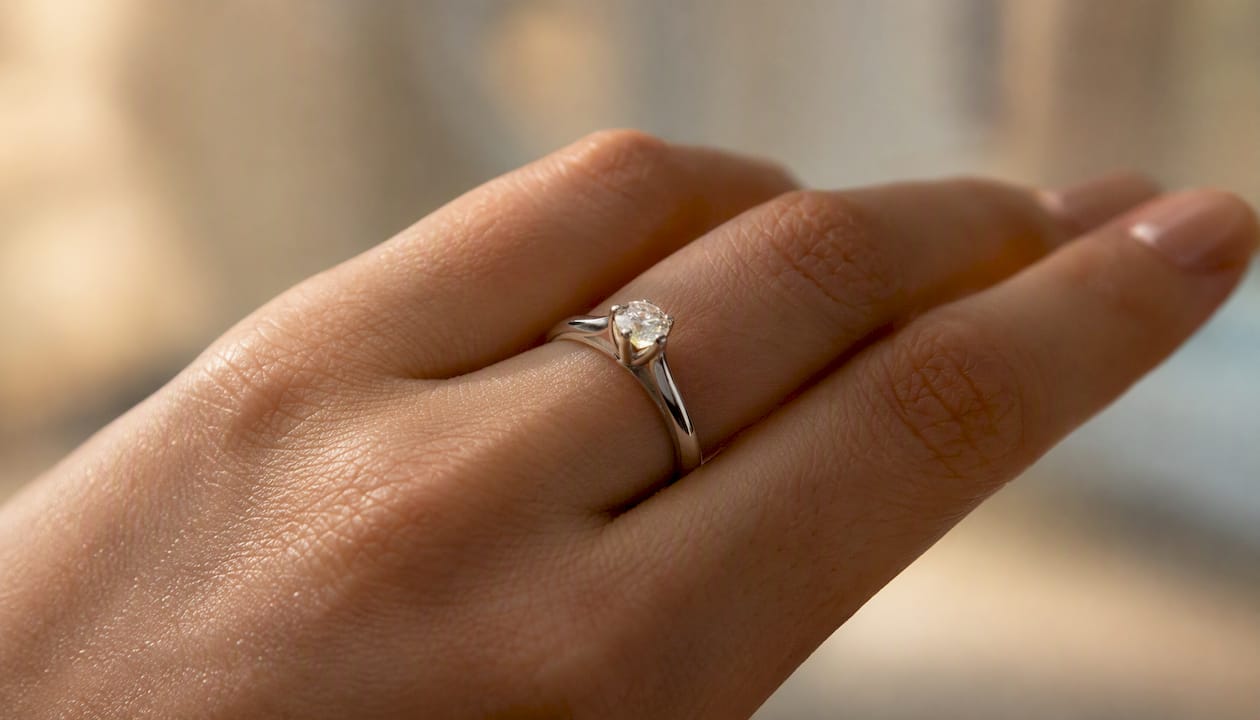
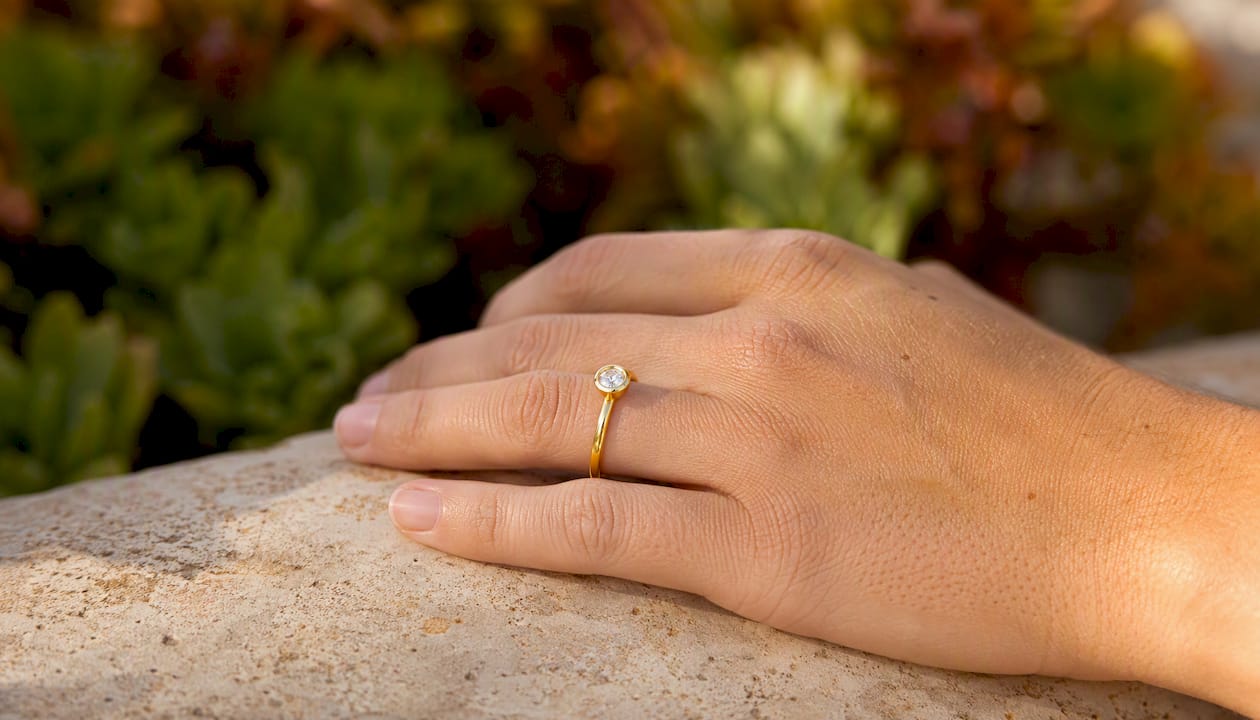
Bezel setting wraps a thin rim of metal around the entire circumference of the stone. It offers the most protection of any solitaire style and sits low on the finger, making it the best choice for active wearers. The trade-off is reduced light entry: the metal rim covers the stone’s edges, which slightly mutes brilliance compared to prong settings.
Tension setting suspends the stone between two ends of the band using the metal’s spring pressure. The result looks almost gravity-defying. It’s visually striking, but tension settings require professional servicing and are not easily resized, so they suit buyers who prioritize aesthetics over flexibility.
Bar setting (less common in solitaires, but worth knowing) uses vertical metal bars on either side of the stone rather than prongs. It offers moderate protection and a clean, architectural look.
| Setting | Sparkle | Protection | Profile | Best For |
|---|---|---|---|---|
| Prong (4-prong) | Very high | Moderate | Medium | Maximum brilliance, modern look |
| Prong (6-prong) | Very high | Moderate-high | Medium | Classic elegance, round stones |
| Cathedral | High | Moderate | High | Dramatic, elevated look |
| Bezel | Moderate | Highest | Low | Active lifestyles, minimalist style |
| Tension | High | Low-moderate | Low-medium | Bold, contemporary aesthetic |
| Bar | Moderate-high | Moderate | Low | Clean, architectural look |
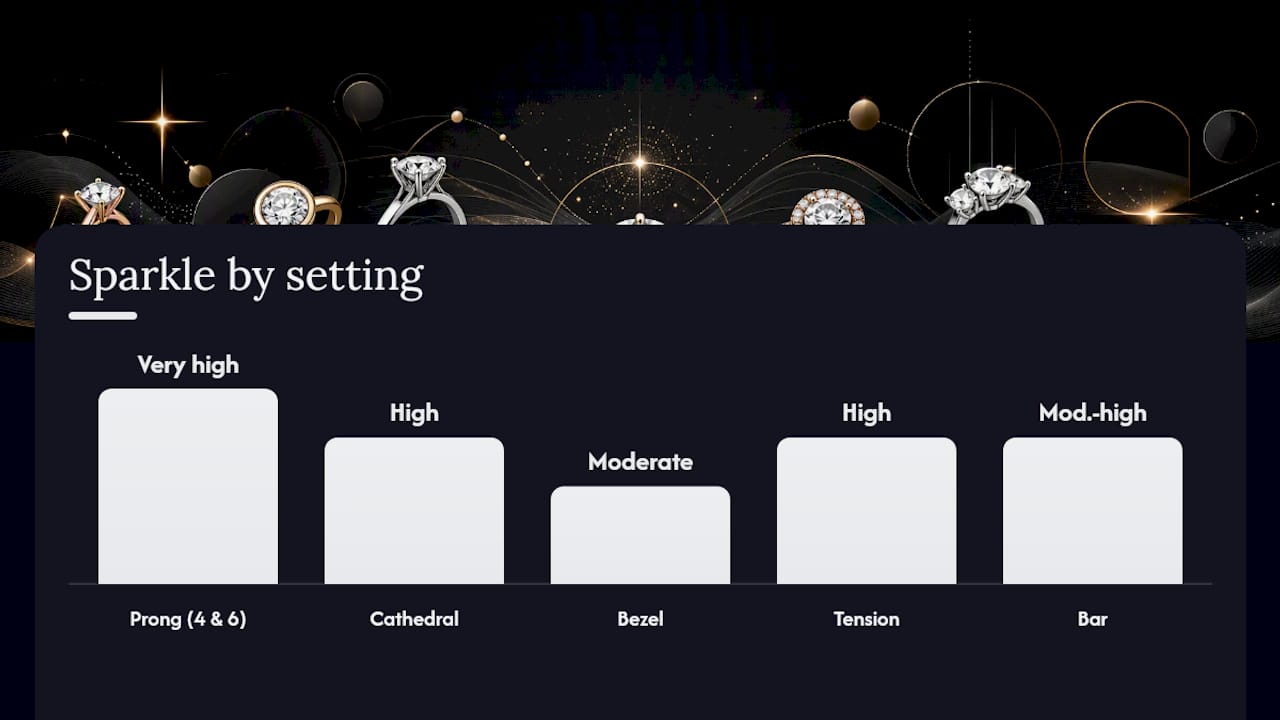
For a broader comparison of solitaire setting styles and trade-offs, security and daily wearability should weigh as heavily as visual appeal when you’re making a final decision.
Why buyers keep choosing solitaire rings
Solitaires remain the most popular engagement ring style because they put a single, high-quality stone front and center — and that simplicity turns out to be exactly what most buyers want. Natural Diamonds confirms that the style’s enduring appeal comes from its ability to highlight the diamond and pair easily with virtually any wedding band.
The practical reasons buyers choose solitaires:
- Style longevity. A solitaire doesn’t look dated because it was never trendy to begin with. It’s the baseline of fine jewelry design.
- Upgrade flexibility. The center stone can be replaced with a larger or higher-quality diamond later without redesigning the entire ring.
- Easier resizing. Plain solitaire bands resize more cleanly than rings with stones set around the shank.
- Wedding band compatibility. A flat or lightly contoured band sits flush against most straight or curved wedding bands. Diamond bridal sets are often designed specifically around solitaire engagement rings for this reason.
- Stone quality focus. When there are no side stones to distract the eye, the center diamond’s cut, color, and clarity matter more — which pushes buyers toward better stones.
GIA cites TheKnot survey data showing the round brilliant accounts for approximately 53% of engagement ring stones, and roughly 25% of engaged buyers received solitaire rings. Those numbers reflect a consistent, broad preference rather than a passing trend.
Which diamond shapes work best in solitaire settings
Any shape can technically be a solitaire, but some pairings are more natural than others. The GIA retailer resource notes that cut quality and mounting choice together determine how much light a stone returns — so the shape-to-setting match genuinely affects how the finished ring looks.
Shape-to-setting pairings that work well:
- Round brilliant pairs with almost every solitaire setting, but shines brightest in a four- or six-prong mount that exposes maximum surface area.
- Princess cut benefits from a four-prong setting with corner prongs that protect the stone’s pointed corners, which are its most vulnerable points.
- Cushion cut looks especially rich in a cathedral or four-prong setting, where the elevated profile complements the stone’s soft, rounded square outline.
- Pear and oval suit prong or cathedral settings that follow the stone’s elongated shape; a bezel works too, though it slightly reduces the visual length.
- Radiant cut is versatile and handles both prong and bezel settings well; a 1-carat radiant solitaire in a four-prong setting is a popular choice for buyers who want the sparkle of a round with a more geometric outline.
- Emerald and Asscher cuts are step cuts with large, open facets; a low bezel or four-prong setting keeps the stone secure while letting the hall-of-mirrors effect read clearly.
Pro Tip: Elongated shapes like oval, pear, and marquise visually extend the finger and often appear larger than their carat weight suggests. A prong or cathedral setting that lifts the stone slightly off the band amplifies this effect further.
For a deeper look at how shape affects visual impact, Superjeweler’s guide on diamond shapes and ring styles covers current trends and practical fit considerations.
How to choose the right solitaire setting for your lifestyle
Start with your priority: sparkle, protection, or profile height. Once you know which of those three matters most, the setting choice narrows quickly. Jewelry education guides consistently recommend matching setting style to the wearer’s daily life before worrying about aesthetics.
Questions to ask before you decide:
- How physically active is the wearer? Nurses, athletes, and people who work with their hands need a low-profile bezel or cathedral setting, not an elevated prong mount.
- Do you want low maintenance? Bezels require less frequent prong checks. Tension settings need professional servicing more often.
- Are you planning to stack a wedding band? A low or medium-profile solitaire pairs more comfortably with a straight band than a high cathedral setting.
- What’s your budget? Prong settings are typically less labor-intensive to produce than custom bezels or tension settings, which means they often cost less for the same stone quality.
- Do you prefer yellow gold, white gold, or platinum? The metal affects both durability and how the stone’s color reads (more on this in the customization section below).
A practical buying sequence:
- Choose your stone shape first.
- Identify which settings complement that shape.
- Filter by lifestyle needs (active vs. low-activity).
- Set a metal preference.
- Compare prong count and profile height in person or through high-resolution photos online.
- Confirm resizing policy before purchasing, especially for tension settings.
Solitaire variations and how they compare to halo settings
Solitaires extend well beyond engagement rings. The same single-stone concept applies to necklaces, earrings, and bracelets, and several hybrid ring designs blend solitaire simplicity with subtle additional detail.
Common solitaire variations:
- Solitaire necklace: a single diamond or gemstone suspended from a plain chain; one of the most versatile fine jewelry pieces a person can own.
- Solitaire stud earrings: a matched pair of single stones in prong or bezel settings; the standard for diamond earrings.
- Pavé-shoulder solitaire: the center stone sits in a classic prong mount, but the band features small pavé diamonds along the shoulders. It reads as a solitaire from a distance but adds sparkle up close.
- Split-shank solitaire: the band divides into two strands as it approaches the center stone, framing it without adding side stones.
Solitaire vs. halo: A halo setting surrounds the center stone with a ring of smaller diamonds, which makes the center stone appear larger and adds overall brilliance. The trade-off is maintenance: more stones mean more prongs to check, and the halo can make pairing with a straight wedding band trickier. A solitaire is simpler to maintain and easier to pair, but the center stone has to carry the visual weight entirely on its own.
Natural Diamonds notes that the solitaire’s clean design is part of what makes it so durable as a style — there’s nothing to go out of fashion.
Care and maintenance for solitaire settings
Regular cleaning and periodic professional inspections keep a solitaire secure and brilliant. The Jewelers of America recommends professional inspection at least once a year for rings worn daily, and more often for active wearers.
Cleaning your solitaire at home:
- Fill a small bowl with warm water and a few drops of mild dish soap.
- Soak the ring for 20–30 minutes.
- Gently scrub with a soft-bristled toothbrush, paying attention to the underside of the stone where oils and soap accumulate.
- Rinse thoroughly under warm running water.
- Pat dry with a lint-free cloth and allow to air dry completely before storing.
What to avoid: ultrasonic cleaners can loosen prongs over time; avoid them for tension settings entirely. Chlorine bleach and harsh household chemicals can damage metal alloys, especially in lower-karat gold.
Maintenance checklist:
- Check prongs every six months for bending, thinning, or sharp edges.
- Inspect bezel edges for lifting or separation from the stone.
- Have tension settings serviced by a professional jeweler annually; the spring pressure that holds the stone can relax with wear.
- Remove the ring before swimming, heavy cleaning, or gym workouts.
Pro Tip: If a prong catches on fabric or feels sharp against your skin, see a jeweler immediately. That’s a sign the prong has bent or worn thin, and a lost stone is far more expensive than a prong repair.
GIA’s technical resources for retailers provide additional guidance on how different settings affect long-term light performance and inspection needs.
The history and evolution of the solitaire setting
The solitaire setting as we know it today traces directly to 1886, when Tiffany & Co. introduced a six-prong platinum mount designed to lift the diamond above the band and expose it to light from every angle. Before that, diamonds in engagement rings were typically set flush with the metal in closed-back settings that blocked light from entering the stone’s pavilion, which dramatically reduced brilliance.
The shift to open-back prong settings coincided with advances in diamond cutting. As cutters refined the round brilliant cut through the late 19th and early 20th centuries, the prong solitaire became the natural showcase for those improvements. The two developments reinforced each other: better cuts demanded settings that let light in, and better settings made the improvements in cut quality visible.
Through the Art Deco period of the 1920s and 1930s, solitaires gained more geometric character with platinum metalwork and angular prong designs. The mid-20th century brought yellow gold back into fashion, and the four-prong solitaire became the standard for mass-market engagement rings. By the 1990s, platinum had returned as the dominant metal for fine solitaires, and the six-prong round brilliant had re-established itself as the default engagement ring silhouette.
The solitaire’s staying power comes partly from its neutrality. It doesn’t belong to any single era’s aesthetic the way an Art Nouveau cluster ring or a 1980s cocktail ring does.
Customization options: metals, bands, and personal touches
A solitaire setting offers more room for personalization than its simplicity suggests. The main variables are metal, band profile, prong style, and finish.
Metal choices and what they mean:
- Platinum is the most durable option and the whitest in color. It’s hypoallergenic and holds prongs securely over decades of wear, though it develops a patina over time that some buyers love and others prefer to polish out.
- 14K or 18K white gold looks similar to platinum but costs less. White gold is rhodium-plated to achieve its bright finish, which wears off over time and requires replating every few years.
- 14K or 18K yellow gold is the classic choice and complements warmer stone colors (lower color grades, fancy yellows). It’s softer than platinum but easy to polish and repair.
- Rose gold has grown steadily in popularity and pairs beautifully with cushion and oval cuts; its warm tone can make near-colorless stones appear slightly warmer, which is worth considering if color grade matters to you.
Band profile options:
- Knife-edge bands taper to a thin ridge along the top, creating a delicate, refined look.
- Comfort-fit bands have a slightly rounded interior that sits more comfortably on the finger for all-day wear.
- Flat bands are the most traditional and pair most easily with straight wedding bands.
Prong styles: rounded prongs are the most common and least likely to catch on fabric; claw prongs have a sharper, more tapered tip that gives a vintage feel; flat or beaded prongs offer a more modern, geometric look.
For buyers who want something beyond a plain band, vintage-style engagement rings often feature solitaire centers with milgrain edges, filigree detailing, or engraved shanks that add character without adding side stones.
The case for keeping it simple
The solitaire gets dismissed sometimes as the “safe” choice, as if choosing one means you lacked imagination. That framing gets it backwards. A solitaire is the only engagement ring style where the quality of the center stone is completely exposed. There’s nowhere to hide a mediocre cut or a distracting inclusion. That means buyers who choose a solitaire are, almost by definition, investing more carefully in the stone itself rather than using surrounding diamonds to create an impression of size or sparkle.
The practical upside is real too. A solitaire pairs with nearly any wedding band, resizes more cleanly than most alternatives, and doesn’t require the same level of ongoing maintenance as a halo or pavé ring with dozens of small stones to check. For buyers who want a ring they’ll wear every day for decades without worrying about it, the solitaire’s simplicity is a feature, not a compromise.
Superjeweler’s solitaire and engagement ring selection
Superjeweler offers one of the broadest selections of solitaire engagement rings available online, with options spanning classic prong settings, bezel styles, and cathedral designs across a full range of diamond shapes and carat weights. The price range is genuinely wide: budget-conscious buyers can find real diamond solitaires in the engagement rings under $1,000 category, while shoppers looking for larger stones or premium metals can filter the full engagement ring collection by shape, setting style, and carat weight. Lab-grown diamond options are available throughout, offering the same visual quality as mined diamonds at a lower price point.

Every order ships free, and Superjeweler’s return policy gives buyers the confidence to order online without the pressure of an in-store sale. If you’re ready to shop by stone shape, the diamond shape selector is the fastest way to narrow your options.
Sources
- What is a Diamond Solitaire Setting?
- What Is a Solitaire Ring? — Natural Diamonds
- A Complete Guide to Solitaire Settings: Styles, Comparisons & More
- 7 Solitaire Ring Setting Styles Every Buyer Should Compare
- Retailer
- Jewelers
Recommended
- What Is Ring Setting and Why It Matters
- Unique examples of ring settings for engagement rings
- Step-by-step engagement ring buying guide for couples
- Engagement Ring Metal Comparison: Your Complete Guide
