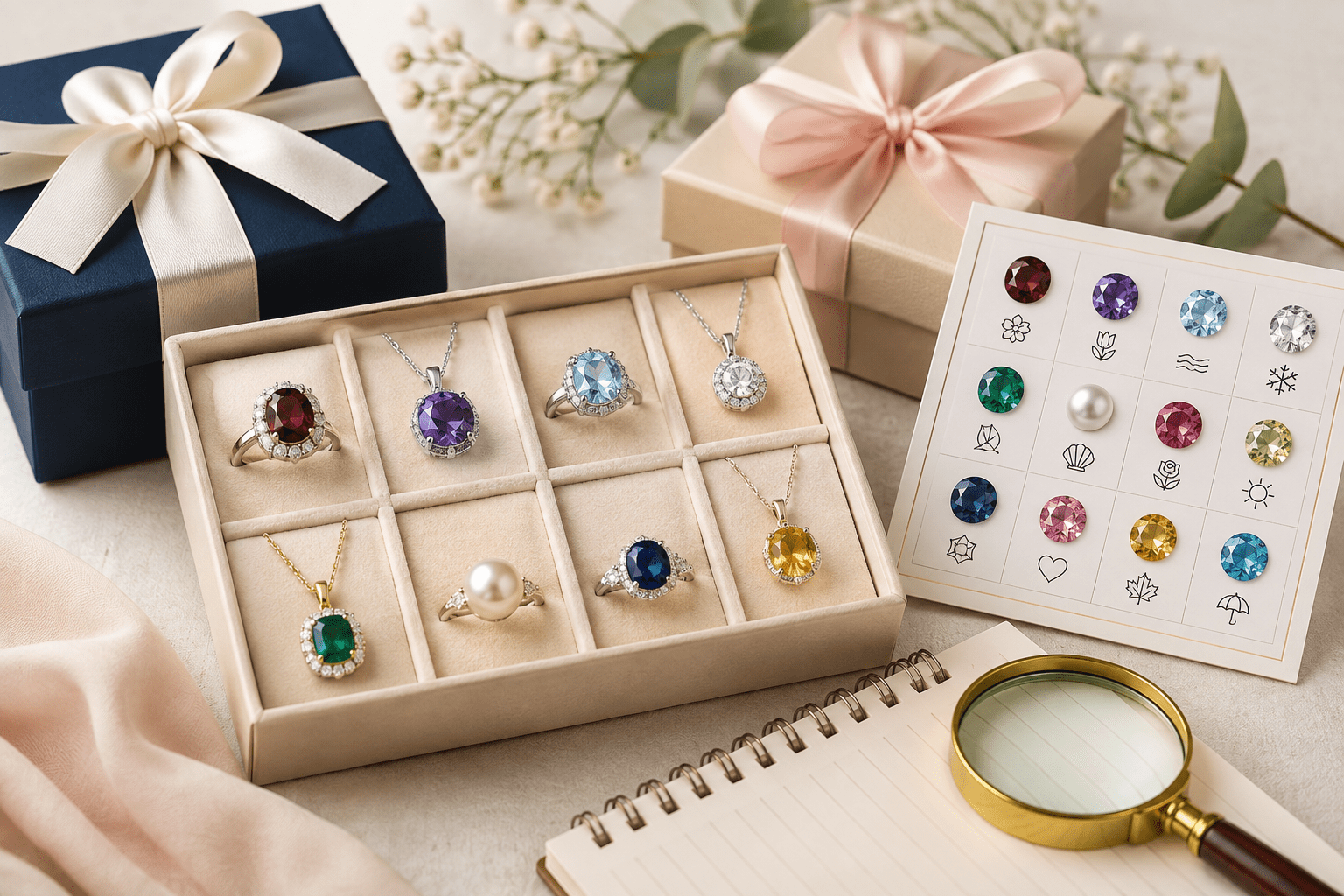
Follow these five steps to pick a meaningful, wear-ready birthstone gift — and you can do it in under ten minutes.
- Identify the birth month (or a month with personal significance, like an anniversary month).
- Choose the jewelry type that fits the recipient’s lifestyle: pendants and earrings for everyday wear, rings for special occasions.
- Check stone hardness. The Superjeweler birthstone buying guide recommends stones rated Mohs 7 or above for daily-wear rings; softer stones belong in pendants or earrings.
- Pick the metal and setting to complement the stone’s color and the recipient’s existing jewelry.
- Set your budget and explore alternatives — lab-grown stones, smaller carat weights, and cluster settings all stretch a dollar without sacrificing beauty.
That’s the whole framework. Everything below fills in the details.
Key Takeaways
Choosing a birthstone gift comes down to five decisions: the right month, the right jewelry type, a stone hard enough for how it will be worn, a metal that complements it, and a budget that fits your options.
| Point | Details |
|---|---|
| Start with the month | Identify the birth month first; months with multiple stones give you flexibility on budget and style. |
| Match jewelry type to lifestyle | Pendants and earrings work for nearly everyone; reserve rings for recipients whose size you know and whose lifestyle suits daily stone wear. |
| Use Mohs 7+ for daily rings | Stones below Mohs 7 (opal, turquoise, pearl) belong in pendants or earrings, not everyday rings. |
| Lab-grown saves money without sacrificing beauty | Lab-grown stones are chemically identical to mined ones and cost less; natural stones hold greater collectability value. |
| Superjeweler for every tier | Superjeweler’s birthstone and personalized jewelry collections cover economy through splurge, with free shipping and a clear return policy. |
Table of Contents
- Why birthstone jewelry works as a personal, lasting gift
- How to pick birthstone gifts: the complete month-by-month reference
- How do you choose a birthstone gift for a specific person?
- Which birthstones hold up to daily wear, and which ones need extra care?
- What are the best budget options for birthstone gifts?
- What are the rarest birthstones, and should you buy them?
- What buying a birthstone gift actually feels like from the other side of the counter
- Find the right birthstone piece at Superjeweler
- Sources
Why birthstone jewelry works as a personal, lasting gift
A birthstone gift lands differently than a generic piece because it’s tied to someone’s identity. The stone isn’t just pretty — it carries a meaning the recipient can point to. That combination of personalization and symbolism is hard to replicate with a candle or a gift card.
Practically speaking, birthstone jewelry is also easy to size. Pendants, earrings, and bracelets require no ring-size guessing, and the stone itself does the personalization work. You don’t need to know someone’s exact taste in metal or setting style to get it right.
The International Gem Society traces the roots of birthstone associations back centuries, with the modern standardized list established in the U.S. in 1912. That history matters for one practical reason: some months now carry two or three accepted stones — both a traditional and a modern option — which gives you real flexibility when choosing birthstone jewelry. If one stone is outside your budget or the recipient dislikes the color, there’s usually a legitimate alternative that still honors the month.
How to pick birthstone gifts: the complete month-by-month reference
The table below covers all 12 months. For months with multiple stones, a short note explains how to choose between them. Durability ratings follow the Mohs scale, where 10 is diamond (hardest) and 1 is talc (softest). The GIA birthstone resource is the authoritative source for the traditional and modern lists used here.
| Month | Birthstone(s) | Meaning / why it gifts well | Best jewelry types | Mohs hardness | Price note |
|---|---|---|---|---|---|
| January | Garnet | Passion, friendship, protection | Rings, pendants, earrings | 6.5–7 | Affordable; red is classic, but green tsavorite garnet is rarer and striking |
| February | Amethyst | Calm, clarity, royalty | Rings, pendants, earrings | 7 | Very affordable; deep purple most prized |
| March | Aquamarine | Courage, serenity | Pendants, earrings, rings | 7–8 | Moderate; larger stones show color best |
| April | Diamond | Strength, eternal love | All types | 10 | Premium; lab-grown cuts cost significantly |
| May | Emerald | Growth, renewal, love | Pendants, earrings, rings | 7–8 | Mid-to-high; inclusions common, oil treatment standard |
| June | Pearl, Alexandrite, Moonstone | Purity (pearl); transformation (alexandrite); intuition (moonstone) | Pearl: pendants, studs; Alexandrite: rings; Moonstone: pendants | Pearl: 2.5–4.5; Alexandrite: 8.5; Moonstone: 6–6.5 | Pearl: affordable; Alexandrite: premium (rare); Moonstone: affordable |
| July | Ruby | Passion, vitality, courage | Rings, pendants, earrings | 9 | Mid-to-high; deep red most valuable |
| August | Peridot, Spinel, Sardonyx | Strength (peridot); vitality (spinel); courage (sardonyx) | Peridot: pendants, earrings; Spinel: rings | Peridot: 6.5–7; Spinel: 8 | Peridot: affordable; Spinel: undervalued gem |
| September | Sapphire | Wisdom, loyalty, nobility | Rings, pendants, earrings | 9 | Mid-to-high; blue classic, but pink and yellow sapphires are equally valid |
| October | Opal, Tourmaline | Hope, creativity (opal); love, compassion (tourmaline) | Opal: pendants, studs, bezel-set; Tourmaline: rings, earrings | Opal: 6–6.5; Tourmaline: 7 | Opal: moderate; Tourmaline: affordable to mid |
| November | Topaz, Citrine | Strength, healing (topaz); warmth, joy (citrine) | Pendants, earrings, rings | Topaz: 8; Citrine: 7 | Both affordable; blue topaz most common |
| December | Tanzanite, Turquoise, Zircon | Transformation (tanzanite); protection (turquoise); prosperity (zircon) | Tanzanite: rings, pendants; Turquoise: pendants, bezel rings | Tanzanite: 6–7; Turquoise: 5–6; Zircon: 7 | Tanzanite: mid-to-high; Turquoise: affordable |
Choosing between multiple stones for the same month
When a month offers two or three options, the decision usually comes down to three things:
- Budget: Alexandrite (June) commands a premium; pearl and moonstone are far more accessible for the same month.
- Durability: If the gift is a ring for daily wear, lean toward the harder stone. For June, that’s alexandrite (Mohs 8.5) over moonstone (Mohs 6–6.5) or pearl (Mohs 2.5–4.5).
- Symbolism: Some recipients connect more with one stone’s story. Alexandrite’s color-change effect is a conversation piece; a pearl carries a quieter, classic elegance.
Pro Tip: Don’t overlook color variants. Garnet comes in green (tsavorite), orange (spessartite), and even rare color-change varieties — not just the deep red most people picture. Choosing a less-common color variant of a birthstone can make the gift feel genuinely one-of-a-kind.
How do you choose a birthstone gift for a specific person?
The month narrows the stone. The recipient narrows everything else. Start with these questions before you buy:
- Does this person wear jewelry daily? If yes, durability matters more than anything. Skip soft stones in ring settings.
- What metals do they already wear? Yellow gold, white gold, rose gold, and silver each read differently against the same stone. Matching their existing pieces avoids a mismatch.
- Do you know their ring size? If not, skip rings entirely. A pendant or earrings sidestep the sizing problem completely.
- What’s the occasion? A birthday calls for something personal; an anniversary might warrant a more substantial piece; a “just because” gift works best as something wearable every day.
- What’s their style? Classic and understated, or bold and colorful? A solitaire pendant reads differently than a cluster ring, even with the same stone.
Matching jewelry type to life stage and lifestyle
A college student who plays sports needs something she won’t worry about losing or scratching. A stud earring or a simple pendant on a sturdy chain is the right call. A professional who wears business attire daily can carry a sapphire ring without issue — sapphire sits at Mohs 9, and it handles a desk job without complaint. An active retiree who gardens or swims should avoid rings with soft stones and open prong settings; a bezel-set pendant is a smarter choice.
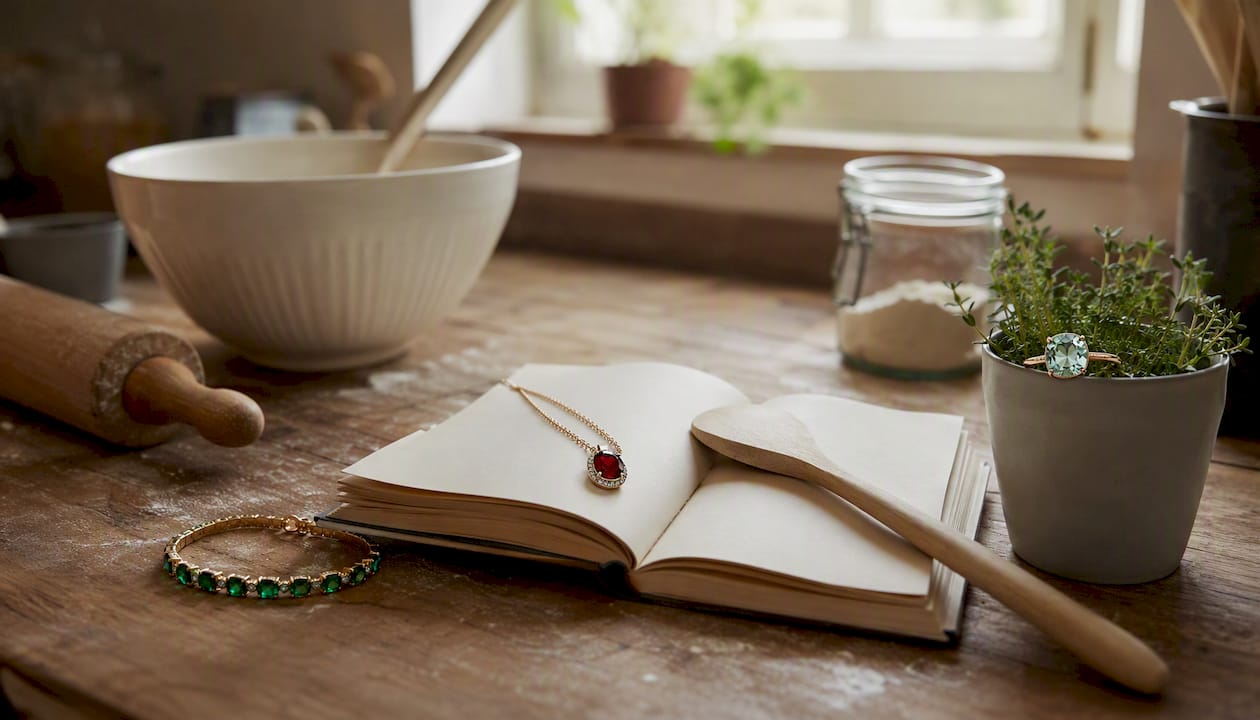
The Superjeweler practical guide to birthstone jewelry puts it plainly: versatile pieces like pendants and stud earrings work for everyday wear, while statement rings and layered necklaces suit special occasions. That’s a useful default when you’re unsure.
Pro Tip: When you don’t know the recipient’s ring size and can’t ask without spoiling the surprise, a pendant with the birthstone is almost always the right move. It’s personal, it’s wearable immediately, and it doesn’t require a return trip to the jeweler.
Which birthstones hold up to daily wear, and which ones need extra care?
The Mohs hardness number tells you how resistant a stone is to scratching — but it doesn’t tell the whole story. Opal, for example, is also brittle and sensitive to temperature changes. Pearls are porous and damaged by perfume, hairspray, and even sweat. Hardness is the starting point, not the finish line.
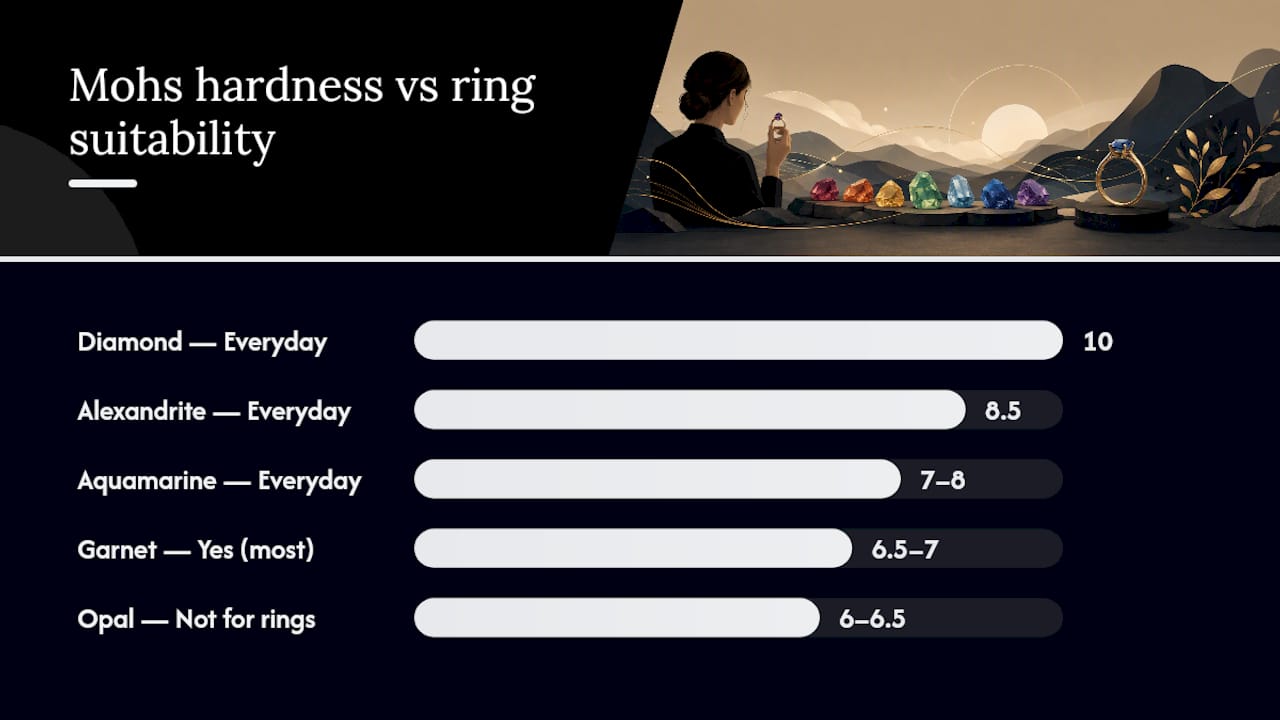
The core rule: choose stones rated Mohs 7 or above for everyday rings. Softer stones are better suited to pendants, earrings, or occasional-wear pieces. This guidance comes directly from the Superjeweler birthstone buying guide.
| Birthstone | Mohs hardness | Everyday ring? | Best setting type |
|---|---|---|---|
| Diamond | 10 | Yes | Any |
| Ruby | 9 | Yes | Any |
| Sapphire | 9 | Yes | Any |
| Alexandrite | 8.5 | Yes | Bezel or prong |
| Aquamarine | 7–8 | Yes | Bezel preferred |
| Topaz | 8 | Yes, with care | Bezel preferred |
| Emerald | 7–8 | With caution | Bezel; inclusions make it fragile |
| Amethyst | 7 | Yes | Bezel or prong |
| Garnet | 6.5–7 | Yes (most varieties) | Bezel preferred |
| Peridot | 6.5–7 | Occasional only | Bezel |
| Tanzanite | 6–7 | Occasional only | Bezel, protective |
| Opal | 6–6.5 | No — pendant/earrings | Bezel only |
| Turquoise | 5–6 | No — pendant/earrings | Bezel only |
| Pearl | 2.5–4.5 | No — pendant/earrings | Bezel or cup setting |
Settings that protect softer stones
A bezel setting wraps a metal rim around the stone’s edge, shielding it from side impacts. A flush setting recesses the stone into the metal surface. Both are meaningfully safer for softer gems than a high prong setting, which holds the stone up and away from the metal — elegant, but it exposes the stone to knocks.
For June birthstone pearl jewelry, a cup or bezel setting in a pendant or stud is the standard recommendation. Avoid prong-set pearl rings for anyone who works with their hands.
Pro Tip: Porous stones like turquoise and opal absorb chemicals. Store them separately from other jewelry, clean them only with a soft damp cloth (no ultrasonic cleaners, no steam), and keep them away from perfume and lotion. Treated turquoise — which is common — is especially vulnerable to discoloration from chemical exposure.
What are the best budget options for birthstone gifts?
Birthstone gifts span a wide price range, and the good news is that the most meaningful options aren’t always the most expensive ones. Here’s how to think about it by tier:
Economy (under $100): Amethyst, garnet, citrine, peridot, and blue topaz are all genuinely beautiful stones available at accessible prices. Sterling silver settings keep costs low without looking cheap. Stainless steel personalized bracelets with birthstone accents are another solid option at this price point — durable, personal, and affordable.
Midrange ($100–$500): Aquamarine, sapphire (smaller stones or lighter colors), ruby (smaller), and spinel all fall here depending on size and quality. White gold or yellow gold settings in this range are realistic. Cluster settings — where several small stones surround a center stone — deliver visual impact at a fraction of the cost of a single large stone.
Splurge ($500 and up): Fine alexandrite, top-color tanzanite, large rubies, and emeralds with minimal inclusions live in this tier. Certification from GIA or AGS matters more here — it documents the stone’s identity, treatments, and origin, which affects both value and resale.
- Lab-grown stones are chemically identical to mined stones and typically cost less while offering comparable color and clarity. The American Gem Society notes that lab-grown alexandrite, for example, offers the same color-change effect as natural alexandrite at a fraction of the price. Natural stones retain greater collectability and provenance value — but for a daily-wear gift, lab-grown is a practical and honest choice.
- Simulants (like cubic zirconia or synthetic spinel) look similar to a target stone but are chemically different. They’re the most affordable option and work well for fashion-forward pieces, but they don’t carry the same meaning or durability as the real stone.
- Smaller carat weights in a quality setting often look better than a large stone in a cheap setting. A well-cut 0.5-carat ruby in a gold bezel outperforms a 1-carat stone in a thin, poorly finished prong setting every time.
For budget-conscious shoppers who want something that still feels special, affordable jewelry gift ideas from the Superjeweler blog cover specific options across price points.
What are the rarest birthstones, and should you buy them?
Three stones consistently top the rarity conversation: fine alexandrite, large high-quality emeralds, and deeply saturated tanzanite.
Alexandrite is the standout. It requires a rare geological combination of elements — chromium alongside beryllium and aluminum — that almost never occurs together. Natural deposits are limited to Russia, Brazil, and Sri Lanka, which keeps supply tight and prices high. The defining feature is its color change: green in daylight, reddish-purple under incandescent light. According to the American Gem Society, natural alexandrite commands significantly higher prices than lab-grown versions, while lab-grown alexandrite delivers the same visual effect at a fraction of the cost.
Tanzanite was discovered in 1967 and comes from a single small mining area in Tanzania. The GIA notes that deeply saturated violet-blue stones are the most valuable, and Geology that color saturation and size both drive price sharply. Most tanzanite on the market is light to medium tone; top-grade color is genuinely rare. Buyers should also know that heat treatment is standard practice for tanzanite and should be disclosed by any reputable seller.
Fine emeralds with minimal inclusions and strong color saturation are similarly rare. Most emeralds contain inclusions (called “jardin”), and oil or resin treatment to improve clarity is industry-standard — but it must be disclosed.
Pro Tip: When buying any of these three stones above a modest price point, request a lab report from GIA or AGS. The report documents the stone’s identity, any treatments, and its geographic origin. For alexandrite especially, a lab report is the only reliable way to confirm you’re buying the real thing and not a synthetic or a simulant.
What buying a birthstone gift actually feels like from the other side of the counter
People worry about the wrong things when buying birthstone jewelry. Ring size is the most common anxiety — and the easiest to solve by choosing a pendant or earrings instead. Durability is the second worry, and the Mohs table above handles it. Treatment disclosure is the third, and it’s the one that actually matters most for higher-value purchases.
Here’s what I’d tell any buyer: a reputable jeweler discloses treatments in writing, offers a clear return policy, and provides certification for stones above a modest price point. Those three things together are your protection. If a seller can’t tell you whether a stone has been treated, that’s a signal worth heeding.
The personal touch of a birthstone gift — the fact that it’s tied to someone’s month, their identity — is what makes it land. Getting the stone right matters more than getting the setting perfect. Start there, and the rest follows.
Find the right birthstone piece at Superjeweler
Superjeweler carries birthstone jewelry across every price tier — from affordable amethyst and garnet pendants to fine sapphire and ruby rings — with free worldwide shipping and a clear return policy that takes the risk out of gifting.
For personalized options, the personalized jewelry collection includes birthstone pendants, engraved lockets, and custom pieces that pair a stone with a name or date. If lab-grown stones fit your budget better, the lab-grown diamond jewelry section covers rings, pendants, and earrings with the same visual quality as mined stones at lower prices. Browse gemstone jewelry at Superjeweler to find the right stone, setting, and metal for your recipient — and filter by birthstone month to go straight to the options that matter.
Sources
- Alexandrite Birthstone: Value, Meaning & Buying Guide
- Birthstones – GIA
- Tanzanite: What you need to know about color, rarity, value
- The Foundation Stones of the New Testament – International Gem Society
Recommended
- Why choose birthstone jewelry: gifts with personal touch
- Birthstone Jewelry Buying Guide: Choose With Confidence
- Gemstone Jewelry | SuperJeweler
