Shopping for an engagement ring can feel overwhelming when you want both elegance and assurance. For many American couples, understanding diamond certification is the key to making a confident choice. Certified diamonds undergo rigorous evaluation by leading laboratories like the Gemological Institute of America, giving buyers clear, unbiased details about quality and value. This guide breaks down the essentials so you can shop with clarity and customize your ring to suit your unique love story.
Table of Contents
- Certified Diamond Meaning And Key Concepts
- Types Of Certification And Grading Labs
- Diamond Grading Process And Certificate Elements
- Certified Versus Non-Certified Diamonds
- Costs, Resale Value, And Insurance Factors
- Common Misconceptions And Mistakes To Avoid
Key Takeaways
| Point | Details |
|---|---|
| Certified Diamonds Offer Assurance | Certified diamonds provide thorough evaluations and documentation of quality, enhancing buyer confidence and value verification. |
| Understand the 4Cs | Familiarize yourself with color, clarity, cut, and carat weight, as these are critical factors in determining a diamond’s quality. |
| Choose Reputable Labs | Prioritize certifications from recognized laboratories like GIA and AGS to ensure credible assessments and fair pricing. |
| Beware of Misconceptions | Rely on professional evaluations instead of visual inspections or at-home tests to accurately understand diamond quality and avoid pitfalls. |
Certified diamond meaning and key concepts
A certified diamond represents a gemstone that has undergone professional, independent evaluation by an authorized gemological laboratory. These diamonds receive comprehensive assessments that document their precise characteristics and quality through rigorous scientific analysis. Diamond certification standards provide buyers with transparent, objective information about their potential purchase.
The certification process involves detailed examination of four critical aspects known as the 4Cs:
- Color: Evaluating the diamond’s chromatic appearance
- Clarity: Identifying internal and external imperfections
- Cut: Assessing the diamond’s proportions and light performance
- Carat Weight: Measuring the diamond’s total mass
Certification serves multiple crucial purposes for diamond buyers. Unbiased diamond grading helps consumers make informed decisions by providing scientific documentation of a diamond’s exact qualities. Professional gemological organizations like the Gemological Institute of America (GIA) conduct these evaluations, ensuring consistent and reliable assessments.
Pro tip: Always request and carefully review the certification report before purchasing any diamond to understand its true quality and value.
Types of certification and grading labs
The world of diamond certification involves several prominent gemological laboratories, each with unique methodologies and reputation. Diamond grading laboratories play a critical role in establishing diamond quality and authenticity, providing buyers with trusted, scientific assessments of their potential purchases.
Key diamond certification laboratories include:
- Gemological Institute of America (GIA): Considered the global standard in diamond grading
- International Gemological Institute (IGI): Specializes in comprehensive diamond analysis
- American Gem Society (AGS): Known for rigorous scientific evaluation
- Gem Certification and Assurance Lab (GCAL): Provides detailed diamond assessment reports
International certification standards help ensure that diamonds are evaluated consistently across different laboratories. Each organization uses sophisticated equipment and trained gemologists to examine diamonds, assessing critical characteristics like color, clarity, cut, and carat weight with remarkable precision.
While these laboratories share similar core evaluation principles, they can have subtle differences in grading approaches. Professional buyers and consumers often compare certifications from multiple labs to gain a comprehensive understanding of a diamond’s true quality.
Here’s a quick reference comparing major diamond grading labs and their strengths:
| Laboratory | Reputation | Grading Approach | Specialty |
|---|---|---|---|
| GIA | International gold standard | Strict, conservative grading | Detailed natural diamond reports |
| IGI | Widely trusted globally | Balanced, comprehensive analysis | Lab-grown diamond certification |
| AGS | Highly respected in US | Scientific light performance | Precision-cut diamond grading |
| GCAL | Specialized boutique lab | Thorough, technical reporting | Assurance reports with advanced diagrams |
Pro tip: Always cross-reference diamond certifications and prioritize reports from internationally recognized laboratories to ensure maximum transparency and accuracy.
Diamond grading process and certificate elements
The diamond grading process is a meticulous scientific evaluation that provides buyers with comprehensive insight into a gemstone’s quality. Diamond grading methodologies involve systematic assessment of four critical characteristics known as the 4Cs: color, clarity, cut, and carat weight. Certified laboratories use advanced equipment and trained gemologists to ensure precise, objective analysis.
A typical diamond certificate contains several essential elements:
- Unique Report Number: Identifies the specific diamond
- Date of Grading: Indicates when the assessment was conducted
- Diamond Measurements: Precise dimensions of the stone
- Carat Weight: Exact weight measurement
- Color Grade: Assessment of the diamond’s color intensity
- Clarity Grade: Documentation of internal and external characteristics
- Cut Grade: Evaluation of the diamond’s proportions and light performance
Comprehensive diamond documentation also includes additional technical details such as polish quality, symmetry, fluorescence, and a plotted diagram showing the diamond’s unique characteristics. These detailed reports help buyers understand the exact quality and value of their potential purchase.
Professional gemological laboratories follow rigorous protocols to maintain consistency and objectivity. Each diamond undergoes multiple independent assessments to ensure accuracy, with trained experts examining the stone under controlled lighting and magnification conditions.

Pro tip: Always carefully review the entire diamond certificate, paying special attention to the plotted diagram and any comments about treatments or additional characteristics.
Certified versus non-certified diamonds
Diamond certification standards represent a critical differentiator in gemstone purchasing. Certified diamonds come with an official document from an independent laboratory that provides comprehensive, objective information about the stone’s quality, while non-certified diamonds lack this crucial verification process.
Key differences between certified and non-certified diamonds include:
- Authenticity Verification: Certified diamonds undergo rigorous testing
- Quality Assurance: Professional grading of color, clarity, and cut
- Resale Value: Certified diamonds typically command higher prices
- Buyer Confidence: Transparent and documented characteristics
- Investment Protection: Detailed documentation reduces purchasing risks
Diamond quality factors demonstrate why certification matters. Non-certified diamonds expose buyers to significant risks, including potential misrepresentation of the stone’s true characteristics and value. Without an independent assessment, consumers might inadvertently overpay or purchase a diamond with undisclosed flaws.
The following summary shows how certified and non-certified diamonds differ in real-world impact:
| Factor | Certified Diamond | Non-Certified Diamond |
|---|---|---|
| Purchase Confidence | Backed by verified documentation | Uncertain attributes, lacking proof |
| Resale Value | Higher due to grade clarity | Lower, often disputed quality |
| Insurance Process | Easy due to precise records | Complicated, value questionable |
| Investment Risk | Lower, transparent evaluation | Higher, risk of misrepresentation |
Professional jewelers and diamond experts universally recommend purchasing certified diamonds. The comprehensive documentation provides transparency, ensures fair pricing, and offers buyers peace of mind about their investment. Certification acts as a critical safeguard against misrepresentation and helps consumers make informed purchasing decisions.
Pro tip: Always request and carefully review the full certification report before purchasing any diamond, paying close attention to the grading details and laboratory credentials.
Costs, resale value, and insurance factors
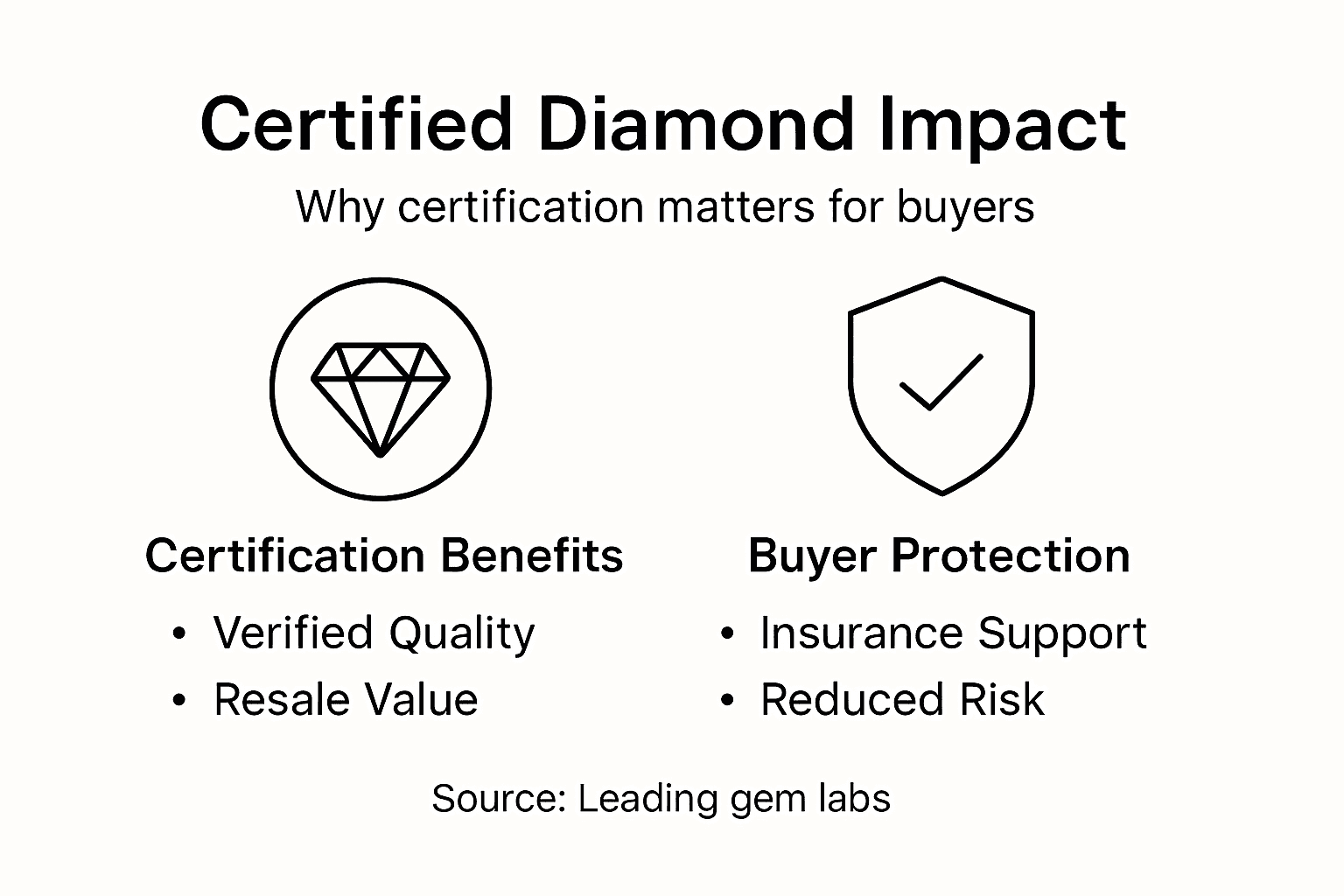
Diamond quality factors play a crucial role in determining a gemstone’s overall financial value and insurability. Certified diamonds typically command higher prices and offer more predictable investment potential compared to their non-certified counterparts, making them a more attractive option for buyers seeking long-term value.
Key financial considerations for certified diamonds include:
- Market Value: Certified diamonds have more transparent pricing
- Resale Potential: Higher likelihood of maintaining value over time
- Insurance Accuracy: Precise documentation enables better coverage
- Buyer Confidence: Verified quality reduces purchasing risks
- Investment Security: Standardized grading supports fair valuation
Diamond purchase strategies reveal that insurance providers rely heavily on certification reports when assessing diamond value. A comprehensive grading report allows insurers to accurately determine replacement costs, which can significantly impact coverage terms and potential claim settlements.
Professional appraisers and financial experts consistently recommend obtaining a detailed certification as a critical step in protecting your diamond investment. The documentation not only provides transparency but also serves as a crucial reference point for future sales, insurance claims, and potential inheritance valuations.
Pro tip: Request an updated professional appraisal every three to five years to ensure your diamond’s insurance coverage remains current with market value changes.
Common misconceptions and mistakes to avoid
Diamond authentication myths often mislead buyers into making uninformed purchasing decisions. Many consumers mistakenly believe they can determine a diamond’s quality through simple visual inspections or unreliable at-home testing methods, which can lead to significant errors in judgment and potential financial loss.
Common misconceptions about diamonds include:
- Visual Inspection Reliability: Assuming appearance guarantees quality
- At-Home Testing: Believing simple tests can verify authenticity
- Carat Weight Obsession: Overemphasizing size over overall quality
- Fluorescence Misunderstandings: Unnecessarily avoiding fluorescent diamonds
- Certification Assumptions: Thinking all certifications are equally credible
Diamond evaluation techniques reveal that professional assessment is crucial. Shoppers frequently make the mistake of relying on incomplete information or unverified claims about diamond characteristics. For instance, fluorescence is often misunderstood as a negative trait, when in reality, it rarely impacts a diamond’s visual appearance or value.
Experts strongly recommend seeking professional guidance and comprehensive certification to avoid these common pitfalls. Understanding the nuanced aspects of diamond quality requires more than superficial knowledge or simplified testing methods. Each diamond is unique, and only thorough professional evaluation can provide an accurate assessment of its true value and characteristics.
Pro tip: Always consult with a certified gemologist and request a detailed grading report before making any significant diamond purchase.
Discover the True Value of Certified Diamonds with Confidence
Understanding the importance of a certified diamond brings peace of mind to one of life’s most meaningful purchases. This article highlights the critical need for unbiased grading of the 4Cs—color, clarity, cut, and carat weight—to avoid costly mistakes and ensure authenticity. If you are looking for transparency and expert validation when selecting engagement rings, wedding bands, or other fine jewelry, it is essential to trust sellers who prioritize certified diamonds backed by reputable gemological laboratories.

At SuperJeweler, we take the guesswork out of buying precious stones by offering a wide range of certified diamonds and expertly crafted jewelry collections. You can explore our selection of engagement rings featuring both natural and lab-grown diamonds, all accompanied by detailed certification reports. Make your purchase with confidence knowing our affordable prices come with free shipping worldwide and trusted warranty options. Start your journey toward the perfect, certified diamond today because true beauty deserves undeniable proof and lasting value.
Frequently Asked Questions
What is a certified diamond?
A certified diamond is a gemstone that has undergone professional evaluation by an authorized laboratory, providing a detailed report of its quality and characteristics based on rigorous analysis.
Why is diamond certification important?
Diamond certification offers buyers transparency by documenting the diamond’s precise qualities, such as color, clarity, cut, and carat weight, helping to ensure informed purchasing decisions and reduce the risk of misrepresentation.
What are the main elements evaluated in diamond certification?
The main elements evaluated in diamond certification are the 4Cs: color, clarity, cut, and carat weight. This thorough assessment helps determine the diamond’s quality and overall value.
How does certified diamond pricing compare to non-certified diamonds?
Certified diamonds typically command higher prices due to their verified quality, ensuring more predictable investment potential. In contrast, non-certified diamonds may lack reliable documentation and may be priced less accurately.
Recommended
- Step by Step Lab Grown Diamond Process for Shoppers
- Why Invest in Diamond Jewelry: Value, Beauty, and Security
- Why Buy Diamond Earrings: Beauty, Value, and Ethics
- Why Choose Lab Diamonds: Sustainable Luxury Explained
