Pick 10K when durability and price matter most: it’s harder, cheaper, and built for rings, chains, or bracelets that take a daily beating. Pick 14K when color and resale value matter more, especially for engagement rings and pieces you’ll wear for decades. The trade-off is simple: 10K trades richness of color and melt value for scratch resistance and a lower price tag, whereas 14K reverses that bargain.
TL;DR:
- 10K gold’s higher alloy content makes it more scratch-resistant and better suited for daily wear, especially for kids’ jewelry and active lifestyles.
- 14K gold offers richer color, higher resale value, and is generally easier to resize, making it preferable for engagement rings and heirloom pieces.
- The price difference is substantial, with 14K containing roughly 40% more pure gold per gram, often translating into several hundred dollars for a typical 20-gram chain.
- Color variations depend on alloy metals; 10K tends to be paler with a brassy tone, while 14K reads warmer and more golden, especially in yellow gold.
- Authenticity matters; genuine pieces show clear hallmarks like “417” or “585,” and red flags include vague alloy descriptions or suspiciously low prices.
Table of Contents
- 10K vs 14K Gold: What the Karat Number Actually Means
- What Color Differences Should You Expect?
- Is 10K or 14K Gold More Durable for Daily Wear?
- How Much More Does 14K Gold Cost Than 10K?
- How Do You Choose Between 10K and 14K?
- How Do You Keep 10K and 14K Gold Looking Its Best?
- Which Karat Does SuperJeweler Recommend, and Why?
- Where to Shop 10K and 14K Gold Jewelry Online
- Sources
- FAQ
10K vs 14K Gold: What the Karat Number Actually Means
The karat system rates gold purity on a 24-part scale, where 24K is essentially pure gold. Everything below that number is an alloy, meaning it’s mixed with other metals for strength and cost control.
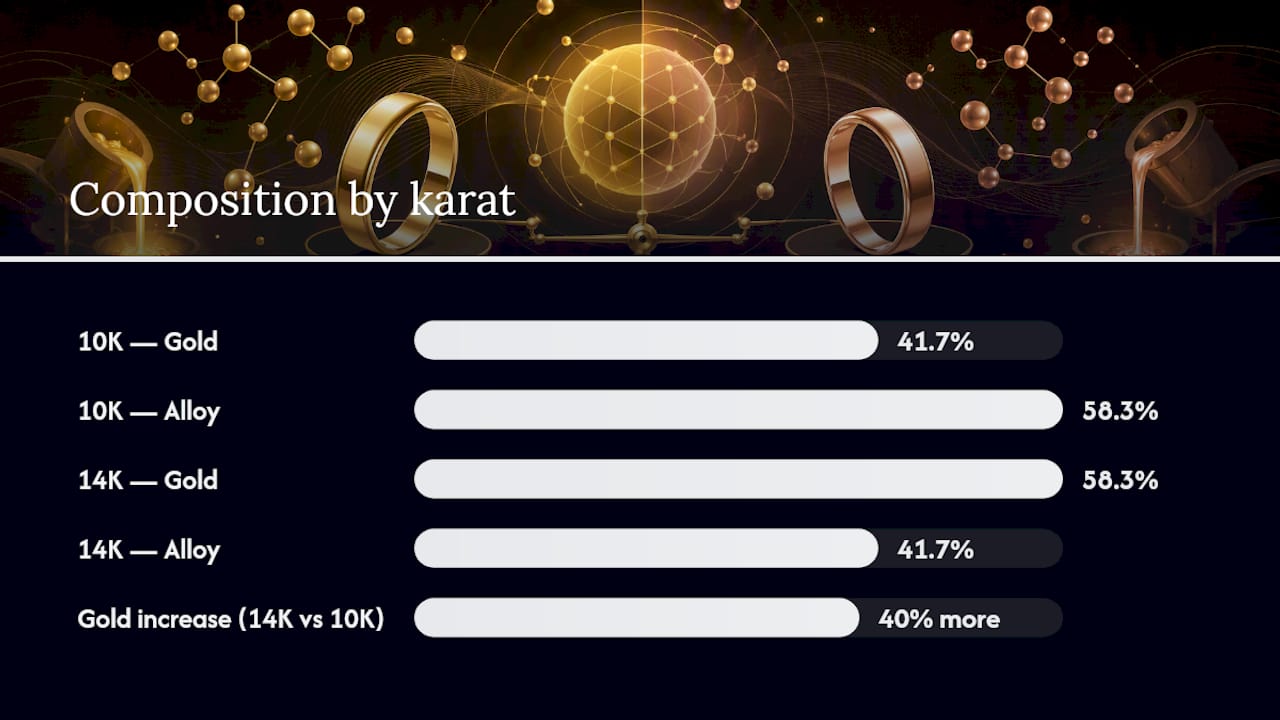
- 10K gold is about 41.7% pure gold, stamped “417” or “10K.”
- 14K gold is about 58.3% pure gold, stamped “585” or “14K.”
That gap of roughly 17 percentage points might look small on paper, but it changes almost everything else about the metal. The remaining 58.3% of a 10K piece (and 41.7% of a 14K piece) is alloy, usually a blend of copper, silver, and zinc, with some jewelers adding nickel for extra rigidity. Formulations vary by maker, which is why two rings stamped “14K” from different brands can still feel and look slightly different in your hand.
More alloy generally means a harder, more scratch-resistant metal. It also means less actual gold by weight, which directly lowers melt value. That single trade off, hardness versus gold content, is the thread that runs through every other difference between these two karats.
What Color Differences Should You Expect?
Gold color isn’t just about karat, it’s about which alloy metals get added and in what ratio. Still, some patterns hold up consistently enough to shop by.
- Yellow gold: 10K tends to look paler and slightly brassy; 14K reads warmer and more golden.
- Rose gold: 10K rose often skews pinker because it carries a higher copper ratio relative to gold.
- White gold: karat matters less here, since both 10K and 14K white gold get rhodium plated to achieve that bright, silvery finish.
If color is the deciding factor in your purchase, karat stamps alone won’t tell the whole story.
Pro Tip: Ask to see 10K and 14K pieces side by side under the same lighting, ideally daylight, and request an unplated white gold sample if you want to see the base alloy color before rhodium masks it.
Is 10K or 14K Gold More Durable for Daily Wear?
Hardness comes down to atomic structure. Higher alloy content disrupts gold’s naturally soft lattice, making the metal more resistant to bending, denting, and surface scratches. That’s the practical reason 10K holds up better under rough conditions, even though it contains less actual gold.
On a comparative hardness scale, 10K generally lands around 3.5 to 4.0, while 14K runs closer to 3.0 to 3.5, though exact figures shift with the alloy recipe. In real-world terms, that difference shows up as fewer visible scratches on a 10K wedding band after a year of yard work, dish washing, and gym sessions.
Here’s how to match karat to use case:
- Kids’ jewelry and everyday rings: 10K holds up better against rough play and frequent knocks.
- Work rings, active lifestyles, and gym-goers: 10K’s added hardness reduces visible wear over time.
- Engagement rings and heirloom pieces: 14K balances durability with richer color and easier resizing, since goldsmiths generally find it more workable for prong setting and repairs.
- Fine chains and statement pieces: 14K’s warmer tone and higher resale value tend to matter more than raw scratch resistance.
Neither karat is fragile. The real question is which trade off fits your routine.
How Much More Does 14K Gold Cost Than 10K?
Melt value is simple math: gold content times the current spot price per gram. Since 14K carries roughly 58.3% pure gold versus 10K’s 41.7%, the difference compounds fast.
- 14K contains roughly 40% more pure gold per gram than 10K, which is the single biggest driver of price and resale value differences.
- Live gram-price snapshots consistently show 14K trading noticeably higher than 10K at any given spot price.
- Retail impact depends heavily on design. Plain metal items feel the gap the most.
Melt value gap: For a 20 gram gold chain, that roughly 40% purity difference can translate into a swing of several hundred dollars in raw melt value alone, before any retail markup.
That gap shrinks fast once gemstones enter the picture. A diamond-heavy ring or a piece with detailed craftsmanship spreads its cost across the stone, the setting, and the labor, not just the metal. Karat matters most for gold chains and plain bands, less for anything gem-forward.
How Do You Choose Between 10K and 14K?
Shopping in person or online, the decision usually comes down to answering four questions honestly.
- What’s the priority: durability or color/resale? Durability and budget point to 10K; color richness and resale value point to 14K.
- How often will you wear it? Daily, high-impact wear favors 10K’s added hardness.
- Is this an engagement ring or heirloom piece? 14K is the common U.S. standard for engagement rings because it balances color, strength, and resale value.
- Does the piece need resizing or repair later? 14K is generally easier for jewelers to work with during resizing or prong repair.
Before you buy, ask the jeweler directly about alloy composition, nickel content (especially if you have sensitive skin), rhodium plating policy for white gold, and the warranty or repair terms.
Pro Tip: Treat a missing karat stamp, a vague answer about alloy composition, or a price that seems too low for the weight as red flags. Legitimate pieces carry clear hallmarks like “417” or “585,” and reputable jewelers know their alloy specs without hesitation.
How Do You Keep 10K and 14K Gold Looking Its Best?
10K tends to show tarnish sooner than 14K because it carries a higher share of reactive metals like copper and zinc. Chlorine, sweat, and heavy lotions or perfumes all speed that process along, so it’s worth pulling rings off before pool time or a heavy workout.
- Clean with mild soap, warm water, and a soft brush for both karats.
- Skip ultrasonic cleaners on pieces with soft or fracture-filled gemstones.
- Wipe pieces dry after wear to cut down on moisture exposure.
- Rhodium plating on white gold wears down over months to a couple of years depending on use, and needs re-plating once the base alloy color starts showing through.
For a deeper routine, our complete gold jewelry care guide walks through cleaning frequency and storage tips piece by piece.
Which Karat Does SuperJeweler Recommend, and Why?
For most fine jewelry, especially engagement rings and pieces meant to last, 14K is the smarter buy. It holds color better, resists tarnish longer, and carries more resale value. That said, 10K earns its place for kids’ jewelry, gym rings, and any piece that takes daily abuse where scratch resistance beats richness of color. Browse both karats across our rings and necklaces collections and compare for yourself.
— Andrew
Where to Shop 10K and 14K Gold Jewelry Online
Superjeweler is the practical alternative to guessing at a mall counter: every product page lists the karat clearly, so you can filter by 10K or 14K before you ever add something to your cart.

Whether you’re after a durable everyday band or a richer-toned piece for an engagement, the selection spans wedding bands, earrings, and bracelets in both karats. SuperJeweler offers policies including guarantees and returns for customer satisfaction; check their site for details on these protections. Start browsing rings now and filter by karat to find the exact balance of durability, color, and price that fits your daily life.
Sources
- 10K vs 14K Gold: Real Differences in Price & Quality — GoldToolkit
- 10 Karat versus 14 Karat Gold: Surprising Differences Revealed — TRB Bullion
- 10K vs 14K Gold — live melt snapshots & comparison — MyGoldCalc
FAQ
What Are the Downsides of 10K Gold?
10K gold looks paler and less rich than higher karats, and it tarnishes faster because it contains more reactive alloy metals like copper and zinc. It also carries roughly 40% less pure gold per gram than 14K, which lowers its melt and resale value.
Is 10K Gold Worth Buying?
Yes, for the right use case. 10K gold is a smart choice for everyday rings, kids’ jewelry, and active lifestyles because its added hardness resists scratches and dents better than higher karats, even though it trades off some color richness and resale value.
How Long Does 10K Gold Last?
10K gold can last for decades with basic care, since its higher alloy content actually makes it more resistant to bending and scratching than softer, higher karat gold. The main maintenance need is more frequent cleaning to manage tarnish from sweat, chlorine, and lotions.
Can Gold Be Fake Even if It’s Stamped 14K?
Yes, a stamp alone doesn’t guarantee authenticity. Legitimate 14K pieces carry a clear “585” or “14K” hallmark, but counterfeit stamps exist, so ask for documentation or request testing if you have any doubt about a piece’s origin.
Recommended
- 14k vs 18k Gold for Engagements
- Solid Gold vs. Gold Filled: Which to Buy and When
- Gold Vermeil vs Gold Plated
