Many shoppers believe a heavier diamond automatically means a larger, more valuable stone. This misconception leads to overspending on poorly cut diamonds or missing opportunities to maximize brilliance within budget. Understanding how carat weight measures diamond mass, not visual size, reveals why prices jump dramatically at certain milestones and how cut quality transforms a diamond’s appearance. This guide clarifies the relationship between carat and value, empowering you to make informed decisions that balance beauty, quality, and cost when selecting your perfect diamond.
Table of Contents
- Understanding Carat Weight: What It Really Means And Why It Matters
- How Carat Weight Affects Diamond Pricing: The Non-Linear Relationship
- The Interplay Of Carat With Cut, Clarity, And Color In Determining Diamond Value
- Maximizing Value: Smart Strategies For Leveraging Carat Weight In Diamond Buying
- Discover Your Perfect Diamond At SuperJeweler
- FAQ
Key takeaways
| Point | Details |
|---|---|
| Carat measures weight | One carat equals 200 milligrams, not a measure of visual size or dimensions. |
| Prices increase exponentially | Diamond costs jump sharply at milestone weights like 0.5, 1.0, and 2.0 carats due to rarity. |
| Cut affects perceived size | A well-cut smaller diamond often appears larger and more brilliant than a heavier, poorly cut stone. |
| Balance the 4Cs | Combining carat with cut, clarity, and color optimizes both beauty and budget. |
| Lab-grown diamonds save money | They offer comparable quality and appearance at 60-80% lower cost than natural diamonds. |
Understanding carat weight: what it really means and why it matters
Carat weight represents a precise measurement of a diamond’s mass, where one carat equals 200 milligrams. This standardized unit allows consistent comparison across all diamonds worldwide. Many buyers mistakenly assume carat directly correlates with how large a diamond looks when worn, but visual size depends heavily on cut proportions and shape.
Two diamonds weighing exactly one carat can appear dramatically different in size. A shallow-cut stone spreads its weight across a wider surface, creating a larger face-up appearance. Conversely, a deep-cut diamond concentrates mass below the girdle, appearing smaller despite identical weight. The role of cut in diamond quality determines how efficiently light reflects through the stone, affecting both brilliance and perceived dimensions.
Shape also influences visual impact independent of actual weight. Consider these common perceptions:
- Marquise and pear shapes maximize surface area, appearing larger than round diamonds of equal carat weight
- Princess cuts show smaller face-up dimensions due to their depth requirements
- Oval and emerald cuts create elongated appearances that enhance finger coverage
- Round brilliants balance visual size with light performance
Understanding carat as weight rather than size helps you set realistic expectations when shopping. A 1.5-carat diamond doesn’t look 50% larger than a 1.0-carat stone because weight distributes three-dimensionally. This knowledge prevents disappointment and guides smarter budget allocation across all quality factors.
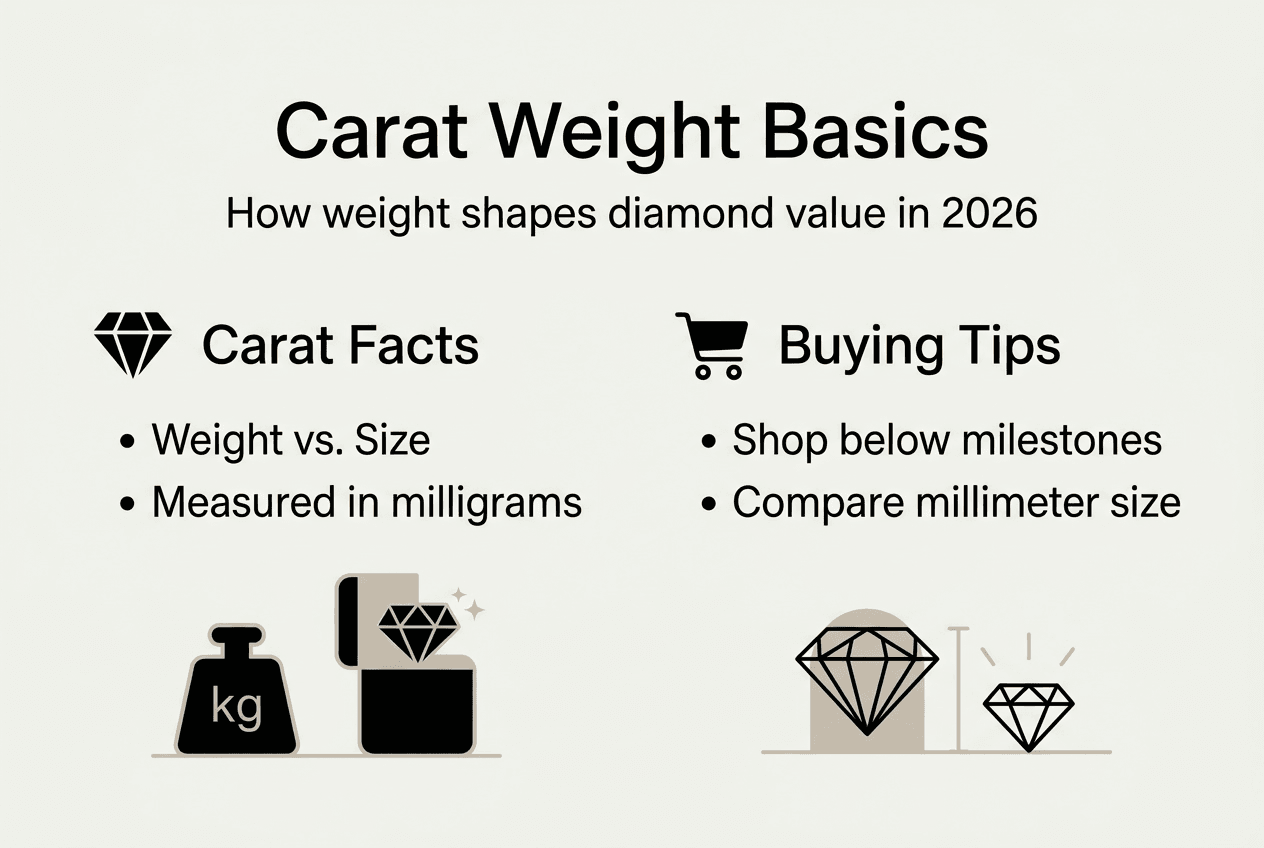
Pro Tip: Measure diamonds in millimeters for accurate size comparison, especially when comparing different shapes at similar carat weights.
How carat weight affects diamond pricing: the non-linear relationship
Diamond pricing follows an exponential curve rather than a linear progression. A 2-carat diamond costs four to five times more than a 1-carat stone of comparable quality, not simply twice the price. This dramatic increase reflects the rarity of finding larger rough diamonds suitable for cutting and the exponentially higher demand for statement pieces.
Milestone carat weights create sharp price jumps that savvy buyers can navigate strategically. The market assigns premium value to psychologically significant weights:
- 0.50 carats marks the entry point for many engagement rings
- 1.00 carat represents a major prestige threshold
- 2.00 carats enters luxury territory with exponential rarity pricing
- 3.00 carats and above become investment-grade pieces
A 0.95-carat diamond appears virtually identical to a 1.00-carat stone when set, yet costs significantly less due to falling just below the milestone. Larger natural diamonds command three to four times higher prices than smaller ones because substantial rough material meeting quality standards becomes increasingly scarce.
The following table illustrates approximate price ranges for round brilliant diamonds with excellent cut, G color, and VS2 clarity:
| Carat Weight | Price Range | Price per Carat |
|---|---|---|
| 0.50 ct | $1,200-$1,800 | $2,400-$3,600 |
| 0.90 ct | $3,200-$4,500 | $3,555-$5,000 |
| 1.00 ct | $4,500-$6,500 | $4,500-$6,500 |
| 1.50 ct | $9,000-$13,500 | $6,000-$9,000 |
| 2.00 ct | $18,000-$28,000 | $9,000-$14,000 |
These figures demonstrate how price per carat escalates dramatically as total weight increases. The rarity factor compounds the base material cost, creating steep curves at popular weights.
Pro Tip: Target diamonds 5-10% below milestone weights to capture significant savings while maintaining visual impact indistinguishable to the naked eye.
The interplay of carat with cut, clarity, and color in determining diamond value
Carat weight represents just one component of diamond valuation. Cut, color, and clarity influence how large a diamond appears and significantly affect its market value alongside mass. A perfectly cut 0.90-carat diamond with excellent proportions often outperforms a poorly cut 1.10-carat stone in both brilliance and perceived size.
Cut quality determines how effectively a diamond returns light to your eye. Ideal proportions create maximum sparkle and can make a stone appear 10-15% larger than its actual measurements suggest. Shallow or deep cuts leak light through the pavilion, reducing brilliance and making the diamond look smaller and duller. The diamond clarity impact becomes more visible in larger carat weights, where inclusions occupy more surface area.
Color grading interacts with carat weight in subtle ways. Larger diamonds show more color than smaller ones because there’s more material for light to travel through. A K-color grade might appear nearly colorless in a 0.50-carat stone but display noticeable warmth in a 2.00-carat diamond. This relationship affects pricing strategies:
- Smaller diamonds (under 1 carat) tolerate lower color grades without obvious tint
- Larger stones (over 1.5 carats) benefit from higher color grades to maintain white appearance
- Fancy shapes like emerald and Asscher cuts reveal color more readily than brilliant cuts
The following comparison shows how balancing the 4Cs creates different value propositions:
| Scenario | Carat | Cut | Color | Clarity | Approximate Price | Best For |
|---|---|---|---|---|---|---|
| Maximum Sparkle | 0.90 ct | Ideal | G | VS2 | $4,200 | Brilliance priority |
| Size Focus | 1.10 ct | Good | J | SI1 | $4,500 | Larger appearance |
| Balanced Quality | 1.00 ct | Excellent | H | VS1 | $5,800 | Overall excellence |
Clarity becomes increasingly important as carat weight rises. Inclusions barely visible in a 0.50-carat stone may become eye-visible in a 2.00-carat diamond. Conversely, investing in flawless clarity for a 0.30-carat accent stone wastes budget that could improve cut or color instead.
The diamond cut importance cannot be overstated when maximizing value across all weights. An excellent cut grade transforms how light performs within the stone, creating the fire and scintillation that define diamond beauty. Choosing the right balance means understanding your priorities and how each factor contributes to the finished piece’s visual impact and long-term satisfaction.
Maximizing value: smart strategies for leveraging carat weight in diamond buying
Strategic carat selection delivers exceptional value without sacrificing visual impact. Diamonds just under milestone weights look similar but cost significantly less, offering the most effective way to stretch your budget. A 0.95-carat diamond set in a ring appears identical to a full 1.00-carat stone, yet saves 15-20% on purchase price.
Shape selection dramatically influences perceived size relative to actual carat weight. Elongated shapes maximize surface area and finger coverage:
- Marquise cuts appear up to 15% larger than round diamonds of equal weight
- Oval shapes provide 10% more surface area with elegant proportions
- Pear shapes combine size perception with unique character
- Emerald cuts emphasize length and sophistication over sparkle
Prioritizing cut quality ensures your diamond performs at its visual peak regardless of carat weight. An ideal cut grade maximizes brilliance and can make a stone appear substantially larger than a poorly cut heavier diamond. This principle holds true across all price points and represents the single most impactful decision for overall satisfaction.
Lab-grown diamonds revolutionize value propositions by offering identical optical and physical properties at fraction of natural diamond costs. These stones provide the same brilliance, hardness, and beauty while enabling buyers to afford larger carat weights or higher grades within budget. The lab grown diamonds collection includes certified options across all popular weights and quality levels.
Follow this systematic approach when evaluating diamonds:
- Determine your total budget and allocate percentages across the 4Cs based on priorities
- Target carat weights 5-10% below milestone numbers for maximum savings
- Never compromise below Excellent or Very Good cut grades regardless of other factors
- Select color grades appropriate for your metal choice and carat weight
- Choose clarity grades that ensure eye-clean appearance without overpaying for microscopic perfection
- Compare lab-grown alternatives to access higher quality or larger sizes within budget
Consider these engagement ring buying tips when finalizing your selection. Metal choice affects color perception, with platinum and white gold requiring higher color grades than yellow or rose gold settings. Halo designs and side stones enhance the center diamond’s apparent size, allowing smaller carat weights to create substantial visual impact.
Exploring various diamond shape options reveals how personal style preferences interact with technical specifications. Some shapes naturally complement specific hand sizes or ring styles, creating harmony between the diamond and wearer that transcends carat weight alone.
Discover your perfect diamond at SuperJeweler
Finding a diamond that balances quality, size, and value requires expertise and selection. SuperJeweler offers curated collections spanning every budget and style preference, from affordable engagement rings to premium statement pieces. Our inventory includes both natural and lab-grown diamonds certified by leading gemological laboratories, ensuring you receive verified quality regardless of carat weight.

Our 1 carat radiant diamond rings showcase how strategic carat selection combines with exceptional cut quality to create stunning pieces at accessible prices. Each diamond undergoes rigorous evaluation across all 4Cs, with detailed specifications available to inform your decision. Free shipping worldwide and comprehensive warranties protect your investment while expert guidance helps you navigate the relationship between carat weight and overall value to find your ideal match.
FAQ
What is the difference between carat weight and diamond size?
Carat measures a diamond’s weight in 200-milligram units, not its physical dimensions or visual appearance. Two diamonds with identical carat weights can look dramatically different in size depending on their cut proportions and shape. A shallow-cut stone spreads weight across a larger surface area, appearing bigger than a deep-cut diamond of equal mass.
Why do diamond prices jump at certain carat weights?
Milestone weights like 0.5, 1.0, and 2.0 carats trigger sharp price increases due to psychological demand and natural rarity. Larger rough diamonds suitable for cutting become exponentially scarcer as weight increases. The market assigns premium value to these round numbers, creating price gaps that buyers can exploit by selecting stones just below thresholds.
Can a smaller carat diamond look bigger than a heavier one?
Yes, cut quality and shape dramatically influence perceived size independent of actual weight. An excellently cut 0.90-carat diamond with ideal proportions often appears larger and more brilliant than a poorly cut 1.10-carat stone. Elongated shapes like oval and marquise maximize surface area, creating greater visual impact than round diamonds of equal mass.
How do lab-grown diamonds compare in price and value to natural diamonds?
Lab-grown diamonds cost 60-80% less than natural counterparts while offering identical optical properties, hardness, and chemical composition. Leading gemological laboratories certify both types using the same grading standards for cut, color, clarity, and carat. This price difference allows buyers to afford larger carat weights or higher quality grades within the same budget, making lab-grown options increasingly popular for engagement rings and fine jewelry.
Recommended
- Role of cut in diamond quality: maximize sparkle in 2026
- Diamond necklace buying tips: quality & value in 2026
- 2.4karatgold | SuperJeweler
- Diamond Clarity – How It Impacts Ring Value
