TL;DR:
- Neckline and occasion determine the ideal diamond necklace style and length.
- Effective layering involves 2 to 4 necklaces with varying lengths and complementary textures.
- Confidence and intentionality are more important than strict adherence to styling rules.
You’re standing in front of the mirror, a stunning diamond necklace in hand, and suddenly you’re stuck. Does it pair with this neckline? Is it too much for a Tuesday? Too little for a gala? That moment of hesitation is something most jewelry lovers know well. The right diamond necklace can completely transform an outfit, adding polish, personality, and a sense of intention that plain accessories rarely achieve. This guide walks you through everything: the foundational rules, occasion-specific choices, layering techniques, and finishing details that turn a great piece into a truly unforgettable look.
Table of Contents
- Understand the essentials: Necklines, lengths, and core principles
- Choose the right necklace for every occasion
- Master the art of layering and mixing styles
- Expert finishing touches: Settings, shapes, and jewelry coordination
- Our perspective: Why diamond necklace styling is about intention, not rules
- Enhance your style with exclusive diamond necklaces
- Frequently asked questions
Key Takeaways
| Point | Details |
|---|---|
| Neckline determines the best necklace | Always match your diamond necklace length and style to your outfit’s neckline for the most flattering look. |
| Occasion guides style selection | Casual, formal, and trendy occasions each call for different diamond necklace designs and carat scales. |
| Layer with intention | Use 2-4 necklaces of different lengths and textures, leaving gaps for a chic, balanced appearance. |
| Balance is key | Bold diamond necklaces look best when paired with minimal earrings and simple accessories. |
| Confidence beats rules | Make your own style statement by applying guidelines—and breaking them—for impact and individuality. |
Understand the essentials: Necklines, lengths, and core principles
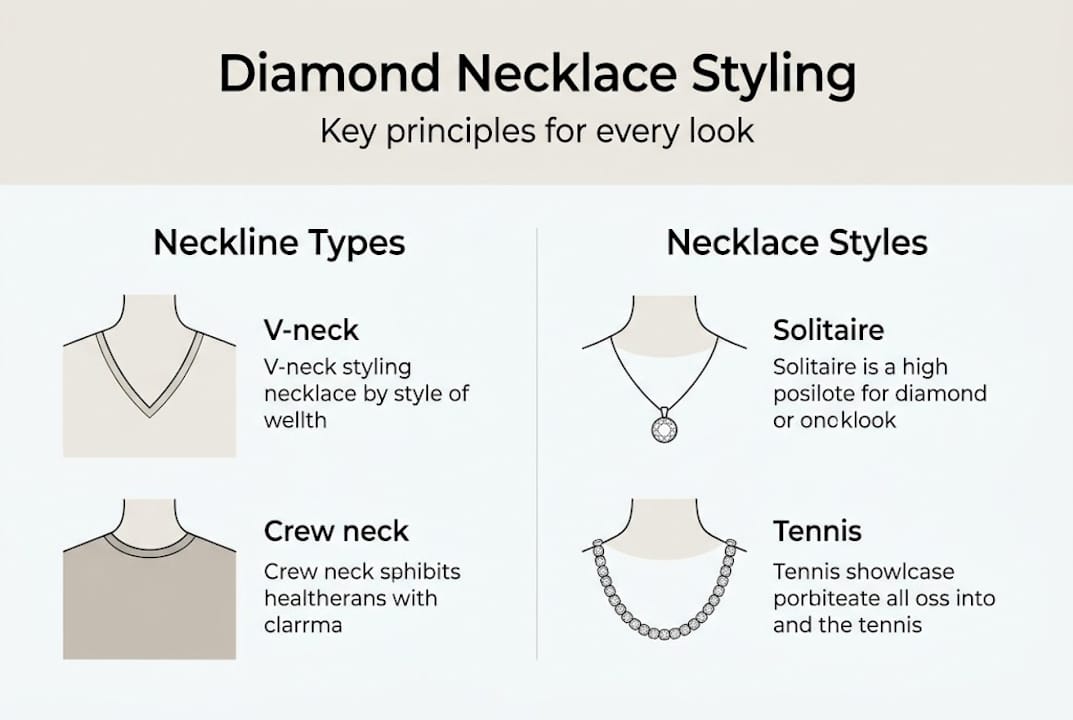
Before you open your jewelry box, it helps to understand what actually drives good necklace styling. The answer is simpler than most people expect. According to core necklace methodology, neckline dictates style and length first, and then occasion scales the brilliance. Start there, and every other decision gets easier.
Necklace length changes how a piece sits on the body and how it interacts with your outfit. Here’s a quick reference table:
| Length name | Measurement | Best necklines |
|---|---|---|
| Choker | 14–16 inches | Off-shoulder, tank tops, square necks |
| Princess | 17–19 inches | V-neck, crew neck, scoop neck |
| Matinee | 20–24 inches | High neck, turtleneck, button-up |
| Opera | 28–36 inches | Deep V, strapless, formal gowns |
These necklace length standards are widely accepted in the styling world, and they give you a smart starting point every single time.
Beyond length, you also need to understand the main diamond necklace styles so you can match them to your look. The most popular include:
- Solitaire pendant: One diamond, clean and classic. Works for almost any occasion.
- Tennis necklace: A continuous line of diamonds. Formal and striking.
- Halo pendant: A center stone surrounded by smaller diamonds. Adds visual weight and drama.
- Diamonds by the yard: Subtle diamonds spaced along a delicate chain. Great for everyday layering.
- Cluster or statement pendant: Multiple diamonds grouped together. Bold and fashion-forward.
Each style speaks a different visual language. A solitaire whispers quiet elegance. A tennis necklace commands a room. Knowing the types of diamond necklaces available means you’re never guessing.
Pro Tip: When you try on a necklace, step back and look at proportion. A delicate pendant can disappear against a busy neckline, while a bold piece on a simple top creates instant impact. Let the necklace breathe.
Choose the right necklace for every occasion
Once you’ve grasped the basics, you can confidently transition to choosing the most flattering necklace for any event or outfit. The key is matching the scale and sparkle of your diamond piece to the energy of the occasion.
Experts recommend matching necklace style to occasion this way: a dainty solitaire pendant for casual outfits, a statement tennis or halo necklace for formal events, a bezel-set 1-carat piece for daily wear, and creative layering for street style.

Here’s a comparison table to make it concrete:
| Occasion | Ideal necklace style | Suggested carat range |
|---|---|---|
| Casual (jeans, tee) | Delicate solitaire or diamonds by the yard | 0.10–0.25 ct |
| Workplace | Bezel pendant or simple princess chain | 0.25–0.50 ct |
| Formal event | Tennis necklace or halo pendant | 0.75 ct and up |
| Street style | Layered mixed styles | Varies |
To build a go-to game plan, follow these steps:
- Identify the setting. Is this a daytime errand run or a black-tie dinner? The stakes shape the sparkle.
- Pick your outfit first. The clothing sets the tone. Your necklace follows, not the other way around.
- Match energy levels. Quiet luxury calls for a solo pendant. A bold maximalist moment calls for layering.
- Consider your frame. Petite builds tend to look best with shorter lengths and smaller stones that don’t overwhelm.
- Let one piece lead. If your outfit is minimal, your necklace can be bold. If your outfit is detailed, keep the necklace simple.
For everyday elegance with genuine brilliance, diamond tennis necklace styles offer remarkable versatility. And if budget flexibility matters, lab grown options deliver identical sparkle at a more accessible price point.
Master the art of layering and mixing styles
With your occasion and focal piece in mind, the next step is mastering the art of chic and balanced necklace layering. Done right, it looks intentional and effortless. Done wrong, it looks cluttered.
The golden rule: layer 2 to 4 necklaces with varying lengths between 15 and 24 inches, start with an anchor piece, leave roughly 2-inch gaps between each layer, mix textures, and avoid busy patterned necklines.
Here’s a step-by-step layering guide:
- Choose your anchor. This is your longest, most substantial piece. It grounds everything else.
- Add a mid-length piece. Something 2 to 3 inches shorter than the anchor. A delicate pendant works beautifully here.
- Introduce your shortest layer. A choker or princess-length chain sits closest to the neck and frames the collarbone.
- Step back and check for breathing room. Each layer needs visible space. Crowding kills the effect.
- Adjust and secure. Use an extender chain if one necklace needs more length. Clasp placement can also shift the balance.
Pro Tip: For formal layering, keep it to 2 or 3 pieces and stick to similar metal tones. For casual looks, try mixing gold and silver for a more editorial feel.
Mixing styles adds dimension. Consider pairing a bold diamond initial necklace as your anchor with a fine chain featuring a tiny pendant above it. Or stack a diamond cross at mid-length with a delicate diamonds-by-the-yard chain at collarbone level.
Common layering mistakes to avoid:
- Overcrowding: More is not always more. Limit yourself to 4 pieces maximum.
- Clashing shapes: A very geometric pendant paired with another angular piece creates visual noise.
- Patterned necklines: Busy prints or textured fabrics compete with layered necklaces. Choose one focus.
- Ignoring pendant size: A massive pendant can get tangled with shorter chains.
Exploring fashion necklaces in different textures and styles is a great way to experiment with layering combinations before committing to a final look.
Expert finishing touches: Settings, shapes, and jewelry coordination
Once you’ve created your base and layered with intention, a few expert choices can take your look from good to unforgettable. The details really do matter at this stage.
Diamond shape changes the entire mood of a necklace. Round diamonds are timeless and send the most light back to the eye, making them ideal for formal events. Pear-shaped diamonds offer a slightly romantic, elongated silhouette that flatters the neckline beautifully. Checking out 2026 diamond shape trends gives you a feel for what’s resonating right now across different styles.
Settings also shift the vibe significantly:
- Bezel setting: Modern and sleek. Great for active lifestyles and everyday wear.
- Prong setting: Classic and open. Maximum light exposure for brilliant sparkle.
- Halo setting: Glamorous and bold. Makes the center stone look larger.
“Let one piece be the star. A bold diamond necklace demands understated earrings. A dramatic pair of earrings deserves a quieter necklace.”
When coordinating fashion earrings with your necklace, balance is the word to live by. Balancing jewelry intentionally means: bold necklace pairs with minimal earrings, while dramatic earrings pair with a simple chain or no necklace at all.
Common finishing mistakes:
- Doubling up on statement pieces. Two bold items compete instead of complement.
- Ignoring outfit tone. A glittering formal necklace against a relaxed linen outfit sends mixed signals.
- Forgetting the neckline. Even the most beautiful necklace looks off if it fights the cut of your collar.
- Overlooking metal matching. While mixing metals intentionally can look great, accidental mismatches look unplanned.
Pro Tip: Before leaving the house, remove one piece of jewelry. If the look still works, that last item was probably extra. Restraint is its own kind of style.
And remember: there is no styling difference between lab-grown and natural diamonds. Choose freely based on what speaks to your taste and budget.
Our perspective: Why diamond necklace styling is about intention, not rules
We’ve worked with thousands of jewelry lovers, and there’s one pattern we keep seeing: people who look the most put-together aren’t always following every rule. They’re wearing their pieces with conviction. That’s the real secret.
Some style voices advocate for minimal solo pendants. Others push bold layering as the only way to look modern. The truth, as noted in balanced styling perspectives, is that contrasting views exist for a reason. Balance is personal.
The biggest mistake isn’t choosing the wrong necklace length. It’s being afraid to experiment. Rules are useful tools, not limits. A choker on a high-neck top technically breaks the guidelines, but if you love it and wear it with confidence, it works. Style always has room for that.
We encourage you to treat the guidelines in this article as a launching pad. Learn them, internalize them, and then play. Browse fashionable necklaces and try combinations that feel right to you, even if they bend the rules a little. Intention always reads as style.
Enhance your style with exclusive diamond necklaces
Ready to elevate your jewelry wardrobe and put these tips into action? SuperJeweler offers everything you need to build a collection that works for every mood and moment.

From timeless solitaire pendants to modern tennis necklaces, SuperJeweler’s selection covers every style and occasion. Explore the lab grown diamond collection for stunning brilliance at a price that makes experimenting with your look genuinely fun. If you want something truly one-of-a-kind, check out our personalized diamond necklaces for custom options that reflect your unique taste. With free worldwide shipping and flexible return policies, there’s no risk in exploring what works for you.
Frequently asked questions
What necklace length flatters most necklines?
Princess length, 17 to 19 inches, is the most versatile option and works beautifully with V-necks, crew necks, and scoop necklines, offering a balanced and elegant finish.
How many necklaces should I layer for a stylish look?
Aim for 2 to 3 necklaces for formal outfits and 3 to 4 for casual looks, always varying their lengths and leaving at least 2 inches of space between each piece.
Are lab-grown and natural diamond necklaces styled differently?
There is no styling difference between lab-grown and natural diamond necklaces. Choose whichever fits your personal taste and budget without any concern about how it will look.
How do I balance a bold diamond necklace with other jewelry?
Keep everything else minimal. A bold necklace pairs best with subtle stud earrings or a delicate bracelet so your centerpiece gets the full spotlight.
Recommended
- Diamond Necklace Terminology: What Every Buyer Should Know
- Diamond Trends 2026: Styles, Shapes & Smart Choices
- Shop Perfect Diamond Tennis Necklace At Amazing Prices | SuperJeweler
- designer-styles
