TL;DR:
- Gemstone prices depend heavily on origin, quality, and treatment, not just appearance or size.
- Certified, untreated stones from prestigious locations command significantly higher prices and better value.
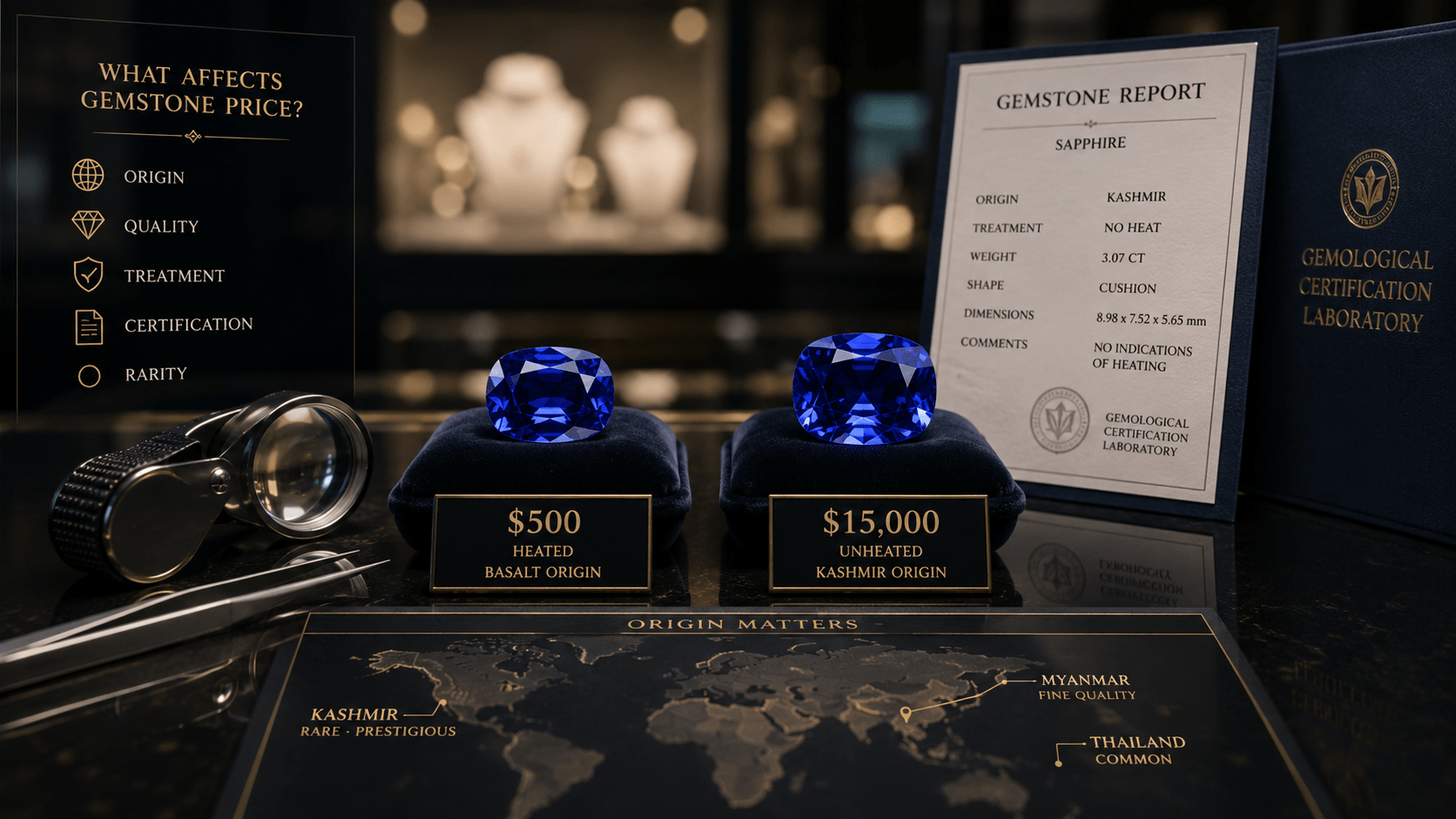
Shoppers are often surprised to find two stones that look almost identical sitting at wildly different price points. One sapphire costs $500, another $15,000, and both are blue. The truth is, gemstone pricing is driven by a layered system of factors that have nothing to do with how brilliant something looks in a jewelry case. Understanding those factors is the single most powerful thing you can do before spending money on a gemstone, whether it’s a casual birthday gift or a once-in-a-lifetime engagement ring.
Table of Contents
- The main factors that affect gemstone price
- Why origin makes such a difference
- Certification and gem treatments: what adds real value
- Investment vs. beauty: practical advice for buyers
- What most buyers overlook about gemstone value
- Find the best gemstone jewelry for your budget
- Frequently asked questions
Key Takeaways
| Point | Details |
|---|---|
| Origin premium | Gems from famous locations can cost up to 10-15 times more than similar stones from lesser-known origins. |
| Certification matters | Certification by trusted labs verifies quality and boosts both price and buyer confidence. |
| Treatment impacts value | Untreated stones often hold greater value and investment appeal but are rarer and more expensive. |
| Not all gems appreciate | Only the highest quality, untreated gems from top sources tend to hold or increase value over time. |
| Buy for intent | Choose gems that fit your purpose, whether for beauty or future value, and trust your preferences as much as the market. |
The main factors that affect gemstone price
Most buyers start by looking at size. That’s understandable, but size is just one variable in a long equation. Gemologists and traders evaluate stones on a cluster of attributes that interact with each other in complex ways.
Color, clarity, cut, and carat are the foundation. You’ve likely heard of the four Cs in the context of diamonds, but they apply broadly to colored gemstones too. For rubies, sapphires, and emeralds, color carries the most weight. A deeply saturated, evenly distributed hue with no visible zoning commands a dramatic premium over a washed-out or uneven stone of the same size. Clarity matters too, but the thresholds differ by stone type. Emeralds, for example, are expected to have inclusions (called “jardins”), so eye-clean emeralds are exceptionally rare and priced accordingly. You can learn more about what to look for in our detailed gemstone clarity guide.
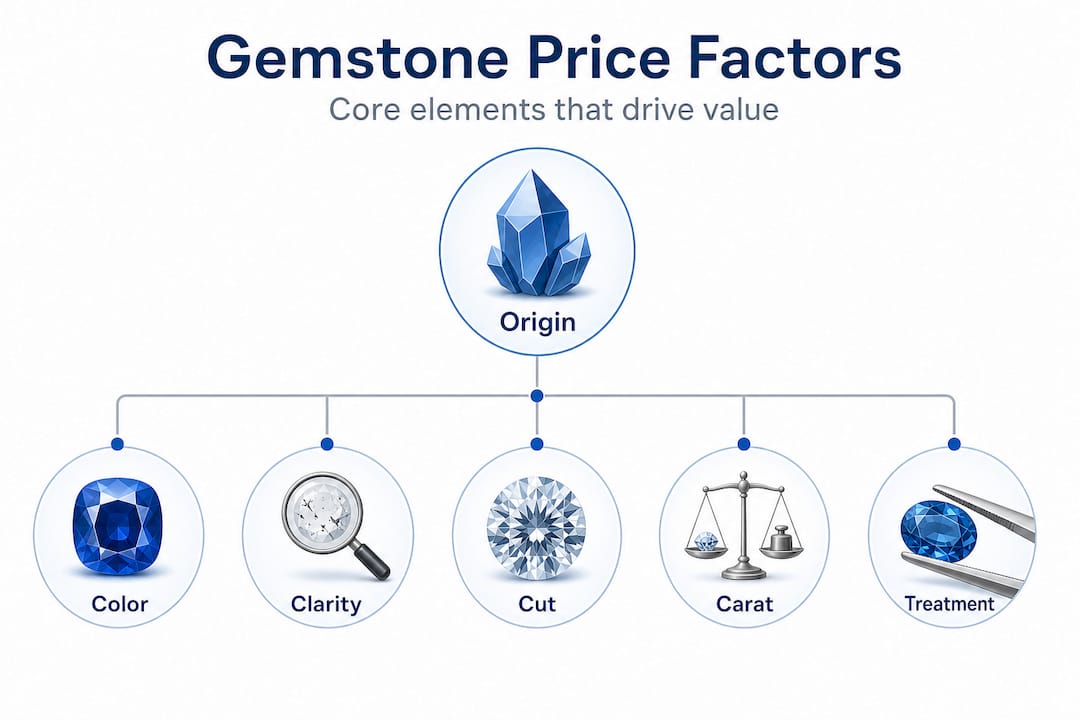
Cut is often underestimated. A well-cut stone maximizes light return, creating that vivid, lively color that catches your eye. A poorly cut stone of the same color grade looks dull and flat, even if it technically scores the same on paper. Carat weight increases value exponentially, not linearly. A 2-carat ruby is far more than twice the price of a 1-carat ruby because large specimens are disproportionately rare.
Origin acts as a powerful multiplier on all of those base attributes. Gems from famed mining locations like Kashmir, Burma, and Colombia carry an origin premium up to 10-15x higher compared to similar-quality stones from less prestigious sources.
Treatment status is another huge price driver. The vast majority of gemstones on the market have been treated in some way, through heat, fracture filling, or dyeing. Untreated stones are significantly rarer and fetch considerably higher prices when certified.
| Factor | Lower price impact | Higher price impact |
|---|---|---|
| Color | Pale, uneven, or off-hue | Vivid, saturated, evenly distributed |
| Clarity | Many visible inclusions | Eye-clean or slightly included |
| Cut | Windowed, poorly proportioned | Well-faceted, maximum brilliance |
| Carat | Under 1 carat | Over 2 carats (exponential jump) |
| Origin | Commercial mining regions | Kashmir, Burma, Colombia |
| Treatment | Heated, filled, or dyed | No treatment, certified |
Here’s a practical breakdown of how these factors stack against each other:
- A treated ruby from a commercial source will always cost less than an untreated Burmese ruby of the same carat weight, even if the color looks identical to the naked eye.
- Two sapphires with the same clarity grade can differ by thousands of dollars if one is from Kashmir and one is from Thailand.
- An emerald without fracture filling is so rare it commands a premium of 50% or more over a filled stone of matching appearance.
Pro Tip: Don’t get too caught up chasing a prestigious origin if the actual stone quality is mediocre. A beautiful, well-cut blue sapphire from Madagascar with excellent color and no treatment can outperform a lackluster Kashmir stone at a fraction of the price. Shop with your eyes first, then verify the paperwork.
When you’re ready to see these factors in action on real pieces, explore gemstone rings with full stone details listed so you can compare firsthand.
Why origin makes such a difference
Geographic origin is the factor that surprises buyers the most. Two rubies that look visually similar under the same lighting conditions can be separated by a price gap that seems almost irrational, until you understand what origin actually means in the gem trade.
The “origin premium” exists because certain mining regions produce stones with distinct geological characteristics that result in superior color, fluorescence, or optical properties. Kashmir sapphires, mined in a remote Himalayan region of India, display a velvety blue that no other deposit has ever fully replicated. Burmese rubies from the Mogok Valley carry a vivid “pigeon blood” red with strong fluorescence that makes them glow under sunlight. Colombian emeralds have a warm, slightly yellowish-green hue with a depth and warmth not found in stones from Zambia or Brazil.
“Gems from famed locations like Kashmir sapphires, Burmese rubies, and Colombian emeralds command premiums that can reach 10 to 15 times the price of a comparable stone from a different source.”
These deposits are also exhausted or nearly inaccessible today, which adds scarcity on top of prestige. Kashmir sapphire mining has been essentially inactive for decades. That combination of geological uniqueness and limited supply drives prices to extraordinary levels.
Here’s a simplified comparison to put the origin premium in perspective:
| Gemstone | Origin | Relative price per carat (indicative) |
|---|---|---|
| Ruby | Thailand or Africa | $500–$2,000 |
| Ruby | Mogok, Burma (untreated) | $5,000–$30,000+ |
| Sapphire | Australia or Madagascar | $300–$1,500 |
| Sapphire | Kashmir (untreated) | $10,000–$50,000+ |
| Emerald | Zambia | $500–$2,500 |
| Emerald | Muzo, Colombia (untreated) | $3,000–$20,000+ |
How do you spot genuine origin vs. marketing hype? The only way to confirm origin is through a report from a reputable gemological laboratory. Any seller claiming “Burma origin” or “Kashmir origin” without third-party documentation is simply marketing, not making a verifiable claim. For buyers interested in vivid pink stones with these premiums in mind, browsing pink gemstones from premium origins gives you a real-world sense of what’s available at different price levels. If you’re drawn to sapphires specifically, the blue gemstone selection is a great place to compare qualities side by side.
Key signals to watch for when evaluating origin claims:
- Always ask for a third-party lab certificate before paying an origin premium.
- Understand that origin enhances value only when paired with top-quality attributes like color and clarity.
- Be skeptical of vague claims like “possibly Kashmir quality,” which has no formal meaning.
Certification and gem treatments: what adds real value
Beyond the stone itself, paperwork plays a surprising role in what you actually pay and what you get for your money.
A gemological certificate is essentially a stone’s biography. It records carat weight, dimensions, color grade, clarity observations, country of origin, and critically, whether any treatments were applied. The most respected labs in the world for colored stones include GIA (Gemological Institute of America), SSEF (Swiss Gemmological Institute), and Gübelin. For diamonds, GIA and AGS certifications verify quality, origin, and treatments, serving as the gold standard that buyers and sellers both trust.
Here’s how to read a certificate report when you receive one:
- Confirm the stone identity. The report should name the stone species (e.g., corundum for sapphire or ruby) and variety.
- Check for treatment disclosures. Look for language like “no indications of heating” or “clarity enhancement detected.” These phrases directly affect value.
- Review the origin statement. This will be listed as a probability or confirmation, depending on the lab’s confidence level.
- Match the report to the stone. Every GIA report has a unique report number. Scan the QR code or check the number on the lab’s website to verify authenticity.
- Note the date. An older certificate (10+ years) on a stone being sold today may not reflect current grading standards. A regrade is sometimes worth the investment.
Treatments dramatically change market pricing. A heat-treated sapphire typically sells for 30% to 60% less than a no-heat stone of identical visual quality. Fracture-filled emeralds can be beautiful and durable but carry significant discounts compared to untreated stones. Understanding diamond and gemstone certification means you can decode these reports with confidence instead of taking a seller’s word for it. For a step-by-step approach, the guide on verifying gemstone quality walks you through the full process.
Pro Tip: A reputable seller will hand over a lab report without hesitation. If there’s resistance, deflection, or a vague mention of “in-house grading,” that’s a red flag worth taking seriously. The cost of an independent appraisal before purchase is minimal compared to the risk of overpaying for a treated stone priced as untreated.
Investment vs. beauty: practical advice for buyers
A lot of shoppers want to know whether gemstones are a good investment. The honest answer is complicated, and how you approach it should depend on why you’re buying in the first place.
Investment-grade gemstones are a real category. Top-quality untreated rubies, sapphires, and emeralds from prestige origins have shown strong value retention over decades. But high-quality untreated gems hold value best while remaining illiquid, meaning you can’t sell them quickly the way you’d sell a stock. Finding a buyer who will pay full market value for a premium gemstone takes time, specialized auction exposure, and often significant transaction fees.
Compare that to buying an amethyst. A gorgeous purple amethyst might be beautiful and extremely wearable, but amethyst rarely appreciates as an investment because large, high-quality specimens are relatively abundant. Browse amethyst jewelry examples to see just how accessible they are at all price points. That accessibility is great for buyers who want beauty on a budget, but it signals a very different value trajectory than a fine ruby.
| Gemstone | 10-year value trend (indicative) | Liquidity |
|---|---|---|
| Untreated Burmese ruby | Strong upward trend | Low (specialist market) |
| Kashmir sapphire | Strong upward trend | Low (specialist market) |
| Colombian emerald (untreated) | Moderate upward trend | Low to moderate |
| Heat-treated sapphire | Stable to moderate | Moderate |
| Amethyst | Flat to minimal growth | High (widely available) |
Practical advice for aligning your goals with the right stone:
- Buying for personal enjoyment? Prioritize color, wearability, and budget. A treated sapphire in a gorgeous cut at a fair price will give you daily joy without the stress of investment-grade documentation.
- Buying as a long-term store of value? Only consider untreated stones from prestige origins with full lab reports from top-tier labs. Budget accordingly, and expect to hold for years.
- Buying as a gift? Focus on meaning and beauty. The emotional resonance of a birthstone or a meaningful color outweighs investment logic in almost every gifting context.
What most buyers overlook about gemstone value
Here’s something worth saying plainly: most buyers walk into gemstone shopping with their brains switched into investment mode, and that framing causes more bad decisions than any lack of technical knowledge.
We’ve seen buyers skip over genuinely stunning, well-priced sapphires because they weren’t from Kashmir, or pass on a beautiful Colombian emerald because it had been gently treated. They’re chasing a version of “investment-grade” that’s really only relevant to buyers spending six figures at auction, not shopping for jewelry they plan to wear and love.
The real risk for everyday buyers isn’t missing an investment opportunity. It’s overpaying for a story instead of a stone. An origin certificate is valuable documentation, but it doesn’t make a dull, poorly cut stone beautiful. And a beautiful, lively, eye-catching stone that makes you gasp a little when you see it? That’s not something a price chart can measure.
That said, we’re not dismissing documentation. Certification is non-negotiable. A trustworthy seller should always provide a third-party lab report, especially at higher price points. Unique gemstone rings backed by clear stone information let you shop with both confidence and excitement. The point is simply this: the gem that genuinely moves you, the one that you keep coming back to look at, with solid documentation behind it, is almost always the right buy.
The true value of gemstones is never purely financial. Buyers who treat personal jewelry like a commodity investment often end up owning stones they don’t connect with, sitting in a safe instead of living on a hand. Balance your head with your heart, and let documentation be the guardrail, not the whole decision.
Find the best gemstone jewelry for your budget
Ready to explore beautiful and fairly priced stones? Here’s where to find the best options for your next jewelry purchase.

At SuperJeweler.com, the gemstone collections are built for exactly the buyer who just finished reading this guide: someone who understands value, wants transparency, and isn’t willing to compromise on beauty. Whether you’re starting with a budget or looking for something extraordinary, you’ll find browse gemstone rings with stone type and quality details clearly listed. For buyers who want maximum beauty without stretching the budget, our affordable engagement rings offer real value with no guesswork. If sapphires and aquamarines caught your attention in this guide, the blue gemstone selection gives you a curated range with free worldwide shipping and trusted return policies on every order.
Frequently asked questions
Can two gemstones that look nearly identical have vastly different prices?
Yes, similar-looking gems can differ greatly in price due to factors like origin, treatment status, and certification. As the origin premium data confirms, gems from Kashmir or Burma can cost 10 to 15 times more than visually comparable stones from other regions.
Does a gemstone’s country of origin always guarantee quality or value?
No, while certain origins are prized, other quality factors like clarity, cut, and color can outweigh country of origin for individual stones. A beautifully cut, untreated sapphire from Madagascar can outperform a dull Kashmir stone of lower quality.
What certification should I look for when buying a gemstone?
Look for certifications from trusted labs like GIA, AGS, or SSEF, which verify quality, origin, and treatments with rigorous, standardized grading methods. These reports are the most reliable way to confirm what you’re actually buying.
Do all gemstones increase in value over time?
No, only top-quality untreated gems from premium origins tend to hold or appreciate. Stones like amethyst rarely see appreciation because large, high-quality specimens remain widely available in the global market.
Recommended
- Gemstone clarity guide: essential tips for jewelry buyers
- Gemstone Rings | SuperJeweler
- Blue Gemstones: Ocean-Inspired Beauty
- Gemstone Clarity Explained: How to Choose Flawless Jewelry
