TL;DR:
- Buying jewelry without certification is risky because you lack independent proof of quality and value. Certification from reputable labs like GIA, IGI, or AGS ensures verified characteristics, protects your investment, and enhances resale and insurance prospects. Always verify certifications through official lab databases and ensure physical details match the report before purchasing.
Buying an engagement ring or fine jewelry piece without a proper certification is a bit like buying a used car with no service history. The jewel may look stunning in the case, and the salesperson might sound completely convincing, but you have no independent proof of what you’re actually getting. Certified diamonds sell for 15-25% more on resale than uncertified stones, and the difference in confidence between a certified and uncertified purchase is even greater. This guide breaks down exactly what certifications mean, which ones matter most, and how to use them to protect your money and your peace of mind.
Table of Contents
- What does jewelry certification mean?
- Breaking down the major diamond grading labs
- Why certifications protect your jewelry investment
- How to verify a jewelry certificate before you buy
- Beyond diamonds: Metals and colored gems
- Why conventional wisdom on jewelry certification falls short
- Find certified jewelry you can trust
- Frequently asked questions
Key Takeaways
| Point | Details |
|---|---|
| Certification boosts value | Jewelry and diamonds with proper certification can be resold for significantly more and are trusted by insurers. |
| Lab reputation matters | Who certifies your gem—the lab’s process and reputation—matters more than just having a certificate. |
| Always verify certificates | Check certificate numbers directly with the issuing lab to protect against counterfeits and fraud. |
| Metals need hallmarks too | Gold and platinum jewelry should bear purity hallmarks to ensure authenticity and resale value. |
| Certification is not enough | Assess visual quality and craftsmanship alongside paperwork for a smart jewelry purchase. |
What does jewelry certification mean?
Understanding why certifications matter starts with knowing what they actually are and the forms they take.
A jewelry certification is an independent, third-party evaluation of a gemstone or precious metal. It’s not a store’s opinion or an internal assessment. It is a formal document issued by a specialized laboratory that uses scientific tools, trained gemologists, and standardized processes to evaluate quality characteristics. These characteristics include the four Cs of diamonds (cut, color, clarity, and carat weight), as well as metal purity grades for gold and platinum.
Certification covers several categories of jewelry:
- Diamonds: The most commonly certified gemstones, evaluated on cut, color, clarity, and carat weight
- Colored gemstones: Rubies, sapphires, and emeralds can be assessed for origin, treatment, and quality
- Gold jewelry: Evaluated through hallmarking for metal purity, such as 14k or 18k ratings
- Platinum: Hallmarked to confirm purity levels, often noted as PT950 or PT900
What diamond certification means goes beyond a stamp of approval. The GIA (Gemological Institute of America) uses anonymous handling, multiple graders for consensus on the four Cs, scientific instruments for authenticity testing, and detailed cut assessment with computer modeling combined with human observation. This layered process removes the potential for individual bias.
Metal hallmarks tell a parallel story. Hallmarks certify metal purity in gold and platinum, providing fraud protection and stronger resale value. A platinum ring marked PT950 is guaranteed to be 95% pure platinum. Without that mark, you only have the seller’s word.
“A jewelry certificate is not just paperwork. It is the one independent voice in a transaction between a seller who knows everything and a buyer who typically knows very little.”
This is the fundamental role certifications play: they level the information gap between buyer and seller, replacing assumption with verified fact.
Breaking down the major diamond grading labs
Now that you know what certification is, it’s key to look at who actually issues these industry-standard reports.
Three labs dominate diamond grading worldwide: the GIA, the IGI (International Gemological Institute), and the AGS (American Gem Society). Each uses rigorous processes, but they differ in structure, methodology, and the trust they command in the market.
| Lab | Founded | Structure | Grading Scale | Best known for |
|---|---|---|---|---|
| GIA | 1931 | Nonprofit | Alphabetical (D-Z) + FL-I3 | Natural diamond standard |
| IGI | 1975 | For-profit | Similar to GIA | Lab-grown diamonds |
| AGS | 1934 | Nonprofit | 0-10 numerical | Cut and light performance |
GIA is the originator of the modern four Cs grading system, and its nonprofit status means there is no financial incentive to inflate grades. GIA’s grading process uses anonymous stone handling so individual graders never know who owns the diamond, multiple graders must reach consensus, and advanced computer modeling is applied to assess cut performance. This makes GIA the gold standard for natural diamonds.
IGI grades both natural and lab-grown diamonds. IGI’s grading process uses calibrated scales, multiple independent graders for color and clarity consensus, 10x magnification for clarity evaluation, and ray-tracing software for cut light performance. IGI has become the leading certifier for lab-grown stones, where GIA is making growing inroads but IGI has the widest lab-grown catalog.
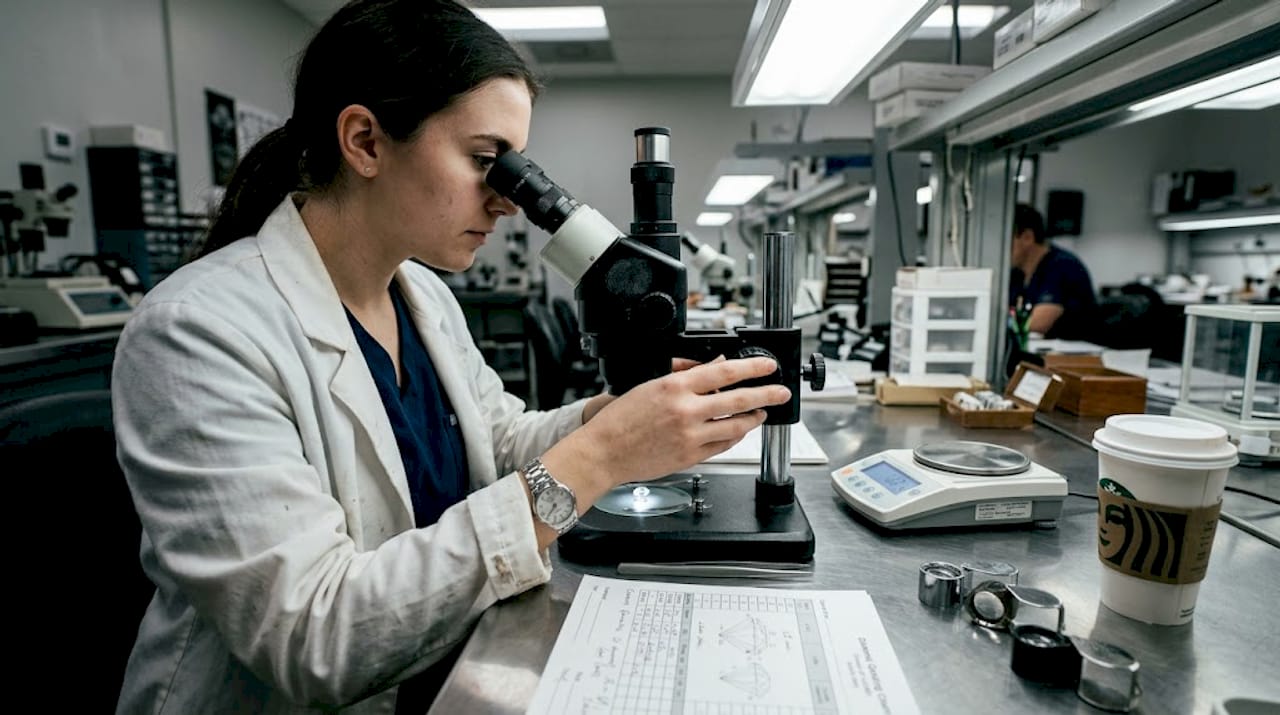
AGS uses a unique 0-10 numerical scale that places heavy emphasis on cut quality and light performance, with 0 as the ideal score. If you care deeply about how brilliantly a diamond sparkles, an AGS report gives you more granular cut data than most other labs.
Understanding how diamond grading works helps you interpret the numbers and letters on a report rather than just trusting they mean “good.” And if you’re weighing lab-grown vs natural diamond certification, the lab you prioritize may actually shift depending on which type of stone you choose.
Pro Tip: For natural diamonds, prioritize GIA certification. For lab-grown diamonds, IGI certificates are widely accepted and often offer greater selection at competitive price points.
Why certifications protect your jewelry investment
After examining the labs and their methods, let’s see what these certifications actually do for you as a buyer and owner.
The financial case for certified jewelry is clear and measurable. Certified diamonds command 15-25% more on resale than uncertified stones, and GIA-certified natural diamonds earn a 12-20% premium over IGI-certified equivalents for the same stone quality. That means the small cost of certification built into your purchase price comes back to you when it’s time to sell or upgrade.
Here are the four core ways certifications protect your investment:
- Verified quality at purchase: You know exactly what you’re buying. The grade on the certificate is independent of what the jeweler tells you.
- Stronger resale position: A certified diamond is easier to sell privately or to trade back because its quality is already established and documented.
- Insurance acceptance: Insurance companies often require a certified appraisal, but having a current lab certificate makes the insurer’s job easier and the coverage more accurate.
- Fraud prevention: Uncertified diamonds risk misrepresentation, lower resale prices, and problems with insurance claims. A forged or absent certificate is a major red flag.
| Scenario | With GIA certification | Without certification |
|---|---|---|
| Resale value | 15-25% premium | Buyer discount demanded |
| Insurance coverage | Accurate, straightforward | Requires independent appraisal |
| Fraud risk | Minimal | Significant |
| Buyer trust | High | Low to moderate |
Beyond the numbers, certifications carry emotional weight. When you hand someone an engagement ring and can say, “Here is the independent report that confirms every quality characteristic of this stone,” it adds a layer of meaning to the gift. It communicates that you took the purchase seriously and that the ring represents genuine quality, not just good marketing.
Learning more about why certified diamonds are valuable and reviewing the actual diamond resale value data can help you make a fully informed decision before you spend a significant amount of money.
How to verify a jewelry certificate before you buy
Knowing the benefits, your next essential step is ensuring any certificate is authentic and valid for the jewelry you’re considering.
Certificates can be faked, outdated, or attached to entirely different stones. Here is how to verify one properly before committing to a purchase:
- Get the full certificate number: Every legitimate lab report carries a unique report number, usually laser-inscribed on the girdle (the thin edge) of the diamond itself.
- Check the lab’s official database: Go directly to the certifying lab’s website. GIA, IGI, and AGS all offer free online lookup tools. Type in the report number and confirm the details match the stone you’re looking at.
- Match the physical description: The certificate lists exact measurements, weight, and identifying characteristics. If anything doesn’t match, that is a serious problem.
- Check physical security features: Authentic GIA reports include holograms, microprint lines, and security screens. Look for these in person or ask to see high-resolution scans.
- Ask for the laser inscription: Most certified diamonds have their report number inscribed on the girdle. A loupe (a small magnifying glass used to examine stones) or in-store microscope can confirm this.
Uncertified diamonds risk misrepresentation and insurance difficulties. Don’t skip verification even with reputable retailers. A trustworthy seller will always support your need to confirm.
A step-by-step diamond certificate verification guide walks you through this process in detail, and understanding how to identify quality for engagement rings will make you a sharper, more confident buyer.
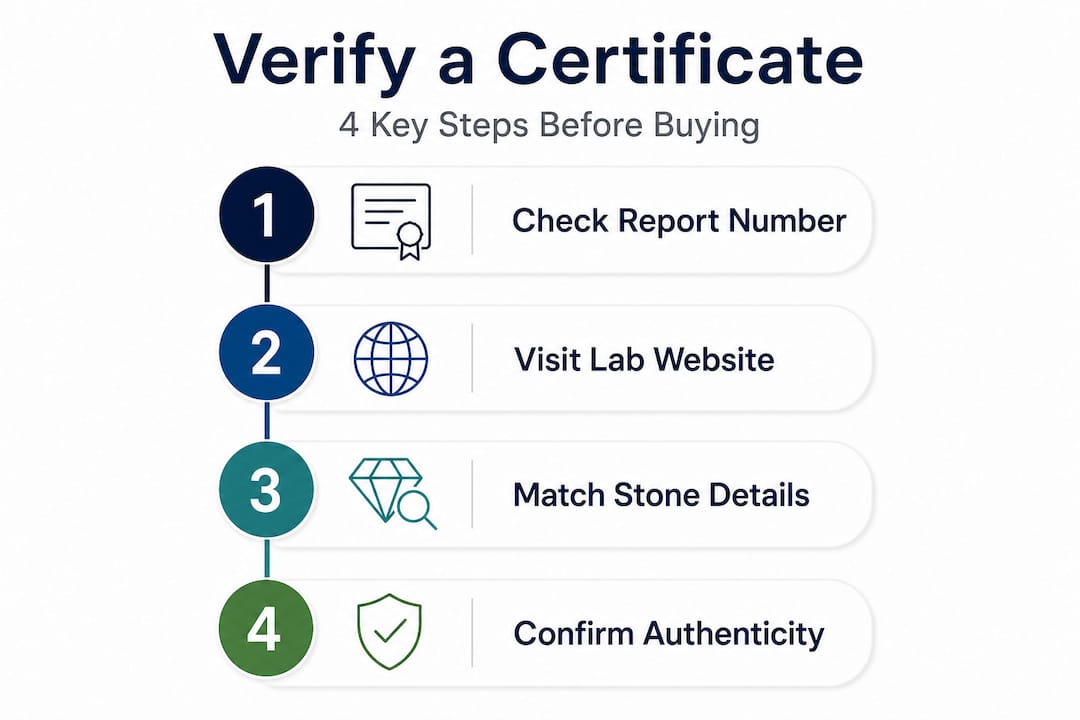
Pro Tip: Never rely on a photocopy of a certificate. Always verify the report number directly on the official lab website, ideally while standing in the store before completing your purchase.
Beyond diamonds: Metals and colored gems
While diamonds take the spotlight, other jewelry materials also benefit from reputable certification and testing.
Gold and platinum hallmarks are the most common form of non-diamond jewelry certification. A hallmark is a stamp applied to a precious metal piece that confirms its purity level. Hallmarks on gold and platinum provide fraud protection and better resale value by guaranteeing exactly what percentage of the piece is genuine precious metal.
Common hallmarks to look for include:
- 14k or 585: Indicates 58.5% pure gold
- 18k or 750: Indicates 75% pure gold, common in fine engagement rings
- PT950: Platinum at 95% purity, the most popular grade for engagement ring settings
- PT900: Platinum at 90% purity, often used in detailed settings
- 925: Sterling silver at 92.5% purity
Colored gemstones present a more complex certification picture. Unlike diamonds, there is no single universal grading standard for rubies, sapphires, or emeralds. However, respected labs like the GIA and the Swiss Gemmological Institute (SSEF) issue reports that identify origin (natural vs. synthetic), detect heat treatments, and confirm species and variety. For high-value colored stones, an origin and treatment report from a reputable lab protects you the same way a diamond grading report does.
“A ruby described as ‘pigeon blood red’ from Burma commands a far higher price than one without origin documentation. The certificate isn’t decorative paperwork. It’s the difference between market value and true value.”
When buying fine jewelry with gemstones beyond diamonds, always ask what documentation accompanies the stone, especially for pieces above $1,000.
Why conventional wisdom on jewelry certification falls short
Most articles about jewelry certification will tell you to look for a GIA report and call it a day. That’s helpful but incomplete, and it misses some of the most important nuances that experienced buyers learn the hard way.
The first thing conventional guides underplay is that lab reputation is not uniform. There are dozens of labs offering certification worldwide, and some are significantly less rigorous than GIA, IGI, or AGS. A certificate from an unknown local lab can be essentially meaningless. It may describe a stone as VS1 clarity when GIA would grade it SI1, inflating its apparent value. The name on the report matters enormously.
The second gap in typical advice is that certification does not guarantee beauty. Two diamonds can share identical grades on paper and look completely different to the naked eye. Cut, proportions, and light performance interact in ways that numbers only partially capture. A well-cut I color diamond often looks more stunning than a poorly-cut F color stone. Never buy based on a certificate alone. See the stone, or at minimum, review high-resolution video of it.
Third, and perhaps most importantly, overreliance on paper can lead to ignoring craftsmanship. The setting, the metalwork, the finish, and the way a stone is held in place all affect a ring’s longevity and beauty. None of that appears in a grading report. GIA’s nonprofit, strict grading versus for-profit alternatives is exactly the kind of structural difference that shapes whether a certificate reflects reality. For engagement rings with natural diamonds, prioritize GIA. For lab-grown stones, IGI is widely trusted. But always let your eyes confirm what the paper describes.
You’ll find that thoughtful jewelry buying tips consistently recommend treating a certificate as a starting point, not a final judgment. Use it to eliminate bad choices quickly, and then apply your own judgment to select the best stone within the qualified pool.
Find certified jewelry you can trust
Making sense of certifications becomes a lot easier when you shop with a retailer that does the verification work for you.

At SuperJeweler, every engagement ring and fine jewelry piece comes with clear certification documentation, so you’re never left guessing about what you’re buying. Whether you’re searching for affordable certified engagement rings that fit your budget without sacrificing quality, exploring the growing world of lab-grown diamond engagement rings backed by IGI certification, or browsing a full range of lab-grown certified jewelry for every occasion, you’ll find verified, documented quality at prices that make fine jewelry genuinely accessible. Every piece comes with free worldwide shipping and a satisfaction guarantee, so your purchase is protected from the moment you click “buy” to the moment it arrives at your door.
Frequently asked questions
What is the difference between a diamond certificate and an appraisal?
A diamond certificate is a scientific lab report that documents a stone’s physical and quality characteristics. An appraisal is a market value estimate, typically prepared for insurance purposes, and often reflects retail replacement cost rather than scientific grade.
Which is the most trusted diamond certification?
The GIA is widely considered the gold standard for natural diamond certification because of its strict, unbiased grading process, nonprofit structure, and decades of industry leadership.
Do certified diamonds cost more?
Yes. Certified diamonds sell for 15-25% more than uncertified stones on resale, and GIA certificates carry a 12-20% premium over IGI reports for natural diamonds of the same grade.
Should I verify a certificate before buying jewelry?
Absolutely. Always use the lab’s online database to cross-reference your certificate number. Uncertified or unverified diamonds risk misrepresentation, reduced resale value, and complications with insurance claims.
What do hallmarks on gold or platinum mean?
Hallmarks guarantee precious metal purity, giving buyers protection against fraud and providing documentation that supports stronger resale value. Marks like 18k or PT950 confirm exactly what percentage of precious metal is in your piece.
Recommended
- Protect Your Jewelry Investment: The True Value of a Warranty
- Why jewelry makes great gifts: meaningful & timeless
- What Is Conflict-Free Jewelry? A Guide to Ethical Choices
- Understand diamond certification to buy with confidence
