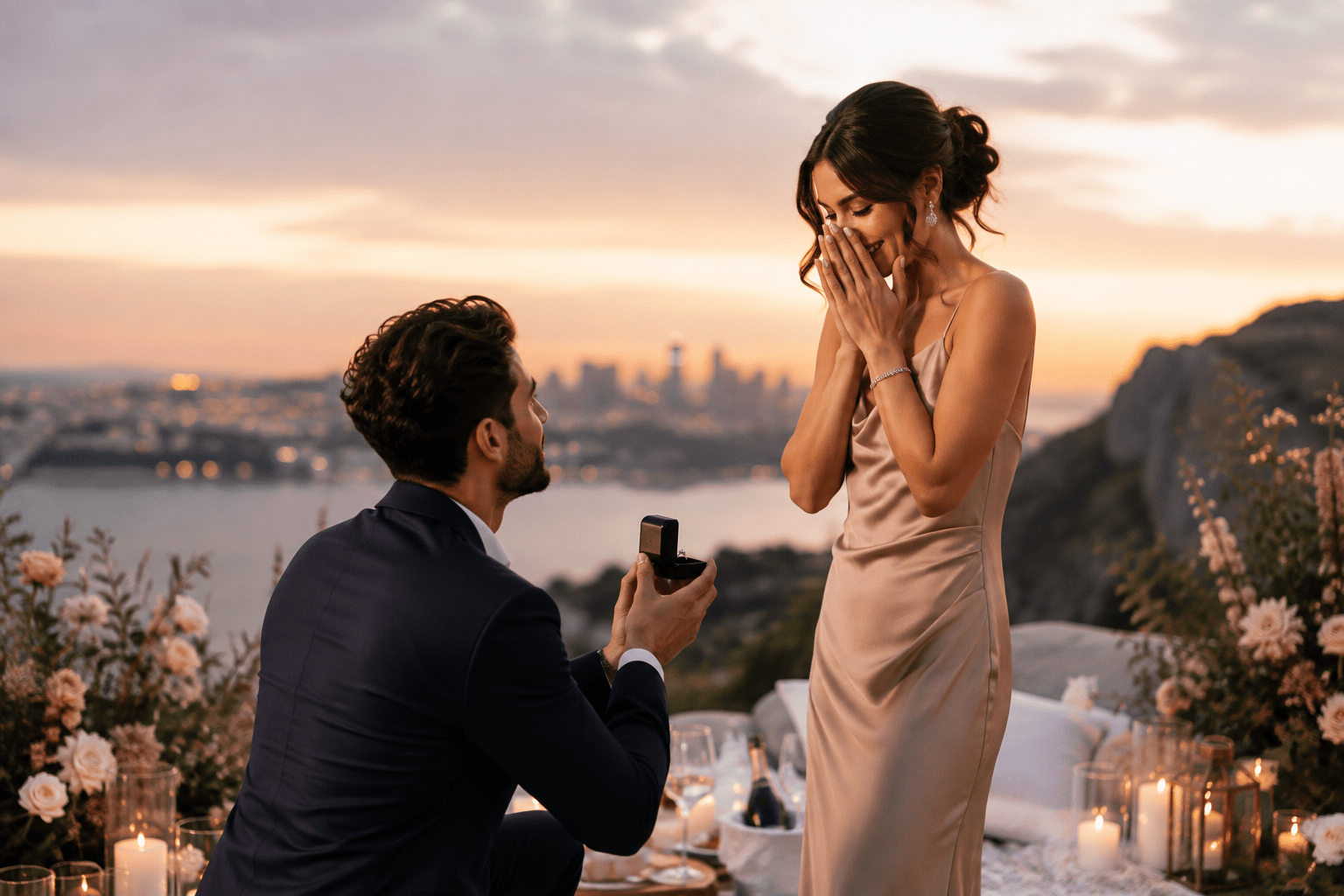
TL;DR:
- A proposal’s style influences how a partner recalls the moment, emphasizing emotional fit, wearability, and intent. Personal style cues and trivial details, like ring setting and presentation, deeply impact the story told afterward. Choosing a ring and setting aligned with daily life and the partner’s true personality increases the likelihood of a meaningful, lasting memory.
Style shapes how a proposal is remembered. The ring, the setting, the words you choose — together they tell your partner whether you were paying attention. A GIA-certified diamond in a setting that clashes with how your partner actually dresses will always feel slightly off, no matter how expensive it is. Jewelers of America consistently emphasize that the most meaningful proposals connect the ring to the person’s real life, not to a generic idea of romance.
Three things matter most:
- Emotional fit: The story your partner tells later will be about how it felt, not the carat weight.
- Wearability: A ring that suits daily life gets worn with joy; one that doesn’t gets left in a drawer.
- Intentionality: Match the ring to everyday style, then plan the reveal to highlight that fit.
Table of Contents
- Why does the proposal’s look shape the story your partner will tell?
- How do you identify your partner’s personal style before buying?
- How does the proposal setting interact with the ring you choose?
- How do you balance a ring’s visual impact with daily wearability?
- What are the most effective ways to present the ring?
- How do you shop for a ring that matches both style and real life?
- What should you do in the 6–8 weeks before the proposal?
- How does cultural background shape what a proposal style means?
- Why does tying the proposal to a shared story make it land harder?
- What are the most common style mistakes in proposals, and how do you avoid them?
- How do you adapt proposal style to different personalities?
- Key Takeaways
- What I would actually do differently
- Finding a ring that fits both style and real life
- Useful sources and further reading
Why does the proposal’s look shape the story your partner will tell?
People remember how a proposal felt far more than what the ring cost. Wedding planning research confirms that surprise, emotional tone, and personal intentionality are what future storytellers describe — not the cut grade or the setting height.
That emotional memory has social weight, too. A ResearchGate study with 2,174 participants found that conforming to traditional proposal elements — including presenting a ring — leads third-party observers to judge the relationship as stronger. The ring’s presence signals commitment; its style signals how well you know your partner.
Consider two proposals at the same restaurant. One partner receives a cushion-cut halo ring in yellow gold — exactly the vintage-inspired style she pins on weekends. The other receives a sleek modern solitaire in white gold, beautiful but nothing like the warm, layered jewelry she wears every day. Both proposals succeed. One becomes a story about love and attention; the other quietly carries a footnote.
How do you identify your partner’s personal style before buying?
Identify the everyday signals first, then confirm with discreet checks. The goal is to find the dominant style — what they wear on a typical Tuesday morning, not what they put on for a formal event.
Daily observation checklist:
- Metal color they wear most often (yellow gold, rose gold, silver/white gold, mixed)
- Scale of their jewelry (delicate and minimal, or bold and layered)
- Recurring motifs (vintage filigree, geometric, nature-inspired, clean modern lines)
- Clothing vibe (classic, bohemian, minimalist, maximalist)
- How often they wear rings, and on which hand
Do / don’t:
- Do check their jewelry box or Instagram saves for patterns.
- Do ask one close friend or sibling two specific questions: “What metal does she wear most?” and “Does she prefer delicate or statement pieces?”
- Don’t assume a trending style equals her personal preference.
- Don’t try to blend every aesthetic you’ve noticed — pick the dominant one.
Safe ways to confirm ring size without spoiling the surprise:
- Borrow a ring she wears on her ring finger and trace it on paper, or take it to a jeweler for a quick measurement.
- Ask a friend to casually bring up ring sizing in conversation.
- Use a ring-size chart and compare against a ring you know fits.
If you genuinely cannot confirm size, proposing with a placeholder band and shopping together afterward is a legitimate option that protects both the surprise and the fit.
How does the proposal setting interact with the ring you choose?
Pick a ring that complements the setting and suits everyday life. When those two goals conflict, everyday life wins — but the setting still shapes which features will shine in the moment.
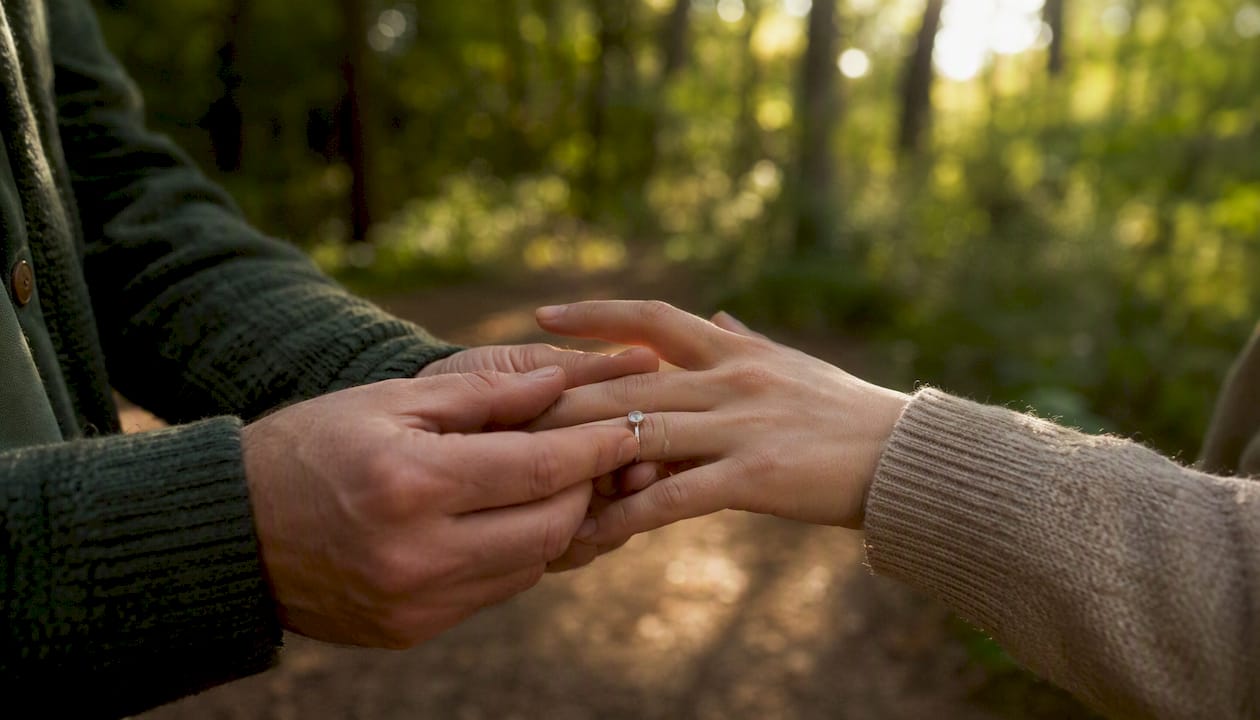
Outdoor and adventure proposals call for secure, lower-profile settings. A high cathedral prong on a beach or hiking trail catches on everything and risks stone loss. A bezel or low-profile prong setting photographs cleanly in bright natural light and stays secure during an active reveal.
A candlelit restaurant or rooftop setting is where brilliant-cut round and oval diamonds earn their reputation. Those cuts are engineered to scatter light in low-light conditions, so the ring genuinely sparkles across the table. Emerald and Asscher cuts, which rely on broad flashes rather than sparkle, can look subdued by candlelight — worth knowing before you choose.
A private home proposal gives you the most control. You choose the light, the backdrop, and the moment. Here, the ring’s style can lean fully into your partner’s aesthetic without worrying about environmental hazards.
Attire note: Wear something that coheres with the setting’s formality. A tuxedo at a casual picnic creates visual friction in photos; jeans at a rooftop restaurant do the same. The goal is for the photos to look like the two of you, not like a costume.
Pro Tip: Round and oval cuts photograph well in almost any light. If your partner loves a specific cut that doesn’t perform as well in low light, plan the reveal near a window or ask a friend to position a phone flashlight subtly behind you.
How do you balance a ring’s visual impact with daily wearability?
Daily wearability should usually outweigh proposal-only showpieces. A ring your partner wears every day for decades needs to survive a real life — not just look stunning in one photograph.
Common tradeoffs:
- Halo settings add visual size and sparkle but raise the profile, increasing snag risk on bags, gloves, and hair.
- Pavé bands are beautiful but require more maintenance; small stones can loosen with daily wear.
- Larger carat vs. cut quality: A well-cut smaller stone outperforms a poorly cut larger one in everyday light — and costs less to insure.
Lifestyle-to-style mapping:
| Lifestyle | Recommended setting | Recommended metal |
|---|---|---|
| Active / hands-on job | Bezel or low-profile prong | Platinum or white gold |
| Frequent traveler | Low-profile solitaire | Platinum (scratch-resistant) |
| Formal office | Classic prong solitaire or halo | Yellow or white gold |
| Casual creative | Vintage or nature-inspired | Rose gold or mixed metals |
Jewelers consistently recommend bezel and lower-profile prong settings for active lifestyles because they protect the stone on all sides and reduce repair frequency. Platinum is denser than gold and holds prongs more securely over time, making it worth the premium for someone who works with their hands.
The ring purchase and the proposal are not separate projects. The setting height and prong style you choose will determine which venues make the ring look its best — and which ones create practical headaches from day one.
What are the most effective ways to present the ring?
The simplest reveal that feels intentional usually beats an overproduced stunt. Elaborate setups shift focus from the person to the production, and anything that can go wrong in a staged moment will.
Reveal methods and when to use each:
- Classic knee-and-box: Works in almost any setting; the physical gesture carries the weight. Best when your partner values tradition.
- Hidden box in dessert or gift: Adds surprise but requires a trusted server or friend. Works well in a restaurant with a close collaborator.
- Proposing with a temporary band: Preserves full surprise while letting your partner choose the final ring. Best when fit or style is genuinely uncertain.
- Proposing, then shopping together: No ring at the moment, but the conversation is the proposal. Works best for partners who are very particular about jewelry.
Sample one-sentence prompts that feel personal:
- “I’ve been paying attention to you for [X] years, and I want to keep doing that forever.”
- “You are the person I want next to me for every ordinary Tuesday.”
- “I know this isn’t a surprise, but I wanted to ask you properly.”
- “I chose this because it reminded me of [specific shared memory].”
- “I don’t have a speech — I just know I want to marry you.”
For photos, position a trusted friend 10–15 feet away with a phone on portrait mode. Natural light from the side produces the most flattering images. Candid shots taken during the reaction are almost always more powerful than posed ones afterward.
How do you shop for a ring that matches both style and real life?
Shop for craftsmanship and policy as well as appearance. A beautiful ring from an unverifiable source is a liability, not a gift.
Shopping checklist:
- Verify a GIA or IGI grading report and confirm the laser inscription matches.
- Check the return policy: 30 days minimum, no-questions-asked is the standard to expect.
- Confirm resizing is available and whether it is covered under warranty.
- Ask about the warranty terms for prong tightening and stone replacement.
- Plan for jewelry insurance within 30 days of purchase.
Superjeweler offers customizable engagement rings across both mined and lab-grown diamond collections, with options to select diamond shape, setting style, and metal. The lab-grown selection is particularly useful for shoppers who want a larger visual presence without stretching the budget. Free worldwide shipping and clear warranty and return policies make the purchase process lower-risk.
Pro Tip: Use the step-by-step ring buying guide to cross-reference your partner’s style signals against specific setting types before you browse — it saves significant time and narrows choices fast.
What should you do in the 6–8 weeks before the proposal?
Start with the ring well ahead of the proposal date. Resizing, custom orders, and certification verification all take time, and rushing any of them creates avoidable stress.
Week-by-week schedule:
- 6–8 weeks out: Select the ring, verify certification, confirm sizing, and place the order. Review the proposal planning checklist to catch anything you might miss.
- 4–6 weeks out: Book the venue or confirm the location, arrange a photographer or trusted friend, and plan attire.
- 1–3 weeks out: Confirm all logistics, practice what you want to say (not a script, just the core idea), and brief any friends or family who are involved.
- 1–3 days out: Prepare an emergency kit.
Emergency kit:
- A small cloth to clean the ring before the reveal
- Printed or downloaded backup of the certification report
- A charged phone for photos
- A backup plan for weather or venue changes
The day before: confirm the venue reservation, check the ring one more time, and tell one trusted person your plan. The hour before: arrive early, breathe, and let go of the script. The moment will not go exactly as planned. That is fine.
How does cultural background shape what a proposal style means?
Proposal style carries meaning that varies significantly by cultural background, family tradition, and personal history. What reads as romantic in one context can feel performative or insufficient in another.
In many American families, a public proposal with friends present signals confidence and commitment. In others, privacy is the mark of sincerity — a public spectacle would feel like theater rather than intimacy. Neither is wrong; they reflect different values about what a proposal is for.
Religious and ethnic traditions add further layers. Some communities expect a formal conversation with family before the proposal happens. Others treat the ring itself as a family heirloom decision. Ignoring these expectations does not make the proposal more authentic — it makes it feel like you did not do your homework.
The practical implication: ask yourself whether your partner’s family has visible traditions around proposals, and whether your partner has ever commented on proposals they found meaningful or awkward. Those comments are data.
Why does tying the proposal to a shared story make it land harder?
A proposal that references a specific shared moment activates memory in a way that a generic romantic gesture cannot. The psychological mechanism is straightforward: the brain encodes emotionally significant events more deeply when they connect to existing memories. A proposal at the place you had your first real conversation, or with a ring that echoes a piece of jewelry your partner inherited, does not just mark a new moment — it reframes the entire relationship story.
This is why jewelers and planners consistently advise against imitating a proposal you saw in a movie or on social media. Those proposals are designed for an audience of strangers. Yours is designed for one person who has a specific history with you. The more precisely it reflects that history, the more it will feel inevitable rather than performed.
One concrete way to apply this: choose a ring detail — a stone shape, a metal color, a motif — that connects to something real. A partner who grew up near the ocean might love a wave-inspired band. Someone who treasures a grandmother’s vintage brooch might respond to an Art Deco setting. The connection does not need to be explained; it just needs to be there.
What are the most common style mistakes in proposals, and how do you avoid them?
The most common mistake is buying for the wrong version of your partner — the idealized version, the trending version, or the version you think an engagement ring should look like. As one ring-buying guide puts it plainly: she will wear it, and she will smile, and a small part of her will always know it is slightly off.
Other frequent missteps:
- Choosing a ring based on size alone. A larger stone in a poor cut looks dull in everyday light. Cut quality drives visual impact more than carat weight.
- Ignoring the setting profile. A high-profile halo on someone who works with their hands will be damaged within months.
- Overproducing the reveal. Flash mobs, drone drops, and jumbotron proposals put your partner on the spot in front of strangers. Unless you are certain they would love that, default to something intimate.
- Skipping certification. Buying a diamond without a GIA or IGI report is a gamble on an expensive purchase.
- Waiting too long to order. Custom work and resizing take weeks. Ordering three days before the proposal is how you end up proposing with a printout.
How do you adapt proposal style to different personalities?
The proposal style that works for an extroverted, social partner will feel wrong for someone who finds public attention uncomfortable — and vice versa. Personality is the most reliable guide.
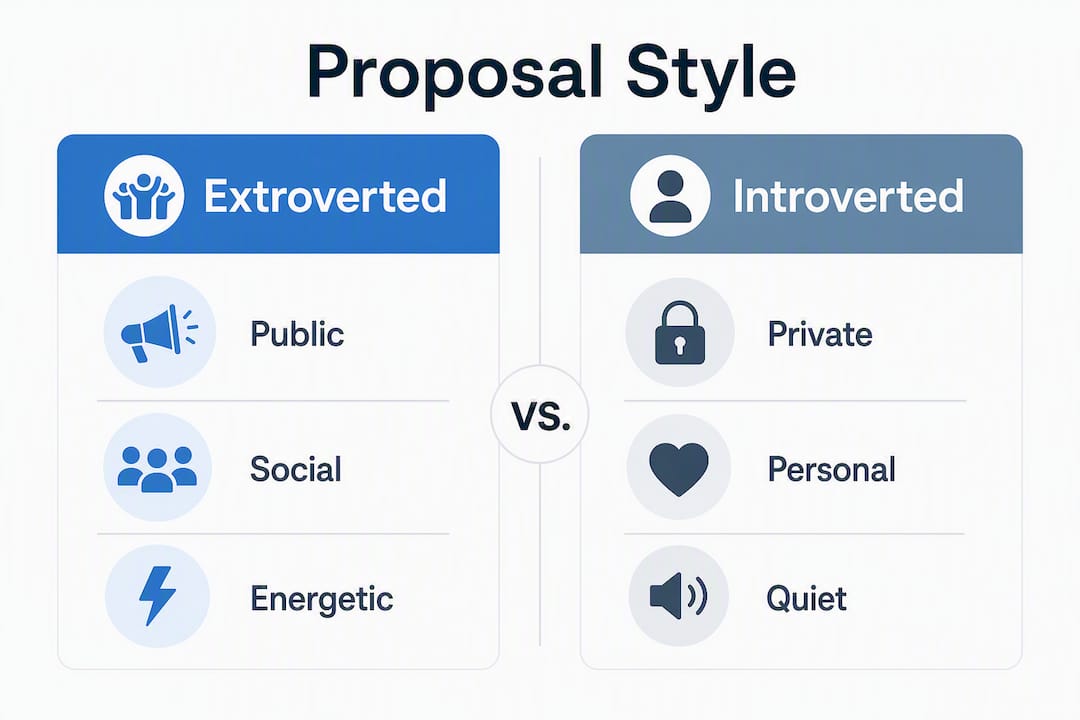
For a private, introverted partner: keep it small, personal, and controlled. A home setting, a meaningful location you share, or a quiet dinner for two. The ring should feel like an extension of their daily aesthetic, not a statement piece.
For an adventurous, experience-driven partner: tie the proposal to an activity they love. A hike to a specific viewpoint, a trip to a city they have always wanted to visit. The ring can afford to be bolder, but wearability still matters — they will be wearing it on every future adventure.
For a detail-oriented, aesthetic partner: the presentation matters as much as the ring. A beautiful box, a considered setting, clean and intentional styling. This partner will notice if the ring box is scuffed or the lighting is unflattering.
For a practical, no-fuss partner: skip the elaborate setup. A direct, sincere moment in a place that means something to both of you will land harder than any staged production. Consider proposing first and shopping together — they will likely prefer choosing the ring themselves.
Key Takeaways
The role of style in proposals comes down to one principle: every visual choice should reflect your partner’s real life, not a generic idea of romance.
| Point | Details |
|---|---|
| Prioritize everyday style | Match the ring to what your partner wears on a typical morning, not their most formal look. |
| Choose settings for durability | Bezel and low-profile prong settings protect stones and reduce repairs for active lifestyles. |
| Match the reveal to personality | Introverted partners want privacy; adventurous ones want experience; detail-oriented ones notice presentation. |
| Verify vendor trust signals | Confirm GIA or IGI certification, laser inscription, return policy, and resizing before paying. |
| Use Superjeweler for customization | Superjeweler’s customizable rings, lab-grown options, and clear return policy reduce risk and expand style choices. |
What I would actually do differently
Skip the grand gesture and spend that energy on the ring choice. The proposal moment fades into a story; the ring stays on the hand every day. If I were planning a proposal, I would choose a low-profile bezel or protective prong setting in the metal my partner actually wears, confirm the GIA report before paying, and keep the reveal small enough that my partner could react honestly rather than perform for a crowd. The words matter more than the staging. Say something true and specific to your relationship, and the moment will carry itself.
Finding a ring that fits both style and real life
Superjeweler gives you a practical starting point without the pressure of a showroom. The engagement ring collection covers a wide range of settings, metals, and diamond shapes — including a strong selection of lab-grown diamonds for shoppers who want more visual presence per dollar. Customization options let you adjust the setting and metal to match your partner’s dominant style, and resizing is available if the fit needs adjustment after the proposal.

Every purchase comes with free worldwide shipping, a clear return policy, and warranty coverage — the kind of practical backstop that matters when you are spending seriously on something your partner will wear for decades. Browse the full selection, filter by setting style and metal, and use the style signals from this guide to narrow your choices before you commit.
Useful sources and further reading
Third-party certification and clear vendor policies are the most reliable trust signals in any ring purchase. These sources are worth bookmarking:
- Jewelers of America — industry guidance on buying engagement rings, finding reputable jewelers, and understanding warranties.
- Superjeweler Engagement Ring Proposal Checklist — a practical planning checklist covering ring selection, certification, sizing, and proposal logistics.
- “A Story and a Ring”: Audience Judgments about Engagement Proposals — academic research on how proposal elements influence perceived relationship strength.
Recommended
- Coexist Jewelry, We Can All Get Along. Necklaces With Namaste, Buddha, Crosses, Ganesha, and More
- Claddagh Ring and Claddagh Engagement Ring, Fantastic New Modern Styles at Great Prices!
- Pot Leaf Jewelry | Fire Up This Amazing New Pot Leaf Ring, Earring, Necklace Collection
- Vine Engagement and Gemstone Rings, Check Out SuperJeweler’s Amazing New Handmade Vine Rings
