Here is the short version of this necklace style checklist, so you can use it right now before reading further:
- Pick your length first. An 18" princess chain sits just below the collarbone and works with almost every neckline. Start there if you are unsure.
- Match the neckline, not the outfit. The neckline’s shape tells you which length and style to reach for. The rest of the outfit follows.
- Layer in odd numbers, with at least 2" between each chain. Two or three chains of varied weight look curated; four of the same gauge look tangled.
- Clean after every ten wears. A quick warm-water rinse and a soft cloth prevent most tarnish before it starts.
- When shopping online, confirm three things: the exact length in inches, the metal type, and the return policy before you add to cart.
For a quick neckline reference: V-necks pair with pendant drops; crew necks suit princess-length chains; strapless and square necklines call for a choker or collar; turtlenecks need a long opera chain (28" or more) to clear the fabric. The 18" princess is the single safest gift length when you do not know the recipient’s preference. Browse fashion necklaces at Superjeweler to start building your collection.
Key Takeaways
A necklace style checklist works best when it starts with the neckline, sets the length from there, and treats layering and care as separate but equally important decisions.
| Point | Details |
|---|---|
| Default to 18" princess | This length clears most necklines and flatters most body proportions; it is the safest gift length. |
| Echo or fill the neckline | Decide whether to repeat the neckline’s geometry or fill its negative space before choosing a style. |
| Layer with 2" spacing | Use at least 2" between each chain; a 16" + 18" + 22" set is the classic starter combination. |
| Clean by material | Gold tolerates gentle soaking; plated metals need a dry cloth only; porous stones should never be soaked. |
| Shop at Superjeweler | Filter by length and metal type to find the 18" chain, adjustable option, and statement piece the checklist recommends. |
Table of Contents
- What does the necklace style checklist say about standard lengths?
- What necklace styles and chain types should you know?
- How do you match a necklace to your neckline?
- How do you choose the right necklace for your face, body, outfit, and occasion?
- How do you layer necklaces so they look curated, not chaotic?
- How should you clean and store your necklaces?
- What the checklist gets right that most styling advice misses
- Where to start shopping: Superjeweler’s necklace categories
- Sources
What does the necklace style checklist say about standard lengths?
Standard necklace lengths have names, and those names correspond to specific inch measurements and body placements. Knowing them removes the guesswork from both shopping and styling.
According to AJLuxe’s complete necklace guide, the most widely used lengths and their typical placements are:
| Length Name | Measurement | Where It Sits |
|---|---|---|
| Collar | 14" | Sits high on the neck, above the collarbone |
| Choker | 16" | Rests at the base of the neck |
| Princess | 18" | Falls just below the collarbone |
| Matinee | 20"–24" | Sits at or just above the bust |
| Opera | 28"–36" | Hangs at the sternum or below |
| Rope | 36"+ | Falls to the navel or lower; can be doubled |
Measuring your own necklace: Lay it flat on a ruler or use a soft tape measure from clasp to clasp. To measure for a new piece, wrap a string around your neck where you want the necklace to sit, mark it, then measure the string against a ruler.
Height and torso adjustments
The chart above describes average placement on a 5’4"–5’6" frame. AJLuxe’s length guide recommends adding 1–2" for taller frames and subtracting 1–2" for petite frames to achieve the same visual placement. A 16" choker on a 5’9" person may sit closer to a collar; the same piece on a 5’1" frame may feel tight.
The 18" princess remains the safest default for gifting and everyday wear. It clears most necklines, flatters most body proportions, and works under a collarbone-grazing crew neck without disappearing.

Pro Tip: Before buying a necklace as a gift, check whether the recipient’s existing pieces cluster around 16"–18" or 20"–24". That cluster tells you their preferred placement zone.
What necklace styles and chain types should you know?
Style names and chain constructions are the vocabulary of jewelry shopping. Once you know them, product descriptions stop being confusing.
Common necklace styles
- Chain-only: A standalone chain with no pendant; the link pattern is the focal point. Works for layering or minimalist looks.
- Pendant: A chain with a single drop element. The pendant’s size should scale with the chain’s gauge and the outfit’s visual weight.
- Lariat / Y-neck: An open-ended chain that loops through itself or has a dangling drop at the center. Flatters V-necks and plunging necklines.
- Choker: A close-fitting style at 14"–16". Pairs with strapless, off-shoulder, and square necklines.
- Collar: Sits at or above the collarbone (14" or less). Often rigid or semi-rigid; a statement piece on its own.
- Station: Evenly spaced stones or charms along the chain. Delicate enough to layer, interesting enough to wear alone.
- Tennis: A continuous line of matched stones, usually diamonds or cubic zirconia. Formal and symmetrical; best worn as a single piece.
- Graduated: Stones or links that increase in size toward the center. Creates a natural focal point without a pendant.
- Locket: A hinged pendant that opens to hold a photo or keepsake. Personalized lockets are a strong sentimental gift option.
- Statement: Any oversized, bold, or heavily embellished piece designed to be the focal point of an outfit. Wear alone; do not layer.
Chain link types and visual weight
The link construction changes how a chain drapes, catches light, and reads at a distance.
- Cable: Round or oval interlocking links. Classic, durable, easy to layer.
- Curb: Flat, interlocking links that lie flush. Heavier visual weight; reads bold even at a thin gauge.
- Rope: Twisted segments that spiral. Catches light well; substantial-looking even at a medium gauge.
- Box: Square links. Clean, modern, and less prone to kinking than cable.
- Figaro: Alternating short and long links (typically 2–3 short, 1 long). Italian in origin; sits between casual and dressy.
- Snake: Smooth, flexible bands of tightly joined plates. Sleek and modern; pairs well with minimalist outfits.
- Herringbone: Flat, V-shaped links that lie completely flat. Very delicate; prone to kinking if twisted.
Chain gauge and outfit scale
Gauge (the chain’s thickness) determines whether a piece reads delicate or substantial.
- 1–2mm: Delicate. Works for layering base chains, fine pendants, and lightweight fabrics like silk or chiffon.
- 3–4mm: Medium. Versatile enough for casual and semi-formal wear; holds a pendant without looking overwhelmed.
- 5mm+: Substantial. A statement on its own; pairs with structured fabrics, bold outfits, and open necklines.
How do you match a necklace to your neckline?
The pairing rule has two modes, as described in Ezra Gems’ neckline rulebook: echo the neckline’s geometry, or fill the negative space it creates. A V-neck echoed by a V-shaped pendant drop looks intentional. A crew neck with a pendant that fills the open space above the fabric does the same job differently.
The rule from FashionFile’s neckline pairing guide: never let a necklace land exactly on the fabric edge. Leave roughly 1"–2" of breathing space above or below the neckline so the piece reads as a deliberate choice rather than an accident.
| Neckline | Recommended Length | Best Styles |
|---|---|---|
| V-neck | 18"–20" | Pendant drop, lariat, Y-neck |
| Crew neck | 18"–20" | Princess chain, station, pendant |
| Scoop neck | 18"–22" | Pendant, graduated, layered chains |
| Strapless | 14"–16" | Choker, collar, bib |
| Off-shoulder | 14"–16" | Choker, collar |
| Square neck | 14"–16" | Choker, collar, short pendant |
| Turtleneck | 28"–36" | Opera chain, long pendant, rope |
| Halter | 18"–22" | Pendant, station, lariat |
Atolea Jewelry’s styling guide adds a useful step: identify the neckline’s direction first. Does it point downward (V, halter), run horizontal (boat, off-shoulder), or curve openly (scoop, crew)? That direction tells you whether to echo with a matching angle or contrast with a horizontal collar. Fabric weight matters too: a heavy knit turtleneck needs a long, substantial chain to read at all; a silk blouse calls for something fine enough not to snag.
Pro Tip: When you cannot decide between filling and echoing, choose filling. A pendant that drops into the open space of a scoop neck almost always looks more polished than one that sits at the same height as the fabric.
The Wardrobe Consultant’s pairing guide notes one practical shortcut: if the neckline is busy (ruffles, embellishment, texture), go with a plain chain. If the neckline is plain, the necklace can do more work.
How do you choose the right necklace for your face, body, outfit, and occasion?
Run through these questions in order. The answers narrow your options fast.
- What is the neckline shape? Use the pairing chart above to set your length range.
- What is the occasion? Casual calls for delicate chains and everyday metals. Formal calls for tennis necklaces, statement collars, or fine pendants with gemstones.
- Does the fabric move? Flowing fabrics (chiffon, jersey) work with lightweight chains. Structured fabrics (denim, wool) can carry heavier gauge.
- What visual weight do you need? A busy print needs a simple chain. A plain outfit can handle a statement piece.
- Will you layer? If yes, start with your base chain (usually 16"–18") and plan the other lengths before you shop.
What to check when shopping online
These are the details that separate a confident purchase from a return:
- Exact length in inches (not just “short” or “medium”)
- Metal type and purity (14K gold, sterling silver, 316L stainless steel, gold-filled vs. gold-plated)
- Clasp type (lobster claw, spring ring, toggle) and whether it is easy to self-fasten
- Allergy information (nickel-free, hypoallergenic claims)
- Return policy and warranty terms
Red flags on a product page: vague metal descriptions (“gold-tone,” “gold-colored”), no stated length, no model shot showing placement on the body, and no care instructions. DG Jewelry’s necklace guide points out that adjustable chains sidestep the length-guessing problem entirely and are worth prioritizing when you are unsure of your preferred placement.
For gemstone pendants, the Gem Society’s consumer grading guide recommends checking clarity, color, cut, and carat weight as a baseline. GIA’s jewelry education resources are the authoritative reference for understanding what those grades actually mean before you spend.
How do you layer necklaces so they look curated, not chaotic?
The two-inch rule is the foundation. Leave at least 2" between each chain to prevent tangling and create visible separation between layers. A classic starter set is 16" + 18" + 22", as recommended by AJLuxe’s layering guide. That combination gives you a choker-level base, a princess mid-layer, and a matinee drop, with enough space between each that all three read as distinct pieces.
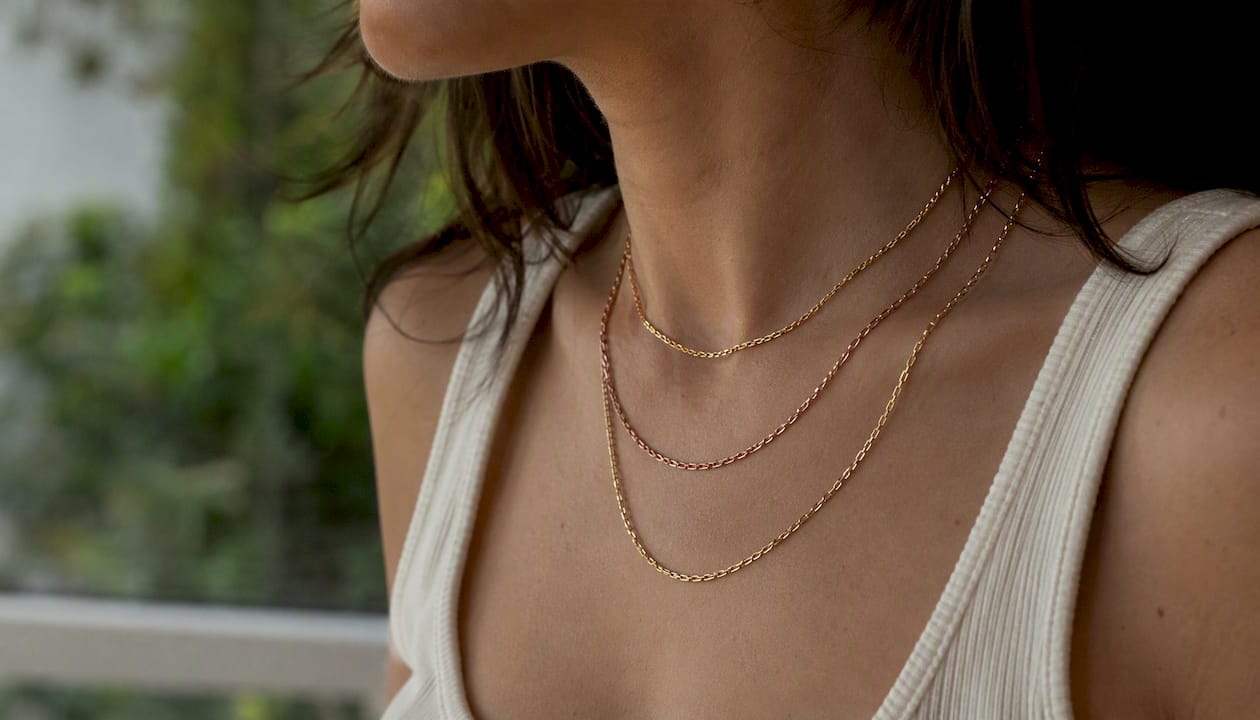
Professional stylists recommend composing a layered set with one thin base chain, one textured or medium-gauge mid-layer, and one focal piece (a pendant, a locket, or a station necklace with stones). The thin base floats; the focal piece anchors. Everything in between adds texture without competing.
Pro Tip: Mixing metals is fine, but mix intentionally. Pair yellow gold with warm-toned stones and silver with cool-toned stones. Mixing both metals in the same layer set works best when one metal dominates (two gold chains, one silver) rather than splitting evenly.
For casual and beach settings, a guide on layering beach jewelry suggests keeping all pieces in the same metal family and favoring lightweight chains that move freely. That principle applies beyond the beach: when the setting is relaxed, simplicity in the metal palette makes layering look effortless rather than overdone.
Converting a single piece into a layered look
An opera-length chain (28"–36") can be doubled to create two loops of different lengths, giving you an instant layered effect from one piece. Adjustable chains with sliding clasps let you shift the focal point up or down without buying a second necklace. Both are worth keeping in a versatile jewelry wardrobe.
How should you clean and store your necklaces?
Cleaning by material
- Gold (10K, 14K, 18K): Soak in warm water with a drop of mild dish soap for 15–20 minutes. Gently scrub with a soft-bristle toothbrush. Rinse and pat dry with a lint-free cloth. Avoid ultrasonic cleaners for pieces with gemstone settings unless the stone is confirmed safe.
- Sterling silver: Use a silver polishing cloth for light tarnish. For heavier tarnish, a paste of baking soda and water applied with a soft cloth, then rinsed thoroughly, works well. Store with an anti-tarnish strip to slow oxidation.
- 316L stainless steel: Wipe with a damp cloth. Stainless resists tarnish and corrosion, making it low-maintenance for everyday wear.
- Gold-plated or gold-filled: Avoid soaking. Wipe gently with a damp cloth only. Harsh cleaners strip the plating. Gold-filled has a thicker bonded layer than plated and lasts significantly longer with proper care. See Superjeweler’s gold-filled chain options for context on the difference.
- Gemstone settings: Check the stone before cleaning. Porous stones (turquoise, opal, pearl) should never be soaked. Hard stones (diamond, sapphire, ruby) tolerate gentle soaking. When in doubt, a dry soft cloth is always safe.
GIA’s jewelry resources are the authoritative reference for stone-specific care guidance.
Storage rules
| Storage Practice | Why It Matters |
|---|---|
| Separate compartments or pouches | Prevents chains from tangling and stones from scratching each other |
| Anti-tarnish strips in the storage box | Slows silver oxidation without chemicals touching the piece |
| Hang delicate chains vertically | Prevents kinking in herringbone and snake chains |
| Keep away from humidity | Bathrooms accelerate tarnish; a bedroom drawer or jewelry box is better |
| Avoid direct sunlight | UV exposure fades some gemstones and degrades elastic or cord elements |
When to call a jeweler
Simple fixes you can do yourself: reattaching a lobster claw clasp with a jump ring (requires two pairs of needle-nose pliers), cleaning tarnish, and re-stringing a beaded necklace if you have the tools. Send a piece to a professional when you notice stretched or cracked links, a clasp that no longer closes securely, a loose stone in its setting, or any crack in a prong. Catching a loose stone early costs far less than replacing it after it falls out.
What the checklist gets right that most styling advice misses
Most necklace guides treat length charts as the answer. They are not. A length chart tells you where a chain sits; it does not tell you whether that placement works with your specific neckline, fabric, or the other pieces you are wearing. The checklist approach in this guide treats the neckline as the starting point, not the length.
The echo-or-fill framework from Ezra Gems is the most useful single concept in necklace styling because it gives you a decision, not just a recommendation. You look at the neckline, decide whether it needs to be echoed or filled, and then the length and style follow logically. That is a repeatable process. A chart you memorize is not.
The other thing most guides undervalue: negative space. A necklace that sits too close to a neckline edge disappears into the garment. One that floats clearly above or below the fabric reads as intentional. That 1"–2" breathing space rule from FashionFile is worth more than any specific length recommendation, because it applies regardless of what you are wearing.
My personal travel rule: I pack three necklaces for any trip. A 16" choker, an 18" pendant, and a 22" chain. Those three cover every neckline I am likely to encounter, layer into two combinations, and fit in a single small pouch without tangling. That is the checklist in action.
Where to start shopping: Superjeweler’s necklace categories
Putting the checklist into practice is straightforward when you know where to look. Superjeweler carries a wide range of fashion necklaces organized by style and length, so you can filter directly to the 18" princess chains, adjustable options, and statement collars the checklist recommends as your starting three.

Use the site’s metal and length filters to narrow quickly. Look for listings that state the exact length in inches, name the metal type and purity, and include a model shot showing placement. Superjeweler’s return policy and warranty terms are listed on each product page, which checks the trust-signal boxes from the shopping checklist above. For a first purchase, an 18" gold chain is the lowest-risk starting point. From there, add one adjustable chain for flexibility and one statement piece for occasions. Browse the full gold chain selection to find the gauge and link style that fits your wardrobe.
Sources
- Finding the perfect necklace to match every neckline – FashionFile
- Gia
- Gemsociety
- Necklace Pairings 101: How to Match Your Necklace to Your Neckline — The Wardrobe Consultant
- What Necklace To Wear With What Neckline? The Ultimate 2026 Guide to Flawless Styling – DG Jewelry
Recommended
- Diamond necklace styling guide: elevate every look
- How to Style Fashion Jewelry for Any Occasion
- Pearl Necklaces: Elevate Your Look Instantly
