
TL;DR:
- Regularly wipe necklaces after wearing to remove oils and lotion, preventing buildup.
- Store each piece separately with the clasp closed and avoid exposure to water or chemicals.
Six habits protect your necklaces better than any expensive cleaner: wipe them after every wear, remove them before water or chemical exposure, store each piece separately with the clasp closed, clean most metals with lukewarm water and mild dish soap, skip harsh chemicals on porous gems, and schedule a professional inspection at least once a year. The American Gem Society and Jewelers of America both back these fundamentals, and Superjeweler’s care guides can help when a piece needs repair or replacement.
Table of Contents
- Jewelry care tips for necklaces: your quick-start checklist
- How do you safely clean a necklace at home?
- What cleaning habits actually damage your necklaces?
- How should you store necklaces to prevent tangles and tarnish?
- What care does each necklace material actually need?
- When should you take a necklace to a jeweler?
- How do you fix minor tarnish or a knotted chain at home?
- Why are popular cleaning hacks like Windex actually risky?
- Key Takeaways
- The habit that actually saves heirlooms
- Superjeweler has necklaces built to last, and the resources to help
- Useful sources and further reading
Jewelry care tips for necklaces: your quick-start checklist
| Point | Details |
|---|---|
| Wipe after every wear | Use a soft, slightly damp cloth to remove skin oils and lotion before storing. |
| Remove before water or chemicals | Take off necklaces before swimming, showering, or applying perfume. |
| Store separately, clasp closed | Individual pouches or compartments prevent tangles, kinks, and tarnish. |
| Clean with mild soap and water | Lukewarm water plus a few drops of dish soap is safe for most metals. |
| Skip harsh cleaners on porous gems | Pearls, opals, and turquoise need a dry or barely damp wipe only. |
| Annual professional inspection | A jeweler checks settings, clasps, and chain wear once a year. |
How do you safely clean a necklace at home?
The American Gem Society recommends lukewarm water with a few drops of mild dish soap as the safest go-to cleaning method for most necklaces. It works on solid gold, sterling silver, platinum, and most faceted gemstones without stripping finishes or loosening settings.
Follow these steps for a safe, thorough clean:
- Pre-check the piece. Lay the necklace on a white cloth and look for loose stones, bent prongs, or a stiff clasp. If anything looks off, skip cleaning and go straight to a jeweler.
- Prepare the solution. Fill a small bowl with lukewarm water and add a few drops of mild dish soap. Never use hot water; thermal shock can loosen adhesive-set stones.
- Soak briefly. Let the necklace sit in the bowl for two to three minutes to loosen residue. Keep the bowl on a flat surface so you don’t accidentally knock a small pendant into the drain.
- Brush gently. Use a soft-bristled toothbrush to work the solution into chain links and around any settings. Light pressure only.
- Rinse thoroughly. Hold the piece under cool running water or dip it in a second bowl of clean water. Soap residue left in crevices dulls the finish over time.
- Dry completely. Pat with a lint-free cloth, then let the necklace air-dry completely on a soft surface before storing. Moisture trapped in a closed pouch accelerates tarnish.
Safe tools: soft-bristled toothbrush, lint-free cloth, small bowl, mild dish soap, soft polishing cloth for a final buff.
Avoid: toothpaste (too abrasive for plated metals), baking-soda scrubs on gold-plated or vermeil pieces, and paper towels (they scratch soft metals).
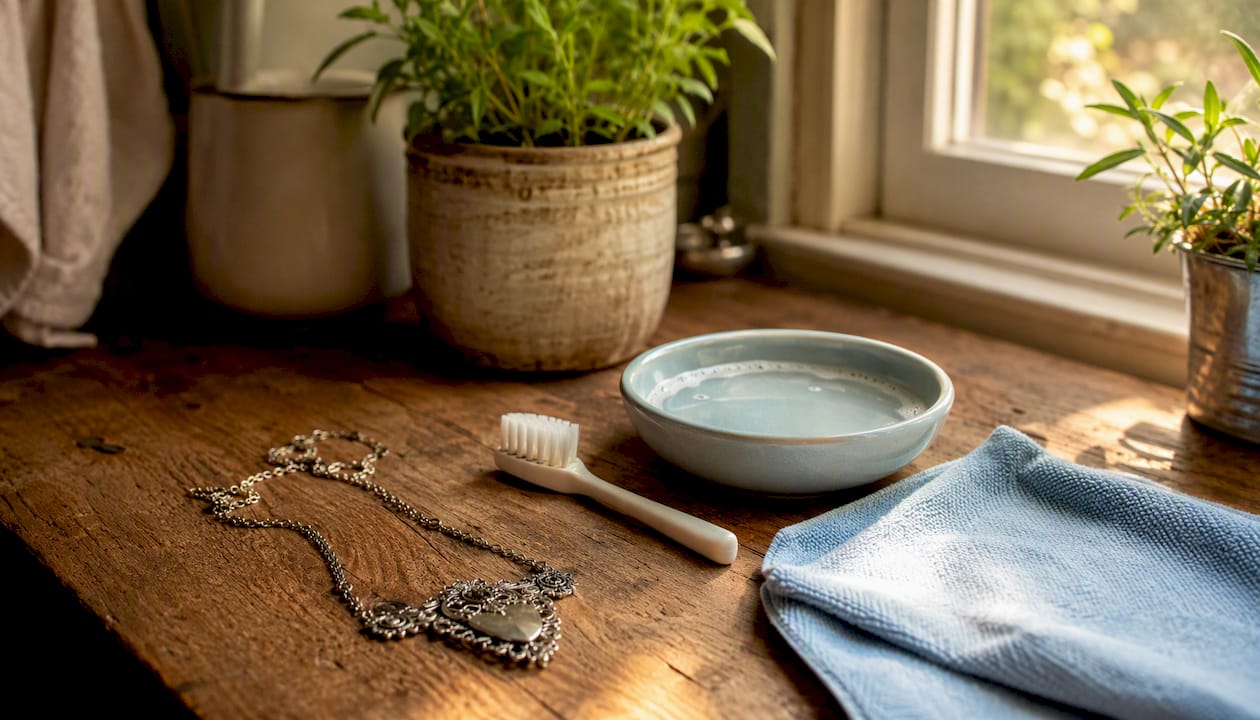
Pro Tip: Use a small bowl instead of the sink. Clasps and tiny pendant bails can slip down the drain in seconds, and a bowl also lets you see any loose stones that fall out during cleaning.
What cleaning habits actually damage your necklaces?
Harsh chemicals, chlorine, saltwater, and abrasive scrubbing cause discoloration, pitting, and erosion. The damage is usually permanent.
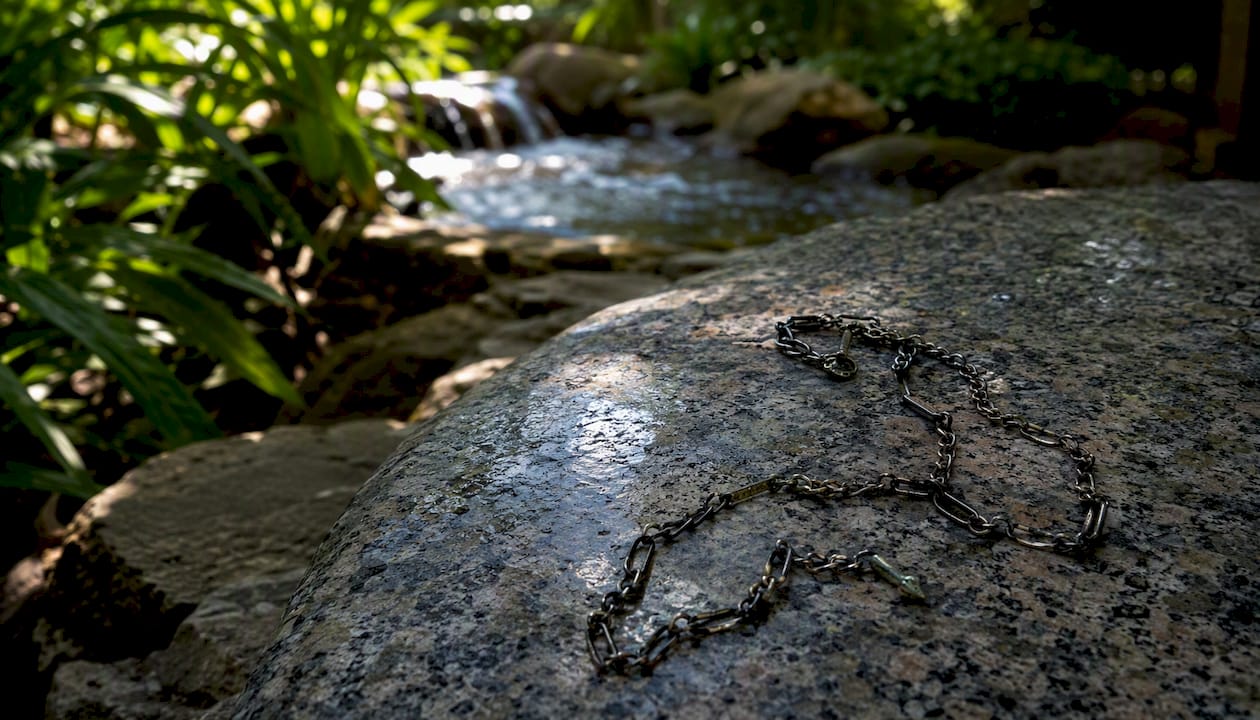
That warning matters more than most people realize. White gold has a rhodium plating that ammonia strips over time, leaving a yellowish tint that requires professional replating to fix. Plated metals are even more vulnerable: once the base metal is exposed, tarnish accelerates and the piece rarely recovers its original look.
Risky habits go beyond the cleaning cabinet. Sleeping in a necklace creates friction against fabric all night, which slowly wears down chain links and can kink delicate styles beyond repair. Wearing a necklace during a workout exposes it to sweat, which contains salts and acids that pit metal and dull gemstone surfaces. Spraying perfume or applying lotion while wearing a necklace leaves a chemical film that builds up in chain links and around settings.
Chlorine deserves its own mention. Pool water and hot tubs both contain chlorine at concentrations high enough to weaken gold alloys and cause stress fractures in chains over repeated exposure. Salt water from the ocean has a similar effect on sterling silver, accelerating tarnish and corrosion.
How should you store necklaces to prevent tangles and tarnish?
Store necklaces separately, hang or lay them flat, and always close the clasp before putting them away. That single habit prevents the majority of knots and kinks.
Home storage options:
- Individual fabric pouches: The soft lining prevents scratches, and the enclosed space slows tarnish by limiting air exposure.
- Hanging organizer or necklace stand: Keeps chains straight and visible, which also encourages you to inspect them regularly.
- Soft-lined compartment jewelry box: Good for heavier statement pieces that would stretch if hung.
- Anti-tarnish strips: Tuck one into a drawer or box to absorb sulfur compounds in the air, the main driver of silver tarnish.
- Silica gel packets: Reduce humidity inside a closed jewelry box, especially useful in humid climates.
Travel tips:
- Thread a delicate chain through a drinking straw before fastening the clasp. The straw keeps the chain straight and prevents it from looping on itself in a bag.
- Lay flat necklaces between two layers of tissue paper inside a small zip bag.
- Use the original pouch or box the necklace came in whenever possible.
- Pack each piece in its own zip bag to prevent metal-on-metal contact.
Pro Tip: Keep one or two frequently worn necklaces in a small open tray on your dresser rather than buried in a box. Easy access means you’ll actually wear them, and you’ll notice any clasp or chain issues before they become serious.
What care does each necklace material actually need?
One cleaning method does not fit every necklace. The table below covers the most common materials and what works, what doesn’t, and how to store each one.
| Material | Safe cleaning method | What to avoid | Storage note |
|---|---|---|---|
| Solid gold | Mild dish soap + lukewarm water, soft brush | Chlorine, abrasive cloths | Pouch or lined compartment |
| Sterling silver | Mild soap + water; silver polish cloth for tarnish | Rubber bands, chlorine, ammonia | Anti-tarnish pouch or strip |
| Gold-plated / vermeil | Soft damp cloth only; no soaking | Abrasive cloths, ultrasonic cleaners, toothpaste | Individual pouch; avoid stacking |
| Pearls | Barely damp soft cloth; wipe after every wear | Soaking, chemicals, ultrasonic, steam | Lay flat in soft pouch; never hang |
| Opals and turquoise | Dry or barely damp cloth only | Water soaks, chemicals, heat, ultrasonic | Separate pouch; keep away from heat |
| Diamonds (non-porous) | Mild soap + water, soft brush; ultrasonic when advised | Chlorine, abrasive cleaners | Any lined compartment |
| Gemstone pendants (treated) | Consult jeweler; mild damp cloth as default | Ultrasonic, steam, harsh chemicals | Separate pouch |
A few material-specific details worth knowing:
- Pearls — are organic and porous. Even tap water left sitting on a pearl can seep into the nacre over time. The rule is simple: wipe only, and let them air-dry before storing. The American Gem Society notes that porous and treated gems need minimal moisture and no harsh chemicals.
- Diamonds — are durable, but the settings holding them are not always. Professional jewelers advise against using ultrasonics on treated or porous gemstones and recommend checking with a jeweler before machine-cleaning any piece with mixed materials.
When a necklace has fragile or treated stones, a jeweler-approved dip formulated for that specific material is safer than any DIY method. If you’re unsure, ask before cleaning.
When should you take a necklace to a jeweler?
Jewelers of America recommends a professional cleaning and inspection for fine jewelry at least once a year. That annual visit catches problems you can’t see at home: micro-fractures in prongs, worn clasp springs, and chain links thinned by daily friction.
Bring a necklace in now if you notice:
- A stone that shifts, rattles, or looks lower than it used to
- Kinks in the chain that won’t straighten with gentle manipulation
- A clasp that no longer clicks securely or springs open on its own
- Peeling or flaking on a plated piece, exposing the base metal
- Fraying silk thread on a pearl or bead necklace
- Discoloration that doesn’t respond to gentle cleaning
A simple maintenance timeline:
- After every wear: wipe with a soft cloth, close the clasp, store separately.
- Monthly: quick visual check of clasp, chain links, and any stone settings.
- Annually: professional cleaning and inspection by a qualified jeweler.
- As needed: replating for gold-plated pieces (frequency depends on wear), restringing for pearl or bead necklaces, clasp replacement, or chain repair.
During a professional inspection, a jeweler will check prong security, clasp integrity, chain wear at stress points, and the condition of any surface treatments. Ask specifically for all of those if the jeweler doesn’t volunteer them.
Restringing a pearl necklace and replating a gold-plated piece are both considered routine maintenance. Costs vary by jeweler and region, so treat any estimate as a starting point rather than a fixed price. Getting a quote from two jewelers before committing to a major repair is reasonable.
How do you fix minor tarnish or a knotted chain at home?
Light tarnish on most metals comes off with a soft cloth and mild soap. For sterling silver, a silver polishing cloth works faster and leaves a brighter finish without any liquid at all.
For a knotted chain, the standard approach is two straight pins and a tiny drop of baby oil or mineral oil applied directly to the knot. Work the pins into the center of the knot and gently pull outward in opposite directions. The oil reduces friction between the links and lets the knot loosen without force. Once the chain is free, wipe away all the oil with a clean cloth and wash the piece with mild soap and water to remove any residue.
A few other safe quick fixes:
- Light tarnish on silver: silver polishing cloth, used with light circular strokes.
- Dull finish on solid gold: mild soap wash followed by a buff with a soft lint-free cloth.
- Non-porous gemstone haze: a mild jewelry dip labeled safe for that stone type, followed by a thorough rinse.
- Loose clasp in a pinch: a small safety pin through the last chain link works as a temporary closure until a jeweler can replace the clasp.
Stop all DIY attempts immediately if a stone shifts during the process, if metal bends or tears, or if a chain link separates. Those are jeweler repairs, not home fixes.
Why are popular cleaning hacks like Windex actually risky?
Certain DIY cleaners and electrolytic tricks can damage metals and porous gems. Don’t use them on valuable necklaces.
The chemistry is straightforward. Ammonia in Windex and similar glass cleaners reacts with the rhodium plating on white gold, stripping it unevenly and leaving a dull, patchy surface. On porous stones like opal and turquoise, ammonia penetrates the surface and can cause permanent discoloration. Chloride compounds in some household cleaners pit gold alloys at the microscopic level, weakening the metal over time.
Electrolytic DIY methods, which use baking soda, aluminum foil, and boiling water to “pull” tarnish off silver, are popular online but carry real risk. The process can remove more than tarnish: it strips surface treatments, damages soft stones, and can loosen settings if the piece heats unevenly.
Safer alternatives that actually work:
- Mild dish soap and lukewarm water for most metals and non-porous gems
- A silver polishing cloth for surface tarnish on sterling silver
- Jeweler-approved dips for non-porous stones like diamonds and sapphires
- Professional ultrasonic cleaning, but only when a jeweler confirms the piece can handle it
The American Gem Society and Jewelers of America both point to professional cleaning as the right call for anything fragile, treated, or porous. When a hack sounds too easy, it usually is.
Key Takeaways
Consistent daily habits, material-specific cleaning, and an annual professional inspection are the three things that keep necklaces looking their best for years.
| Point | Details |
|---|---|
| Daily wipe habit | Removing skin oils and lotion after every wear prevents buildup that accelerates tarnish. |
| Safe cleaning method | Lukewarm water and mild dish soap, applied with a soft brush, is safe for most metals. |
| Material-specific rules | Pearls and porous gems need a dry wipe only; plated metals need gentle cloth, no abrasives. |
| Annual professional check | A jeweler inspects settings, clasps, and chain wear at least once a year per Jewelers of America. |
| Superjeweler as a resource | Browse necklace categories or care guides for replacement options and deeper cleaning advice. |
After every wear: wipe with a soft cloth, close the clasp, store separately.
Monthly: inspect clasp, chain links, and stone settings visually.
Annually: professional cleaning and inspection by a qualified jeweler.
The habit that actually saves heirlooms
Most necklace damage isn’t dramatic. It’s cumulative: a little chlorine here, a night sleeping in a chain there, a few months of storage in a tangled pile. By the time the piece looks noticeably worse, the damage is already done.
The advice in this article isn’t complicated, but it does require consistency. A 30-second wipe after you take a necklace off, a quick visual check of the clasp once a month, and one trip to a jeweler each year will do more for a piece’s longevity than any expensive cleaner. Sentimental pieces, especially inherited ones, deserve that small investment of attention. When something looks off, don’t wait. A jeweler can often fix a loose prong in minutes; replacing a lost stone is a much bigger project.
Superjeweler has necklaces built to last, and the resources to help
If a necklace has reached the end of its life, or you want to add a piece that’s built to hold up to daily wear, Superjeweler carries a full range of diamond necklaces and gemstone necklaces at prices that make quality accessible without compromise.

Every piece ships free, and Superjeweler’s warranty and return policies mean you’re covered if something isn’t right. The difference from buying at a traditional retail markup is real: the same quality at a fraction of the price, with the same fine jewelry standards. Browse the necklace collections at superjeweler.com to find a replacement or an upgrade, and check the Superjeweler care guide for a step-by-step cleaning walkthrough you can bookmark.
Useful sources and further reading
- Jewelry Care | Jewelers of America: Trade organization guidance on daily care habits, professional inspection frequency, and when to avoid ultrasonic cleaning.
- Practical Tips for How to Clean Your Precious Jewelry | American Gem Society: Step-by-step at-home cleaning methods and material-specific cautions, including porous gems.
- Summer Jewelry Care | American Gem Society: Debunks common cleaning myths, including ammonia-based cleaners and their effects on white gold and porous stones.
- How to care for and store your jewelry | AP News: Practical storage advice including the clasp-closing habit and travel hacks.
- Jewelry Care Tips | Superjeweler Blog: Superjeweler’s own care guide for ongoing maintenance and cleaning advice.
Recommended
- Jewelry Care Tips: Keep Your Pieces Sparkling Longer
- Diamond Earring Care Tips: Proven Steps to Keep Them Sparkling
- Diamond necklace styling guide: elevate every look
- Step by Step Jewelry Cleaning: Your Safe Home Guide
