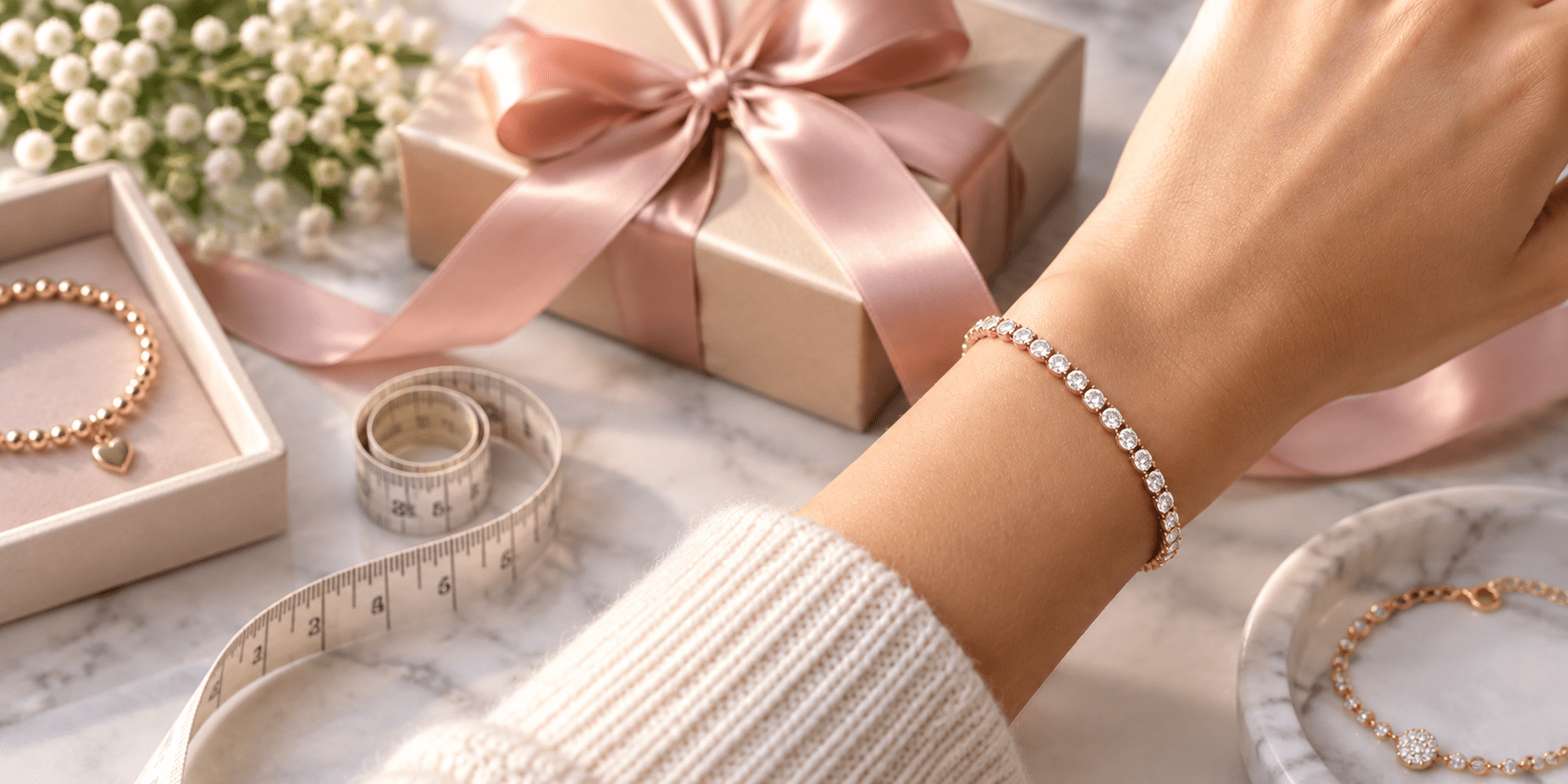
Your bracelet size comes from one number: the circumference of your wrist, measured just above the wristbone with a soft tape or a strip of string. From there, add roughly 1/2 inch for a snug tennis-style fit, 3/4 to 1 inch for a comfortable everyday wear, or up to 1.5 inches if you want it loose or plan to stack charms. Bangles break this rule entirely. You size those to your hand, not your wrist, because they have to slide over your knuckles.
TL;DR:
- Adding 1/2 to 1 inch to your wrist measurement gives a comfortable fit for most bracelet styles, but tennis bracelets need a closer fit of only 1/4 to 1/2 inch.
- Bangles are sized based on your hand measurement across the knuckles, not your wrist circumference, which often results in a looser fit on the wrist.
- Charm bracelets should be sized looser than plain chains to accommodate added weight and bulk from charms.
- Chain and link bracelets often include an extender chain, making adjustments easier after purchase, while bangles and cuffs require professional resizing.
- For gift buying without wrist measurement, choose adjustable or elastic styles and opt for small, lightweight designs to prevent size mismatches.
Table of Contents
- How to Measure Your Wrist for a Bracelet
- Bracelet Size Chart: Converting Wrist Measurement to Bracelet Length
- Style-Specific Bracelet Sizing Rules
- Buying a Bracelet as a Gift Without a Wrist Measurement
- Checking the Fit and Fixing a Bracelet That’s Off
- Why Trust This Bracelet Sizing Advice
- Bracelet Fit Tips for Different Wrist Shapes
- An Editorial Take on Getting Bracelet Sizing Right
- Shop Bracelets Sized to Fit, Not Just to Guess
- Sources
- FAQ
How to Measure Your Wrist for a Bracelet
Grab a soft measuring tape (the kind used for sewing) or, if you don’t have one, a strip of paper or string and a ruler. Either method works fine as long as you follow the same steps.
- Wrap the tape or string around your wrist just above the wristbone, where a watch would sit.
- Pull it snug against your skin, but not tight enough to pinch. You should be able to slide one finger underneath comfortably.
- If you’re using string or paper, mark the spot where it overlaps, then lay it flat against a ruler and read the measurement in inches or centimeters.
- Record that number. This is your bare wrist circumference, before any fit allowance.
- If you’re using a printable sizer from a retailer, check the print scale first. Lay a credit card next to the printed ruler mark. Standard cards measure 3.375 inches long, so if the printed guide doesn’t match that length, your printer has scaled the page and the sizer will be off.
The most common mistake is measuring over a sleeve or sweater cuff, which adds false bulk to the number. The second most common mistake is pulling the tape too tight, which shrinks your measurement and leaves you with a bracelet that never quite closes comfortably. Measuring directly against skin, right above the wristbone, gives the most reliable baseline every time.
Pro Tip: Measure your wrist at the end of the day rather than first thing in the morning. Hands and wrists swell slightly with activity and heat, so an evening measurement tends to reflect how the bracelet will actually feel most of the time you’re wearing it.
Bracelet Size Chart: Converting Wrist Measurement to Bracelet Length
Once you have your wrist circumference, you’re not shopping for that exact number. You’re shopping for that number plus the allowance that matches how you want the piece to sit. A finished bracelet length and a wrist measurement are two different things, and mixing them up is the single biggest reason online bracelet orders come back for exchange.
Women’s bracelets commonly center around 7 inches finished length, while men’s bracelets commonly run closer to 8 inches, though both vary by wrist size and style. Here’s how that plays out across common wrist measurements:
A 6 inch wrist landing at 6.5 to 7 inches of finished bracelet gives you an everyday, comfortable drape. If you’re eyeing a tennis bracelet, shave that allowance down closer to 1/4 to 1/2 inch since these pieces are meant to sit close and stay put. If you’re building a stack or leaving room for charms, go the other direction and add closer to a full inch so the piece has room to move without feeling like a tourniquet.
Style-Specific Bracelet Sizing Rules
Not every bracelet style follows the same fit logic. Here’s how the sizing math shifts by design:
- Chain and link bracelets: These often ship with a 1 to 2 inch extender chain, so you can adjust the actual worn length after the fact. Measure the extender’s range, not just the base chain, when comparing options.
- Charm bracelets: Size these looser than a plain chain. Charms add bulk and weight, and a bracelet that fits perfectly empty will feel tight once loaded with even three or four charms.
- Tennis bracelets: Go tighter than you would for a chain. A tennis bracelet that’s too loose will slide around and catch on things, so aim for the smaller end of your allowance range, generally 1/4 to 1/2 inch over bare wrist circumference.
- Bangles: These use an entirely different measurement. Slide a tape around the widest part of your hand, across the knuckles with your fingers together, then compare that number to the bangle’s inner diameter or circumference listed by the retailer.
- Cuffs: Open cuffs have some flexibility built in, but the adjustment range is limited compared to a chain. If you’re between sizes, size toward the larger measurement since most cuffs can be gently narrowed but rarely widened.
- Elastic and stretch bracelets: These are marketed as one size fits most, but “most” has real limits. If your wrist runs notably larger or smaller than average, an adjustable clasp style will serve you better than stretch cord.
Pro Tip: When in doubt between two chain sizes, size up. It’s far easier to have a jeweler remove a link than to add one back, and an extender chain often solves a slightly-too-loose problem for free.
Buying a Bracelet as a Gift Without a Wrist Measurement
You can’t exactly whip out a tape measure on someone you’re trying to surprise. Here’s how to close the gap.
- Find a bracelet the recipient already wears and measure it. If it has a clasp, measure it laid flat and closed; if it’s a bangle, measure the inner diameter directly.
- If you truly have no reference point, lean on average size ranges (roughly 7 inches for women, 8 inches for men) and choose an adjustable or elastic style so a slight miss doesn’t ruin the gift.
- Favor small beads and lightweight designs over heavy statement pieces. A thin bead bracelet with some stretch tolerates a sizing guess far better than a rigid, oversized cuff.
- Before you check out, confirm the resize and return window. Forgiving designs paired with a clear return policy are what separate a gift that gets worn from one that sits in a drawer, and ordering early gives you breathing room if a custom resize is needed.
Checking the Fit and Fixing a Bracelet That’s Off
A correctly sized bracelet passes a simple test: you should be able to slide one finger underneath it without forcing it, and it shouldn’t slide over your hand on its own when your arm hangs loose. Watch how it behaves during normal movement, typing, gripping a steering wheel, shaking hands, rather than just how it looks standing still in a mirror.
- If it’s slightly loose, try the extender chain first. Most chain and charm styles include one, and it costs nothing to use.
- If it’s noticeably too big or small, a jeweler can usually add or remove links from chain bracelets with minimal fuss.
- Bangles and rigid cuffs are far less forgiving. Resizing these often means professional metalwork, so get the hand measurement right before you buy rather than after.
- Before ordering, check the seller’s policy for resize timing, any associated cost, and whether return shipping is covered. A vague policy is a bigger red flag than a slightly uncertain measurement.
Why Trust This Bracelet Sizing Advice
Superjeweler carries bracelet categories built around fit flexibility, including tennis and length-specific styles, fine gold bracelets, and pieces for younger wrists in the kids bracelet category. Every product listing includes a wearable length you can hold up against your own measurement before you buy. Superjeweler also backs orders with return support, so a sizing miss isn’t the end of the story.
Bracelet Fit Tips for Different Wrist Shapes
Wrist shape affects how a bracelet sits even when the circumference number is identical, and this is where a lot of generic sizing advice falls short.
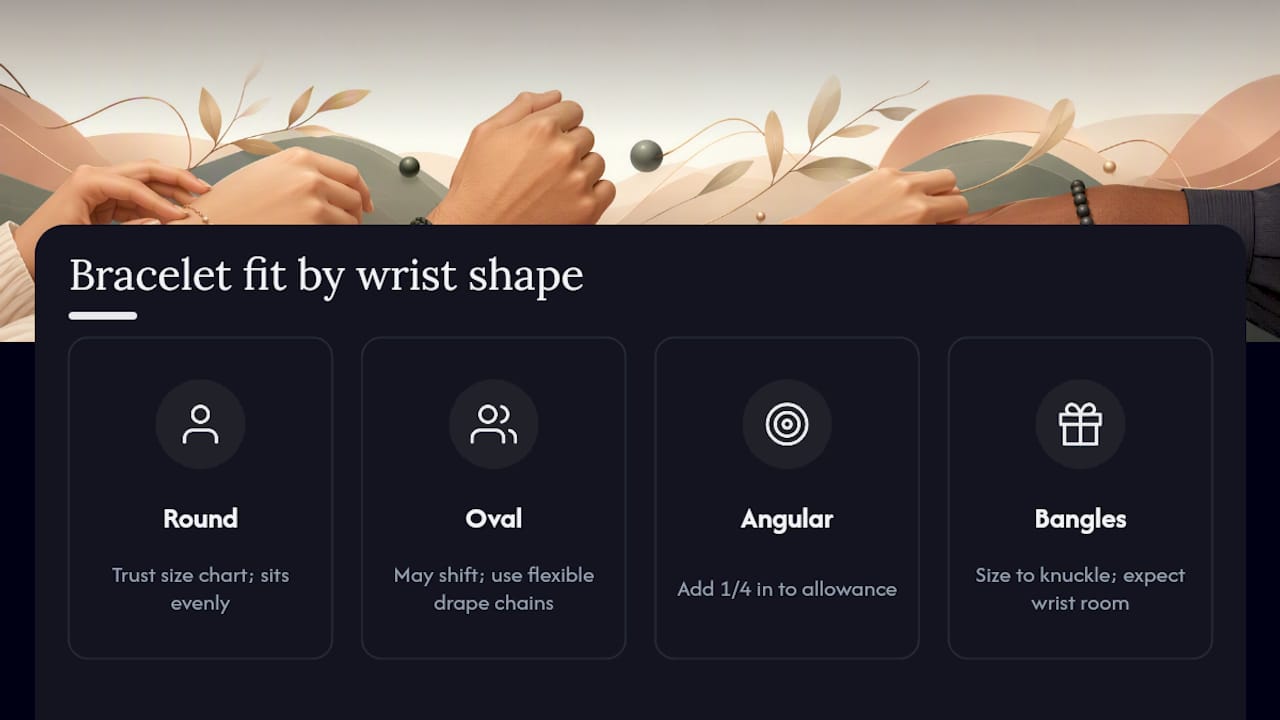
Round wrists tend to carry a bracelet evenly all the way around, so most standard chain and bangle styles sit well without special adjustment. If your wrist reads round, you can generally trust the size chart at face value.
Oval wrists are wider one way than the other, which means a bracelet that measures correctly can still feel like it shifts or twists during the day. Slightly flexible chain styles or ones with a bit of drape handle this better than rigid cuffs, which tend to rock on an oval wrist because they’re only touching two contact points.
Angular or bony wrists, common on leaner frames, benefit from a touch more allowance than the chart suggests. A close, tight fit on an angular wrist can press uncomfortably against the wristbone with every movement. Adding an extra 1/4 inch beyond the standard comfortable-fit allowance usually solves this without making the piece look sloppy.
Bangles are the trickiest case across all three shapes, since they have to clear your knuckles going on but then ideally shouldn’t swing too freely once they’re past your hand. If your knuckles are noticeably wider than your wrist, which is common, size the bangle to the knuckle measurement every time. It will feel a little roomy on the wrist itself, and that’s expected.
An Editorial Take on Getting Bracelet Sizing Right
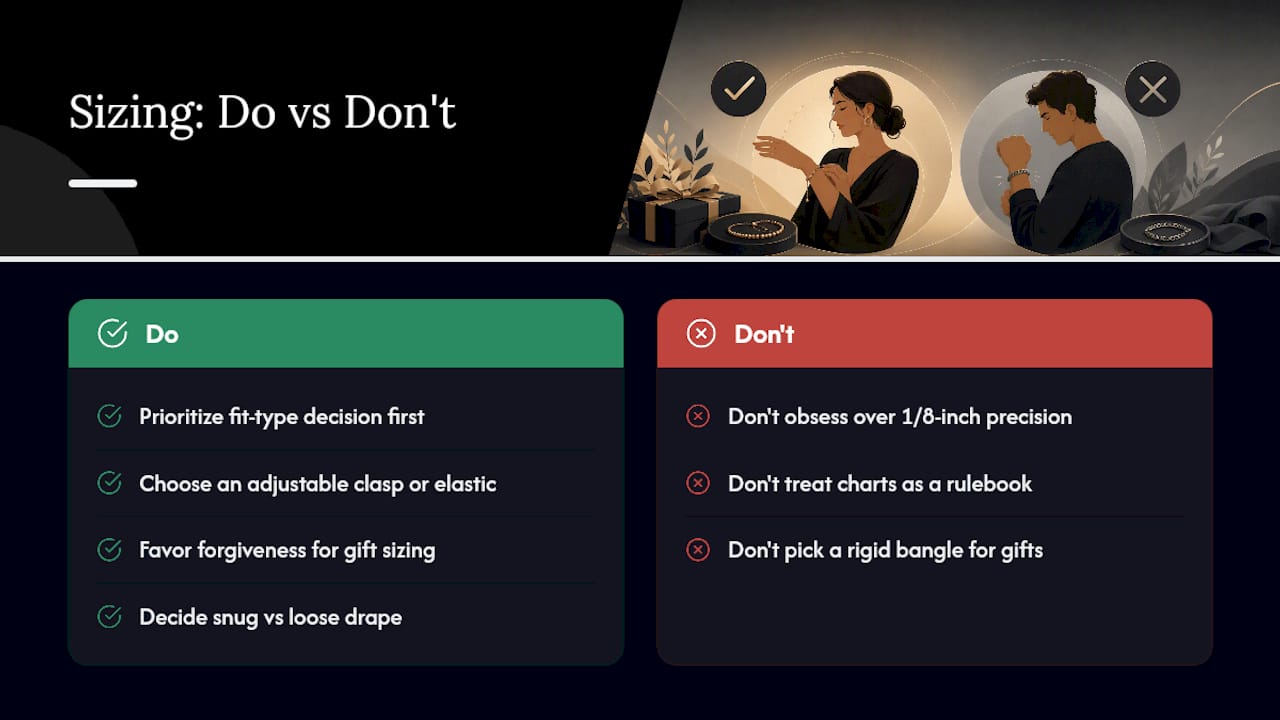
Most sizing charts treat bracelet fit like a math problem with one correct answer. It isn’t. The research and guidance across the jewelry industry keeps circling back to the same point: charts are a starting position, not a rulebook, and personal preference is what actually decides the right fit. I’d go further than that. The conventional advice oversells precision and undersells the allowance decision. Getting your wrist circumference right to the eighth of an inch matters far less than correctly deciding whether you want a snug tennis fit or a loose, charm-friendly drape, because that choice swings your ideal length by close to a full inch on its own.
If you take one thing from this guide, prioritize the fit-type decision before you obsess over tape-measure precision. Gift buyers should prioritize forgiveness over exactness. An adjustable clasp or elastic cord absorbs a measurement guess far better than a rigid bangle ever will, and that single design choice matters more than getting the number itself perfectly right.
— Andrew
Shop Bracelets Sized to Fit, Not Just to Guess
Superjeweler is built for shoppers who want to buy with confidence, not gamble on a size. The full bracelet collection spans adjustable chains, tennis styles, and bangles, with wearable lengths listed on every product page so you can hold your own measurement up against the listing before you check out.

If you’re shopping for a close, classic fit, the tennis and length-specific bracelets category is built around exactly the tighter allowance this guide recommends, and men’s shoppers can go straight to the men’s tennis bracelet selection for fit-focused options in larger wrist ranges. Before you check out, match the listed wearable length against your measured wrist plus your preferred allowance, and confirm the extender or resize options on the product page. Browse the current bracelet selection and find a length that fits the first time.
Sources
- The Complete Guide to Bracelet Sizing: How to Get the Perfect Fit Every Time | Borsheims
- Bracelet Size Chart Guide – How to Measure Bracelet Size
- Bracelet Size Guide & Chart | World of Yurman
- What size gemstone bracelet should you buy as a gift? A practical sizing guide
FAQ
What’s the easiest way to measure my wrist for a bracelet?
Wrap a soft tape measure or a strip of string just above your wristbone, snug but not tight, then read the number where it overlaps against a ruler. This bare circumference is your starting point before adding any fit allowance.
How much should I add to my wrist size for a comfortable bracelet fit?
Add about 1/2 to 1 inch (1.3 to 2.5 centimeters) to your wrist circumference for an everyday comfortable fit. Use less allowance for a close tennis-style fit and more if you’re planning to add charms.
What is the average bracelet size for women and men?
Women’s bracelets commonly run around 7 inches, while men’s bracelets commonly run around 8 inches, though the right size still depends on individual wrist measurement. Use these figures as a reference point for gift buying, not a guarantee of fit.
How do I measure my wrist for a bangle instead of a chain bracelet?
Bangles are sized to your hand, not your wrist. Measure around your knuckles with your fingers held together, then compare that number to the bangle’s inner diameter or circumference listed by the seller.
Can I resize a bracelet that turns out too big or too small?
Chain and link bracelets can usually be resized by adding or removing links, and many already include an extender for quick adjustment. Bangles and rigid cuffs are much harder to alter, so getting the hand measurement right before purchase matters more for those styles.
What’s the safest bracelet size to choose as a gift?
When you can’t measure the recipient’s wrist, choose a forgiving design like an adjustable clasp, elastic cord, or small beads, and confirm the seller’s resize or return policy before you order. This reduces the risk of a gift that doesn’t fit and can’t be fixed.
