A tennis necklace is a continuous line of individually set diamonds or gemstones. A regular chain is a run of metal links with no stones. They sit in the same place on the neck, but they do different jobs. The chain gives you metal, weight and texture. The tennis necklace gives you steady sparkle. If you are shopping for a diamond necklace and wondering which to buy first, the answer usually comes down to how much light you want and how often you will wear it. You can browse both styles on our necklaces page.
TL;DR
- A tennis necklace is a flexible strand of matched stones that circles the neck with no gaps. A chain is metal links, with or without a pendant.
- “Tennis chain” and “tennis necklace” describe the same piece. The word “chain” is just the more casual label.
- Choose a tennis necklace for sparkle that goes with everything. Choose a chain for weight, texture and a lower-key look.
- Total carat weight, stone quality and metal drive the price. Length and clasp drive how well it wears.
- Lab-grown diamonds let you get a fuller, brighter line for your budget.
Table of Contents
- In this guide
- What a tennis necklace is
- Tennis necklace vs. chain, side by side
- Is a tennis chain different from a tennis necklace?
- How to choose: length, metal and stones
- How to wear a tennis necklace
- Care and checking the settings
- Our perspective
- Shop tennis-style necklaces
- FAQ
- Sources
In this guide
- What a tennis necklace is
- Tennis necklace vs. chain, side by side
- Is a tennis chain different from a tennis necklace?
- How to choose: length, metal and stones
- How to wear a tennis necklace
- Care and checking the settings
- Our perspective
- Shop tennis-style necklaces
- FAQ
What a tennis necklace is
A classic tennis necklace is a flexible strand of individually set gemstones linked together so that it completely encircles the neck with no open gaps. It can be choker length or longer. Every stone is the same size or graduated very gently, and each one sits in its own small setting, usually claws called prongs or a small metal frame called a bezel.
The name comes from the tennis bracelet, which took its nickname from a famous moment on court. The necklace is the same design made longer. The older name for it is the rivière, a diamond line that has been worn since the 1700s, according to National Jeweler’s trend report. What has changed is the mood. Today’s version is meant to be worn day to day, not locked in a safe for special evenings.
Two things make a tennis necklace what it is:
- Continuity. The stones run all the way around, so the sparkle does not stop at a pendant or a clasp.
- Flexibility. The links let the strand drape and move with you, which is why it feels more like a chain than like a rigid collar.
Tennis necklace vs. chain, side by side
Here is how the two compare on the points shoppers ask about most.
| Feature | Tennis necklace | Regular chain |
|---|---|---|
| What you see | A continuous line of stones | Metal links in a pattern (cable, box, rope, curb) |
| Where the shine comes from | Light moving through each stone | Light reflecting off polished metal |
| Typical look | Refined, bright, dressy or casual | Understated, textured, or bold depending on link |
| Main cost drivers | Total carat weight, stone quality, metal | Metal weight, karat, link style |
| Pendant option | Usually worn on its own | Often carries a pendant or charm |
| Layering | Works as the sparkly base layer | Works as the texture layer |
| Care | Settings and clasp need regular checks | Clasp and link wear need occasional checks |
The biggest practical difference is care. A chain has nothing to loosen but links and a clasp. A tennis necklace has dozens of tiny settings that hold stones, so it benefits from periodic attention. That is a small trade for the amount of light it gives you.
Why the stones change the look
Metal reflects light from its surface. A diamond bends light inside the stone and sends it back as sparkle and flashes of color. When many small diamonds sit in a row, your eye reads that as a single glowing line. This is why a tennis necklace looks “dressed” even on a plain white T-shirt, while a gold chain looks like an accessory to the outfit.
The cut grade of the stones decides how well that happens. If you want to understand why, our guide on excellent vs. very good cut diamonds explains what the grades mean in terms of brilliance.
Is a tennis chain different from a tennis necklace?
No. The two terms describe the same style: a continuous line of set stones on a flexible band. “Tennis necklace” is the traditional jewelry-store name. “Tennis chain” is the more casual label you will see on men’s styles and in streetwear, where the piece is often sized a little heavier and sits lower on the chest.
What does vary is the build under the name:
- Stone size. Smaller stones give a fine, delicate line. Larger stones give a bold, statement look.
- Width. A slim line sits close and layers easily. A wider line makes a stronger visual impact.
- Setting style. Prong settings let in the most light. Bezel settings are smoother and snag less on clothing.
- Stone type. Diamonds are the classic choice. Lab-grown diamonds, white sapphire and other gemstones are also used, and colored stones such as sapphire, emerald or birthstones turn the line into a color statement.
If you are weighing diamonds against a clear stone that costs less, see white sapphire vs. diamond. If cubic zirconia is on your list, lab diamond vs. CZ shows what really differs in hardness, fire and longevity.
How to choose: length, metal and stones
Three decisions shape how a tennis necklace looks and wears. Make them in this order.
1. Length
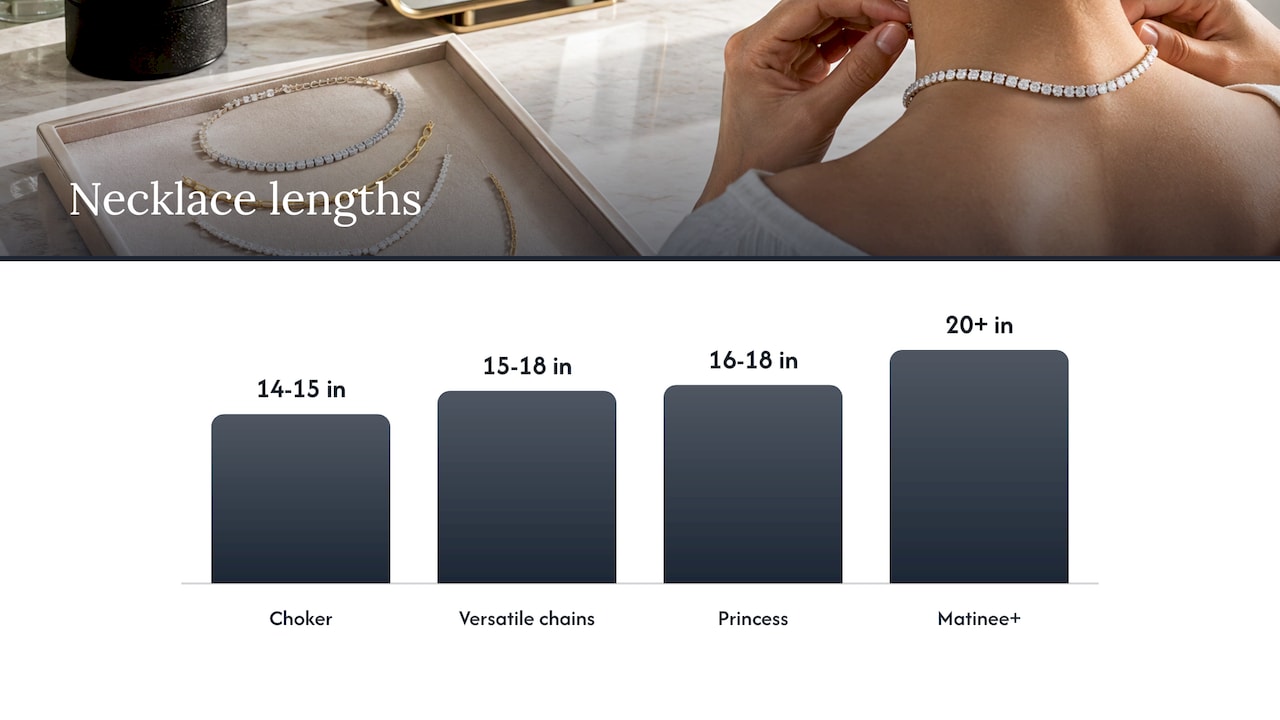
Length changes the whole personality of the piece. Designers have been pushing gold and diamond chains of about 15 to 18 inches as versatile, layerable alternatives to the classic.
- Choker, about 14 to 15 inches: sits at the base of the throat. Bold and formal.
- Princess, about 16 to 18 inches: rests at or just below the collarbone. The most popular and the easiest to wear every day.
- Matinee and longer, about 20 inches or more: drapes onto the chest. Works with open collars and layering.
Length is also a comfort decision. Jodi Reynolds, a designer at The Karat Concierge, told Forbes that smaller, lighter necklaces tend to roll, and that even body lotion can make the piece stick and rotate. A length that sits right at your collarbone keeps the stones facing forward.
To find yours, wrap a soft tape measure or a piece of string around your neck where you want the necklace to sit, then measure it flat.
2. Metal
The metal frames the stones. Reynolds noted in the same Forbes piece that white gold lets diamonds blend into one continuous line, while yellow gold draws the eye to the metal. So:
- White gold or platinum: the cleanest, most icy look. The line reads as pure stones.
- Yellow gold: warmer and more traditional. It pairs well with chains you may already own.
- Rose gold: softer and more romantic, and flattering on many skin tones.
3. Stones
This is where most of the price and most of the beauty lives. Total carat weight is the sum of every stone in the necklace, so a longer strand or larger stones means a higher number. Color, clarity and cut then decide how bright the line looks.
- Color: for a line of small stones, near-colorless grades look white in the setting. Our guide to near colorless diamonds, G to J grades explains where the sweet spot is, and the best color for lab diamonds covers the same question for lab-grown stones.
- Cut: the cut controls sparkle more than any other factor.
- Certification: Forbes notes that GIA certification is the standard to look for when diamonds are involved. For lab-grown stones, see IGI, GIA and GCAL certification compared.
When you compare pieces, evaluating diamond tennis necklaces comes down to the same few checks: consistency of stone size and color down the whole strand, a secure clasp, and clear documentation.
Why lab-grown works well here
A tennis necklace needs many stones, and every one adds to the cost. Lab-grown diamonds are real diamonds with the same structure as mined ones, so they are a practical way to get a fuller, more generous line. If you are new to buying them online, our step-by-step guide to comparing certified options walks through it.
How to wear a tennis necklace
The reason the style has returned is that it no longer demands an occasion. Forbes ties the current popularity to quiet luxury and notes that Zoe Kravitz has worn it with denim, knitwear and casual tailoring. National Jeweler adds that smaller-diamond versions have multiplied because they suit daytime and layering.
Some easy ways to wear one:
- Everyday: a slim 16 to 18 inch line with a plain tee, a crewneck sweater or a button-down with the top button open.
- Work: under a collared shirt or with a blazer and a simple neckline.
- Evening: with a scoop, V or off-the-shoulder neckline that lets the full strand show.
- Layered: the tennis necklace on top of the neck, with a longer chain or a small pendant below it. Keep the sparkly layer shortest and the textured layer longest.
- With earrings: pair it with simple studs. Let the necklace lead and keep the earrings quiet.
Chain or tennis necklace first?
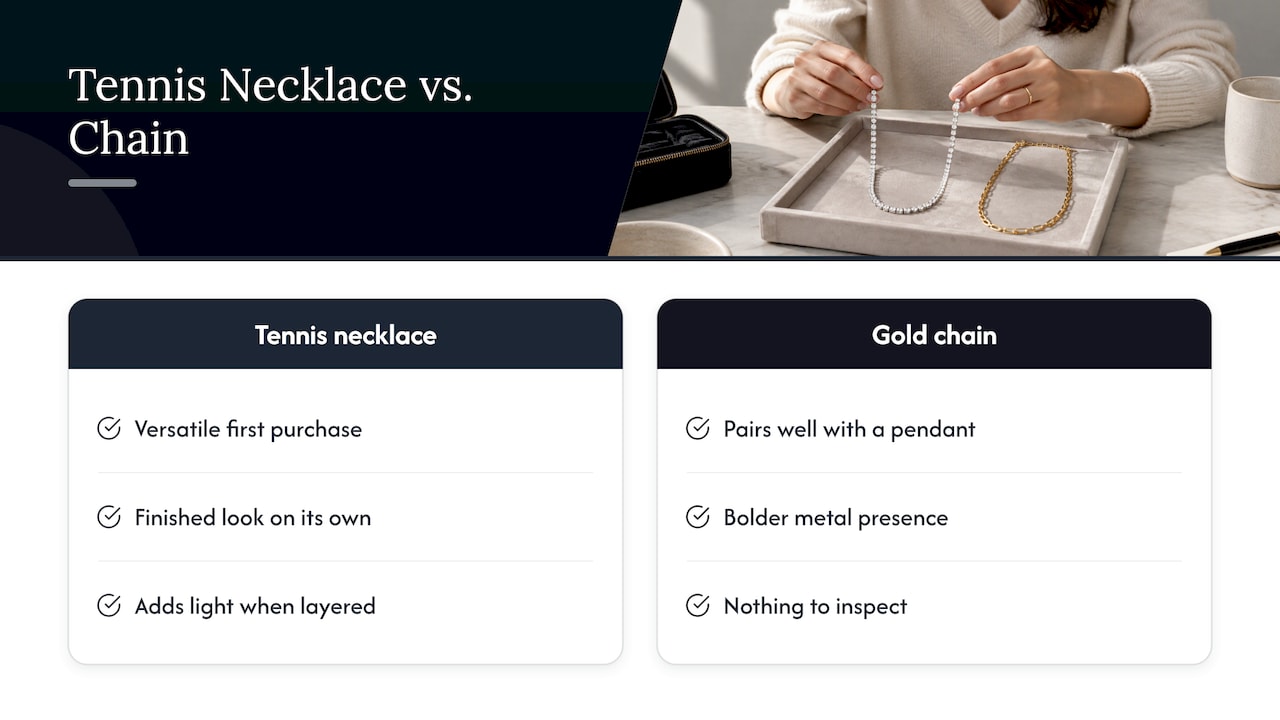
If you already own a gold chain, a tennis necklace adds a new kind of light and makes the chain look intentional when layered. If you own neither, a tennis necklace is the more versatile first purchase, because it is a finished look on its own. A chain suits you better if you love a pendant, want a bolder metal presence, or prefer a piece with nothing to inspect.
Buying as a gift? A tennis necklace in a classic length and a neutral metal is hard to get wrong. It also pairs naturally with a matching tennis bracelet later.
Care and checking the settings
A tennis necklace is built from many tiny parts, so a little routine keeps it secure.
- Check the clasp. It should close with a crisp, positive click. A box clasp with a safety catch adds security for daily wear.
- Look at the stones. Hold the necklace under good light and look for any stone that sits crooked, looks dull or seems loose. A stone that rattles when you shake the strand gently needs a jeweler.
- Keep it clean. Soak briefly in warm water with a few drops of mild dish soap, brush gently with a soft toothbrush, rinse and pat dry with a lint-free cloth.
- Put it on last. Apply lotion, perfume and hairspray first. Residue dulls the stones and, as noted above, can make the necklace rotate.
- Take it off for the gym, the pool and sleep. Store it flat in a pouch so the links do not tangle.
- Get a yearly inspection. A jeweler can tighten prongs and test the clasp before a problem starts. Stop wearing the necklace if you notice a loose stone or a clasp that feels loose, and have it looked at first.
Our perspective
We think the tennis necklace is the best way to wear diamonds without making a big event of it. It looks finished on its own, it needs no pendant, and it goes with a hoodie as easily as a dress.
Because it takes so many stones, the stone choice matters most. That is why we put lab-grown diamonds at the center of our collection: you can choose a fuller line, a better cut or a longer length without the budget getting in the way.
We source directly and aim to pass the savings on to you, and our jewelry comes with a lifetime guarantee, free worldwide shipping and a 60-day money-back guarantee. If you are choosing between a chain and a tennis necklace, we would start with the one that sparkles, then add the chain as a layer.
Andrew
Shop tennis-style necklaces
Our necklaces collection includes diamond and gemstone styles in a range of lengths and metals. If you prefer lab-grown stones, start with our lab-grown diamonds. To match the look with another piece, see our earrings and bracelets. Free shipping worldwide and a 60-day money-back guarantee apply to your order.

Looking for a deal? Our clearance sale is worth a look, and our guide to judging clearance diamond quality shows what to check.
FAQ
What is a tennis necklace?
It is a flexible necklace made of a continuous line of individually set diamonds or gemstones that circles the neck without gaps. It is the longer version of the tennis bracelet. The stones are usually the same size, set in prongs or bezels.
Is a tennis chain the same as a tennis necklace?
Yes. Both names describe the same style. “Chain” is the more casual term, often used for heavier or men’s styles, while “necklace” is the traditional jewelry term.
What do you wear a tennis necklace with?
Almost anything. It works with a plain tee, a knit sweater, a blazer or an evening neckline. For a layered look, put the tennis necklace shortest and add a longer chain or small pendant below.
What length should I choose?
For everyday wear, 16 to 18 inches is the usual starting point, since it rests near the collarbone. Choose a choker length for a formal look or 20 inches and up if you want it to drape and layer.
Can I wear a tennis necklace every day?
Yes, with a little care. Remove it for workouts, swimming and sleep, put it on after lotion and perfume, and have the clasp and settings checked by a jeweler about once a year.
Sources
- Diamond Tennis Necklaces: A Buying Guide, Gem Society
- Current Jewelry Trend: Don’t Call It a Tennis Necklace, National Jeweler
- Here’s Why The Tennis Necklace Earned Its Timeless Status, Forbes
Recommended
- Tennis Bracelet vs. Bangle: How to Choose the Right One
- Curb vs. Rope Chains: 2mm Rope for Comfort, Curb for Pendants
- Cuban vs Rope Chain: How to Choose the Right Style
- 16 vs 18 Inch Necklace: Which Length Fits You Best?
