Real gold is an alloy with a legally defined share of pure gold, marked with a karat stamp and a maker’s trademark. Fake gold is usually base metal that is plated or simply colored to look the part. The surest way to avoid the second is to buy from a seller that stands behind its karat marks in writing, and to know what those marks mean before you pay.
At SuperJeweler we sell engagement rings, wedding bands, earrings, necklaces and bracelets, and we back our jewelry with a lifetime guarantee and a 60-day money-back guarantee. This guide gives you the rules, the stamps and the home checks, with honest limits for each.
TL;DR
- Look for a karat stamp (10K, 14K, 18K, or .417, .585, .750) plus a maker’s trademark. The FTC says to skip gold jewelry with no trademark beside the quality mark.
- “Gold plated” or “gold filled” is not solid gold. Plating can be extremely thin.
- Home checks (magnet, scratch, vinegar, skin) are quick screens, not proof. A stamp can also be faked.
- For a valuable piece, a jeweler’s acid or X-ray test is the reliable answer.
- Keep receipts and written guarantees. They matter more than any home test.
Table of Contents
- Contents
- What counts as real gold
- Karat numbers and hallmarks decoded
- The many kinds of fake gold
- Color: what real gold looks like
- Home checks and their limits
- When a jeweler should test it
- How to buy gold with confidence
- Shop real gold jewelry with a guarantee
- Our perspective
- FAQ
- Sources
Contents
- What counts as real gold
- Karat numbers and hallmarks decoded
- The many kinds of fake gold
- Color: what real gold looks like
- Home checks and their limits
- When a jeweler should test it
- How to buy gold with confidence
- Our perspective
- FAQ
What counts as real gold
Pure gold is 24 karat. It is soft, so jewelry is almost always an alloy: gold mixed with other metals for strength and color. The U.S. Geological Survey explains that karats are parts in twenty-four, so 12K is half gold, and an 18K white gold stamp means 75% gold.
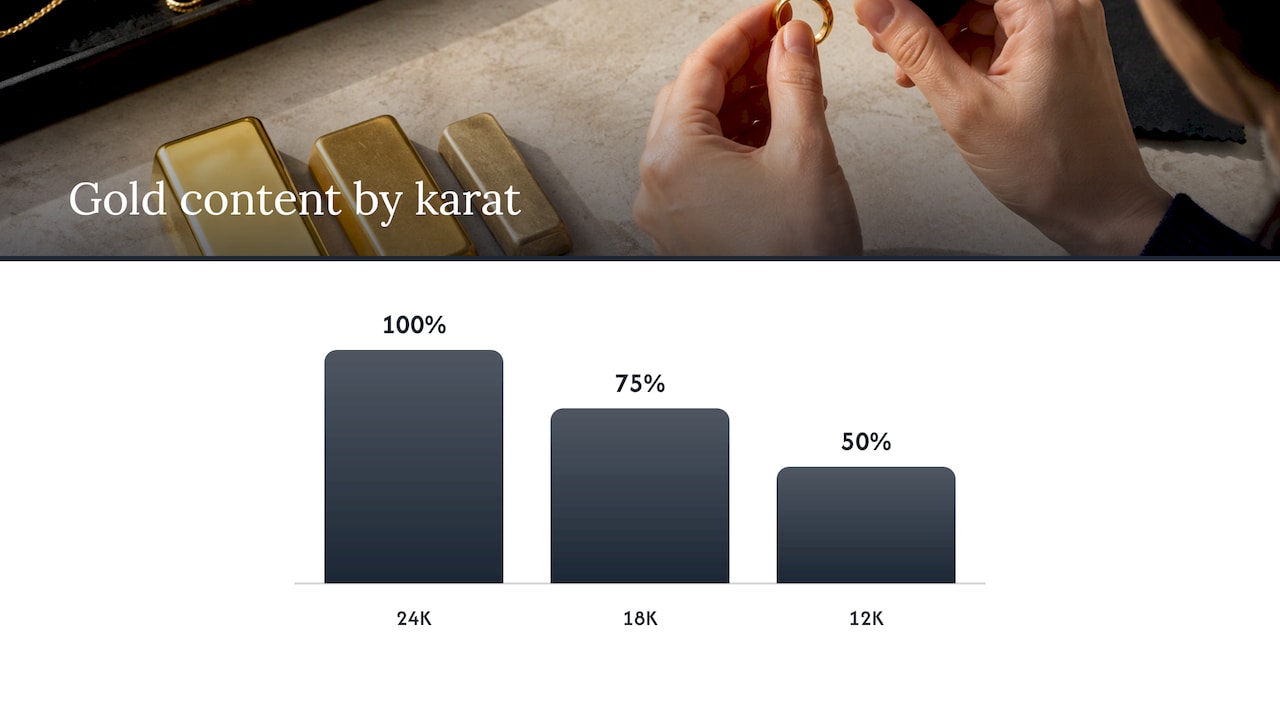
That means “real gold” is not one thing. A 14K ring is real gold, even though more than 40% of it is other metals. What is not real gold is a base-metal piece with a gold-colored surface.
Karat numbers and hallmarks decoded
The Jewelers’ Mutual metals chart lists the minimum gold content by weight:
| Karat stamp | Fineness stamp | Minimum gold content |
|---|---|---|
| 24K | .999 | 99.95% |
| 22K | .917 | 91.67% |
| 18K | .750 | 75.00% |
| 14K | .585 | 58.33% |
| 10K | .417 | 41.67% |
The World Gold Council notes that 10K is the traditional legal minimum in the U.S. and 14K is the most popular. It also explains that 14K is often stamped 585 following European practice, even though 14 divided by 24 is .5833.
Is 10K gold real?
Yes. 10K is real gold, just with the lowest gold share commonly sold. The FTC’s 2018 revision of its Jewelry Guides, as described in the Federal Register, allows gold terms below 10K when the karat fineness is disclosed clearly. In practice, a lower karat means less gold, so check the number against what you are paying.
The trademark matters as much as the number
The FTC’s consumer guide, All That Glitters, says the word “gold” by itself means 24-karat. Anything lower must carry its karat quality. It also says a registered trademark or company name should sit near the karat mark, identifying who stands behind it, and advises against buying gold jewelry without one.
The stamp is also regulated for accuracy. Under the National Gold and Silver Stamping Act, actual fineness may not fall more than three parts per thousand below the stamped figure when tested on a portion without solder, with a wider tolerance of seven parts per thousand for most items assayed whole.
A stamp is a clue, not a guarantee
GIA’s verification lab has documented counterfeits where a hallmark was engraved on a separate piece of metal and glued onto a base-metal item. Treat a stamp as the first thing to look for, not the last.
The many kinds of fake gold
“Fake” covers several different products, and the law treats them differently. The FTC’s Jewelry Guides call it deceptive to misrepresent the presence or karat of gold, or the thickness and method of any gold plating.
- Gold plated or electroplated: a thin gold layer over another metal. Electroplate needs at least 0.175 microns of fine-gold equivalent thickness, and heavy gold electroplate 2.5 microns, per the Federal Register.
- Gold filled: a heavier layer, at least 1/20 of the item’s weight, bonded mechanically.
- Rolled gold plate or gold overlay: at least 1/40 by weight.
- Vermeil: gold over sterling silver.
- Gold-colored base metal: brass, copper alloys or similar, sold with no real gold claim at all.
- Gold-plated tungsten: the hardest fake to spot, because tungsten is almost exactly as dense as gold, 19.3 g/cm³, according to Gramercy Gold. It is mostly a risk with bars and coins, not ordinary jewelry.
A plated piece sold honestly as plated is not a scam. It is simply not solid gold, and its value is much lower.
Color: what real gold looks like
Pure gold is a rich, almost buttery yellow. Alloying changes that: copper adds a rosy tone, and white metals like nickel or palladium lighten it. Lower karats allow more color variety, according to the Jewelers’ Mutual chart.
White gold is usually coated with rhodium for its bright white look, and that coating may need renewing about every six months. A white gold ring that warms to a pale champagne tone has not turned fake. If you are weighing metals for a ring, our comparison of sterling silver vs white gold covers it.
Color alone proves nothing, since plating copies it. Use it only as a first impression.
Home checks and their limits
Home tests can raise a red flag. They cannot give a clean pass. Here is what each one tells you, based on the goldsilver.com testing guide.
- Inspect the marks. Look under good light or a loupe for a karat stamp and trademark. Blurry, uneven or oddly placed stamps deserve suspicion. Remember stamps can be faked.
- Magnet test. Gold is not magnetic, so a strong pull means base metal. But passing proves nothing, because many non-magnetic metals look like gold. Clasps and springs inside real pieces can contain magnetic steel.
- Skin and discoloration check. Green or black marks on skin or a visible color change hint at base metal, but humidity, lotion and skin chemistry muddy the result.
- Ceramic scratch test. Drawing the piece across unglazed ceramic leaves a gold streak for gold and a black or gray streak for base metal. It is mildly destructive, so never do it on a ring you love.
- Vinegar test. The weakest check. It is milder than the acids professionals use and misses many well-made fakes.
- Density test. Weigh the piece in grams, then hang it fully submerged in water on a zeroed scale to read its volume, and divide. Gramercy Gold’s method puts pure gold at 19.3 g/cm³, silver at 10.5 and copper at 9.0. Alloys read lower than pure gold, and small pieces with stones make the math unreliable.
A note on the toothpaste and “bite” tricks you may see online: they can scratch or damage solid gold. Skip them.
When a jeweler should test it
For anything valuable, an inherited piece, or a purchase you are unsure about, professional testing is the right step.
- Acid and touchstone testing. In GIA’s touchstone method, the unknown piece and reference needles of known karat are rubbed on a stone and treated with measured acids. The reaction shows which known karat the piece matches. It uses hazardous acids and requires gloves, goggles and ventilation, so it is a bench job, not a kitchen one.
- XRF (X-ray fluorescence). Each element emits a characteristic X-ray signature, and GIA’s 2024 laboratory overview explains that this lets labs measure precious metal content and spot plating without damage. The devices require training and safety protocols.
- Ultrasonic testing. Sound travels through gold and tungsten at different speeds, so it can catch a tungsten core that XRF might miss, according to goldsilver.com. This matters mostly for bars and large pieces.
No method is perfect. A GIA study found XRF most accurate on flat, uniform pieces tested against a similar calibrated alloy. That is why a trained person reading the result matters.
How to buy gold with confidence
Most buyers never need to test anything, because the best protection happens before payment.
- Check the listing for karat and metal. Reputable listings state “14K yellow gold,” not just “gold tone” or “gold finish.”
- Look for the stamp and trademark when the piece arrives.
- Read the guarantee. The Better Business Bureau advises readers to read refund, warranty and lifetime guarantee fine print before buying, and to keep the receipt and any appraisal or certificate.
- Be wary of prices far below the market. Gold has a global price, and a heavy, “solid” piece at a bargain figure deserves questions. Our guide to diamond scams online lists the same warning signs for stones.
- Know your hardness trade-offs. If you are choosing a band, see how tungsten compares with gold for durability and resizing.
The same logic applies to marked-down jewelry. Our clearance jewelry guide shows how to shop markdowns by reading the metal and karat details first.
Shop real gold jewelry with a guarantee
If you want the question answered before the box arrives, start with pieces sold with their metal and karat listed. SuperJeweler offers gold rings, wedding bands, earrings and necklaces, with free worldwide shipping, a lifetime guarantee and a 60-day money-back guarantee.

Browse the full range at SuperJeweler, or check the clearance sale for markdowns on the same kind of jewelry.
Our perspective
Most people who ask us about fake gold are really asking a different question: can I trust what I am buying? A home test cannot answer that, and neither can a stamp alone.
What answers it is a seller that states the karat, sources directly and backs the piece afterward. That is why we offer a lifetime guarantee on our jewelry and a 60-day money-back guarantee, and why we focus on in-house craftsmanship and ethical sourcing.
When you shop for a ring, a pair of earrings or a necklace you will wear for years, read the karat, the metal and the guarantee before anything else. Those three lines tell you more than any scratch test.
Andrew
FAQ
How can you tell if gold is real?
Start with the karat stamp and the maker’s trademark, then use gentle screens such as a magnet and a close look at wear. None of these prove purity. For a valuable piece, have a jeweler run an acid or X-ray test.
Is 10K gold real or fake?
10K is real gold. It contains at least 41.67% gold by weight, with the rest being alloy metals for strength. It is more durable than higher karats and costs less, but it holds less gold.
What color is real gold?
Pure gold is a deep, warm yellow. Jewelry gold can be yellow, white or rose depending on the alloy, and white gold is typically rhodium plated. Color alone cannot confirm authenticity because plating copies it.
Is gold plated jewelry fake gold?
Gold plated jewelry has a real gold layer, but it is not solid gold. The layer can be very thin: electroplate may be as little as 0.175 microns of fine-gold equivalent. It should be sold as plated, not as gold.
Can a hallmark be faked?
Yes. GIA’s lab has documented stamps engraved on separate metal and glued onto base-metal items. That is why the seller’s reputation and written guarantee matter alongside the mark.
Sources
- USGS: What is the meaning of the karat mark on gold jewelry?
- Jewelers’ Mutual: Just the Facts metals chart
- World Gold Council: Gold jewellery, colour, carat and purity
- FTC: All That Glitters… How to Buy Jewelry
- U.S. Code Title 15, National Gold and Silver Stamping Act
- eCFR: 16 CFR Part 23, Jewelry Guides
- Federal Register: Guides for the Jewelry, Precious Metals, and Pewter Industries
- GIA: Touchstone method bench tip
- GIA: Chemical analysis in the gemological laboratory
- GIA: Methods for determining the gold content of jewelry metals
- Better Business Bureau: Buying and selling jewelry
- Six fake gold tests, and the one even X-rays miss
- How to tell if gold is real: the tests that work
Recommended
- Sterling Silver vs White Gold: Which Metal Should You Buy?
- Tungsten vs Gold Wedding Bands Trade 10x Hardness for Resizing
