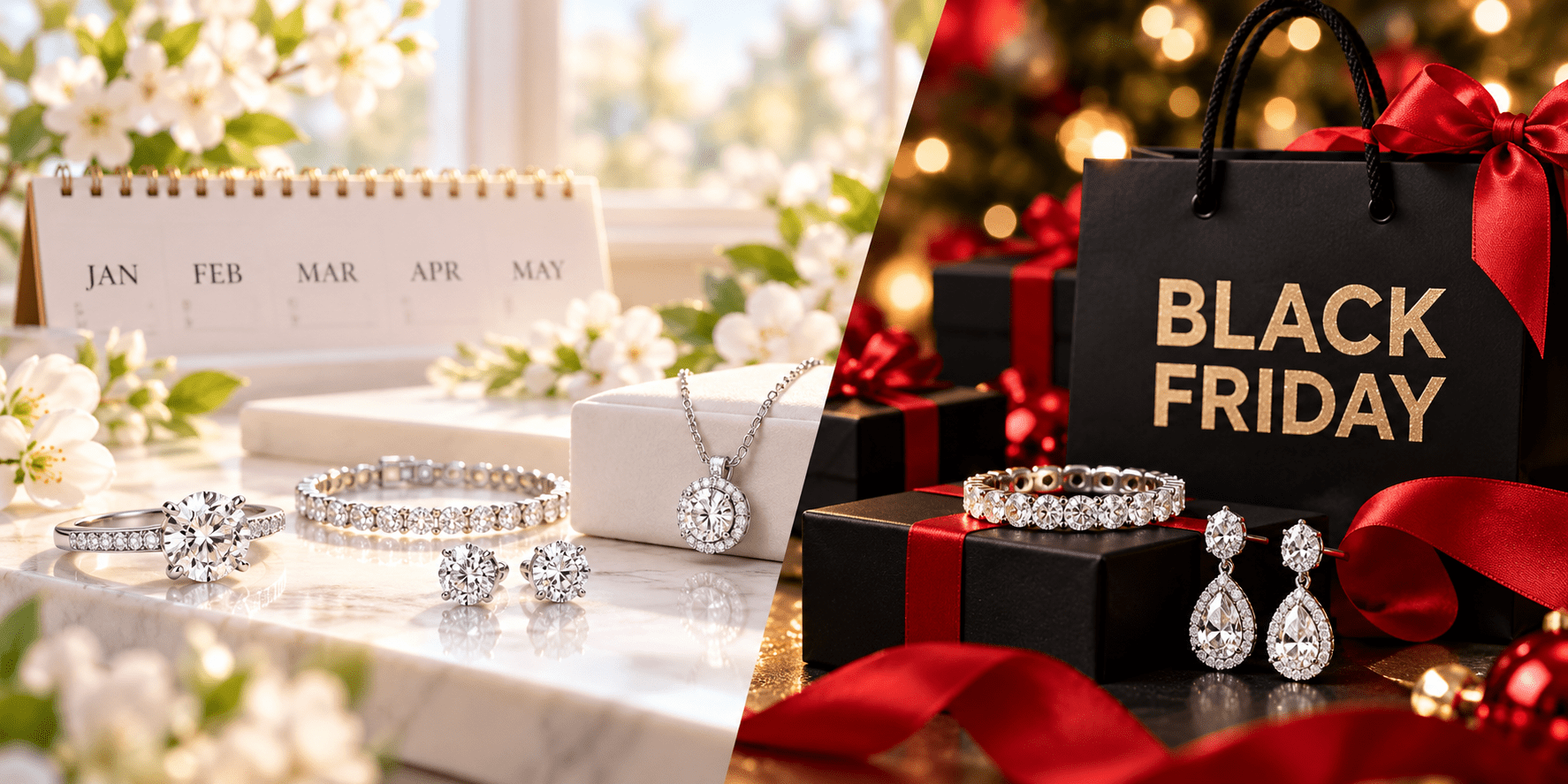
The best time to buy jewelry is usually early January through May, when demand cools and jewelers have room to talk, with late November a close second for advertised deals. Follow one rule: buy off-peak if you want selection and service, or buy during a major sale event if you want the biggest discounts. Check the GIA and FTC guidance below before you pay.
TL;DR:
- Valentine’s Day and Mother’s Day bring strong selection but few price cuts, while late December discounts tend to appear only after Christmas.
- Treat discounts of 50% or more as a warning sign; compare the actual selling price, return window, warranty, and grading report before paying.
- A 0.90 carat diamond can look nearly identical to a 1.00 carat stone; redirecting the savings toward cut quality may improve visible sparkle.
- For a custom ring, begin months ahead and request a written completion date; July or August orders can avoid holiday workshop delays and rush fees.
- Ask sellers to document metal purity, treatments, and gemstone origin, and confirm return terms in writing; federal guidance requires truthful descriptions.
Table of Contents
- Which months give you the best shot at a good deal?
- How do holiday sales actually work?
- Why does timing change price and selection?
- When should you start shopping for an engagement ring or custom order?
- What money-saving tactics work in any month?
- Should you buy jewelry online or in store?
- What do GIA, the FTC, Jewelers of America and the NRF say that matters to you?
- Is there a summer slump in jewelry buying?
- How do gemstone sourcing and market cycles affect prices?
- How do jewelry trade events affect pricing and availability?
- Andrew’s take: match the timing to what you want most
- Ready to shop? Start with these categories
- FAQ
- Sources
Which months give you the best shot at a good deal?
Your best window depends on what you value most. Here is how the main periods stack up:
- Early January to March: Post-holiday quiet. Stores want to move stock, staff have time for you, and prices are easier to discuss. Best for engagement rings and custom work.
- March to May: Spring refresh. New inventory arrives and shoppers who started researching in winter can buy before Mother’s Day crowds. Good balance of selection and service.
- Late November: Black Friday and Cyber Monday bring the biggest advertised markdowns, especially online. Best for gifts and fashion pieces.
- February and early May: Valentine’s Day and Mother’s Day. Selection is strong, but demand is at its peak, so deals are rare.
- Mid-December: Selection thins and shipping deadlines tighten. Worth it only for in-stock items.
The tradeoff is simple. Holiday weeks give you the most to choose from but the least flexibility on price. Quiet months flip that.
If you’re buying a gift on a deadline, aim for the November sales. If you’re buying an engagement ring, start in January and plan ahead so you never shop under pressure. For custom pieces, the quiet months also mean shorter waits for the bench jeweler’s attention.
How do holiday sales actually work?
Retailers build promotions around moments when shoppers already plan to spend. That creates real deals in some windows and thin ones in others.
- Black Friday and Cyber Monday: Retailers compete hard on advertised discounts, and many starts online sales days early. November is the one month where large percent-off banners are common across the industry. Always compare the sale price with the price outside the sale.
- Valentine’s Day: Demand is driven by gift deadlines, so stores have little reason to discount. Expect promotions on bundles and free shipping rather than deep price cuts.
- Mother’s Day: Same dynamic, with a slightly longer shopping window in late April and early May.
- Christmas: Prices hold early in December. Markdowns tend to show up in the last days or right after, once leftover stock becomes a problem.
- Post-holiday clearance: Watch late December through January for marked-down items, discontinued styles and floor models.
The scale of seasonal demand is real. The NRF reported that jewelry leads Mother’s Day spending, with shoppers expected to spend about $7.5 billion on jewelry in 2026. When that many people shop in the same weeks, sellers don’t need to cut prices.
Why does timing change price and selection?
Jewelry pricing follows the same forces as most retail: demand, inventory and cost. When demand surges around gifting holidays, sellers hold prices and reorder fast. When demand drops, they carry more stock than they want and become more willing to negotiate or run promotions.
Inventory refreshes matter too. New collections often land in spring and fall, which pushes older styles toward clearance. If you’re flexible on design, last season’s piece can be the better value.
Then there is diamond weight. GIA notes that diamonds are priced exponentially by weight, with notable jumps at “magic” thresholds of 0.50, 0.75 and 1.00 carats. A stone just under a threshold often looks nearly identical to the heavier one but costs noticeably less. A 0.95 carat diamond and a 1.00 carat diamond are close to indistinguishable face-up, yet they price differently.
GIA also says the old three-month-salary rule is outdated. It advises choosing a budget that is comfortable and based on your own priorities, as explained in its guide on how much an engagement ring should cost. In practice, deciding which of the 4Cs matters most to you usually saves more than perfect timing.
Pro Tip: Set your budget first, pick your top one or two of the 4Cs, then shop a stone just below a carat threshold in a quiet month.

When should you start shopping for an engagement ring or custom order?
Work backward from your proposal or event date. Ready-to-ship rings can arrive in days, but custom designs involve design approval, casting, stone setting, finishing and sometimes resizing. Holiday seasons stretch every one of those steps because workshops are busy.
A practical timeline:
- Well before your date: Research styles, set a budget and learn the 4Cs. Compare shapes and settings. Our guide on oval versus round diamonds helps with the visual tradeoffs.
- Before placing your order: Choose the stone and setting. Confirm the grading report and the return policy before you pay a deposit.
- Allow enough lead time: Place the order for a custom piece. Ask for a written completion date.
- Before your event: Allow time for sizing, engraving and any adjustments. Engraving is a common source of last-minute delays.
- Before the event: Inspect, insure and store the ring. Keep a buffer for shipping.
Rush fees usually appear when you order inside the typical production window. Ordering in January through March, when workloads are lighter, often avoids them. Ordering in November or early December for a Christmas proposal is where delays and rush charges pile up.
What money-saving tactics work in any month?
Timing helps, but habits save more. These work year-round:
- Distrust extreme discounts. Jewelers of America warns that advertised discounts of 50% or more are often a red flag, because the “original” price may be inflated.
- Shop off-peak. Quiet months give you attention, flexibility and sometimes better terms.
- Buy just under carat thresholds. Pick 0.90 instead of 1.00 and put the savings toward cut quality.
- Use clearance and layaway. Marked-down inventory can be excellent value, and a payment plan spreads the cost. Read our guide to layaway plan terms before you sign.
- Spend on what you can see. Cut usually shows more than color or clarity grades that sit beyond what the eye can detect.
- Verify the paperwork. Check grading reports, return windows and warranty terms. The FTC’s Jewelry Guides require sellers to describe metal purity, treatments and origin truthfully.
Pro Tip: Screenshot the listing, the grading report number and the return policy before you buy, so you can compare them with what arrives.
Should you buy jewelry online or in store?
Neither channel wins every time. Match the channel to your timing.
Online advantages:
- Easy price comparison across many styles and sizes
- Early Black Friday and Cyber Monday offers, plus year-round clearance sections
- Shopping at any hour, which helps when the holiday deadline is close
In-store advantages:
- Hands-on appraisal of sparkle, color and proportions
- Ring fittings and same-day sizing advice
- More room to negotiate service and terms in slow months
The hybrid approach often works best: research and narrow your list online, then buy in store during January to May, or use an online offer in late November once you know exactly what you want. GIA’s holiday shopping guidance points the same way, suggesting that online shopping can work when time is limited as long as you verify grading and return policies.
What do GIA, the FTC, Jewelers of America and the NRF say that matters to you?
Four organizations shape how you should read any sale:
- GIA: Build your budget around your own priorities and the 4Cs, not rigid formulas. Carat thresholds affect pricing.
- FTC: Sellers must be truthful about materials, treatments and claims in advertising.
- Jewelers of America: Extreme discounts can mislead. Compare policies and warranties, not only price tags.
- NRF: Seasonal demand spikes at Valentine’s Day and Mother’s Day, which is why deals are scarce then.
Valentine’s Day 2026: The NRF expects shoppers to spend about $7 billion on jewelry, a reminder of how concentrated gifting demand is in February.
Is there a summer slump in jewelry buying?
Summer is typically the slowest stretch of the retail year for fine jewelry. There is no major gifting holiday between Mother’s Day and the fall, vacations pull attention away from shopping, and wedding season keeps many couples focused on events rather than purchase.
When foot traffic and online browsing slow down, jewelers have time to answer questions, explain grading reports and work through custom designs. You are less likely to feel rushed or to run into sold-out sizes. Some retailers use the lull to run mid-year promotions or clear spring inventory, so watch for those, and apply the same discount skepticism you would in November.
Summer is also a smart moment to buy ahead for fall engagements. If you plan to propose around the holidays, ordering a custom ring in July or August leaves a comfortable buffer for sizing and engraving, so you avoid the November and December rush.
Be realistic about the limits. A slow season does not guarantee a lower price, and a good sale in July is not automatically better than a good sale in November. What summer reliably gives you is time and attention. Use it to compare stones, ask about warranty terms and confirm return windows.
If you are shopping for yourself rather than a gift, summer lets you buy without a deadline. Choose a piece you will wear in warm weather, such as lightweight earrings or a bracelet, and check that clasps and settings suit daily wear.

How do gemstone sourcing and market cycles affect prices?
Jewelry prices do not move only with the shopping calendar. They also follow what happens upstream, where stones are mined, grown, cut and traded, and where metals are bought and sold.
Supply is a big factor. Natural gemstones come from a limited number of sources, and mining output, weather, regulation or political events can tighten supply. When fewer high-quality stones reach the market, wholesale prices tend to rise, and that eventually shows up at retail. Lab grown diamonds follow a different path because production can be scaled, which is one reason many value-minded shoppers look at them first. You can browse our lab grown diamonds to compare options.
Metal costs matter too. Gold, platinum and silver trade on global markets, and a jump in the metal price can raise the cost of a finished ring even if the stone price stays flat. That is why a setting can look more expensive in one season than the same design did months earlier.
Demand cycles add another layer. Fashion trends can make a particular shape, color or gem suddenly popular, which raises prices until supply catches up. A less trendy but equally beautiful alternative can offer better value.
What does this mean for you? Don’t try to predict the market. Instead:
- Compare similar stones across several sellers on the same day.
- Ask where a stone comes from and whether it has independent grading.
- Be flexible on shape, color or origin when a cheaper option looks just as good.
Under the FTC’s Jewelry Guides, sellers must also disclose treatments and origin accurately, so ask for that information in writing.
How do jewelry trade events affect pricing and availability?
The industry runs on a trade calendar that most shoppers never see. Large trade shows bring manufacturers, designers and retailers together to preview collections, place orders and negotiate wholesale prices. Those decisions shape what ends up in stores months later.
Here is how that reaches you. After a major show, retailers commit to new styles and set inventory for the coming season. New collections tend to appear in spring and fall, which pushes older designs toward markdowns. If you are happy with a slightly earlier style, you can often buy it at a better price once the new line arrives.
Trade events also influence availability. Popular designs and certain gemstones can sell out wholesale, which means fewer options at retail, particularly in the weeks before a major gifting holiday. That is another reason to shop early for Valentine’s Day, Mother’s Day and Christmas rather than waiting for last-minute deals.
You don’t need to attend a trade show to benefit from them. Watch for these signals instead:
- New collection launches, which often signal clearance of last season’s designs.
- “Last chance” or “final stock” labels on discontinued styles.
- Limited sizes or stone options on trending designs.
When you spot a discontinued piece you love, confirm the warranty, return policy and grading details before buying. A markdown is only a bargain if the paperwork is solid.
Andrew’s take: match the timing to what you want most
Here is how I’d put it together. If you value choice and service, shop January through May and give yourself months, not weeks. If you want the loudest discounts, shop late November and verify every claim. Whatever you choose, set your budget and timeline first. We offer rings, lab grown diamonds and clearance assortments at SuperJeweler that fit these tactics, so you can act on this whenever your window opens.
— Andrew
Ready to shop? Start with these categories
If your timing is right, we make it easy to act. Browse our rings for engagement and fashion styles, explore lab grown diamonds for strong value, or check the clearance sale for marked-down pieces. We offer custom options if you want something made to your plan.

Start with a category above and compare before you decide.
FAQ
What month is jewelry cheapest?
There is no single cheapest month, but quiet periods such as January through March often offer the most flexibility, and late November offers the biggest advertised discounts. Gifting months like February and May usually have the least room for deals.
What is the 2:1:1 rule in jewelry?
We don’t rely on a fixed formula like this. GIA advises building your budget around your own priorities rather than rigid rules. Decide which of the 4Cs matters most to you and spend there first.
What is the 3 month ring rule?
It usually refers to the old three-month-salary guideline for engagement rings. GIA calls this rule outdated and recommends choosing a budget that feels comfortable for you instead.
When should I order a custom engagement ring?
Start researching well ahead of your date and place a custom order with enough lead time for production. Ordering in a quieter month helps you avoid rush fees and holiday delays.
Sources
- Jewelry Guides | Federal Trade Commission
- Jewelry Shopping FAQs | Jewelers of America
- Mother’s Day Spending Expected to Hit Record $38 Billion | NRF
Recommended
- Jewelry Layaway Plans: 4 Terms Shoppers Should Check Before Paying
- Size or Sparkle: How Buyers Choose Between Oval and Round Diamonds
- Wearable Stackable Rings: 3–5 Rings, Fit Tips, and Durable Stones
