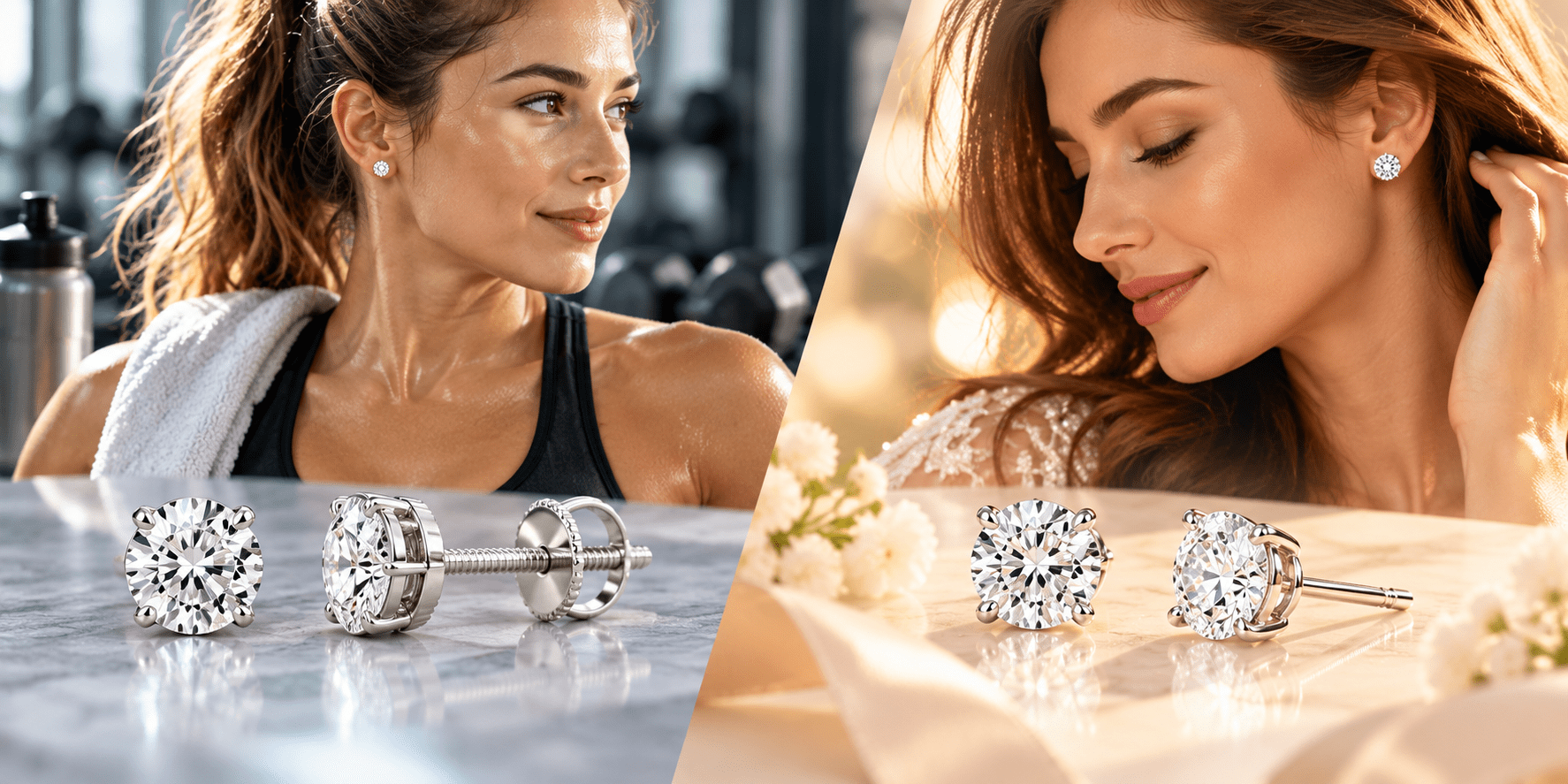
For everyday wear, we recommend prong or basket settings when sparkle is the priority, bezel or partial bezel settings when protection matters most, and a low-profile bezel or secure basket paired with screw backs for active lifestyles. The right pick also depends on your earring backs and metal choice, both of which we cover below along with how to match them to your routine.
TL;DR:
- For larger stones, six prongs distribute pressure more evenly than four; V prongs or bezels protect pointed princess, marquise, and pear corners.
- Screw and La Pousette backs offer high security; friction backs can loosen and need tension adjustments, while larger discs help heavy studs sit flat.
- A 0.25 to 0.50 carat total weight per earring looks subtle; at 0.75 carat or more, a bezel or basket can support added weight.
- Press each stone monthly to check for movement, and schedule a jeweler’s inspection at least annually, or more often with heavy daily wear.
- Before buying, confirm the listing identifies the setting, metal, back, and diamond origin, and check for written details on weight, size, and clarity enhancements.
Table of Contents
- Core Setting Types: Prong, Bezel, Martini, Basket, and Halo
- Why Setting Style Changes Sparkle and Perceived Diamond Size
- Protection and Durability: Which Settings Resist Chips and Loss
- Earring Backs and Fit: Choosing the Right Support
- Matching Setting, Back, and Metal to Your Lifestyle
- How Metal Choice and Finish Affect Appearance and Comfort
- Choosing the Right Size for Your Ear and Face
- Keeping Your Settings Secure: Maintenance and Inspection
- Craftsmanship, Disclosure, and Buying With Confidence
- A Simple Checklist Before You Buy
- Where to Shop for Diamond Stud Settings
- FAQ
- Sources
Core Setting Types: Prong, Bezel, Martini, Basket, and Halo
Each setting style changes how much diamond shows, how the earring sits on your ear, and how the stone is held in place. Understanding the mechanics helps you weigh sparkle against security before you buy.
Prong settings use a minimal number of thin metal claws, typically four or six, to hold the diamond while leaving most of its surface exposed. According to GIA’s guide to diamond stud earrings, prong settings use minimal metal to maximize light return and the diamond’s perceived size, which is why they remain the classic choice for sparkle-focused studs.
Bezel settings do the opposite: a thin rim of metal wraps around the diamond’s girdle, covering the edge completely.
Martini settings are a variation on the prong style, tapering the metal into a cone shape beneath the diamond so the stone appears to float with little visible metal. Basket settings use a slightly more open, rounded understructure of metal to support the diamond from below while still showing prongs on top. Halo settings surround the center diamond with a ring of smaller accent stones, adding sparkle around the perimeter and making the central diamond look larger.
Common variations include:
- V-prongs, which cup pointed corners on princess or marquise cuts to prevent chipping.
- Partial bezels, which protect only the most vulnerable edges while leaving the rest of the stone open to light.
- Double-prong or six-prong settings, which add extra security for larger stones without fully enclosing them.
Why Setting Style Changes Sparkle and Perceived Diamond Size
The amount of metal around a diamond directly affects how much light enters and exits the stone, which is why setting choice matters almost as much as cut quality when it comes to brilliance.
Prong settings expose the most diamond surface, and fewer or thinner prongs mean more open space for light to travel through. GIA notes that less metal yields more visible diamond and that this directly supports greater light return and a larger apparent size, which is why a well-cut diamond in a four-prong setting often reads brighter than the same stone in a heavy bezel.
Halos and white-metal bezels can make small diamonds look larger. GIA’s stud earring guidance confirms that a halo of accent stones or a white-metal surround can visually expand a modest center stone, a useful trick if you want presence without upgrading carat weight.
None of this replaces cut quality. A poorly cut diamond will look dull in any setting, while a well-cut stone performs well across styles. Round brilliants pair naturally with prong or martini settings that maximize light return, while fancy shapes like princess or emerald cuts often benefit from bezels or V-prongs that protect their corners.

Protection and Durability: Which Settings Resist Chips and Loss
If you wear your studs daily, through workouts, work gloves, or sleep, durability deserves as much weight as sparkle.
Bezel settings protect the diamond’s girdle and edges from the impacts of daily life, which is why GIA points to them as a strong choice for active lifestyles. A full bezel covers the entire perimeter, while a partial bezel shields only the most exposed points while keeping more of the stone visible.
Prong settings carry more risk of snagging on hair, clothing, or gloves, and their security depends heavily on workmanship. GIA’s bench-quality benchmarks for prong settings specify a prong angle of 70 to 80 degrees, sufficient bearing fit, and consistent prong height relative to the table, all of which reduce the risk of a stone working loose over time.
A few practical rules help you choose with confidence:
- Ask about prong count: six prongs distribute pressure more evenly than four on larger stones.
- Check prong height: prongs that sit too high above the table catch on fabric and hair more easily.
- Consider V-prongs or bezels for pointed cuts: princess, marquise, and pear shapes chip most often at their corners.
- Favor bezels for daily-wear studs: the enclosed edge resists the bumps of a typical day far better than an open prong.
Earring Backs and Fit: Choosing the Right Support
The back is often the single weakest point in a stud earring, regardless of how well the stone is set.
- Screw backs and La Pousette backs offer the highest security. The FTC’s guidance on buying diamonds categorizes these mechanisms as high security, making them a sound choice for high-value or sentimental studs.
- Friction, or butterfly, backs are common but offer medium security. The same FTC guidance notes that friction backs can loosen over time and may need periodic tension adjustments.
- Back diameter affects how studs sit. A larger disc distributes weight across more of the earlobe, helping heavier stones sit flat instead of drooping forward.
- Bench jewelers can tighten loose friction backs. GIA’s bench tip on adjusting earring backs describes adjusting the curvature of clutch springs or using a small burr to create indents so the clutch seats more securely, a routine and inexpensive service.
Matching Setting, Back, and Metal to Your Lifestyle
Your daily routine should drive your setting choice more than trends do.
- Active lifestyles (gym sessions, manual work, frequent glove use): a low-profile bezel or secure basket setting paired with a screw or locking back minimizes snag risk and keeps the stud in place through movement.
- Office and daily wear: a four-prong or martini setting with a medium-security friction back balances comfort with everyday sparkle, since the risk of impact is lower than during active pursuits.
- Special occasion pieces: a six-prong or halo setting with maximum light exposure makes sense for events, even if it trades some protection for extra brilliance, since the earrings see less wear-and-tear exposure on those days.
Pro Tip: If you only own one pair of diamond studs, choose a setting and back built for your busiest day, not your fanciest one.
How Metal Choice and Finish Affect Appearance and Comfort
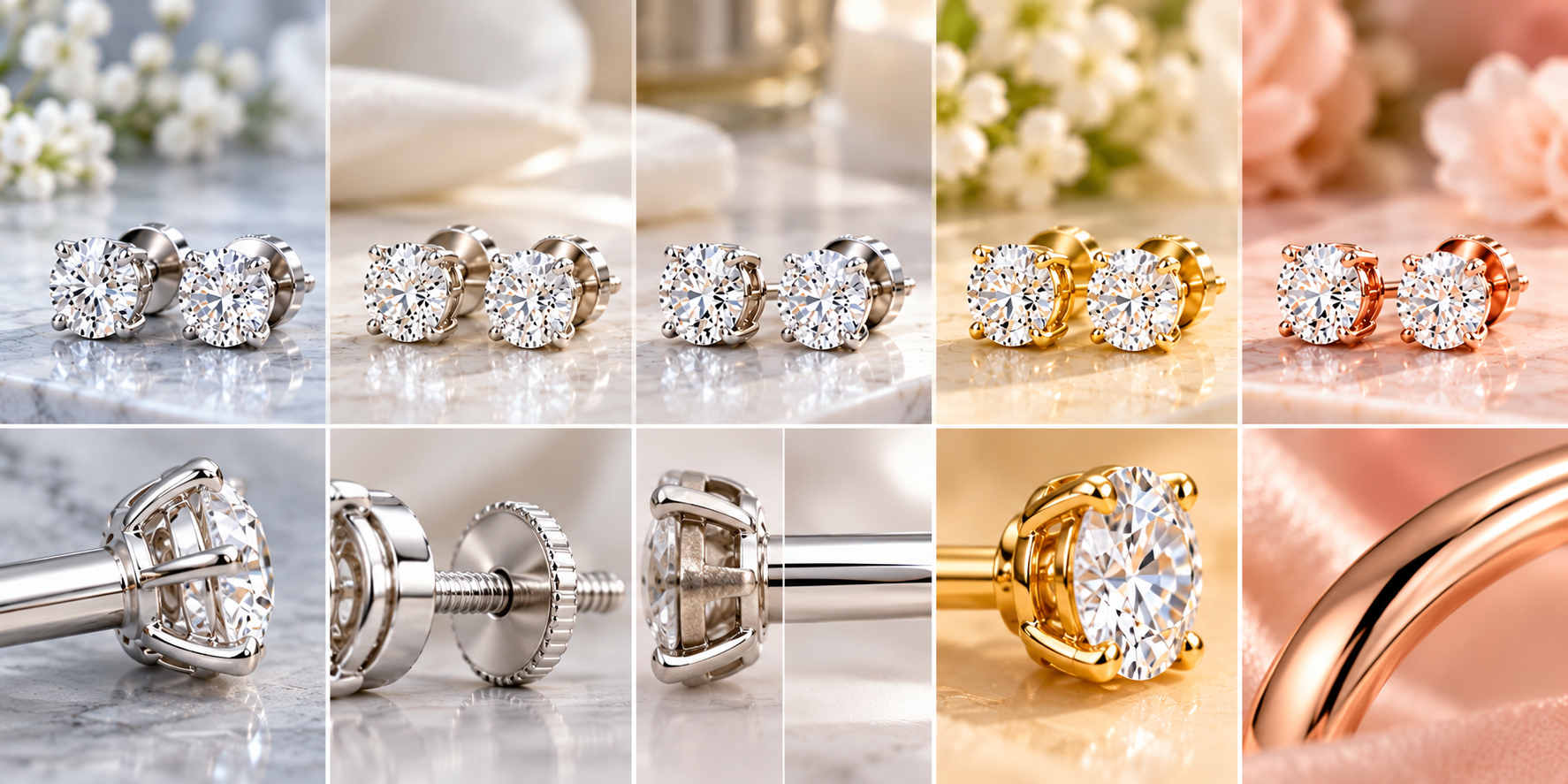
Metal color interacts directly with how a diamond reads to the eye, and it also determines how much upkeep your studs need.
- White metals like platinum and white gold complement colorless diamonds by blending with the stone rather than introducing warm tones at the edges.
- Rhodium plating gives white gold its bright white finish, but the plating wears over time and needs reapplication to keep that look.
- Platinum resists tarnish and holds prongs securely over decades, though it develops a soft patina that some buyers polish away and others prefer to keep.
- Yellow and rose gold warm up the overall look and can suit diamonds with a slight tint, since the warmer metal tone masks faint color.
- Nickel-sensitive buyers often do better with platinum or higher-karat gold, since lower-karat white gold alloys sometimes contain more nickel.
Choosing the Right Size for Your Ear and Face
Diamond stud size affects both how the earring looks on your ear and how a given setting performs visually.
- 0.25 to 0.50 carat total weight per earring sits close to the earlobe and reads as a subtle, everyday size, especially in a prong or martini setting that keeps the stone visible.
- 0.75 to 1.0 carat and above creates noticeably more presence and benefits from a bezel or basket setting that supports the added weight without excessive height.
- Halo settings can make a smaller center stone appear closer to the next carat size up, a useful option if presence matters more than carat weight alone.
- Earlobe proportion matters: smaller lobes often suit studs that sit closer to the ear, while larger lobes can carry bigger stones comfortably.
- Weight versus diameter: a wider, shallower stone often feels more comfortable over a full day than a deep stone of the same carat weight, since less weight projects forward from the lobe.
Keeping Your Settings Secure: Maintenance and Inspection
A secure setting today does not stay secure forever, which is why regular checks matter as much as the initial purchase.
- Do a monthly press test: gently press each diamond to feel for movement, and look for visible gaps between the stone and its prongs or bezel.
- Watch for dirt buildup: a cloudy or dull diamond often signals lotion or soap residue rather than a damaged stone, and a soft brush with mild soapy water usually clears it.
- Schedule a professional check annually, or more often with heavy daily wear; Jewelers of America recommends periodic inspection to catch loose prongs or worn mountings before a stone is lost.
- Avoid harsh chemicals and ultrasonic cleaners at home on settings with filled fractures or coatings, and let a bench jeweler handle deep cleaning and prong re-tipping.
Craftsmanship, Disclosure, and Buying With Confidence
Before you buy, confirm the setting type, metal, and back style listed on the product page, along with clear documentation of the diamond’s origin. The FTC’s Jewelry Guides require sellers to clearly disclose lab-grown or treated diamonds and provide written documentation on origin, weight, size, and clarity enhancements, so look for that language on any listing. A warranty, a clear return policy, and documented measurements protect you if a setting needs adjustment later. We back our jewelry with guarantees and provide product pages that list setting type, metal, and diamond origin so you can confirm these details before checkout.
A Simple Checklist Before You Buy
Pick your setting by your primary goal, sparkle, protection, or daily durability, then match it to a secure back and confirm the seller discloses the diamond’s origin and offers a clear warranty. That short sequence catches most of the mistakes buyers make with stud earrings.
— Andrew
Where to Shop for Diamond Stud Settings
Once you know which setting and back suit your routine, our earrings category lets you filter by setting style, metal, and back type to narrow the search quickly.

If you are weighing lab-grown options, our lab-grown diamonds selection lists clear origin disclosures alongside carat, cut, and clarity details, so you can compare studs with full confidence before you buy. On any product page, check the listed back type, metal, and warranty terms so the pair you choose matches the lifestyle guidance above. When you are ready, browse our earrings collection to find a setting built for the way you actually wear your studs.
FAQ
What size works best for diamond stud earrings?
Many everyday wearers choose 0.25 to 0.50 carat total weight per earring for a subtle look that sits close to the lobe, while 0.75 carat and above creates more noticeable presence. A halo setting can make a smaller stone look closer to the next size up if you want extra visual impact.
What is the difference between 3-prong and 4-prong martini settings?
A 3-prong martini setting uses fewer claws and shows slightly more of the diamond, giving a touch more sparkle but less contact to secure the stone. A 4-prong martini setting distributes pressure more evenly, which can offer steadier long-term security for everyday wear.
Are diamond stud earrings still in style?
Diamond studs remain one of the most consistently worn pieces of fine jewelry, valued for pairing easily with both casual and formal outfits. Setting styles like martini and bezel have grown in popularity for their ability to balance a classic look with everyday durability.
How do I know if a diamond is lab-grown or mined before I buy?
Sellers are required to clearly disclose lab-grown diamonds and provide written documentation on origin, weight, size, and clarity enhancements under the FTC’s Jewelry Guides. Look for this labeling directly on the product page before purchase, since clear disclosure protects you as a buyer.
How often should a jeweler check my stud earring settings?
An annual professional check is a reasonable baseline, with more frequent visits if you wear your studs daily or during active pursuits. Jewelers of America notes that periodic inspection helps catch loose prongs or worn mountings before a stone is lost.
Sources
- How to choose diamond stud earrings | GIA 4Cs
- Buying gemstones, diamonds, and pearls | Federal Trade Commission
- Bench tip: How to adjust earring back | GIA
- Bench-tip: Avoid stone loss with quality assurance benchmarks | GIA
