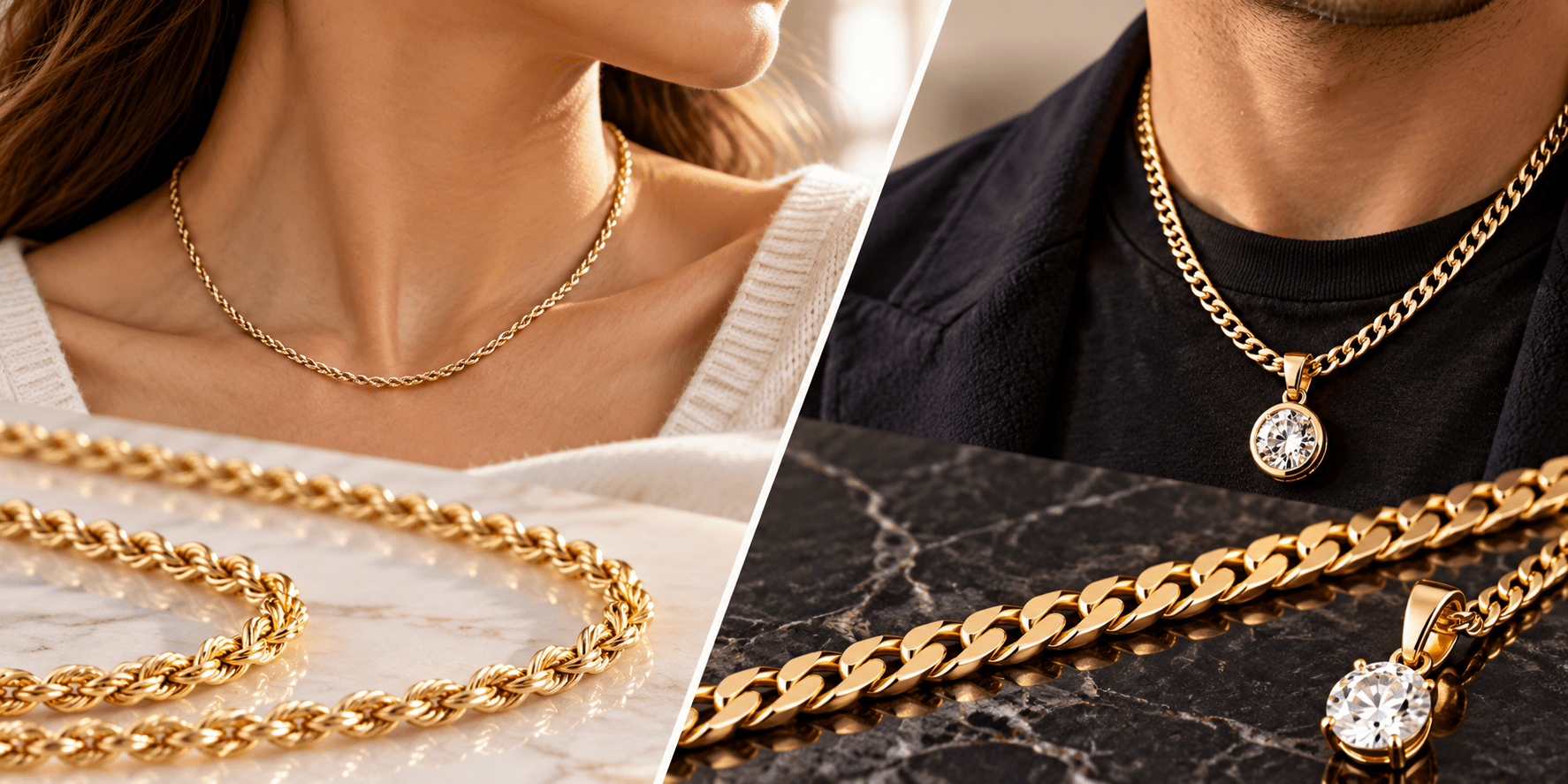
If you wear pendants often, a curb chain is usually the better base because its flat links handle hanging weight well; if you want a necklace that shines on its own, a rope chain delivers more texture and sparkle. Both styles hold up to daily wear when made with solid construction and a gauge suited to use. The right pick comes down to how you plan to wear it and how much shine or structure you want.
TL;DR:
- For everyday wear without a pendant, choose 1.5mm to 3mm; regular pendants generally call for 2mm to 4mm and a solid chain.
- Confirm the pendant’s bail opening fits the chain, and choose curb for easier link repairs or rope if resistance to kinking matters more.
- Thin rope chains can feel firmer than curb chains; try one at 2mm or wider if stiffness bothers you, while longer lengths reduce perceived weight.
- For a necklace worn alone, 4mm or wider creates visible presence; rope adds overall sparkle, while curb gives a cleaner, structured look.
Table of Contents
- How curb and rope chains are built and how that affects look
- Drape, stiffness, and comfort when worn daily
- Strength, kinking, and repairability: real-world durability comparison
- Which chains work best with pendants, charms, and layering
- How to choose width, metal, and finish for your intended use
- How to clean, prevent damage, and when to seek professional repair
- A practical take on choosing between curb and rope
- Find the right curb or rope chain for your routine
- FAQ
- Sources
How curb and rope chains are built and how that affects look
The two styles start from completely different link shapes, and that difference drives everything about how they look on the body. A curb chain uses flat, interlocking links that twist and lie flat against the skin, which produces a cleaner, flatter reflection and a smooth, structured drape. A rope chain is made of many small links twisted into a spiral, so its surface catches light from multiple angles at once instead of in single flashes.
That construction gap means the same stated width can read very differently depending on style.
- Curb chains show distinct, chunky links with visible flat faces and clean light flashes.
- Rope chains show continuous texture with no single link standing out, giving an all-over glitter effect.
- A rope chain’s sparkle often reads heavier visually than its measured width, useful if you want presence without extra bulk.
Shoppers who want a necklace to look substantial from across a room tend to gravitate toward rope, while those who want a chain that reads clean and architectural, especially under a pendant, lean curb.
Drape, stiffness, and comfort when worn daily
How a chain feels against your neck depends on its link structure as much as its metal. Curb chains at common gauges stay flexible and drape naturally along the collarbone because the flat links pivot freely against each other. Rope chains, especially at thinner gauges, can feel slightly stiffer since the twisted links compress tightly together, though this stiffness tends to disappear as width increases.
- Thin curb chains (under 2mm) move loosely and sit close to the neck.
- Thin rope chains can feel firmer and hold a slight shape rather than falling completely flat.
- Longer lengths in either style reduce the sensation of weight because the chain distributes along more of the chest.
Pro Tip: If you’re sensitive to stiffness, try a rope chain at 2mm or wider rather than the thinnest option, since added width softens the twisted feel considerably.
Strength, kinking, and repairability: real-world durability comparison
Durability questions usually come down to how a chain handles the specific stress you put on it. Curb chains generally perform better under pendant weight because the flat link structure distributes downward tension more evenly, which matters if you wear the same pendant daily. Rope chains resist kinking better and hold up well under everyday movement, but repair is a different story.
- Curb links are individually accessible, making them easier to open, close, or replace.
- Rope chains’ tightly woven structure makes clean, invisible repairs more difficult.
- Solid construction in either style outperforms hollow versions under repeated stress.
Both curb and rope chains deliver outstanding durability when constructed solidly, with curb typically handling pendant weight better and rope resisting kinking more effectively, according to BlueStone’s chain durability comparison. Repairing a rope chain also requires different bench skills and more time than closing or opening a curb link, which can affect repair cost and turnaround if a link ever breaks.
Which chains work best with pendants, charms, and layering
Pendant compatibility is where the styles diverge most for everyday shoppers. Rope chains work well with pendants because their round, consistent profile lets a pendant glide and settle naturally at the chain’s lowest point rather than catching on a flat edge. Curb chains are also acceptable for pendants, particularly heavier ones, since the link structure resists the pulling and twisting that pendant weight creates.
- Match the chain’s gauge to your pendant’s weight: heavier pendants need thicker, solid-link chains in either style.
- Confirm the pendant’s bail opening is wide enough to move freely on the chosen chain width.
- For layering, pair a textured rope chain with a flat curb chain to create visual contrast rather than stacking two similar styles.
Following basic design-for-wear guidance, matching chain construction and metal thickness to how a piece will actually be worn, including any attached stones, helps a necklace hold up over time.
How to choose width, metal, and finish for your intended use
Width and metal choice shape both the look and the lifespan of either chain style. For everyday wear without a pendant, a 1.5mm to 3mm chain in either style stays comfortable and understated. For pendant use, 2mm to 4mm gives enough strength to support regular weight, and for a statement piece worn alone, 4mm and up in rope or curb delivers visible presence.
- 14k gold offers a strong balance of durability and value for daily wear in either chain style.
- 18k gold has a richer color but is softer, so it shows wear slightly faster on thin gauges.
- Sterling silver and stainless steel options suit shoppers who want durability at a lower price point.
- A polished finish maximizes reflectivity, while a matte or diamond-cut finish hides minor surface scratches better over time.
Browsing necklaces by width and metal side by side makes it easier to compare how curb and rope options will actually perform for your routine.
How to clean, prevent damage, and when to seek professional repair
Routine care keeps either chain style looking its best. Clean gold and sterling silver chains with mild soap, warm water, and a soft cloth, and avoid harsh chemicals or ultrasonic cleaners on plated pieces since they can strip the finish. Store necklaces flat or hung separately so links don’t tangle or scratch against other jewelry.
- Remove chains before sleeping, showering, or heavy physical activity to reduce stretching and kinking.
- Avoid pulling a pendant or clasp to unknot a chain; work knots loose gently instead.
- See a jeweler for soldering or link repair rather than attempting it yourself, since a poor repair can weaken the chain further.
Pro Tip: If a rope chain develops a tight kink, don’t force it straight. Have a jeweler assess it, since forcing a twisted link can cause it to snap.
For chains you don’t wear daily, a dedicated storage option like a jewelry safe keeps pieces protected from tangling, dust, and accidental damage between wears.

A practical take on choosing between curb and rope
My honest read after comparing both styles: curb is the safer default for most shoppers because it handles pendant weight well and stays easy to repair if something goes wrong. Rope earns its keep when you want shine and texture without a pendant doing the visual work. Neither style is objectively better. The right one depends on whether your necklace needs to support something or simply needs to shine on its own.
— Andrew
Find the right curb or rope chain for your routine
Both curb and rope chains are available in common widths and metals, allowing you to compare them side by side instead of guessing from a single product photo. Filtering by metal, width, and solid versus hollow construction makes it easier to land on a chain that matches how you actually plan to wear it, whether that means supporting a daily pendant or standing on its own.

- Filter by width to match your intended use, from thin layering pieces to statement-width chains.
- Choose solid construction for any chain you plan to wear with a pendant regularly.
- Compare metal options, including gold and silver, to balance look and maintenance.
Browse available necklaces to see curb and rope options side by side and find the width and metal that fits your everyday wear.
FAQ
Is curb or cable chain better?
Curb chains generally offer more structure and better pendant support than cable chains because of their flat, interlocking link design. Cable chains are simpler and lighter, making them a good fit for delicate, pendant-free looks, while curb suits everyday wear with a pendant attached.
Why are curb chains so popular?
Curb chains stay popular because their flat links create a clean, versatile look that works with or without a pendant and holds up well to daily wear. Their accessible link structure also makes repairs more straightforward compared to more tightly woven styles.
Which chain style is strongest?
Strength depends on the stress involved: curb chains typically handle pendant weight better due to even tension distribution across flat links, while rope chains resist kinking more effectively. Both perform well for everyday wear when made with solid construction and adequate gauge.
Are curb chains still in style?
Yes, curb chains remain a staple in both men’s and women’s jewelry because their clean, structured look pairs easily with pendants, layering pieces, or worn alone. Their steady popularity comes from versatility rather than a passing trend.
What width chain should I choose for a pendant?
A good rule of thumb is to match chain gauge to pendant weight, generally 2mm to 4mm for most everyday pendants in either curb or rope style. Confirm the pendant’s bail opening fits comfortably on your chosen chain width before buying.
Sources
- Curb chains: styles, fit guide and how to choose the right one – BlueStone Blog
- Gemstone durability: design to display – GIA
