TL;DR:
- Customizing a diamond necklace involves understanding essential factors like the 4Cs, metal choices, and setting styles to create a meaningful piece. Selecting a well-cut diamond with balance among color, clarity, and carat and verifying certification ensures value and beauty. Proper final inspection, care, and personalization turn a custom necklace into a treasured, lasting symbol of personal expression.
You want a diamond necklace that means something. Not a display case leftover, not a generic box gift, but something that tells a story, fits your life, and looks exactly like the image in your head. Learning how to customize a diamond necklace is more accessible than most people assume, but it does require knowing the right questions to ask, the right choices to make, and the mistakes to sidestep before you spend a dollar. This guide walks you through every stage, from foundational diamond knowledge to final inspection, so you walk away with a piece worth wearing for decades.
Table of Contents
- Essential preparations: what you need to know before customizing
- Step-by-step guide to designing your custom diamond necklace
- Common challenges and expert tips for a flawless custom necklace
- Final verification and care for your custom diamond necklace
- An expert’s perspective: why customization transforms your jewelry experience
- Start customizing your perfect diamond necklace with SuperJeweler
- Frequently asked questions
Key Takeaways
| Point | Details |
|---|---|
| Prioritize diamond cut | Choosing a high-quality cut maximizes sparkle and visual appeal in your custom necklace. |
| Verify with GIA certificates | Always insist on matching GIA reports to ensure the diamond’s quality claims are accurate. |
| Choose clarity VS2-SI1 | VS2 to SI1 clarity diamonds offer the best balance of beauty and value for custom designs. |
| Select metal for style | Metal color influences diamond appearance and should complement your overall design. |
| Care extends jewelry life | Routine cleaning and inspections keep your custom diamond necklace looking brilliant. |
Essential preparations: what you need to know before customizing
Before you sketch a design or browse settings, you need a working knowledge of diamonds. Not textbook deep, but enough to make decisions you won’t regret.
The 4Cs are your foundation: cut, color, clarity, and carat weight. Each one affects price and appearance, but they don’t all carry equal weight when it comes to how your necklace actually looks.
Cut is the single most important factor. A well-cut diamond reflects light in a way that creates that unmistakable brilliance. A larger diamond with a poor cut will look dull next to a smaller, perfectly cut stone. As GIA recommends, you should prioritize cut quality over size and always obtain a GIA Diamond Grading Report to verify the 4Cs independently. That report is not optional. It’s your proof.
Color and clarity matter, but they offer more room for savings without visible compromise. Diamond color is graded from D (colorless) to Z (noticeable yellow). For white metal settings like platinum or white gold, stay in the D to H range. For yellow or rose gold, you can go as low as J or K and the warm tone of the metal will mask any color shift.
Here’s a quick comparison to keep handy:
| 4C Factor | What it affects | Best value range |
|---|---|---|
| Cut | Brilliance and sparkle | Excellent or Very Good |
| Color | Warmth or coolness | D to H (white metals), I to K (yellow/rose gold) |
| Clarity | Visible inclusions | VS2 to SI1 (eye-clean) |
| Carat | Size and weight | Based on budget and proportion |
Metal choice shapes the entire feel of a custom piece. White gold and platinum make diamonds appear icier and brighter. Yellow gold gives a classic, warm look. Rose gold adds a romantic, modern edge. Each metal also differs in durability. Platinum is the hardest and most tarnish-resistant but carries a higher price. 14K white gold is a practical, beautiful middle ground for everyday wear.
For broader diamond necklace buying tips and guidance on navigating your options, it pays to do homework on quality before you commit to customization.
Pro Tip: Don’t skip verifying the GIA report number against the laser inscription on the diamond girdle (the narrow band around the diamond’s edge). It takes 30 seconds and confirms the stone in front of you matches the certificate on paper.
Among personalized jewelry options, diamond necklaces offer the widest room for expression, which is exactly why preparation makes the difference between something special and something forgettable.
With the basics in mind, let’s explore the step-by-step process to bring your custom diamond necklace vision to life.
Step-by-step guide to designing your custom diamond necklace
This is where your custom diamond necklace ideas start becoming real decisions. Here’s how to work through each choice deliberately.
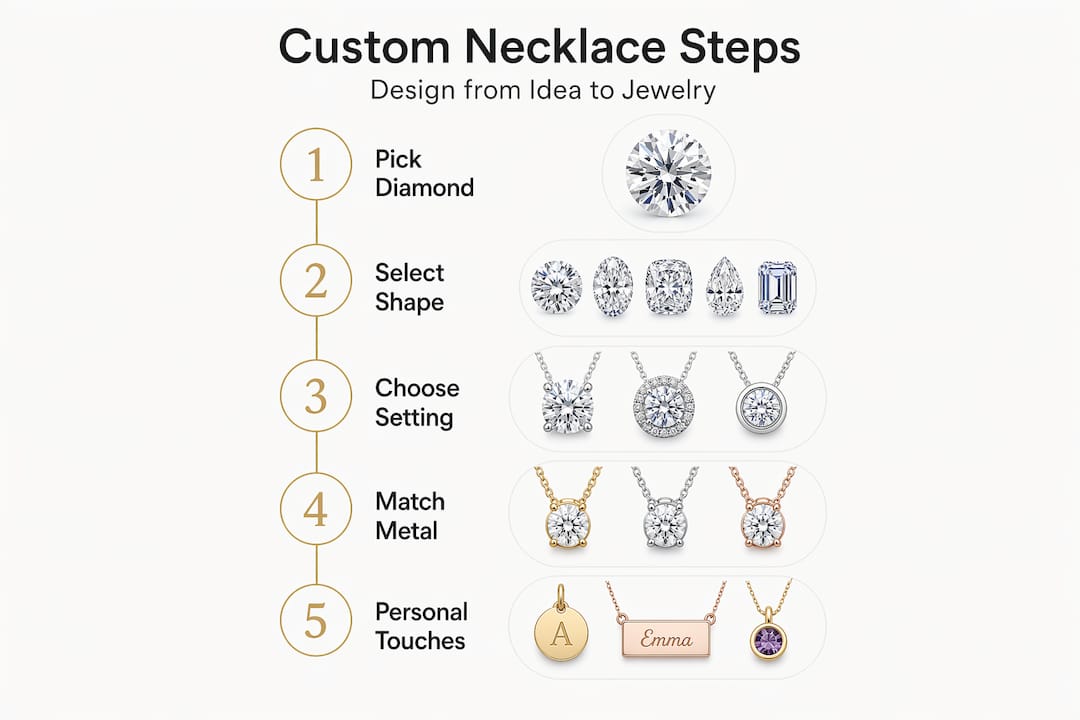
1. Choose your diamond shape. Shape does more than define looks. It affects how large the stone appears relative to its carat weight. Elongated shapes like oval, pear, and marquise tend to look larger face-up than a round of the same carat. Round brilliant diamonds maximize sparkle. Cushion and princess cuts have a vintage and modern-geometric feel respectively. Pick what speaks to you, not what’s trending.
2. Select your clarity grade. VS2 to SI1 clarity is widely recognized as the sweet spot for custom jewelry. These grades appear eye-clean in settings, meaning you won’t see inclusions with the naked eye, but you won’t pay the premium of a VVS or Flawless stone. As certified loose diamond specialists note, VS2-SI1 clarity gives you the appearance of perfection at a more accessible price point. For a pendant, where the diamond is viewed from above and at distance, this range is ideal.
3. Pick your setting style. Setting style defines the personality of your necklace more than most people realize.
- Solitaire: Clean, timeless, lets the diamond speak on its own
- Halo: A ring of smaller diamonds surrounds the center stone, amplifying visual size and brilliance
- Bezel: Metal wraps around the diamond’s edge for a sleek, protective look ideal for active wear
- Pavé: Tiny diamonds set along the band or pendant frame for maximum glitter
- Three-stone: Center diamond flanked by two side stones, often symbolic of past, present, and future
4. Match metal to diamond and lifestyle. Someone who works with their hands needs a bezel or lower-profile setting in a harder metal. Someone who treats jewelry gently can opt for delicate prong settings and pavé work.
5. Decide between natural and lab-grown diamonds. Lab-grown diamond necklaces offer the same physical and optical properties as natural diamonds but at 50 to 70 percent lower prices. For custom work, this means you can allocate more of your budget toward a better cut or a larger center stone without compromising on sparkle.
6. Add personal touches. Engraving a date, initials, or a short phrase on the bail or chain adds meaning. Custom diamond initial necklaces are a natural evolution of this, using the diamond to trace letters that carry personal significance.
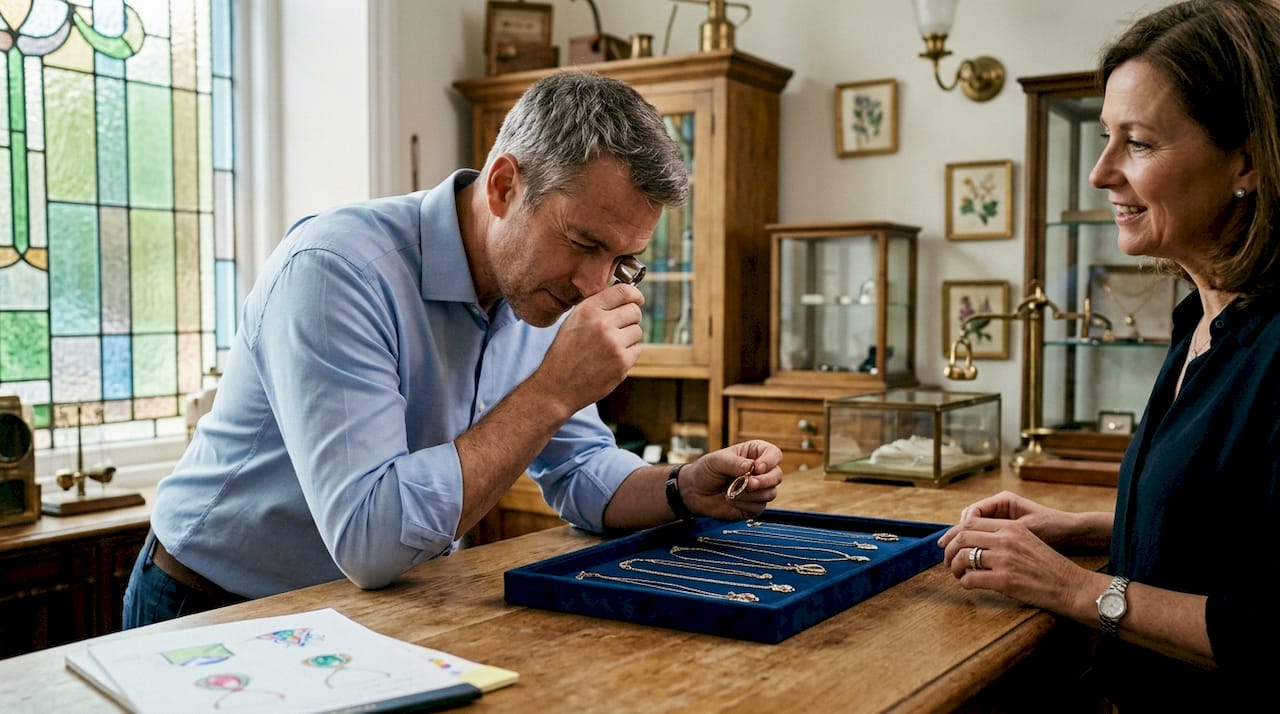
Pro Tip: Ask your jeweler for a wax or digital 3D model of the pendant before any metal is cast. Seeing the actual proportions at scale helps you catch sizing issues that sketches can miss.
Now that you know the design steps, let’s examine common mistakes to avoid for the best results.
Common challenges and expert tips for a flawless custom necklace
Custom jewelry is deeply rewarding, but it has a handful of consistent pitfalls. Knowing them in advance puts you ahead of most buyers.
Authenticity verification matters more than you think. Always verify GIA certificates match the diamond’s 4Cs exactly. A gemologist’s advice echoed across the industry is that objective verification from an independent certification body protects you from inflated quality claims. Match the report number to the laser inscription on the stone. Every time.
Here are the most common mistakes buyers make during customization:
- Choosing carat size over cut quality and ending up with a dull stone
- Skipping the 3D model or prototype review and being surprised by proportions
- Selecting fragile prong settings for active lifestyles, leading to lost stones
- Underestimating the visual impact of metal color on diamond appearance
- Forgetting to check the clarity guide and defaulting to the highest clarity grade out of habit rather than need
“The most expensive diamond is not always the most beautiful one. The best diamond is the one cut to maximize its light performance, verified by a trustworthy certificate, and chosen with intention.”
Setting durability deserves serious thought. Prong settings are beautiful but expose the diamond to impact and snagging. If you wear your necklace while working out, cooking, or doing hands-on tasks, a bezel setting physically surrounds the stone, significantly reducing the risk of chipping or loss. The tradeoff is that bezels cover a portion of the diamond’s edge, slightly reducing the visible surface.
Size obsession is the most expensive mistake in custom jewelry. A 2-carat diamond with an Excellent cut will look more brilliant than a 2.5-carat stone with a Good cut. More importantly, it will cost substantially less. For custom jewelry personalization tips, directing budget toward cut quality rather than maximum carat weight is consistently the more satisfying choice.
Pro Tip: Request a hold or viewing appointment for multiple stones side by side before committing. Seeing a VS2 next to a VVS1 under normal lighting often reveals they look identical, which makes the decision to save money on clarity feel earned rather than like a compromise.
With common challenges addressed, let’s look at how to verify your custom necklace meets expectations before finalizing.
Final verification and care for your custom diamond necklace
Receiving your finished piece is a genuinely exciting moment. Don’t skip the inspection because of that excitement.
Examine the piece against your design specs. Compare the finished necklace to the signed design document, 3D rendering, or written agreement. Metal type, setting style, diamond shape, chain length, and any engraving should all match exactly. Check that the prongs are smooth and even, that no diamonds are loose, and that the clasp functions correctly.
Verify the certificate matches the stone. Use the GIA report number to confirm the diamond’s 4Cs. Proper GIA documentation gives you confidence that what you paid for is what you received. This step protects you before you leave the jeweler’s hands.
| Care task | How often |
|---|---|
| Gentle cleaning at home | Weekly or as needed |
| Professional ultrasonic cleaning | Every 6 to 12 months |
| Prong inspection | Annually |
| Chain inspection and clasp check | Every 6 months |
Daily wear recommendations:
- Remove your necklace before swimming in chlorinated pools or salt water. Chemicals degrade metal over time.
- Apply perfume, lotion, and hairspray before putting on your necklace. Product buildup dulls diamond brilliance.
- Clean weekly with warm water, a drop of mild dish soap, and a soft toothbrush. Rinse well and pat dry.
- Store the necklace in a soft-lined box or pouch, separate from other jewelry to avoid scratching.
These diamond necklace care tips and guidance on jewelry care essentials will extend both the brilliance and structural integrity of your piece for years of wear.
Pro Tip: Take photographs of your finished necklace alongside the GIA report immediately upon receipt. This documentation is invaluable for insurance purposes and future appraisals.
Having completed your custom diamond necklace journey, consider our expert perspective on customizing jewelry.
An expert’s perspective: why customization transforms your jewelry experience
Here’s what most guides won’t tell you. The finished necklace is not the point.
The point is the process. When you learn how diamond cut affects light, when you hold two stones and actually see the difference, when you choose a setting because it fits your life rather than because it appeared in a magazine, something shifts. You stop being a buyer and start being a designer. That ownership changes how you wear the piece, how you talk about it, and what it means to you five years from now.
Custom jewelry creates a category of emotional value that off-the-shelf pieces cannot reach. This is not sentiment. It’s practical reality. When a necklace represents a decision you made, research you did, and a collaboration you had with a skilled craftsperson, it carries weight. People hold onto those pieces differently. They become heirlooms not because of their monetary value but because of the story embedded in every choice made to create them.
There’s also something valuable in the challenges. Realizing your first choice of setting doesn’t suit your lifestyle leads you to understand yourself better as a wearer. Discovering that the diamond you almost bought had a GIA report inconsistency teaches you to be an informed buyer forever. These are not inconveniences. They’re the curriculum.
Our view at SuperJeweler is that unique personalized jewelry is not a luxury category reserved for high budgets. Customization is available at every price point when you know where to start and what to prioritize. A modest lab-grown diamond in a thoughtfully chosen setting with a meaningful engraving carries more personal significance than a much more expensive generic piece. The skill is knowing that before you shop.
Start customizing your perfect diamond necklace with SuperJeweler
You now have the knowledge to make real decisions about your custom diamond necklace. Putting that knowledge to work is where SuperJeweler comes in.

Browse our personalized jewelry collection to explore initial necklaces, engraved pendants, and custom settings designed to fit every style and budget. If you’re drawn to ethical, affordable options, our lab-grown diamond necklaces deliver the same brilliance as natural diamonds at prices that leave room to invest in quality craftsmanship. And if you’re pairing your necklace with an engagement ring, our curated range of budget-friendly engagement rings makes it easy to build a complete, meaningful set without overspending. Free shipping worldwide and a satisfaction guarantee mean there’s no risk to starting your customization journey today.
Frequently asked questions
What is the most important diamond quality when customizing a necklace?
Cut quality is the most critical factor because it determines how brilliantly your diamond reflects light. As GIA experts confirm, prioritizing cut over size delivers the most visually striking result for your investment.
Why should I insist on a GIA certificate when buying a custom diamond necklace?
A GIA certificate gives you independent, objective confirmation of your diamond’s 4Cs rather than relying on a seller’s description. Gemologist guidance consistently confirms that matching the certificate to the actual stone’s laser inscription is the clearest protection a buyer has.
What clarity grade is recommended for custom diamond necklaces to balance beauty and cost?
VS2 to SI1 is the recommended range, as these grades look eye-clean in a setting without the premium cost of higher clarity. Certified diamond specialists recognize VS2-SI1 as the practical sweet spot for custom jewelry buyers.
Can I use my own diamond in a custom necklace design?
Yes, jewelers routinely work with customer-supplied diamonds, including inherited heirlooms, and design settings built specifically around those stones. This is one of the most meaningful ways to create truly personalized jewelry with existing sentimental pieces.
What are practical care tips to maintain a custom diamond necklace?
Clean your necklace gently at home weekly, store it separately from other pieces to prevent scratching, and schedule professional prong inspections annually. Consistent care practices preserve both the brilliance and the structural security of the setting over years of wear.
Recommended
- Diamond necklace styling guide: elevate every look
- Lab Grown Diamond Necklace | SuperJeweler
- Shop Perfect Diamond Tennis Necklace At Amazing Prices | SuperJeweler
- Diamonds By The Yard Necklace | Huge Selection At Low Prices From SuperJeweler
