Short answer: lab-grown diamonds usually do not hold resale value. That gap exists because new lab-grown diamonds keep getting cheaper, which undercuts anything already sitting in someone’s jewelry box. The sections below break down the real numbers, why the market behaves this way, and what you can actually do about it.
TL;DR:
- Resale offers for lab-grown diamonds generally range from 5% to 30% of the original purchase price, with a typical value around 10% to 15%.
- The market’s declining resale value is driven by falling production costs and the interchangeable, commodity nature of these stones, which lack rarity or provenance premiums.
- Certification from GIA or IGI, larger carat sizes, and good cut, color, and clarity improve resale prospects, but do not reverse the overall depreciation trend.
- Online resale platforms, pawn shops, and consignment sales offer different balances of speed and price, with faster sales often resulting in lower offers.
- Buying certified lab-grown diamonds for everyday wear is logical if you prioritize size or ethics, but natural diamonds remain a better choice for retaining resale value.
Table of Contents
- Lab Diamond Resale Value: The Real Numbers
- Why Lab Diamonds Resell for So Little
- What Actually Moves Your Resale Price
- How to Sell a Lab-Grown Diamond
- Trade-Ups, Appraisals, and What Retailers Actually Offer
- What Buyers Should Prioritize Right Now
- Shop Certified Lab-Grown Diamonds at Superjeweler
- Sources
- FAQ
Lab Diamond Resale Value: The Real Numbers
Trade sources and jewelry industry guides consistently land in the same range: expect to recover roughly 10% to 30% of retail on a lab-grown diamond, and sometimes as little as 5% to 15% depending on size, cut quality, and how badly you need the cash. That’s not a typo, and it’s not an outlier estimate. It’s the consistent pattern across pawnshops, consignment dealers, and online resale platforms.
Here’s what that looks like in dollars. A one-carat lab-grown round diamond that retailed for $1,200 to $1,800 a couple of years ago is now commonly priced closer to $700 to $1,200 at retail, because production costs keep falling. If new stones of the same size and quality now sell for less than you paid, a buyer has no incentive to pay more for a used one. Your resale offer is based on the current low price for new stones, not your original purchase price.
Quick math: If you paid $1,500 for a one-carat lab-grown diamond and current retail on an equivalent stone is $900, a buyer offering you $150 to $250 (10% to 15% of your original price) is actually being fair by market standards, not lowballing you.
Compare that to natural diamonds. Mined stones don’t escape depreciation either. A natural diamond typically resells for a noticeably higher portion of retail than lab-grown stones, depending on quality and demand, largely because natural diamond supply is limited compared to lab-grown production.
A few things consistently separate a decent lab-grown resale outcome from a bad one:
- Certification from GIA or IGI, which gives a buyer confidence in the grading.
- Larger carat weights, which hold value slightly better than small accent stones.
- Clean, popular shapes like round or oval, which have broader buyer demand.
- Original paperwork and receipts, which speed up any transaction.
- Minimal wear, since resetting or repairing costs eat into your net proceeds.
None of these factors turn a bad resale market into a good one. They just move you from the bottom of the range toward the top of it.
Why Lab Diamonds Resell for So Little
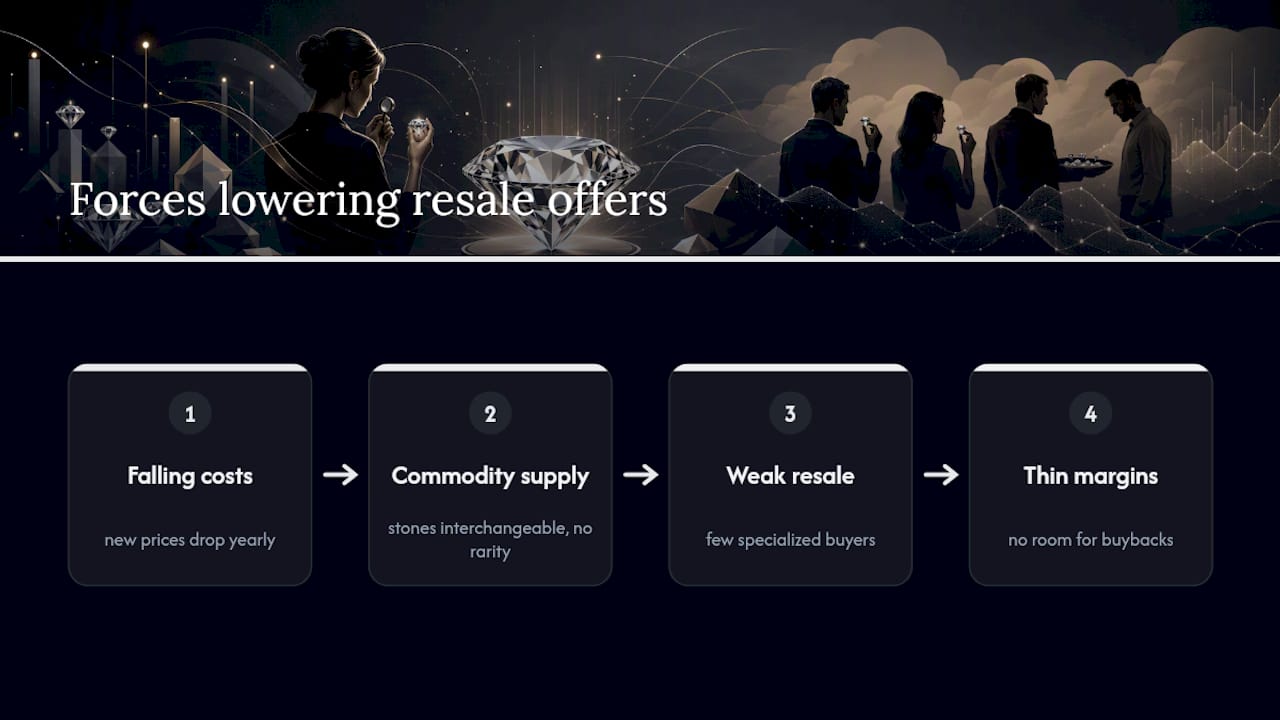
The core issue isn’t quality. Lab-grown diamonds are chemically and optically identical to mined diamonds; a jeweler needs specialized equipment to tell them apart. The issue is economics, and it comes down to four forces working against you.
Production costs keep collapsing. In the early 2000s, growing a one-carat diamond in a lab cost several thousand dollars. Today that cost has dropped to the low hundreds, and it keeps falling as growers scale up and improve their processes. Every year, the “new” price for a comparable stone drops, which drags the resale ceiling down with it.
Lab-grown stones are commodities, not collectibles. A round, one-carat, VS1-clarity lab-grown diamond from one grower is functionally interchangeable with the same stone from another grower. There’s no rarity story, no provenance premium, nothing that makes a specific used stone more desirable than a brand-new equivalent. Natural diamonds at least carry some mystique around age and formation; lab-grown stones are inventory.
The secondary market infrastructure barely exists. Auction houses, estate dealers, and specialty resale networks built decades of expertise and demand around natural diamonds. That ecosystem doesn’t really exist yet for lab-grown stones. Fewer specialized buyers means fewer competitive offers, which means lower prices across the board.
Margins don’t leave room for buybacks. Trade press has documented falling margins across the lab-grown category, with some retailers and growers struggling as prices race downward and new entrants flood in. When a jeweler’s own profit margin on new lab-grown inventory is already thin, there’s little financial room to pay you meaningfully for a used stone they’ll have to resell at a discount anyway.
Put those four forces together and you get a market where sellers are competing against an ever-cheaper flow of new supply. That’s a structural problem, not a marketing one.
What Actually Moves Your Resale Price
Not every lab-grown diamond depreciates identically. Some factors genuinely change what a buyer will offer, and knowing them helps you set realistic expectations before you try to sell.
- Certification and lab matter more than people think. A stone graded by GIA or IGI, with a matching laser inscription on the diamond itself, gives buyers confidence they’re getting what’s advertised. An uncertified stone, even a genuinely nice one, gets treated with suspicion and priced accordingly low, sometimes refused outright by pawnbrokers and consignment shops.
- Carat weight changes the math. Small stones under half a carat often struggle to find buyers because the payout barely covers a transaction’s hassle. Larger stones, two carats and up, sometimes perform slightly better in percentage terms simply because fewer sellers are competing with big lab-grown inventory at once, though the absolute discount is still steep.
- Cut, color, and clarity still count. A well-cut, colorless, eye-clean stone in a popular shape like round or oval will always find a buyer faster than an oddly shaped fancy cut with visible inclusions. Resale buyers price in whatever it will cost them to move the stone again.
- Setting and condition affect net proceeds. A diamond still mounted in a scratched or bent setting often needs to be removed and reset before resale, and that cost comes out of your payout. Loose stones in original condition move faster and cleaner.
- Documentation closes the deal faster. Original receipts, the grading report, and any warranty paperwork all speed up a transaction and reduce a buyer’s leverage to lowball you over “unknowns.”
None of these factors reverse the broader depreciation trend.
How to Sell a Lab-Grown Diamond
Selling a lab-grown diamond is not hard in the sense of finding a buyer. It’s hard in the sense of finding a buyer who pays you something close to fair value. Different channels trade speed for money in very different ways.
- Local jewelers and pawn shops offer the fastest cash, often same day, but typically sit at the low end of the resale range since they need to resell quickly and protect their own margin.
- Consignment shops hold your stone and sell it on your behalf for a commission, usually netting you more than a pawn shop, but it can take weeks or months to find a buyer.
- Online marketplaces and specialty diamond resale sites connect you with individual buyers directly, which can produce better offers, but you’ll spend time on listings, photos, and negotiation.
- Trade-up or upgrade programs through the original retailer aren’t cash sales at all, but they can preserve more of your original spend if you’re buying a new piece anyway.
Before you approach any buyer, get your paperwork in order. Pull the original certificate, take clear photos from multiple angles under good lighting, and write down the purchase date and price. A stone with full documentation moves faster and draws fewer lowball offers than one with none.
If a buyer offers cash on the spot and you need the money quickly, that’s often the more realistic path. If you can wait, consignment or a marketplace listing usually nets more, just slower.
Pro Tip: Get at least three offers before accepting any cash buyer’s price. Pawn shops and quick-cash buyers often start low expecting you to negotiate, and the spread between the first offer and the third can be surprisingly wide.
Watch for scams when selling online: buyers who want to inspect the stone “in person” at an unfamiliar location, unverifiable cashier’s checks, or requests to ship before payment clears. Use insured, trackable shipping and confirmed payment methods, and never send a certified stone before funds have fully settled in your account.
Trade-Ups, Appraisals, and What Retailers Actually Offer
An appraisal is not a resale offer, and confusing the two is where most owners get disappointed. An appraisal establishes replacement value, which is what it would cost to buy an equivalent new stone today for insurance purposes. Resale value is what an actual buyer will pay you in cash right now, and that number is almost always far lower, because a buyer factors in their own resale risk and profit margin.
Trade-up programs offer a more realistic path to preserving value than a straight cash sale. Instead of selling your stone outright, a jeweler applies its current value toward a larger or different piece, often at a better rate than open-market resale because the retailer is motivated to keep you as a customer rather than compete with your stone in the used market.
When evaluating any retailer’s trade-up or buyback terms, look for a few credibility signals:
- Clear, written trade-up terms rather than a vague verbal promise.
- A certification requirement (GIA or IGI) as a condition of the program, which protects both sides.
- A lifetime or extended warranty on new purchases, which signals the retailer stands behind its inventory.
- A transparent return policy that doesn’t bury conditions in fine print.
Superjeweler’s lab-grown diamonds category is a place to compare certified stones and retailer policies side by side before you buy, which matters more for future resale flexibility than any single feature of the stone itself.
What Buyers Should Prioritize Right Now
If resale value matters to you as part of your buying decision, natural diamonds remain the stronger choice, even though they depreciate too. The secondary market for mined stones is deeper, older, and more liquid, which translates into better offers when you eventually sell.
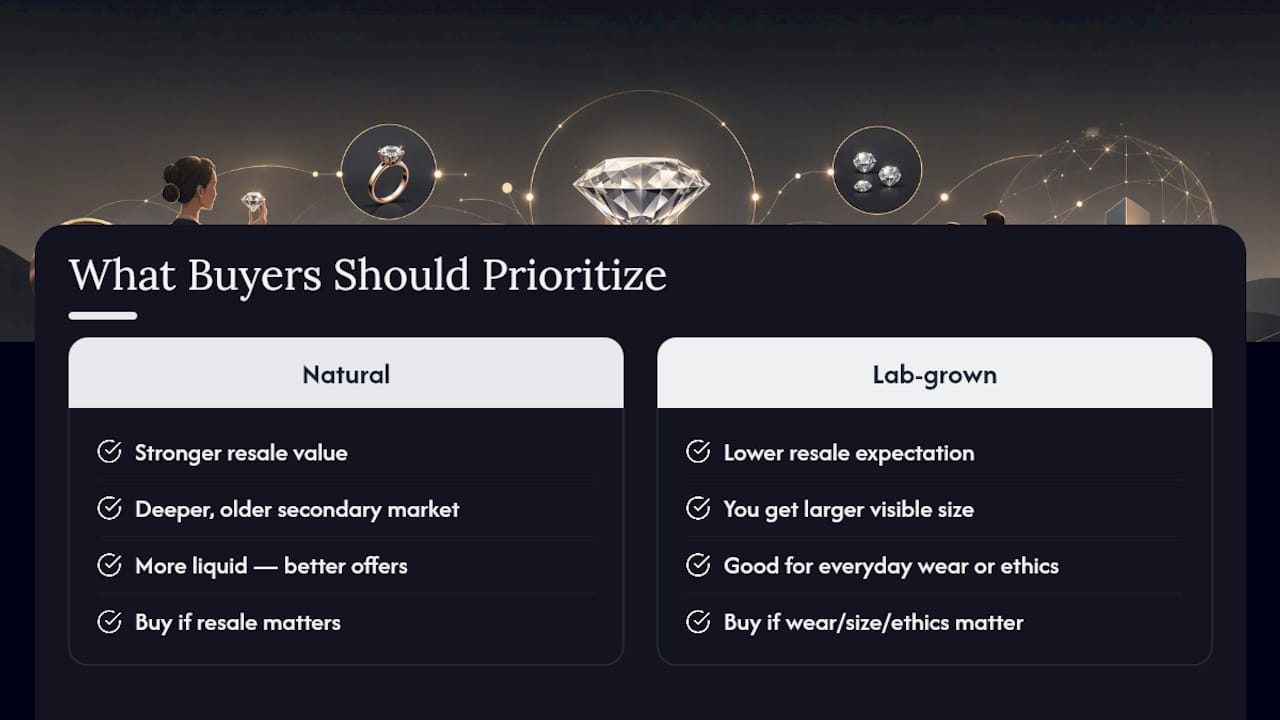
If your priority is everyday wear, getting more visible size for your budget, or supporting lab-grown production for ethical reasons, that’s a rational reason to buy lab-grown. Just go in clear-eyed: you’re buying a beautiful stone to wear and enjoy, not an asset that holds its price.
Either way, buy certified. A GIA or IGI report with a laser inscription protects your options no matter which category you choose, and it’s the single detail that separates a stone you can actually sell from one nobody wants to touch.
— Andrew
Shop Certified Lab-Grown Diamonds at Superjeweler
Superjeweler carries a wide selection of certified lab-grown diamond engagement rings and loose stones, all backed by a lifetime guarantee and a 60-day money-back policy, which means you’re not stuck guessing about return terms after the sale.

Since certification and clear retailer policies are the biggest levers you actually control over resale outcomes, it’s worth comparing options before you buy rather than after. Browse the full lab-grown diamonds selection, check specs on a 1-carat lab-grown diamond ring, or look at engagement rings more broadly if you’re still deciding between lab-grown and natural. Every piece ships free, and every stone comes with grading documentation attached to the listing, so you know exactly what you’re buying before you check out.
Sources
FAQ
Are Lab-Grown Diamonds Dropping in Value?
Yes. Production costs and wholesale prices for lab-grown diamonds have fallen sharply over the past several years, which drags both new prices and resale offers downward. This is a category-wide trend driven by expanding supply and falling production costs, not a temporary dip.
Is It Hard to Sell a Lab-Grown Diamond?
Finding a buyer isn’t difficult, but finding one willing to pay close to what you paid is. Local jewelers, pawn shops, and online marketplaces will all take a look, but expect offers well below your original purchase price regardless of channel.
What Is the Resale Value of Lab-Grown Diamonds?
Lab-grown diamonds typically resell for 10% to 30% of the original retail price, sometimes as low as 5%. Certification, carat weight, cut quality, and documentation all influence where in that range a specific stone lands.
How Much Is a 1-Carat Lab-Grown Diamond Worth?
Current retail on a one-carat lab-grown round diamond runs roughly $700 to $1,200 depending on cut, color, and clarity grade.
Recommended
- Expect 30–50%: Diamond Trade In Value for U.S. Sellers
- Why Invest in Diamond Jewelry: Value, Beauty, and Security
- Lab Diamond Necklace Benefits: Your 2026 Buyer’s Guide
- Why Choose Lab Diamonds: Sustainable Luxury Explained
