TL;DR:
- Vintage jewelry typically spans 20 to 100 years old and features era-specific design elements and craftsmanship. Genuine pieces often have hallmarks, hand-set stones, authentic gem cuts, and natural patina, distinguishing them from reproductions. Collectors value vintage jewelry for its rarity, historical significance, and the skilled craftsmanship that modern mass production cannot replicate.
Walk into any estate sale or antique shop and you’ll hear the words “vintage,” “antique,” and “estate” thrown around as if they all mean the same thing. They don’t. Misunderstanding these labels can cost you money, cause you to overpay for a reproduction, or make you pass up a genuinely rare piece. Vintage jewelry carries era-specific design, superior hand-craftsmanship, and a history that modern mass-produced pieces simply cannot replicate. This guide breaks down exactly what makes jewelry “vintage,” how to identify it, which eras command the highest prices, and how to shop with confidence.
Table of Contents
- Defining vintage jewelry: What sets it apart?
- Era influences: Exploring vintage jewelry’s signature styles
- How to identify genuine vintage jewelry
- What gives vintage jewelry its value?
- Why passion (not trends) drives smart vintage jewelry collecting
- Discover your next treasure with SuperJeweler
- Frequently asked questions
Key Takeaways
| Point | Details |
|---|---|
| Vintage spans 20–100 years | Vintage jewelry lies between antique and modern, showcasing iconic era styles. |
| Era and craftsmanship matter | The value and appeal of vintage jewelry stem from handcraft and historical context. |
| Identify with marks and details | Hallmarks, unique construction, and old gem cuts are clues to authenticity. |
| Buy what you love | Collectors and experts recommend choosing pieces for passion and quality over fleeting trends. |
Defining vintage jewelry: What sets it apart?
Not every old piece of jewelry is vintage, and not every vintage piece is antique. The distinction matters more than most buyers realize.
Vintage generally refers to jewelry that is between 20 and 100 years old. Once a piece crosses the 100-year threshold, it moves into antique territory. Anything newer than 20 years is simply contemporary or modern jewelry, no matter how retro it looks. That Art Deco-inspired ring from 2015? Modern. A genuine platinum and diamond bracelet from 1935? That’s antique. A bold gold bangle from 1975 with era-specific enamel work? That’s vintage.
The distinction goes deeper than age alone. Era-specific design aesthetics, such as Art Deco’s geometric symmetry, Retro’s Hollywood glamour, and Mid-Century Modern’s organic shapes, combined with hand-craftsmanship, set vintage pieces apart from today’s machine-stamped production runs. Modern jewelry is typically cast in bulk using wax molds, while vintage pieces often feature hand-set stones, hand-engraved details, and individually shaped prongs. You can see and feel that difference.
Here’s a quick comparison to keep the categories straight:
| Category | Age Range | Key Characteristics |
|---|---|---|
| Modern/Contemporary | Under 20 years | Machine-made, current trends, mass-produced |
| Vintage | 20 to 100 years | Era-specific design, often handcrafted, patina present |
| Antique | Over 100 years | Historical craftsmanship, collector value, rare materials |
| Estate jewelry | Any age | Previously owned, sold through estate sales or dealers |
A few standout features that signal a true vintage piece:
- Patina: A natural surface aging that develops over decades, especially on silver and gold alloys.
- Construction quality: Hand-engraved shanks, milgrain edging, and individually cut prongs were labor-intensive standards in earlier eras.
- Closed-back settings: Common in pieces predating the 1950s, where stones were set in closed metal cups rather than open prong settings.
- Unique proportions: Vintage rings and fashion necklaces often have proportions that feel weightier and more substantial than their modern counterparts.
“The real value of vintage jewelry is not just its age but the story embedded in every hand-worked detail that modern production cannot reproduce.”
Era influences: Exploring vintage jewelry’s signature styles
With a basic definition in place, let’s look at how specific eras shaped the look and collectible value of vintage jewelry, because not all vintage is equal in the eyes of a collector or a buyer.
Art Deco (1920s to 1930s)
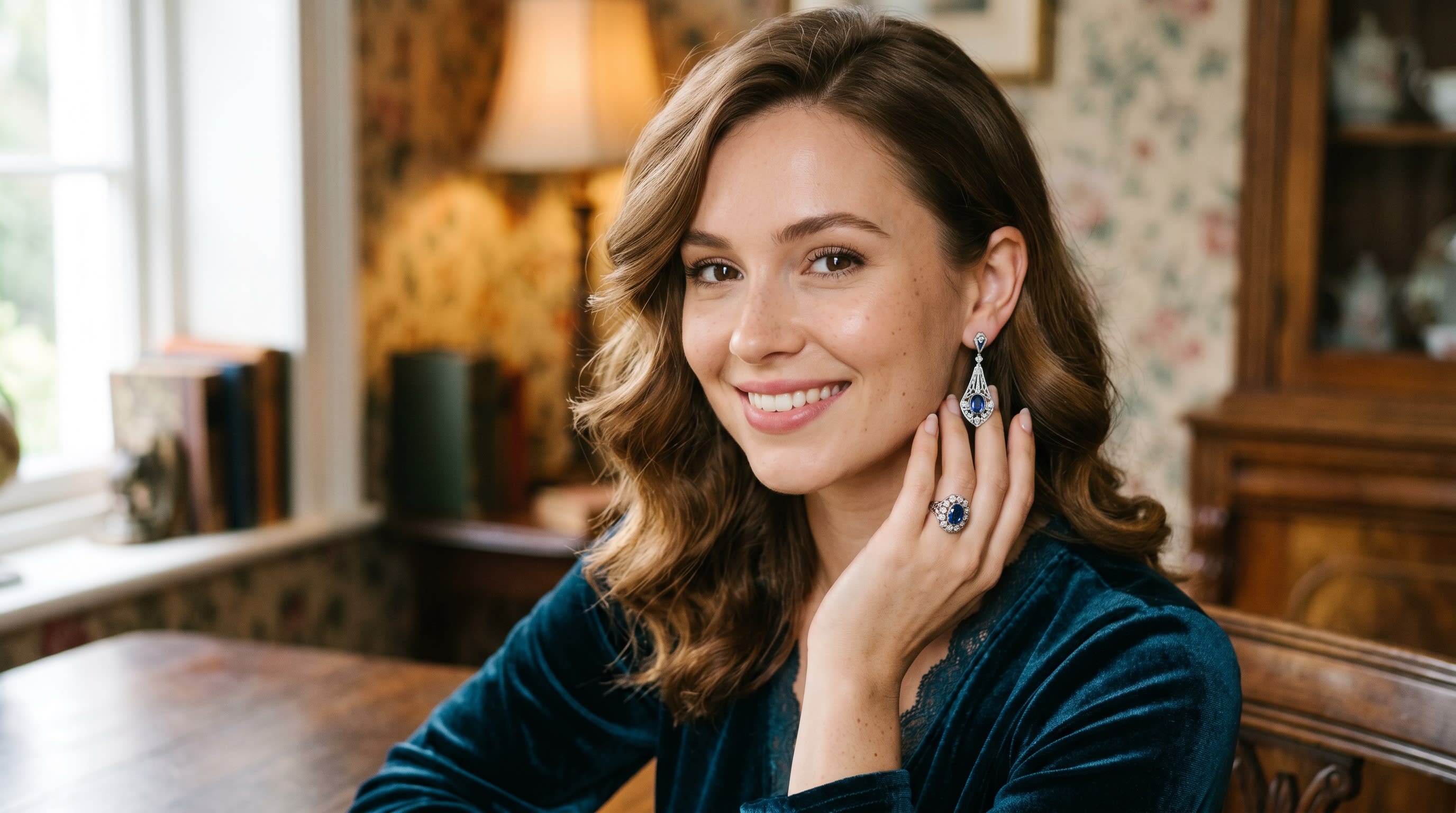
Art Deco is arguably the most recognized and most collected vintage jewelry era. Inspired by industrialization, Cubism, and Egyptian motifs following the opening of Tutankhamun’s tomb in 1922, Art Deco jewelry favors sharp geometry, bold color contrasts, and strict symmetry. Platinum settings, calibre-cut sapphires, onyx, and old European cut diamonds are hallmarks of this era. The look is instantly recognizable: angular lines, fan shapes, stepped “ziggurat” forms, and strong black-and-white or black-and-color contrasts.
Retro (1940s)
World War II changed everything, including jewelry. Platinum was classified as a strategic war material and restricted for civilian use, so jewelers shifted to yellow and rose gold. Retro pieces are bold, three-dimensional, and theatrical, reflecting Hollywood’s golden age. Large synthetic rubies and aquamarines, ribbon motifs, and oversized cocktail rings define this period. The craftsmanship is extraordinary, partly because gold was rationed and jewelers had to work with less material while still delivering impact.
Mid-Century Modern (1950s to 1960s)
The post-war optimism of the 1950s and the space-age excitement of the 1960s produced some of the most forward-looking jewelry ever made. Mid-Century pieces often feature organic, free-form shapes, starburst and atomic motifs, and a mix of yellow gold with colored gemstones. Modernist designers like Andrew Grima and Georg Jensen pushed jewelry into sculptural territory. You’ll also see the first wave of colored gemstone cocktail rings, with estate earrings and estate necklaces from this era featuring unusually bold proportions and unexpected stone choices.
Here’s how the major eras compare across key collecting factors:
| Era | Dominant Materials | Design Hallmarks | Collector Demand |
|---|---|---|---|
| Art Deco (1920s-30s) | Platinum, diamonds, sapphires | Geometric, symmetrical, bold color blocks | Very High |
| Retro (1940s) | Rose and yellow gold, large colored stones | Theatrical, ribbon motifs, 3D forms | High |
| Mid-Century (1950s-60s) | Yellow gold, colored gems | Organic, starburst, sculptural | Moderate to High |
| Victorian (pre-vintage, 1800s-1901) | Gold, seed pearls, jet, garnets | Sentimental motifs, mourning jewelry | Antique category |
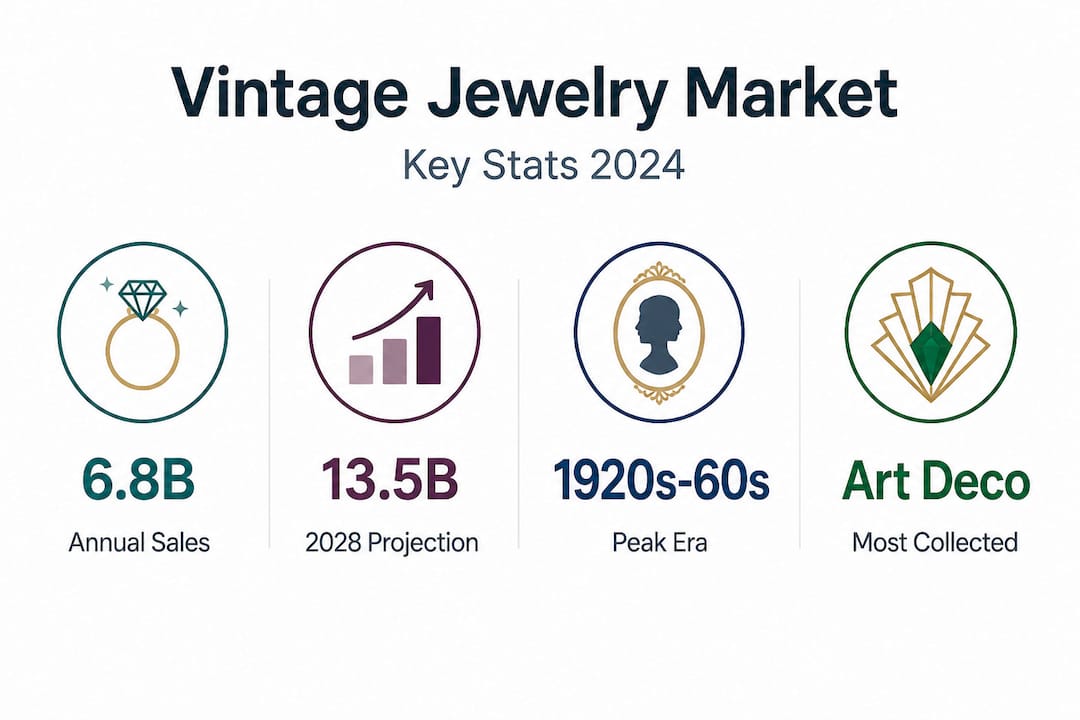
Market data shows the global vintage jewelry market reached $6.8 billion in 2024 and is projected to hit $13.5 billion by 2033, growing at a compound annual rate of 8.1%. Art Deco necklaces lead the demand curve, with an average sale price of $8,420, driven by both sustainability-conscious buyers and serious collectors.
How to identify genuine vintage jewelry
Once you have a sense for different styles, it’s important to know how to distinguish a true vintage piece from a well-made reproduction. There are several concrete methods to do this accurately.
- Look for hallmarks and purity stamps. Genuine vintage pieces almost always carry metal purity marks. You’ll see stamps like 14K, 18K, 750 (for 18K gold), or Pt950 for platinum. Sterling silver carries a 925 stamp. These marks are usually stamped inside a ring’s shank, on the clasp of a necklace, or on the back of a brooch. Identification methods include reading hallmarks, maker’s marks, construction details, patina patterns, and gem cuts like old mine versus modern brilliant.
- Find the maker’s mark. Many fine vintage jewelers, especially in the United States and Europe, stamped their pieces with a house mark or designer cartouche. Cartier, Tiffany, Van Cleef, and smaller guild makers all used specific stamps. A confirmed maker’s mark can dramatically increase a piece’s value and confirm its authenticity.
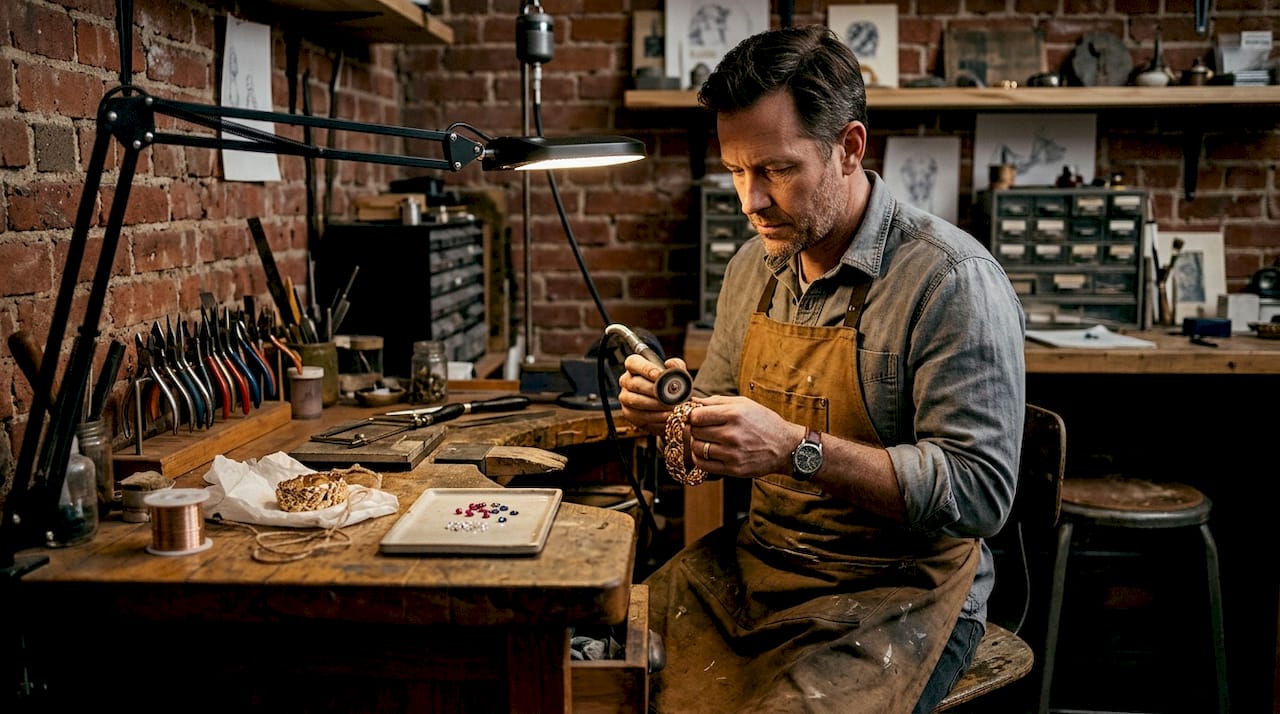
- Examine the construction under magnification. Use a 10x loupe, available at most jewelry supply shops for under $20. Under magnification, hand-engraving shows slight variation in line depth and spacing, while machine engraving is perfectly uniform. Prongs on vintage pieces are often individually filed and shaped, creating subtle inconsistencies that machines cannot duplicate.
- Study the patina and wear patterns. Patina develops naturally over decades. It appears in the recesses of engraved areas and on surfaces that contact skin. Crucially, wear should match the piece’s age: a 70-year-old ring should show wear at contact points like the bottom of the shank, not artificially distributed everywhere.
- Assess the gem cuts. Modern diamonds are cut to maximize brilliance using ideal proportions calculated by computers. Vintage diamonds were cut by hand to maximize size or preserve crystal shape. The gemstone cuts guide explains this in detail. Old mine cuts are cushion-shaped with a high crown, a small table, and a large culet (bottom facet). Old European cuts are rounder, with a circular girdle and a distinctive “eye” visible at the center when viewed from above. These cuts look different under light, producing a softer, more romantic sparkle than modern brilliant cuts.
Pro Tip: Before buying any vintage piece, ask the seller if they can show you photos of the hallmarks under magnification. Any reputable dealer will have this documentation or can provide it on request. If they can’t, treat that as a red flag.
Consider vintage engagement rings as a practical example. A genuine Art Deco engagement ring from the 1920s will carry a platinum mark, show hand-milgrained edges under a loupe, contain an old European cut diamond, and display over 90 years of natural patina in the engraving channels.
What gives vintage jewelry its value?
A well-identified piece is only as valuable as the qualities that make vintage jewelry so prized. Multiple factors determine what a vintage piece is actually worth in today’s market.
Rarity and era specificity. Pieces from short-lived design movements, or pieces produced by guild jewelers with strict hand-crafting standards, are inherently less common than mass-produced modern jewelry. The fewer that exist, the higher the collector demand.
Maker and provenance. A signed piece from a recognized house carries a premium. A Retro bracelet unsigned is worth a fraction of the same piece bearing a Cartier stamp. Provenance, meaning documented ownership history, adds further value, especially for pieces with notable historical connections.
Materials and craftsmanship. Platinum, which dominated fine jewelry from roughly 1910 through 1940, is denser and harder to work than gold, making platinum-era pieces genuinely difficult to replicate today. Guild-era jewelers apprenticed for years before working on fine pieces, producing a quality standard that modern factory production cannot match.
Key value factors at a glance:
- Era and authenticity: Confirmed period pieces from documented eras outperform reproductions.
- Maker’s marks: Signed pieces from recognized houses carry significant premiums.
- Gem quality: Original, unheated, natural stones add value; replaced or synthetic stones reduce it.
- Condition: Structural integrity matters more than surface wear; bent prongs and cracked stones reduce value sharply.
- Market demand: Art Deco remains the top performer; estate rings from this period regularly sell above retail estimates.
Pro Tip: Insist on a written appraisal from a GIA-certified gemologist before purchasing any vintage piece over $500. The appraisal should identify metal purity, stone origin, probable era, and replacement value.
Smart buying advice from seasoned collectors emphasizes purchasing for passion and quality rather than following trends, and notes that vintage pieces typically provide better value than new jewelry thanks to guild-era craftsmanship standards. The market growth data confirms this: a $6.8 billion market growing at 8.1% annually is driven by buyers who connect emotionally with history and quality, not just speculation.
Why passion (not trends) drives smart vintage jewelry collecting
Here’s an uncomfortable truth that most vintage jewelry guides won’t tell you: chasing market trends in vintage jewelry is usually a losing strategy for the average buyer.
Yes, Art Deco necklaces averaged $8,420 per sale last year. Yes, the overall market is growing. But by the time trend data reaches a mainstream buyer, the best pieces at the best prices have already moved. Experienced collectors have been quietly building relationships with dealers and attending regional estate sales for years. They’re not reading market reports and then buying. They buy because they love something, and the market catches up to their taste.
The best collecting advice we’ve seen puts it plainly: buy for passion and quality first, and let the investment case follow. A Mid-Century brooch you genuinely love will give you daily pleasure regardless of what the resale market does. A trendy Art Deco ring you bought as a speculative investment will only cause anxiety if the market dips.
What this really means in practice is slowing down. Use a loupe on every potential purchase. Learn two or three eras deeply before branching out. Study the feel and weight of authentic vintage metalwork by handling pieces at reputable dealers, even pieces you’re not buying. That tactile knowledge is irreplaceable.
Guild-era craftsmanship, the kind built into a 1930s platinum filigree ring or a 1950s gold reticulé bracelet, cannot be replicated at any price point today. The labor hours simply don’t exist in modern manufacturing economics. When you hold a piece like that, you’re not just wearing jewelry. You’re wearing a skill set that took decades to develop and is no longer being taught. That’s the real scarcity that drives value, and passion is what teaches you to recognize it. Explore vintage style rings if you want to start building that tactile sense with pieces you can actually hold and compare.
Discover your next treasure with SuperJeweler
Now that you know how to read an era, identify authentic hallmarks, and understand what drives value, the best next step is to start exploring real pieces. SuperJeweler brings together an exceptional range of estate and vintage-inspired jewelry, giving you the opportunity to find something genuinely unique without the guesswork.

Browse the curated estate necklaces selection for pieces that reflect the bold design sensibility of vintage eras, or explore vintage engagement rings if you’re searching for something with history and romance built right in. SuperJeweler offers free worldwide shipping, transparent return policies, and competitive pricing, so you can shop confidently whether you’re a first-time buyer or adding to an established collection.
Frequently asked questions
What qualifies jewelry as vintage?
Jewelry is considered vintage if it is typically between 20 and 100 years old, reflecting era-specific aesthetics and craftsmanship of its time. Anything older than 100 years falls into the antique category.
How can I tell if a piece is authentic vintage jewelry?
Look for era-appropriate hallmarks, maker’s marks, and distinctive gem cuts, and examine construction signs like hand-engraving or natural patina. Identification methods include reading stamps like 14K, 18K, or Pt950, and checking for hand-set versus machine-set stones.
Why is vintage jewelry so valuable?
Vintage jewelry is valuable because of its rarity, the guild craftsmanship standards no longer used in modern production, documented historic significance, and strong and growing collector demand. These qualities combine to create pieces that appreciate rather than depreciate.
What are the most popular vintage jewelry styles?
Art Deco, Retro, and Mid-Century Modern are the most recognized and sought-after vintage eras. Art Deco necklaces lead current market demand, with an average sale price of $8,420, making them among the most actively traded vintage jewelry categories.
Recommended
- Diamond necklace buying tips: quality & value in 2026
- Jewelry Appraisal Explained: Ensure Value and Authenticity
- Why Invest in Fine Jewelry: 15% Market Growth & Value
- Why Buy Fashion Jewelry: Smart Style and Value
- Jewellery Box and Sublimation blank panel – SubliBlanks Ltd
