TL;DR:
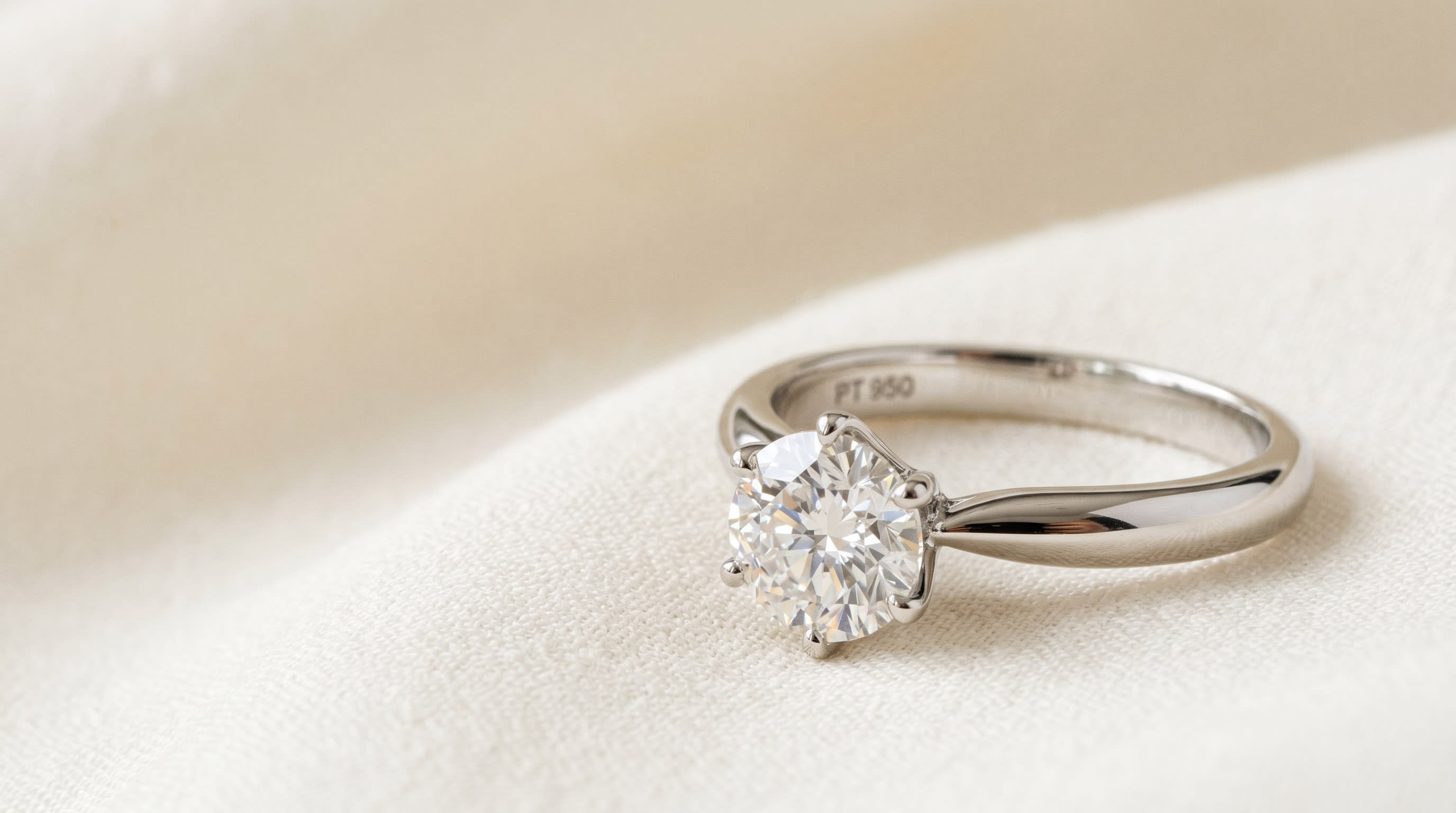
- A solitaire ring features a single center stone with a simple band, emphasizing the diamond’s quality and cut.
- The ring’s design demands high-quality craftsmanship and careful selection of the diamond’s 4Cs for optimal brilliance.
- Classic and versatile, solitaire rings remain timeless choices favored for their elegance and strong personal symbolism.
Every detail of a solitaire ring is on full display. Unlike settings with side stones or decorative halos, a solitaire places one stone front and center with nowhere to hide. That single fact changes everything about how you shop for one. The diamond’s cut, the prong work, the band finish — all of it is visible and matters more than you might expect. If you’re exploring engagement rings or looking for a meaningful gift, understanding what makes solitaire rings special (and demanding) will help you make a smarter, more confident choice.
Table of Contents
- What defines a solitaire ring?
- Why solitaire rings demand quality
- Popular solitaire ring designs and settings
- How to choose a solitaire ring: buyer’s guide
- Why classic simplicity often wins: Our perspective
- Find your perfect solitaire ring at SuperJeweler
- Frequently asked questions
Key Takeaways
| Point | Details |
|---|---|
| Solitaire rings defined | A solitaire ring features a single center stone, offering an elegant and timeless look. |
| Quality matters more | In solitaire rings, imperfections in the stone and setting are more visible, so diamond quality is crucial. |
| Setting impacts appearance | The setting style and band metal shape the ring’s durability and visual effect. |
| Smart shopping advice | Focus on the 4Cs, craftsmanship, and personal style when choosing a solitaire ring. |
| Classic appeal | Solitaire rings remain among the most popular engagement choices because of their versatility and simplicity. |
What defines a solitaire ring?
A solitaire ring is defined by one thing: a single center stone, most often a diamond, set on a plain or minimally styled band. There are no side stones, no decorative clusters, no surrounding halos. Just one stone doing all the work. That simplicity sounds easy to pull off, but it’s actually one of the most demanding ring styles to execute well.
Solitaire rings have been popular for well over a century. Tiffany & Co. introduced what many consider the first modern solitaire setting back in 1886, and the style has never gone out of fashion. Why? Because simplicity scales. A solitaire looks as elegant on a slim platinum band as it does on a wider yellow gold shank. It pairs with nearly any wedding band. It ages beautifully because it doesn’t rely on micro-settings or trend-specific details.
One important distinction worth knowing: not every single-stone ring is technically a solitaire in the traditional sense. A true solitaire keeps the band clean and unadorned. Rings with a center stone plus pavé diamonds along the band, or a halo of small diamonds surrounding the center stone, are categorized differently. When you’re browsing types of engagement rings, you’ll notice solitaires sit in their own category precisely because the stone-to-setting relationship is so direct.
It’s also worth knowing that center stones don’t have to be diamonds. Sapphires, rubies, emeralds, and other gemstones are all used in solitaire settings. You can explore options like gemstone rings if you want the clean solitaire look with a pop of color instead.
Here’s a quick comparison to put it in perspective:
| Ring style | Center stone | Side stones | Band decoration |
|---|---|---|---|
| Solitaire | Yes (single) | No | Minimal or none |
| Halo | Yes | Yes (surrounding halo) | Sometimes |
| Three-stone | Yes | Yes (2 side stones) | Rarely |
| Pavé band | Yes | No | Yes (along band) |
| Cluster | Sometimes | Multiple stones | Varies |
The takeaway from this table is clear. Solitaire rings strip everything back. That’s their strength and their challenge. As the Solitaire Ring Guide notes, solitaire rings put extra importance on the diamond’s 4Cs because imperfections are far more noticeable without surrounding elements to draw the eye away.
Key characteristics of a solitaire ring:
- Single center stone with no side stones or flanking accents
- Plain or near-plain band that doesn’t compete with the center stone
- Setting style (prong, bezel, tension) as the main structural and aesthetic element
- Stone shape (round, oval, princess, pear, emerald, etc.) as the dominant design choice
Why solitaire rings demand quality
With a clear idea of what defines a solitaire ring, let’s look at why these rings place greater demands on both diamond and craftsmanship quality.
There’s a reason jewelry professionals treat solitaire rings as the ultimate test of a diamond’s beauty. In a multi-stone or halo setting, surrounding diamonds scatter light and create visual “noise” that can actually mask minor inclusions or slight color tints in the center stone. In a solitaire, there is no visual noise. The center diamond is performing solo.
“Because the center stone is the only focal element, solitaire rings tend to put extra importance on the diamond’s 4Cs — cut, clarity, color, and carat — and craftsmanship. Imperfections are more noticeable.” — Natural Diamonds, Solitaire Ring Guide
This means your budget priorities shift. Many buyers assume carat weight (how big the stone looks) is the top priority. But for solitaires, cut quality deserves equal or greater weight. A well-cut 1.00 carat diamond will outshine a poorly cut 1.20 carat stone every time. The way a diamond is cut determines how it interacts with light — and in a solitaire, that sparkle (or lack of it) is immediately obvious to anyone looking at the ring.
For guidance on identifying quality diamonds, focus on these four areas:
- Cut: Aim for Excellent or Very Good grades. This has the biggest impact on brilliance.
- Clarity: VS2 or SI1 are popular sweet spots — clean to the naked eye without paying for flawless.
- Color: D through G grades appear colorless or near-colorless. H and I can work in yellow gold settings.
- Carat: Balance size with the other three Cs rather than maximizing carat at the expense of quality.
Understanding why diamond quality matters becomes even more relevant when you’re shopping for a solitaire, because every grade you compromise on will be visible in the finished ring. There’s no architectural complexity to create a distraction.
Craftsmanship of the setting matters just as much as the stone. Look at the prong tips — are they even? Are the prongs centered on the diamond’s girdle (the edge of the stone)? A slightly off-center prong is barely noticeable in a complex setting but glaring in a solitaire.
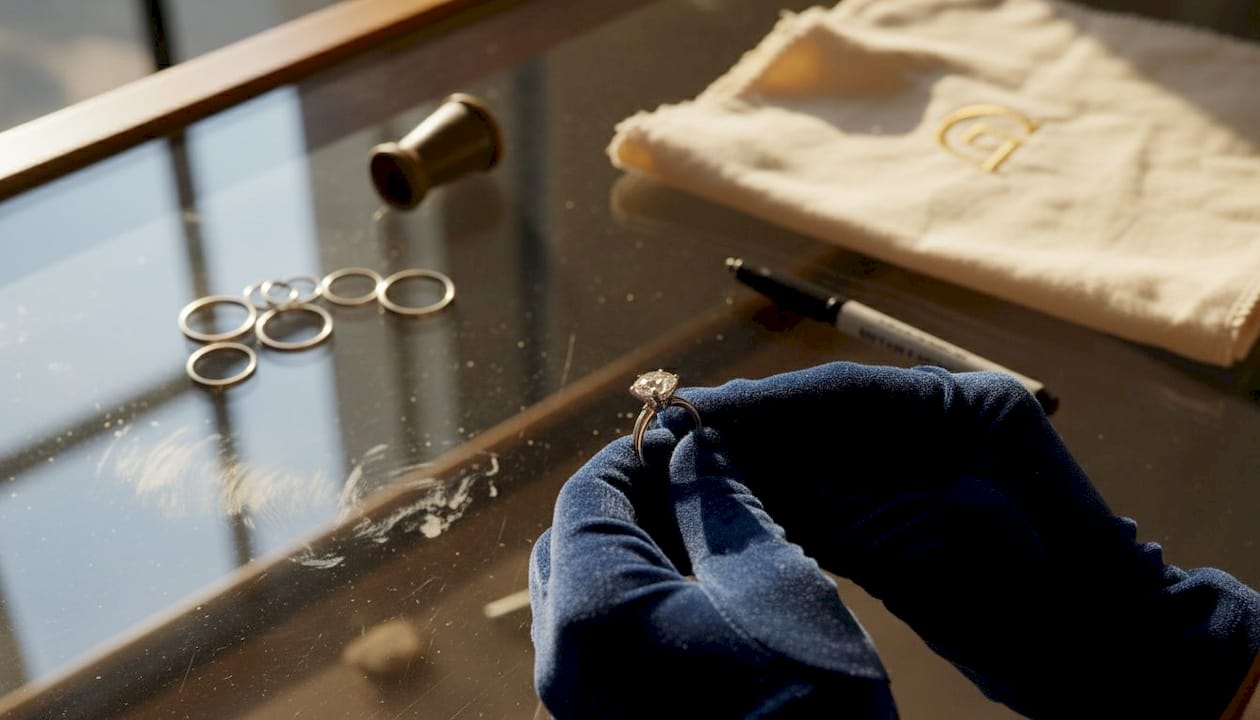
Pro Tip: Always ask for a magnified view of the stone before purchasing, and request a grading certificate from GIA or AGS. This is your roadmap to verifying diamond quality and ensures you know exactly what you’re buying before committing.
Popular solitaire ring designs and settings
Since quality is paramount, the next step is understanding setting choices and how they influence style and function.
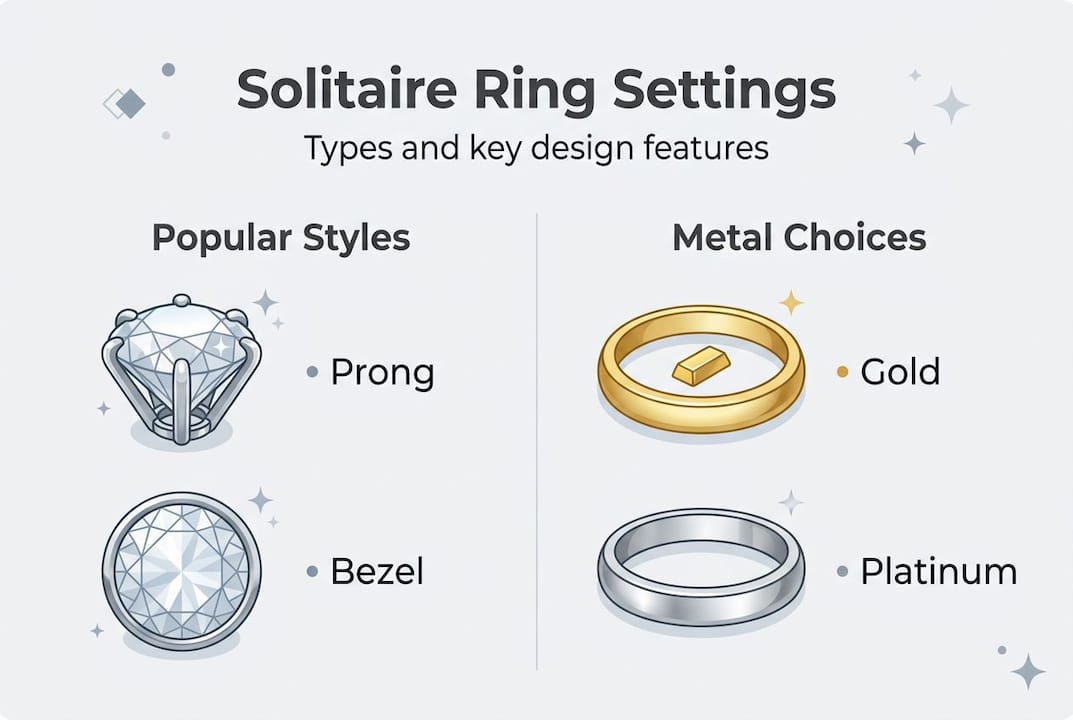
The “setting” is the structure that holds the diamond in place on the band. In a solitaire ring, the setting is the only decorative element besides the stone itself, so it carries enormous visual weight. Four setting styles dominate the solitaire market, each with distinct advantages.
| Setting type | Security | Stone visibility | Maintenance | Best for |
|---|---|---|---|---|
| Prong (4 or 6) | High | Maximum (most open) | Prongs can catch/snag | Classic, sparkle-focused buyers |
| Bezel | Very high | Lower (stone is encircled) | Very easy to clean | Active lifestyles |
| Tension | Moderate | Maximum (floating effect) | Specialist resizing needed | Modern, minimalist aesthetics |
| Cathedral | High | Elevated above band | Standard cleaning | Dramatic, elevated look |
Here’s how to think about each one:
- Prong setting is the most classic and widely used solitaire style. Four or six metal claws grip the diamond and hold it above the band, allowing maximum light entry from all angles. Six-prong settings offer slightly more security; four-prong settings show more of the stone. The Tiffany-style six-prong round solitaire is arguably the most recognized piece of jewelry in the world.
- Bezel setting wraps a thin rim of metal fully around the girdle of the diamond. It’s the most protective option, ideal for people with physically active jobs or hobbies. The trade-off is that less light enters the stone from the sides, which can slightly reduce brilliance. That said, bezel settings give a sleek, modern look that many buyers love.
- Tension setting holds the diamond between two ends of the band using the metal’s spring pressure. The stone appears to float in mid-air, which creates a dramatic, contemporary look. These settings require extremely precise manufacturing and may be harder to resize later.
- Cathedral setting raises the stone higher off the finger using arching metal shoulders that sweep up from the band. This creates an elevated, elegant silhouette and adds a feeling of grandeur to the ring.
Choosing the right metal for your band is equally important. You can explore an in-depth ring metals guide for detailed comparisons, but here’s the short version:
- Platinum is the most durable and hypoallergenic option. It develops a patina over time but never loses metal when scratched (it displaces rather than removes material).
- 14K or 18K white gold mimics platinum’s look at a lower price point but requires rhodium re-plating over time.
- Yellow gold is having a major resurgence and pairs beautifully with lower color grade diamonds (G through I) because the warm metal tone masks slight yellow tints in the stone.
- Rose gold offers a romantic, vintage feel and is particularly popular with oval and pear shaped stones.
The right combination of gemstone ring settings and metal can completely change the personality of a solitaire ring, even when the stone size and quality are identical.
How to choose a solitaire ring: buyer’s guide
Having explored settings and metals, you’re ready for a step-by-step process to select the ideal solitaire ring.
The most common mistake buyers make is starting with size. “I want a 2-carat ring” is a natural first instinct, but it often leads to disappointment when that 2-carat stone has poor cut quality and looks dull on the finger. Here’s a better framework:
- Set your total budget first. Know your absolute ceiling before you look at anything. It keeps decision-making clear and prevents emotional overspending.
- Prioritize cut over carat. An Excellent-cut 1.00 carat stone will look more brilliant and impressive than a Good-cut 1.30 carat stone, often at a similar or lower price.
- Choose your stone shape. Round brilliants maximize sparkle. Oval and elongated shapes (pear, marquise, emerald) can make fingers look longer. Princess and cushion cuts offer a modern geometric look. The engagement ring buying guide covers shape comparisons in depth.
- Select your setting type. Use the comparison table above to match setting style to lifestyle. A teacher who uses her hands constantly might prefer a bezel; a person who loves classic looks might gravitate toward a six-prong cathedral.
- Pick your metal. Consider skin tone, allergies, and maintenance preferences alongside budget.
- Verify certification. Only buy a diamond with a grading report from a reputable lab. GIA and AGS are the gold standard. The solitaire’s single focal element means every detail of the grading report translates directly to what you see on the finger.
Common mistakes buyers make with solitaire rings:
- Buying the biggest carat weight without checking cut grade
- Skipping certification because the price seems good
- Choosing a setting based purely on looks without considering maintenance or lifestyle
- Ignoring the band width, which dramatically affects how the ring looks on different hand sizes
Pro Tip: For gift-givers, spend time learning about the recipient’s lifestyle before choosing a setting. An active person will appreciate a low-profile bezel far more than a high cathedral prong that catches on everything. Quietly checking with close friends or family about style preferences can make the difference between a ring that gets worn every day and one that stays in a drawer.
Why classic simplicity often wins: Our perspective
We’ve watched ring trends come and go for years. Halos dominated the 2010s. Cluster rings had a moment. East-west settings were briefly everywhere. And through all of it, the solitaire kept selling, kept being chosen, kept being passed down through generations.
Here’s our honest take: buyers who chase complexity often regret it. Intricate micro-pavé settings look stunning in a display case, but every tiny diamond is a potential maintenance issue. If one falls out, the setting can start to look worn quickly. The more moving parts, the more things that can go wrong over decades of daily wear.
A solitaire simplifies this equation dramatically. One stone. One setting. One cleaning routine. The ring you propose with can be the ring she wears at 80, without it ever looking dated or tired. That’s remarkable staying power.
We also think there’s something deeply personal about a solitaire that busier designs can obscure. When you buy a solitaire, you’re essentially saying: this one stone is special enough to stand alone. The stone becomes the story. If you’re still exploring ring styles and feel torn between a solitaire and something more elaborate, ask yourself which ring you’d still love in 30 years. The answer usually points clearly in one direction.
The best solitaire rings showcase not just a diamond, but the wearer’s story. That’s the perspective we bring to every ring we offer. Simplicity isn’t a compromise. It’s often the bravest, most confident choice.
Find your perfect solitaire ring at SuperJeweler
With clarity on how to choose and appreciate solitaire rings, here’s how to explore your options further.
At SuperJeweler, we’ve built our collection around the idea that fine jewelry should be accessible without sacrificing quality. Whether you’re working with a modest budget or looking for something truly special, our range covers every style and stone shape discussed in this guide.

Browse our selection of affordable engagement rings if you’re looking for exceptional value without compromise, or explore our full collection of all engagement rings to compare solitaires, halos, and other styles side by side. We offer free worldwide shipping, a generous return policy, and certified diamonds so you can shop with total confidence. Our team is here to help you find the ring that tells exactly the right story.
Frequently asked questions
What makes a ring a ‘solitaire’?
A solitaire ring features a single prominent stone, typically a diamond, mounted on a simple band with no side stones or decorative accents flanking the center gem.
Why is diamond quality more important in solitaire rings?
Because there are no side stones or elaborate designs to distract, every characteristic of the diamond is fully visible. As the Natural Diamonds guide explains, without surrounding stones, the center stone’s cut, clarity, and color are far less “hidden” than in more complex settings.
How do I choose the right metal for a solitaire ring?
Match the metal to your lifestyle, budget, and skin tone. Platinum offers the highest durability, white gold is a cost-effective alternative, and yellow gold pairs beautifully with warmer-toned diamonds.
Are solitaire rings a good choice for engagement?
Absolutely. Solitaire rings are a timeless, versatile option that suits nearly any personal style, budget, and hand shape, making them one of the most consistently popular engagement ring choices year after year.
Recommended
- Engagement Rings | SuperJeweler
- How to Customize Engagement Ring for a Perfect Fit
- How to Choose an Engagement Ring Step by Step Easily
- Unique examples of ring settings for engagement rings
