TL;DR:
- Most jewelry warranties cover manufacturing defects, routine repairs, and maintenance, but exclude loss, theft, or accidental damage.
- Understanding warranty limits helps owners avoid false protections and emphasizes the importance of pairing warranties with jewelry insurance for comprehensive coverage.
Fine jewelry is one of the most emotionally and financially significant purchases you’ll ever make, yet most buyers spend more time choosing the ring than reading the warranty. That’s a costly habit. A stunning diamond engagement ring or a carefully selected pair of sapphire earrings can represent thousands of dollars, and the protection behind that purchase matters just as much as the design. Understanding what your warranty actually covers, where it falls short, and how to use it smartly can save you real money and a lot of frustration over the years.
Table of Contents
- The basics: What is a jewelry warranty?
- What jewelry warranties cover—and what they don’t
- Why warranties still matter for jewelry buyers
- How to get the most value from your jewelry warranty
- Our perspective: Why the real value of warranties goes beyond the fine print
- Ready to protect your jewelry investment?
- Frequently asked questions
Key Takeaways
| Point | Details |
|---|---|
| Warranties cover defects | Jewelry warranties mainly address manufacturing defects and maintenance, not loss or theft. |
| Know coverage limits | Understanding what your warranty covers prevents costly surprises down the line. |
| Insurance is essential too | Pair a warranty with insurance for complete jewelry protection. |
| Documentation is key | Always keep written records of your warranty and store them securely. |
The basics: What is a jewelry warranty?
A jewelry warranty is a written promise from the retailer or manufacturer to address specific problems with a piece of jewelry during a defined period. Think of it like a warranty on a kitchen appliance: it covers things that go wrong due to how the item was made, not how life treats it afterward.
Most jewelry warranties focus on a narrow set of issues:
- Manufacturing defects: Problems with the metalwork, setting construction, or craftsmanship that existed when the piece left the factory
- Stone tightening: Prongs that loosen over time due to the original setting, not a drop or impact
- Routine maintenance: Polishing, cleaning, and minor adjustments to keep the piece in the condition it was sold
- Repair of defective components: Clasps, settings, or findings (metal connectors) that fail because of how they were made
Important limitation: Warranties are positioned as maintenance and defect coverage rather than protection from theft or loss. If your ring is stolen out of your gym locker or falls down a drain, a warranty will not help you. That’s a job for insurance.
This distinction matters enormously. Many buyers walk away from a purchase feeling fully protected, not realizing that the warranty document in their hand covers a narrow band of scenarios. A warranty and insurance are fundamentally different tools. A warranty is a quality guarantee from the seller. Insurance is financial protection against external events. Both can work together, but neither replaces the other. For a clearer picture of how the two differ, reading up on a detailed jewelry insurance guide is a smart move before you finalize any major jewelry purchase.
Understanding this foundation changes how you shop. When a retailer promotes a “lifetime warranty,” you now know the right question to ask: a lifetime warranty for what, exactly?
What jewelry warranties cover—and what they don’t
With the basics clear, it’s vital to know exactly what jewelry warranties tend to include and just as importantly, what they leave out.
Here’s a side-by-side comparison of what typically falls inside and outside standard jewelry warranty coverage:
| Covered by most warranties | Not covered by most warranties |
|---|---|
| Manufacturing defects in metalwork | Loss or mysterious disappearance |
| Loose stones due to original setting issues | Theft |
| Prong re-tipping from normal settling | Accidental damage (drops, crushing) |
| Clasp repair due to defective design | Scratches from daily wear |
| Routine cleaning and polishing | Chips or cracks from impact |
| Rhodium re-plating (for white gold) | Damage from chemicals or water |
| Stone tightening included in plan | Normal wear and tear over time |
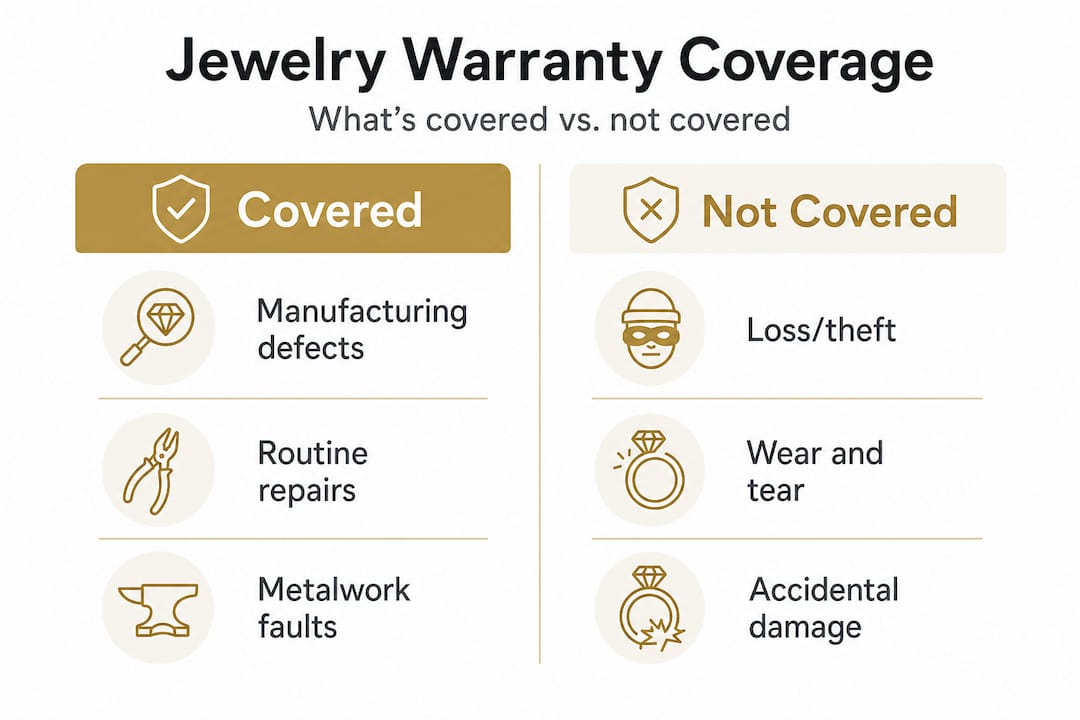
The pattern here is clear. Warranties protect you from problems the jeweler is responsible for. Everything that happens to your jewelry once it leaves the store and enters your life falls outside that protection.
Here’s how to check whether a specific issue qualifies under your warranty:
- Read the actual policy document. Don’t rely on verbal summaries. Get the printed or digital terms and look for the specific language around inclusions and exclusions.
- Ask your jeweler directly. Describe the exact issue you’re experiencing. Ask whether that scenario is covered, and ask them to point to the relevant clause in writing.
- Know the exclusion list cold. Warranties often exclude the most financially significant “life happens” scenarios, including loss, theft, and accidental damage. These are also, not coincidentally, the most expensive claims.
- Check for time limits. Some warranties are valid for one year, others for the life of the piece. The duration affects what value you actually get.
- Understand the claims process. Some warranties require you to bring the piece in for annual inspections to keep coverage active. Miss an inspection, and you might void the warranty entirely.
Pro Tip: Always request the full warranty terms in writing before purchasing, not after. Save a digital copy alongside photos of your jewelry, your receipt, and any appraisal documents. This documentation becomes critical if you ever need to file a claim or use your difference between warranty and insurance coverage down the line.
Why warranties still matter for jewelry buyers
Understanding the limits is crucial, but warranties can still make a big difference for jewelry owners. The key is appreciating what they’re actually designed to do, rather than expecting them to be something they’re not.
Here are the practical scenarios where a warranty genuinely delivers value:
- Free prong re-tightening: Prongs on diamond solitaires and stone settings loosen gradually over years of wear. A warranty that includes prong tightening can save you $50 to $150 per visit at a local jeweler, several times over the life of the piece.
- Stone security checks: Some warranties include periodic professional inspection to confirm your stones are seated properly. Catching a loose stone before it falls out is far better than replacing it afterward.
- Rhodium re-plating for white gold: White gold jewelry is actually yellow gold alloyed and plated with rhodium for that bright white finish. That plating wears off every one to two years. Warranty coverage for re-plating saves a meaningful recurring cost.
- Clasp and mechanism repairs: Bracelet clasps, necklace closures, and earring backs are small parts that take daily stress. Warranty coverage for defective mechanisms means you won’t pay out of pocket when these fail due to a manufacturing issue.
- Polishing and cleaning: Professional polishing restores brilliance to metal surfaces worn down by daily contact. Routine cleaning removes oils, lotions, and grime that dull gemstone sparkle.
Stat callout: Warranties are mostly for maintenance and manufacturing issues, not total loss or unexpected accidents. In practice, the most common jewelry service needs are minor repairs and routine upkeep, not catastrophic replacements. That’s exactly what warranties are built to address.
This is especially important for pieces with deep personal significance. A grandmother’s diamond that has been reset, an anniversary band worn every day, or a custom engagement ring all benefit enormously from having a maintenance warranty in place. These pieces get more wear and emotional weight than fashion jewelry, so their structural integrity matters more over time. That’s the kind of meaningful jewelry investment where a warranty’s day-to-day value really shines.

How to get the most value from your jewelry warranty
Knowing the value a warranty provides, here are practical steps you can take to get as much protection and peace of mind as possible.
-
Register your product immediately. Many warranties require formal registration within a set window after purchase. If you miss that window, coverage may not activate. Register online, by mail, or however the terms require, and save your confirmation.
-
Keep every piece of documentation. Your receipt, warranty certificate, any appraisal documents, and photos of the piece in original condition all matter. If there’s ever a dispute about whether damage was pre-existing or new, documentation wins the argument.
-
Schedule regular professional checkups. Some warranties require annual or semi-annual inspections to remain valid. Even if yours doesn’t require it, bringing your piece in once a year lets a trained eye catch minor issues before they become expensive ones.
-
Clarify what “routine maintenance” means under your specific plan. Some warranties define it broadly to include cleaning, polishing, and prong checks. Others limit it to one specific service. Know exactly what you’re entitled to so you use every benefit available.
-
Pair your warranty with jewelry insurance. A warranty handles defects and maintenance, but protecting your jewelry investment against theft, loss, and accidents requires separate coverage. Together, they create a genuinely complete safety net.
-
Ask about transferability. If you plan to pass a piece to a family member, or if you bought it as a gift, find out whether the warranty transfers. Some do, some don’t, and this can affect long-term value.
Pro Tip: Insurance isn’t a luxury for expensive jewelry; it’s a necessity. Even a modest engagement ring worth $1,500 would cost you out of pocket if it were lost or stolen. A jewelry floater added to your homeowner’s or renter’s insurance policy is often surprisingly affordable. Think of your warranty and insurance policy as a two-layer system, where the warranty handles predictable maintenance and the insurance handles unpredictable loss. It’s worth noting that standard warranties do not cover damage from accidents, misuse, or normal wear and tear, which means insurance fills exactly the gaps that matter most.
Our perspective: Why the real value of warranties goes beyond the fine print
Here’s something the jewelry industry doesn’t say loudly enough: the biggest value of a warranty isn’t in the edge cases. It’s in the ordinary, unglamorous, easy-to-ignore maintenance that most people skip.
Most buyers think about warranties in catastrophic terms. They wonder whether the warranty will cover the scenario where a stone falls out mid-conversation, or whether the metal cracks unexpectedly. Those things can happen, and having coverage for manufacturing defects that cause them is worthwhile. But statistically, the average jewelry owner will never face a true manufacturing catastrophe. What they will face, year after year, is gradual wear.
Prongs get soft. Metals get dull. Clasps get stiff. These aren’t dramatic failures. They’re the slow accumulation of a life lived while wearing something beautiful. A warranty that covers these issues consistently and at no cost is quietly saving you money every single time you use it.
We’ve seen buyers treat warranties like parking tickets: something to file away and forget until disaster strikes. That’s the wrong approach entirely. How warranties actually help most buyers is through years of accumulated minor services, each one extending the life and beauty of the piece at no extra charge.
The other insight worth sharing is this: no warranty was ever designed to be a complete protection plan. Neither was insurance, for that matter. Smart jewelry ownership means using both tools for what they do best. Your warranty is your relationship with the maker, a commitment that the craft behind your piece will be maintained. Your insurance is your financial safety net against the chaos of real life. Together, they form something genuinely powerful.
Don’t just buy the piece. Build the protection strategy around it.
Ready to protect your jewelry investment?
At SuperJeweler, every piece we offer is backed by warranty coverage that actually means something, plus competitive pricing that makes it easier to also invest in proper insurance.

Whether you’re shopping for affordable engagement rings that don’t compromise on quality, exploring the growing world of lab grown diamonds with their exceptional value and modern appeal, or browsing our wide wedding band selection for the perfect everyday piece, each category features pieces designed for lasting wear. We believe jewelry should bring joy for decades, not headaches. That’s why we pair accessible luxury pricing with the warranties and guarantees that give you genuine confidence in every purchase.
Frequently asked questions
What does a typical jewelry warranty cover?
Most jewelry warranties cover manufacturing defects, routine repairs, and some maintenance, but not loss, theft, or major accidents. They focus on problems that originate from how the piece was made, not what happens to it after purchase.
Does a jewelry warranty replace insurance?
No. Warranties cover defects and maintenance while insurance covers theft, loss, and accidental damage. You need both for truly complete coverage of a valuable jewelry piece.
Can normal wear and tear be claimed under a jewelry warranty?
Normal wear and tear is rarely covered by standard jewelry warranties. Most policies explicitly exclude wear and tear as a claimable issue, since it’s considered an expected result of regular use rather than a defect.
How can I find out exactly what a warranty covers for my jewelry?
Ask for the warranty terms in writing before finalizing your purchase, then review the specific inclusions and exclusions section with your jeweler. Written documentation is always more reliable than verbal assurances, especially for high-value pieces.
Recommended
- Protect Your Jewelry Investment: The True Value of a Warranty
- Jewelry Care Tips: Keep Your Pieces Sparkling Longer
- Why Invest in Fine Jewelry: 15% Market Growth & Value
- Why jewelry makes great gifts: meaningful & timeless
