TL;DR:
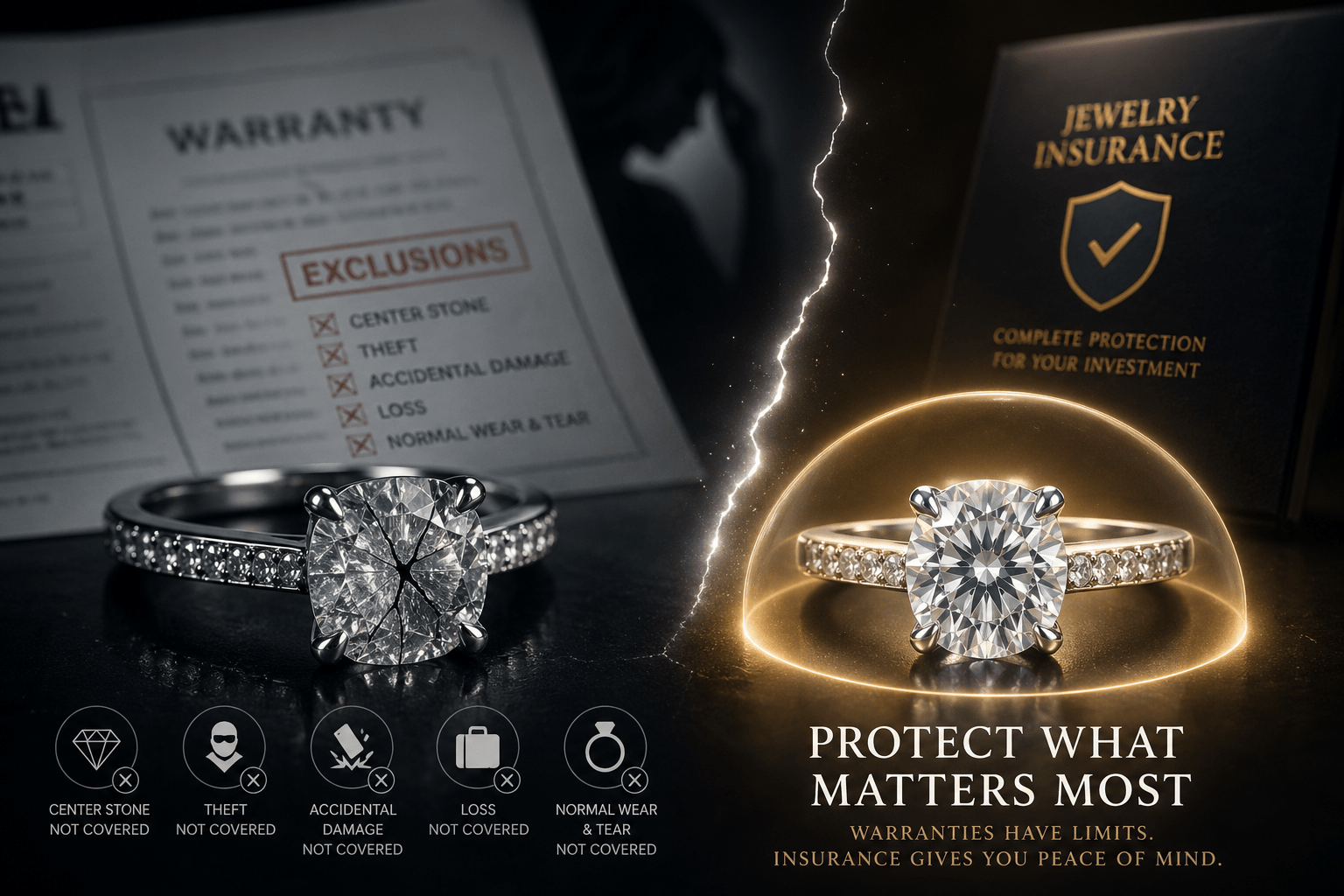
- Most jewelry warranties do not cover the center stone, theft, or accidental damage.
- Insurance is essential for protection against loss, theft, and unforeseen accidents.
- Proper maintenance and documentation maximize warranty benefits and prevent claim denials.
Protect Your Jewelry Investment: The True Value of a Warranty
Most people who buy a fine jewelry piece walk away believing they’re fully covered by a warranty. That assumption feels reasonable, especially after spending thousands of dollars. But here’s what very few retailers mention at the point of sale: standard warranties exclude coverage for the center stone, accidental damage, loss, theft, and normal wear and tear. That center stone? It’s usually the single most expensive component of your ring. Understanding this gap before you buy can be the difference between a smart investment and a very expensive mistake.
Table of Contents
- What is a jewelry warranty and why does it matter?
- Warranty vs. insurance: What’s the difference?
- Common limitations and pitfalls of jewelry warranties
- How to maximize your jewelry warranty’s value
- The hidden truth: Why a warranty is not enough
- Find your perfect ring and get the right protection
- Frequently asked questions
Key Takeaways
| Point | Details |
|---|---|
| Warranties have limits | They often don’t cover the most expensive part of your jewelry, like center stones. |
| Insurance complements warranty | You need both warranty and insurance for full protection of your jewelry. |
| Compliance is crucial | Missing required inspections or unauthorized repairs can void your warranty. |
| Potential for major savings | Properly used warranties can save you hundreds on routine repairs. |
What is a jewelry warranty and why does it matter?
A jewelry warranty is a written promise from the retailer or manufacturer to service, repair, or maintain specific parts of your piece under specific conditions. It is not an all-encompassing shield. Think of it more like a scheduled maintenance plan for your car: it keeps things running, but it won’t cover a collision or a stolen vehicle.
When you buy an engagement ring, you’re making a major financial commitment. The average engagement ring costs between $5,100 and $8,580 according to 2025 data. That’s a substantial sum for most couples. Given that price point, any serious buyer should understand exactly what protection comes with the purchase before walking out the door.
Here’s where most warranties actually add value:
- Prong re-tipping: Prongs hold your diamond in place. Over time, they wear thin and can break. A warranty often covers tightening or re-tipping them.
- Ring resizing: Weight changes, temperature shifts, and natural growth mean your ring size may change. Many warranties include one or two free resizes.
- Cleaning and polishing: Regular professional cleaning keeps your ring looking new and can catch issues early.
- Rhodium plating: White gold loses its bright finish over time. Many warranties include periodic re-plating.
- Setting inspection: A professional checks that all stones are secure and no structural damage has occurred.
These services aren’t trivial. A single rhodium plating session can cost $50 to $150 at an independent jeweler. Prong re-tipping runs $25 to $75 per prong. If you wear your ring daily, you could realistically need these services every year or two. Over five to ten years, that adds up fast.
“Most jewelry buyers assume their warranty covers everything, but the fine print tells a very different story. The center stone, which represents the largest share of your ring’s value, is almost never included.”
Smart engagement ring budgeting means accounting for these ongoing maintenance costs, not just the sticker price. If your retailer offers a free or low-cost warranty, that’s a real financial benefit, but only if you use it correctly.
Pro Tip: Read the full warranty document before you finalize your purchase. Ask your retailer to walk you through every exclusion. If they can’t explain it clearly, that’s a red flag. Strong engagement ring buying tips always include reviewing warranty paperwork the same day you receive it.
Warranty vs. insurance: What’s the difference?
Once you understand what a warranty covers, the next question becomes obvious: what happens when your ring is stolen, lost, or accidentally damaged? That’s where jewelry insurance enters the picture, and the two serve very different purposes.

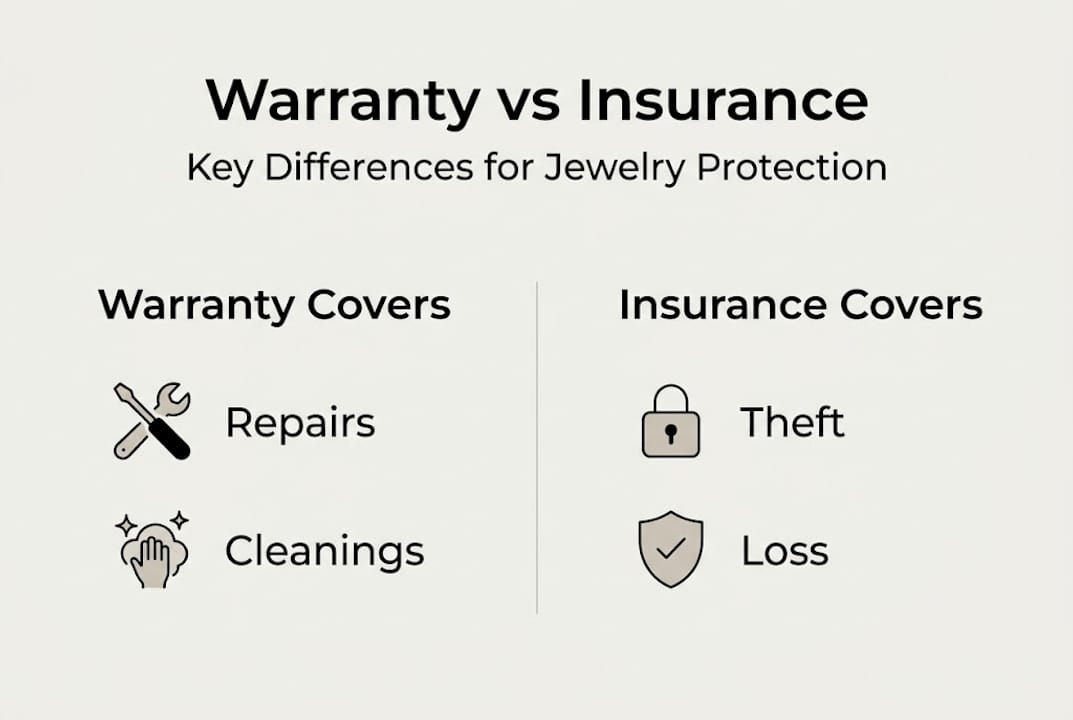
As jewelry experts note, warranties complement but do not replace insurance. Insurance covers loss, theft, and accidents, while warranties handle routine maintenance. These two forms of protection are not interchangeable. They’re designed for completely different scenarios.
Here’s a clear side-by-side look at how they compare:
| Feature | Jewelry Warranty | Jewelry Insurance |
|---|---|---|
| Covers center stone | No | Yes |
| Covers theft | No | Yes |
| Covers accidental loss | No | Yes |
| Covers routine maintenance | Yes | No |
| Covers prong re-tipping | Yes | Rarely |
| Covers accidental damage | No | Yes |
| Annual cost | Free to low-cost | 1-2% of ring value |
| Required inspections | Often yes | Varies by provider |
| Provided by | Retailer/manufacturer | Third-party insurer |
The cost of jewelry insurance is typically 1 to 2 percent of the appraised value per year. On an $8,000 ring, that’s roughly $80 to $160 annually. Compared to the cost of replacing even a single carat diamond, that’s a reasonable expense. Many homeowners’ or renters’ insurance policies offer a jewelry rider as well, though standalone jewelry insurance policies often provide broader, more flexible coverage.
Here’s when you absolutely need each one:
- Warranty is essential when: You wear your ring daily, your prongs are high-profile and vulnerable, your ring has intricate metalwork, or your retailer requires regular inspections to maintain coverage.
- Insurance is essential when: Your ring includes a high-value center stone, you travel frequently, you work with your hands, or you live somewhere with a higher theft risk.
The honest answer? You need both. They fill completely different gaps. Understanding jewelry insurance explained in full detail will help you choose the right policy for your situation. A warranty without insurance leaves your biggest investment exposed. Insurance without a warranty means paying out of pocket for maintenance that could have been free.
Common limitations and pitfalls of jewelry warranties
Even buyers who carefully read their warranty documents sometimes find themselves denied when they try to file a claim. The reasons are almost always buried in the fine print, and they can feel deeply unfair when you’re already dealing with a damaged or broken piece.
Real-world experience makes this very clear. Consumer complaints about jewelry warranties often center on unrecorded inspections voiding coverage, designs that break under normal use, and poor enforcement of stated terms. These aren’t edge cases. They’re common enough to warrant real attention before you trust any warranty.
Here are the most common reasons jewelry warranties get voided:
- Missed mandatory inspections: Many warranties require you to bring your piece in every six months. Miss one appointment, and you may lose coverage entirely, sometimes retroactively.
- No written proof of inspection: An inspection that isn’t recorded in your warranty booklet or account doesn’t count. Always get a written record.
- Third-party repairs: If anyone other than the original retailer touches your ring for repairs, your warranty is often void. This includes local jewelers, even for minor adjustments.
- Unreported damage: If you notice a crack, loose stone, or bent prong and don’t report it promptly, the retailer may claim you allowed damage to worsen through neglect.
- Normal wear and tear disputes: Retailers sometimes classify damage as “normal wear” to avoid covering a repair, even when the damage is clearly a manufacturing issue.
Pro Tip: Keep a dedicated folder, physical or digital, with every warranty document, inspection receipt, and service record for your jewelry. If a claim is ever denied due to lack of documentation, a complete paper trail gives you real leverage. Good jewelry care tips include treating your warranty paperwork with the same care as the jewelry itself.
The most frustrating scenario is the inspection that happened but wasn’t recorded. A staff member may forget to stamp your booklet. A system may not update. Months later, that gap becomes the reason your claim is denied. Always confirm your inspection is logged before you leave the store, every single time.
How to maximize your jewelry warranty’s value
Knowing the risks is valuable, but knowing how to avoid them is where the real benefit lies. A well-managed warranty can genuinely save you hundreds of dollars over the life of your ring. The key is treating it like a recurring financial responsibility, not a one-time paperwork exercise.
As maintenance data confirms, warranties provide cost-effective maintenance for high-wear items like engagement rings, but they require strict compliance. Pair your warranty with insurance for complete protection.
Here’s a practical summary of tasks to stay warranty-compliant:
| Task | Frequency | Why it matters |
|---|---|---|
| Professional inspection | Every 6 months | Required for most warranties |
| Written inspection record | Every visit | Proof of compliance |
| Cleaning and polishing | Every 6 to 12 months | Prevents surface damage |
| Prong inspection | Annually | Catches stone security issues early |
| Rhodium plating (white gold) | Every 12 to 18 months | Restores finish and protects metal |
| Appraisal update | Every 2 to 3 years | Ensures insurance coverage matches current value |
Anecdotal evidence shows that buyers who stay compliant with warranty requirements can prevent hundreds of dollars in out-of-pocket repair costs over five to ten years. But non-compliance, even unintentional, can eliminate all of those savings in a single denied claim.
Here’s a quick list of warranty do’s and don’ts:
- Do schedule your inspections before they’re due, not after.
- Do bring your warranty booklet or account login to every visit.
- Do ask for written confirmation of every service performed.
- Do notify your retailer immediately if you notice any damage.
- Don’t let a local jeweler resize or repair your ring without checking your warranty terms first.
- Don’t assume a verbal confirmation of an inspection counts as documentation.
- Don’t wait until renewal time to review your coverage details.
Pairing smart care tips for protecting your warranty with consistent maintenance habits turns a passive document into an active financial tool. The buyers who get the most from their warranties are the ones who treat each inspection appointment with the same seriousness as a dentist visit. Skip it, and problems compound quietly.
The hidden truth: Why a warranty is not enough
Here’s something most jewelry guides won’t tell you directly: a warranty gives you a false sense of security if you stop there. We see this pattern play out constantly. A buyer spends $7,000 on a diamond ring, receives a free lifetime warranty, and walks away feeling protected. Then the ring is lost on a beach vacation. Or a stone falls out of its setting after a minor impact. Or the ring is stolen from a hotel room. In every one of those cases, the warranty does nothing.
The uncomfortable truth is that insurance covers the scenarios that matter most financially: loss, theft, and accidental damage. A warranty keeps your ring looking great. Insurance keeps you from financial ruin if the ring disappears entirely.
What’s more, the retailers who offer the most generous warranties sometimes benefit from the false confidence those warranties create. A buyer who believes they’re fully covered is less likely to seek out a separate insurance policy. That’s not cynicism, that’s just how marketing works. We believe in giving buyers the full picture so they can make genuinely informed decisions.
If your ring is worth more than $2,000, treat why insurance is necessary as essential reading, not optional homework. A warranty and insurance working together is the only truly complete protection strategy for fine jewelry.
Find your perfect ring and get the right protection
Choosing a beautiful ring is only half the equation. The other half is making sure it’s protected the moment it leaves the store.

At SuperJeweler.com, we offer a wide range of engagement rings at competitive prices, with free worldwide shipping and clear policies around warranties and returns. Whether you’re searching for a classic diamond solitaire, a lab-grown diamond ring, or a gemstone piece that stands out, we make it easy to find something you’ll love and protect it for years to come. Before you finalize any purchase, confirm the warranty details and explore your jewelry insurance options alongside it. Beautiful jewelry deserves complete protection, and we’re here to help you get both.
Frequently asked questions
What does a typical jewelry warranty exclude?
Most jewelry warranties exclude the center stone, accidental damage, loss, theft, everyday wear and tear, and any repairs performed by a third party, meaning the most financially significant risks are usually not covered.
Does a warranty replace the need for jewelry insurance?
No. As warranty and insurance data shows, warranties handle routine maintenance like cleaning and prong tightening, while insurance is what protects you against loss, theft, and accidental damage.
What can void my jewelry warranty?
Missing mandatory inspections, failing to keep written records of those visits, or using unauthorized repair services are the most common reasons warranty coverage is voided, often without the buyer realizing it until they file a claim.
How much can a jewelry warranty actually save me?
Anecdotal repair savings suggest that compliant warranty holders can avoid hundreds of dollars in out-of-pocket maintenance costs over the life of a ring, though the actual benefit depends entirely on consistent compliance and successful claims.
Recommended
- Why jewelry insurance matters: protect your valuables
- Why Invest in Diamond Jewelry: Value, Beauty, and Security
- Jewelry Care Tips: Keep Your Pieces Sparkling Longer
- Why Buy Certified Diamonds: Quality, Value, Trust
