
TL;DR:
- Ethical jewelry sourcing involves practices that protect human rights, minimize environmental harm, and ensure fair wages across the supply chain. Certifications like RJC certify company standards but do not guarantee specific product origins, so consumers should seek additional provenance documentation. Alternatives such as lab-grown gemstones, recycled metals, and vintage pieces offer more traceable and sustainable options for responsible jewelry purchasing.
Not every piece of jewelry labeled “ethical” actually earns that word. Understanding what is ethical sourcing in jewelry means looking past marketing claims and into the real practices behind a piece, from the mine where metals and stones originate to the workshop where they are set. Ethical jewelry sourcing covers social responsibility, environmental protection, and fair economic treatment of workers across a supply chain that can span a dozen countries and just as many hands. This guide cuts through the confusion and gives you the tools to shop with confidence.
Table of Contents
- Key takeaways
- What is ethical sourcing in jewelry
- How the jewelry supply chain works
- Certifications and what they actually mean
- Sustainable materials and ethical alternatives
- How to verify ethical jewelry when you shop
- My take: certifications are the floor, not the ceiling
- Explore ethical jewelry at Superjeweler
- FAQ
Key takeaways
| Point | Details |
|---|---|
| Ethical sourcing is multi-dimensional | It covers human rights, environmental protection, and fair wages, not just conflict-free diamonds. |
| Certifications have limits | An RJC certificate applies to a company’s practices, not necessarily to every individual product. |
| Lab-grown gems are a strong alternative | Lab-grown diamonds and recycled metals reduce environmental impact and support traceability. |
| Greenwashing is real | Vague claims like “responsibly sourced” require supporting documentation before you trust them. |
| You hold purchasing power | Consumer demand directly influences how brands build and audit their supply chains. |
What is ethical sourcing in jewelry
Ethical sourcing in jewelry is the practice of procuring metals, gemstones, and finished pieces in ways that respect human rights, minimize environmental harm, and support fair economic conditions for workers and communities. It is not a single standard or a single certification. It is a framework of commitments that spans every link in the supply chain.
The three pillars of ethical jewelry sourcing are:
- Social responsibility: No child labor, safe working conditions, freedom of association for workers, and protection of indigenous community rights near mining sites.
- Environmental stewardship: Controlling pollution, restoring mined land, reducing water usage, and limiting the use of toxic chemicals like mercury and cyanide in ore processing.
- Economic fairness: Paying living wages, investing in local communities, and ensuring that artisanal miners and factory workers receive a fair share of the value they create.
These pillars align with the standards set by the Responsible Jewellery Council (RJC), whose Code of Practices (COP) is mandatory for members handling diamonds, gemstones, and precious metals. The COP was last fully revised in 2024, and members must complete a certification audit within 1.5 years of joining.
Pro Tip: When a jeweler describes a piece as “ethically sourced,” ask which specific standard or certification backs that claim. A credible seller will name a certification body, not just repeat the phrase.
What makes ethical sourcing genuinely difficult is the breadth of what it covers. A ring might use a conflict-free diamond but be set in gold mined under unsafe labor conditions. Both factors matter. Responsible sourcing practices require attention to every stage, not just the most visible one.
How the jewelry supply chain works
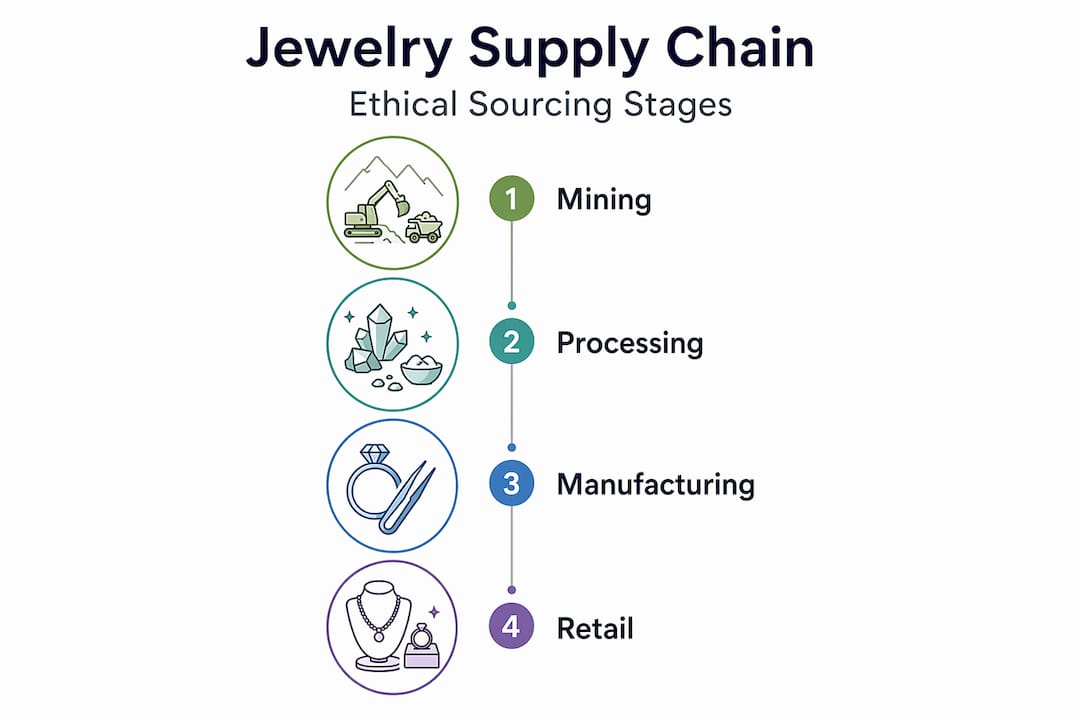
Understanding where ethical risks live requires a clear picture of the jewelry supply chain. Each stage presents different challenges and different tools for accountability.
| Supply chain stage | Key ethical risks | Main accountability tools |
|---|---|---|
| Mining | Child labor, mercury pollution, land damage | OECD due diligence, RJC COP, Kimberley Process |
| Refining and processing | Traceability gaps, chemical waste | COC certification, smelter audits |
| Manufacturing | Labor rights violations, wage theft | Factory audits, third-party inspections |
| Retail | Misleading claims, greenwashing | Provenance documentation, consumer inquiry |
Mining is where the most acute risks appear. Artisanal gold mining accounts for 37% of global mercury pollution and involves over 1 million children in hazardous work environments. These are not fringe statistics. They describe conditions in active supply chains that feed jewelry sold in mainstream retail stores today.
Industrial mining presents a different set of problems: large-scale land disruption, water table contamination, and displacement of local communities. Neither model is automatically ethical or unethical. The difference lies in how operations are managed, monitored, and held accountable.

Refining and processing sit in the middle of the chain, where ore becomes pure metal and rough stones are cut and graded. This stage is where traceability most often breaks down. Metals from multiple sources are frequently smelted together, making it nearly impossible to trace a gold bar back to a single mine without rigorous chain-of-custody documentation.
Pro Tip: Ask your jeweler whether their gold supplier is a certified responsible smelter. Organizations like the Responsible Minerals Initiative maintain public lists of audited smelters you can reference.
Manufacturing adds another layer of complexity. Jewelry may be assembled in countries with weak labor protections, and supply chain transparency at this stage is rarely disclosed to consumers. Ongoing due diligence is not a one-time audit. It is a continuous, proactive process aimed at improving conditions rather than simply avoiding specific regions.
Certifications and what they actually mean
Several certifications exist to help consumers and businesses verify ethical sourcing claims. Knowing what each one covers, and what it does not, is the difference between informed trust and misplaced confidence.
- RJC Code of Practices (COP): This is mandatory for RJC members and covers human rights, labor rights, environmental performance, and business ethics. It certifies that a company’s operations meet defined standards across its supply chain activities.
- RJC Chain of Custody (COC): This voluntary standard allows companies to prove that specific precious metals passed through responsible hands at each stage of processing. It is separate from the COP and not automatically required for RJC members.
- Kimberley Process Certification Scheme (KPCS): Implemented globally since 2003, the KPCS requires government-issued certificates for rough diamond trade to prevent conflict diamonds from entering the market. It is the most widely recognized diamond-specific certification but applies only to rough diamonds and only addresses armed conflict, not broader labor or environmental issues.
Here is the critical limitation consumers often miss. The RJC states clearly that its certificates do not contain product-level provenance data. A store being RJC certified means that store follows ethical practices as a business. It does not mean that the specific ring you are buying was traced from a particular responsible mine. For product-level assurance, you need to ask for separate chain-of-custody documentation.
This gap is where greenwashing often hides. A retailer can display an RJC certificate and technically be accurate while still selling pieces whose individual component origins are unknown. Genuine verification of provenance requires evidence beyond certificates, including documentation that traces specific materials through each processing stage.
Sustainable materials and ethical alternatives
Beyond certifications, the materials themselves can make a significant ethical difference. Several alternatives to conventionally mined materials have gained traction for good reason.
- Recycled metals. Gold and platinum can be reclaimed from electronic waste, old jewelry, and industrial sources. Using recycled metals eliminates new mining demand entirely for that portion of a piece, removing both the environmental and labor risks associated with extraction.
- Lab-grown diamonds and gemstones. Lab-grown stones are physically and chemically identical to mined stones but produced in controlled environments. They carry a traceable origin, no land disruption, and no risk of conflict financing. Their popularity is growing precisely because they provide an ethical option without sacrificing quality.
- Fair Trade and community-sourced gems. Some suppliers work directly with artisanal mining cooperatives that have committed to safe practices and pay premiums back to their communities. This model does not eliminate mining but invests in making it more humane. Look for gems sourced through programs like the Fairtrade Gold standard or verified ASM cooperatives.
- Vintage and antique jewelry. Buying pre-owned pieces sidesteps the supply chain entirely. No new mining is involved, making vintage jewelry one of the most eco-friendly jewelry practices available to consumers.
The question consumers often ask is whether ethical alternatives cost more. Lab-grown diamonds typically cost significantly less than mined diamonds of comparable quality, which means choosing the ethical option here is not a financial sacrifice. Recycled gold commands a small premium in some markets but is often price-neutral in finished jewelry. Fair Trade gems may carry a modest premium, but it directly supports the miners who produced them.
You can explore ethically sourced gemstone rings and see how sustainable materials translate into real jewelry options without requiring a compromise on beauty or value.
How to verify ethical jewelry when you shop
Knowing the theory of ethical sourcing is useful. Knowing what to actually do at the point of purchase is what protects you from misleading claims. Here is what to look for and ask:
- Request specific certifications. Ask whether the retailer holds RJC COP certification, and whether the product comes with COC documentation for the metals or stones used.
- Ask about origin. Where was the gold mined or refined? Where were the gemstones sourced? A credible seller will have at least partial answers. Vague responses like “we only use ethical suppliers” without documentation are a warning sign.
- Check for chain-of-custody proof. As the RJC makes clear, a certificate at the company level does not prove product-level provenance. Request the additional paperwork if product-level traceability matters to you.
- Research the brand’s transparency. Ethical jewelry brands typically publish supplier information, sustainability reports, or third-party audit results. Absence of this information is not proof of wrongdoing, but it should prompt more questions.
- Be skeptical of vague language. Phrases like “conflict-free,” “responsibly made,” or “sustainably sourced” all require backing. Learn more about what conflict-free really means before accepting the label at face value.
- Consider lab-grown options. If full traceability is your priority, lab-grown diamonds and gemstones remove most of the provenance uncertainty inherent to mined materials.
My take: certifications are the floor, not the ceiling
I’ve spent years reading supply chain disclosures and watching how the ethical jewelry conversation evolves, and the pattern I keep seeing is the same. Consumers get reassured by a certification badge and stop asking questions. The brands that actually deserve trust are the ones that welcome those questions, not the ones that treat the certificate as a conversation-ender.
The RJC certification is genuinely meaningful. It represents a serious commitment and independent auditing. But responsible sourcing demands treating sustainability as equal in weight to price and quality, not as a compliance checkbox. The brands doing this well build long-term relationships with suppliers and share what they learn, including when things are imperfect.
What I find most encouraging is the role consumers play. When enough buyers ask the right questions, the industry responds. The growth of lab-grown diamonds is a direct result of consumer demand for traceable, lower-impact options. That shift happened because people cared and spent accordingly.
My advice: use certifications as a starting point, not a final answer. Ask one more question than you think you need to. The jeweler who can answer it confidently has earned more of your trust than the one who points to a logo and changes the subject.
— Andrew
Explore ethical jewelry at Superjeweler

Superjeweler carries a growing selection of lab-grown diamond jewelry and gemstone pieces that reflect the shift toward more transparent, lower-impact sourcing. If you are shopping for an engagement ring and want to prioritize both ethics and value, the lab-grown diamond collection offers stones with traceable origins at prices well below comparable mined diamonds. For budget-conscious shoppers, the selection of engagement rings under $1,000 includes real diamond options that make responsible buying accessible without compromise. Superjeweler also offers free worldwide shipping, warranty options, and a straightforward return policy so your purchase is protected from every angle.
FAQ
What does ethical sourcing mean in jewelry?
Ethical sourcing in jewelry means procuring metals, gemstones, and finished pieces in ways that protect human rights, minimize environmental harm, and support fair wages. It covers everything from mining conditions to manufacturing practices.
Is the Kimberley Process enough to guarantee ethical diamonds?
No. The Kimberley Process only addresses conflict diamonds tied to armed rebellion and applies only to rough diamond trade. It does not cover labor rights, environmental harm, or broader human rights violations in mining.
Are lab-grown diamonds truly more ethical than mined diamonds?
Lab-grown diamonds have a traceable origin, require no land excavation, and carry no risk of conflict financing, making them a strong ethical alternative. They are also chemically identical to mined diamonds and typically cost significantly less.
Does an RJC certificate guarantee my jewelry is ethically sourced?
Not at the product level. RJC certification applies to a company’s business practices, not to the provenance of each individual piece. For product-level assurance, ask for chain-of-custody documentation specific to the materials in your purchase.
What is the easiest way to buy ethically sourced jewelry?
Choosing lab-grown diamonds, recycled metal settings, or vintage pieces removes most supply chain uncertainty. Pairing those choices with a retailer that holds RJC certification and can provide sourcing documentation gives you the strongest ethical foundation.
